
• KSAN
  • Contact us
  • E-Submission
ABOUT
BROWSE ARTICLES
EDITORIAL POLICY
FOR CONTRIBUTORS

Page Path

201
results for

"Life"

Filter

Article category

Keywords

Publication year

Authors

Funded articles

"Life"

Original Articles

Purpose
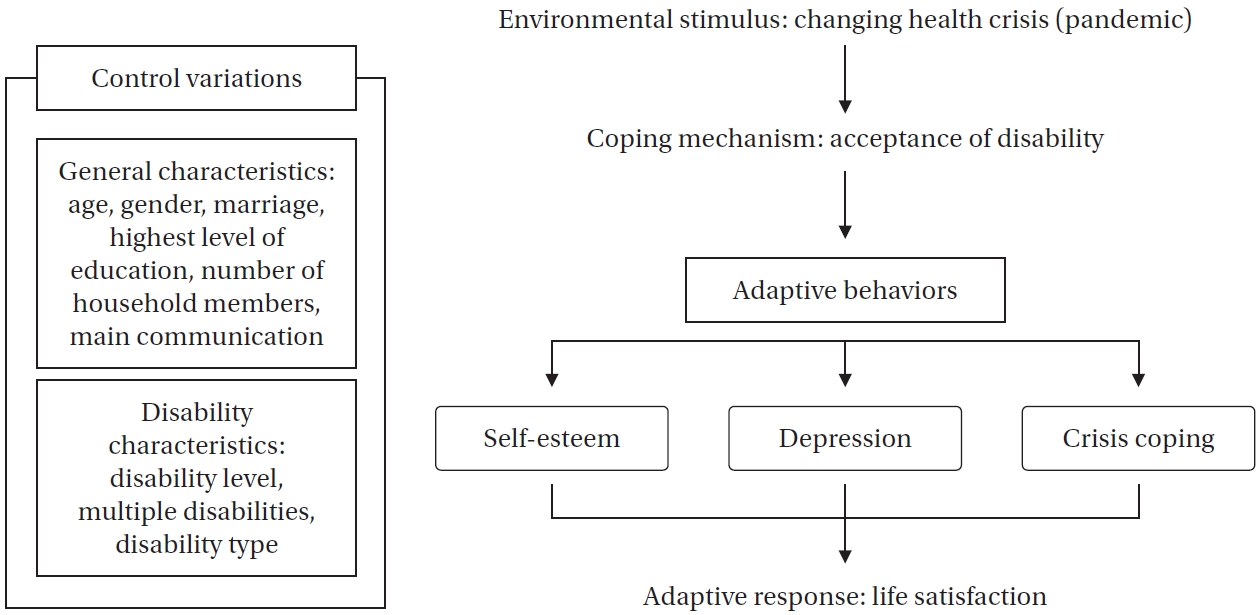
This study aimed to analyze the multiple mediating effects of self-esteem, depression, and crisis coping on the relationship between disability acceptance and life satisfaction among older adults with disabilities, comparing periods before and during the coronavirus disease 2019 pandemic. Methods: This study employed a longitudinal comparative design, using data from waves 1–5 of the Disability and Life Dynamics Panel. The sample was divided into pre-pandemic (2018–2019) and pandemic (2020–2022) periods. Roy’s adaptation model served as the theoretical framework. Multiple mediation effects were examined using the PROCESS macro (Model 6). Results: Both the direct and indirect effects of disability acceptance on life satisfaction were significant, indicating partial mediation. In the pre-pandemic period, approximately 60% of the total effect was attributable to the direct effect and 40% to the indirect effect. During the pandemic, the proportion shifted, with the direct effect decreasing to 49% and the total indirect effect increasing to 51%. Conclusion: In crisis situations such as a pandemic, self-esteem, depression, and crisis coping play crucial roles in improving life satisfaction among older adults with disabilities. These findings highlight the need for policy approaches that consider diverse socio-psychological factors to increase life satisfaction among older adults during pandemics.
  • 202 View
  • 11 Download
Purpose
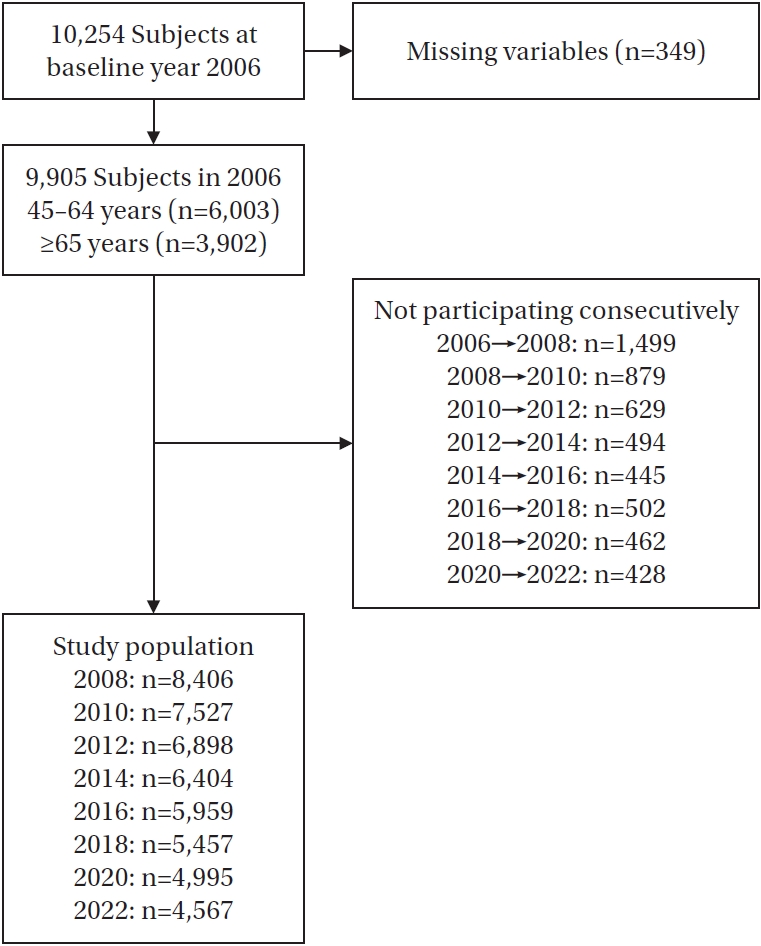
This study examined the 16-year longitudinal impact of social frailty on quality of life (QoL) and health-related quality of life (HRQoL) among middle-aged and older adults. Methods: Data were obtained from the Korean Longitudinal Study of Aging (2006–2022), comprising 9,905 participants (6,003, aged 45–64 years; and 3,902, aged ≥65 years). Social frailty was assessed using five components: social support, social activity, social network, loneliness, and living alone. QoL and HRQoL were measured using self-reported satisfaction scales. Generalized estimating equations were applied to adjust for covariates. Results: Social frailty was prevalent among both middle-aged (44.6%) and older adults (60.1%) and was significantly associated with lower QoL and HRQoL. In longitudinal analyses, declines in QoL and HRQoL persisted throughout the follow-up period in older adults, whereas in middle-aged adults, the declines were significant only during the earlier years. In middle-aged adults, current smoking exerted a stronger negative impact on QoL and HRQoL (QoL: β=–4.33, p<.001; HRQoL: β=–2.89, p<.001), while in older adults, lack of regular exercise had a greater effect on HRQoL (β=–3.84, p<.001). Conclusion: Social frailty was associated with lower QoL and HRQoL across both age groups, with stronger and more persistent effects among older adults. Early interventions are needed during midlife, while sustained strategies are essential in later life. Age-specific approaches are crucial to promoting healthy aging.
  • 270 View
  • 8 Download
Factors Influencing Health-Related Quality of Life in Patients with Rotator Cuff Tears: A Cross-Sectional Study
Hyo Jung Han, Yeon-Hwan Park
Korean J Adult Nurs 2025;37(4):447-457.   Published online November 25, 2025
DOI: https://doi.org/10.7475/kjan.2025.0619
Purpose
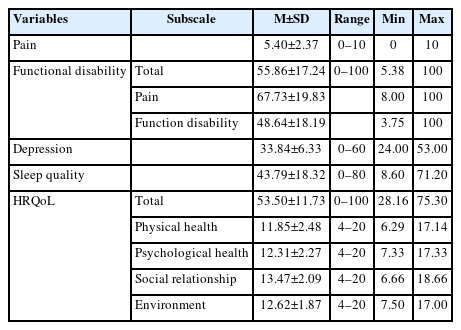
This study investigated health-related quality of life (HRQoL) and aimed to identify factors influencing HRQoL for patients with rotator cuff tears (RCTs). Methods: We conducted a descriptive correlational survey with 118 outpatients diagnosed with RCTs at a tertiary general hospital in Seoul. Data were collected between February and June 2021 using structured self-report questionnaires, including the numeric rating scale, Korean version of the Shoulder Pain and Disability Index, Verran and Snyder-Halpern Sleep Scale, and the World Health Organization Quality of Life Instrument, Short Form. Results: HRQoL showed significant positive correlations with sleep quality (r=.64, p<.001) and the frequency of shoulder-intensive sports activities (r=.24, p=.008). It was negatively correlated with symptom days per week (r=–.32, p<.001), symptom hours per day (r=–.51, p<.001), pain (r=–.21, p=.025), functional disability (r=–.49, p<.001), and depression (r=–.60, p<.001). Stepwise regression analysis indicated that sleep quality (β=.36, p<.001) was the strongest predictor of HRQoL, followed by occupation (β=.26, p<.001), depression (β=–.24, p=.010), and symptom hours per day (β=–.19, p=.013). Conclusion: Sleep quality was the most influential factor affecting HRQoL in patients with RCTs. These findings underscore the need for comprehensive nursing interventions that address sleep disturbances, provide psychological support for depressive symptoms, consider occupational demands, and promote early management of prolonged symptoms to enhance HRQoL in this population.
  • 180 View
  • 6 Download
Purpose
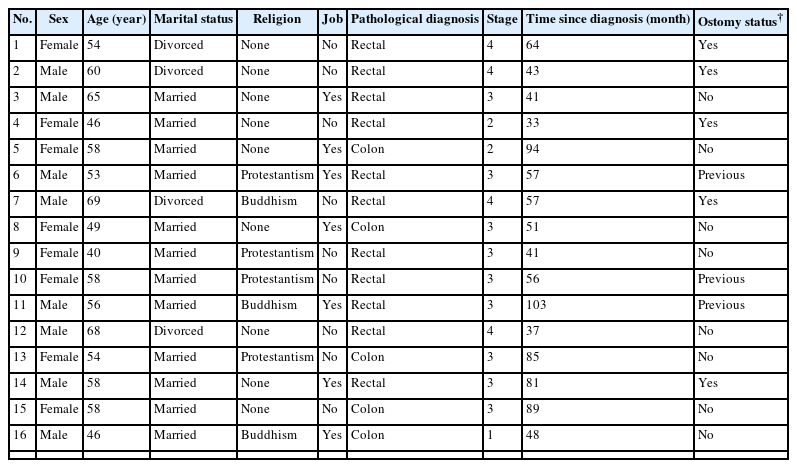
Colorectal cancer (CRC) survivors face significant challenges after completing treatment, including returning to work, concerns about the future, and financial difficulties. Understanding how inner strength developed after treatment affects survivors’ lives is crucial for informing patient-centered care. This study explored the unique inner strength exhibited by CRC survivors during their transition to a “new normal.” Methods: We recruited 16 patients from Korea who had completed treatment, to explore their experiences of managing their health. We conducted a qualitative study from July 4, 2022 to July 25, 2022 using individual interviews and directed content analysis. Transcribed interview data were analyzed to interpret meaning from the data, consistent with the naturalistic paradigm. Results: Participants described their transition to a new normal by reframing the cancer experience, struggling to return to normal life, experiencing growth promoted by supportive relationships, and encountering both positive and negative life changes. Throughout these experiences as survivors, inner strength played a critical role in adapting to a new normal. Conclusion: Our findings suggest that inner strength serves as a dynamic psychological resource, enabling CRC survivors to reframe their illness, regain disrupted roles, and reconstruct a meaningful life despite ongoing physical and emotional challenges. In doing so, inner strength facilitates their adaptation to a new normal.
  • 463 View
  • 18 Download
Effectiveness of a Self-Management Program for Patients Undergoing Lumbar Spinal Stenosis Surgery: A Quasi-Experimental Study
Mi Kyung Seo, Gyoo Yeong Cho
Korean J Adult Nurs 2025;37(3):307-320.   Published online August 29, 2025
DOI: https://doi.org/10.7475/kjan.2025.0331
Purpose
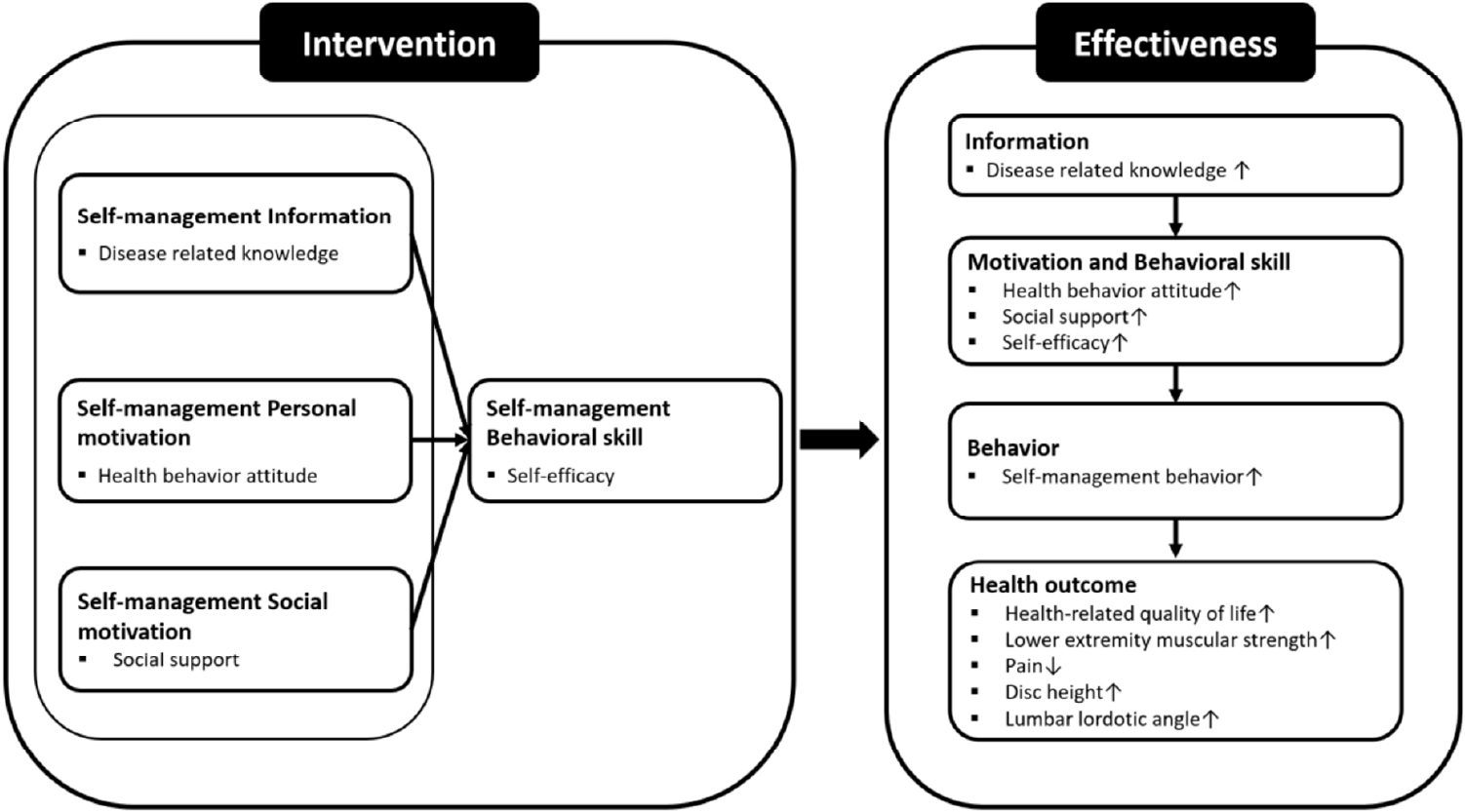
This study developed a self-management program for patients undergoing lumbar spinal stenosis surgery utilizing the information-motivation-behavioral skills (IMB) model. Methods: This study employed a quasi-experimental design with a nonequivalent control group and pretest–posttest design. Data were collected from August 11, 2022, to March 31, 2023, at a general hospital in South Korea. A total of 58 patients participated in the study (30 experimental, 28 control group). The experimental group received a six-session self-management program based on the IBM model, whereas the control group received usual education and information. Data were analyzed with SPSS/WIN 23.0 using the independent t-test, chi-square test, Fisher’s exact test, Shapiro-Wilk test, and Mann-Whitney U test. Results: Significant differences were observed in self-management information (p<.001), personal motivation (p=.002), social motivation (p=.002), behavioral skills (p=.002), behaviors (p=.003), health-related quality of life (p<.001), and disc height (p=.006) in the experimental group following program implementation, compared to the control group. However, no significant differences were found in lower extremity muscular strength, lumbar lordotic angle, or the visual analog scores for low back pain and leg pain between the two groups. Conclusion: The self-management program developed in this study, based on the IMB model, was effective in improving self-management information, motivation, behavioral skills, behaviors, health-related quality of life, and self-management health outcomes in patients undergoing lumbar spinal stenosis surgery. Nevertheless, future research should aim to verify the long-term effects of such self-management programs by extending the intervention period.
  • 1,112 View
  • 29 Download
Purpose
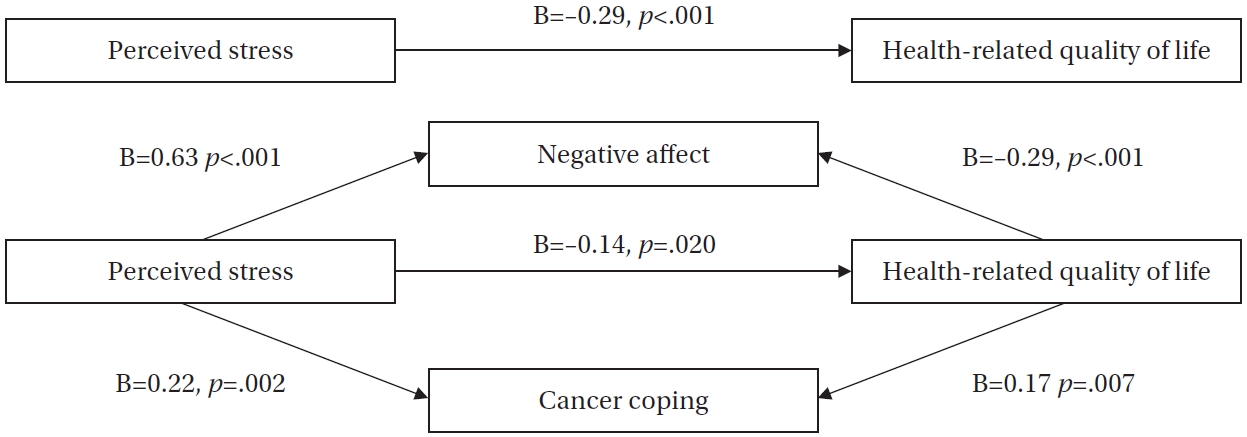
The incidence of gynecological cancers is increasing, presenting significant challenges for patient care and outcomes. Perceived stress and negative affect can impede self-care behaviors and reduce health-related quality of life (HRQoL). This study examined the mediating effects of negative affect and cancer coping on the relationship between perceived hospital stress and HRQoL among patients with gynecological cancer. Methods: A cross-sectional mediation analysis was conducted with 118 gynecological cancer patients recruited from the outpatient clinic of a university hospital (October 2023 to February 2024). Participants completed validated instruments assessing perceived stress, negative affect, cancer coping, and HRQoL. Data were analyzed using Spearman’s correlations and the PROCESS macro (Model 4) with 95% bootstrap confidence intervals (CIs). Results: Perceived stress was significantly correlated with negative affect (r=.58, p<.001), cancer coping (r=.23, p=.012), and HRQoL (r=–.45, p<.001). Negative affect was correlated with HRQoL (r=–.59, p<.001). Furthermore, negative affect and cancer coping mediated the relationship between stress and HRQoL (B=–0.18, 95% CI=–0.27 to –0.11 and B=0.04, 95% CI=0.01 to 0.08, respectively). Conclusion: Negative affect and cancer coping significantly mediated the relationship between hospital stress and HRQoL. Targeted interventions aiming to reduce stress and strengthen emotional and coping strategies could enhance HRQoL among gynecological cancer patients.
  • 1,264 View
  • 37 Download
Purpose
This study identified the mediating effect of resilience on the relationship between job stress and the professional quality of life of hospice and palliative care nurses.
Methods
The participants included 136 hospice and palliative care nurses from 13 inpatient hospice and palliative care wards at a tertiary hospital in a metropolitan city in South Korea. Data were collected from February 2022 to March 2022. Hayes' PROCESS macro 3.5 was used to test the significance of the parameter's indirect effects. Professional quality of life was divided into three subdomains: compassion satisfaction, secondary traumatic stress, and burnout.
Results
As a mediator, resilience had both direct and indirect effects on the relationship between job stress and the compassion satisfaction of hospice and palliative care nurses. Furthermore, there were both direct and indirect effects on the relationship between job stress and secondary traumatic stress. Finally, although there was no direct effect on the relationship between job stress and burnout, there was an indirect mediating effect.
Conclusion
This study confirmed the direct effect of compassion satisfaction on job stress and the professional quality of life of hospice and palliative care nurses, as well as the mediating effect of resilience on job stress and burnout. To improve the professional quality of life of hospice and palliative care nurses, it is necessary to develop and apply programs that enhance resilience in order to promote its mediating effects on compassion satisfaction and burnout.
  • 3,081 View
  • 76 Download
  • 0 Scopus
Purpose
This study investigated differences in inner strength, multiple identities, and quality of life among colorectal cancer survivors, considering gender and the presence of an ostomy. It also focused on identifying factors that influenced their quality of life.
Methods
In this cross-sectional study, 170 colorectal cancer survivors were recruited. Inner strength, multiple identities, and quality of life were assessed through an online survey. Within each subgroup, comparisons were made in two ways: (a) between women and men; and (b) between ostomy and non-ostomy groups.
Results
The quality of life for colorectal cancer survivors was higher among men than women. For inner strength, men reported higher levels of anguish and searching, whereas women showed higher levels of connectedness. The quality of life was higher in the non-ostomy group than the ostomy group. However, the non-ostomy group had a higher level of anguish and searching than the ostomy group. Inner strength emerged as the most powerful factor influencing quality of life after adjusting for age and gender.
Conclusion
This study emphasizes the significance of inner strength in colorectal cancer survivors. It provides a deeper understanding of quality of life in colorectal cancer survivors by examining factors that influence it and considering how these effects differ based on gender and the presence of an ostomy. To improve the quality of life of colorectal cancer survivors, it is essential to comprehend the roles of factors such as gender and ostomy and develop individualized interventions tailored to their specific characteristics.

Citations

Citations to this article as recorded by  
  • The Role of Inner Strength in Korean Colorectal Cancer Survivors on the Journey from Treatment to New Normal: A Qualitative Study
    Hannah Yu, Eunjung Ryu
    Korean Journal of Adult Nursing.2025; 37(3): 332.     CrossRef
  • Cultural Adaptation of a Web-Based Ostomy Care Intervention for Hispanic Cancer Patients and Caregivers: A Mixed Methods Study (Preprint)
    Xiaomeng Wang, Lixin Song, Amy Vondenberger, Fei Yu, Jia Liu, Roxana Delgado, Robert Svatek,  Natalia Villegas Rodriguez, Lurheinna Rosado Rivera, Mark Bonnen
    JMIR Cancer.2024;[Epub]     CrossRef
  • 957 View
  • 18 Download
  • 2 Crossref
Quality of Life in Middle-aged Men with Prostatic hyperplasia: A Structural Equation Model
Hee Nam Moon, Seung Hee Yang
Korean J Adult Nurs 2023;35(4):327-339.   Published online November 30, 2023
DOI: https://doi.org/10.7475/kjan.2023.35.4.327
Purpose
This study employed structural equation modeling to verify the suitability and causality of a hypothetical model constructed based on Wilson and Cleary's health-related quality of life model. The aim was to explain and identify the factors that influence quality of life in middle-aged men with prostatic hyperplasia.
Methods
The study included 217 middle-aged men diagnosed with prostatic hyperplasia between February and March 2022 at the urology department of a general hospital in UJB city. The measurement tools used included biological characteristics, International Prostate Symptom Scores, functional health, general health perceptions, social support, and quality of life. The data collected were analyzed using the SPSS 25.0 and AMOS 25.0 programs.
Results
The final model revealed that the variables with the highest explanatory power for quality of life in middle-aged men with prostatic hyperplasia were general health perceptions, followed by the International Prostate Symptom Score, functional health, and prostate size. The explanatory power of the variables for quality of life in middle-aged men with prostatic hyperplasia was 89.7%.
Conclusion
The model used in this study was found to be suitable for assessing quality of life in middle-aged men with prostatic hyperplasia. Based on the study's findings, it is deemed necessary to foster competencies for managing the disease through the development of educational programs, nursing interventions, and countermeasures. These should be based on general health perceptions, symptoms, and functional health, with an accurate knowledge of the characteristics of prostatic hyperplasia, as per Wilson and Cleary (1995)'s health-related quality of life theory.
  • 846 View
  • 16 Download
  • 0 Scopus
Purpose
The objective of this study was to ascertain the level of life satisfaction among baby boomers in South Korea, as well as the factors that influence it.
Methods
We conducted a secondary analysis and descriptive research using data from the 2020 Korea National Survey of Elderly. From a total of 10,097 individuals, we analyzed the responses of 605 who provided feedback on life satisfaction, applying sample weights for accuracy. Data analysis was performed using hierarchical multiple regression in the SPSS/WIN 23.0 program.
Results
The study's participants comprised 61.8% women, 80.2% individuals with a living spouse, and 54.8% high school graduates, and the participants had an average subjective health status score of 3.77 points. Hierarchical regression analysis revealed several significant factors impacting life satisfaction. These included the presence or absence of a spouse (p<.001), education level (p<.001), subjective health status (p<.001), experience of suicidal thoughts after the age of 60 (p=.004), and use of a smartphone or tablet (p=.037), degree of social respect (p<.001) and the degree of preparation for death (p=.001). The overall explanatory power for life satisfaction was 57.5%.
Conclusion
The life satisfaction of baby boomers did not differ greatly from that of previous generations of older adults. A future longitudinal study should observe changes in older adults' life satisfaction. Additionally, it is important to explore variations in life satisfaction across different age groups, especially given the increasing longevity of older adults.

Citations

Citations to this article as recorded by  
  • Deficits in facial emotion recognition and cognitive function among baby boomers
    Hyunsan Cho, Hee-Jin Park, Yoon Hee Park, Intae Hwang, Hyo Jin Kang
    Acta Psychologica.2025; 253: 104738.     CrossRef
  • Prevalence of depression and its associated factors among Korean women: A cross-sectional study in Seoul
    Thi Thanh Lan Nguyen, Van Cuong Nguyen
    Archives of Psychiatric Nursing.2025; 57: 151928.     CrossRef
  • The Relationship of Satisfaction With Life on Quality of Care in Nurses: A Cross‐Sectional Study
    Necmettin Çiftci, Abdullah Sarman
    Scandinavian Journal of Caring Sciences.2025;[Epub]     CrossRef
  • Risk factors of depression among the baby boomer generation: A cross-sectional study using the 2022 Korean Community Health Survey
    Kyoung Mi Kim, Hye Jung Jun
    Journal of Korean Gerontological Nursing.2025; 27(3): 308.     CrossRef
  • Purposes of Internet Use and Its Impacts on Physical and Psychological Health of Korean Older Adults
    Gyeong-Suk Jeon, Kyungwon Choi
    Healthcare.2024; 12(2): 244.     CrossRef
  • 3,513 View
  • 25 Download
  • 5 Crossref
  • 2 Scopus
Purpose
This study aims to identify factors affecting the Health-Related Quality of Life (HRQoL) in patients with atrial fibrillation.
Methods
The study subjects were 158 outpatients with atrial fibrillation at a university hospital in Metropolitan City B. Data were collected from March 18, 2022 to July 1, 2022 and were analyzed using descriptive statistics, independent t-test, one-way ANOVA, Pearson’s correlation coefficient, and hierarchical multiple regression with SPSS 22.
Results
Self-management behaviors (β=.27, p<.001), self-efficacy (β=.30, p<.001), and grit (β=.33, p<.001) were found to have statistically significant effects on HRQoL. Hierarchical regression analysis showed that age, employment status, and monthly household income explained 23.6% of the variance in HRQoL, while subjective health status and perceived stress added 18.6% of the variance. Self-management behaviors, self-efficacy, and grit had an explanatory power of 32.4%, and the overall explanatory power was 74.6%.
Conclusion
Self-management behaviors, self-efficacy, and grit were identified as factors affecting HRQoL in patients with atrial fibrillation. These results will be used as important fundamental data to develop nursing interventions in order to improve the HRQoL of patients with atrial fibrillation.

Citations

Citations to this article as recorded by  
  • Factors Influencing Health-Related Quality of Life in Patients With Atrial Fibrillation
    Hyeon-Ok Lee, Ji-Yeong Seo
    Journal of Cardiovascular Nursing.2025;[Epub]     CrossRef
  • 1,708 View
  • 25 Download
  • 1 Crossref
  • 0 Scopus
The Development of a Specific Quality of Life Scale for Hypertensive Patients: Methodological Study
Ho Jin Kim, Gab Sun Song
Korean J Adult Nurs 2022;34(6):523-536.   Published online December 31, 2022
DOI: https://doi.org/10.7475/kjan.2022.34.6.523
Purpose
The purpose of this study was to develop and verify a Quality of Life Scale (QOLS) specifically for hypertensive patients. Methods: In the development phase of the QOLS, initial items were derived based on literature review and content analysis through in-depth interviews. After verifying the content validity of the expert group, preliminary questions composed of 94 items were created and confirmed by conducting preliminary research on hypertensive patients. During the verification phase, the preliminary QOLS was administered to 392 hypertensive patients from general hospitals, medical clinics, and public health centers in Busan. Data were analyzed using item analysis, exploratory factor analysis, convergent validity, discriminant validity, criterion validity, and Cronbach’s ⍺. Results: The final scale consisted of 30 items derived from 5 factors. Five factors (negative emotion, acceptance of disease, self-reinforcement, social support, self-regulation) were extracted from the factor analysis, which explained 68.0% of the total variance. The convergent validity showed a positive correlation (r=.51, p<.001), discriminant validity showed an inverse correlation (r=-.60, p<.001), and criterion validity showed a positive correlation (r=.35~.64, p<.001). The Cronbach’s ⍺ was .94 and reliability of the subscales was .78~.92. Conclusion: The specific Quality of Life Scale for hypertensive patients (QOLS_HP) was composed of 30 items using a 5-point Likert scale. The scale demonstrated acceptable validity and reliability.
  • 995 View
  • 26 Download
  • 0 Scopus
Purpose
This study aimed to determine the impact of health literacy, self-efficacy, and social support on the Health-Related Quality of Life (HRQoL) of Korean patients with Acute Coronary Syndrome (ACS) after Percutaneous Coronary Intervention (PCI).
Methods
A cross-sectional design was used, and a total of 189 participants were enrolled. Data were collected using self-reported questionnaires and patient medical records between September and November of 2021. Health literacy, self-efficacy, social support, and HRQoL were measured. The HRQoL was measured using the 12-item Short Form Survey, which included Physical Component Summary (PCS) and Mental Component Summary (MCS). Data were analyzed using hierarchical multiple regression with SPSS/WIN 26.0 program.
Results
The findings revealed statistically significant differences in the PCS according to gender, presence of hypertension, exercise, and sleep state. Furthermore, there were statistically significant differences in the MCS according to disease period and stress management. Hierarchical multiple regression analysis showed that higher social support was a significant factor of better PCS (p<.005). Higher health literacy, self-efficacy, and social support were significant factors of better MCS (p<.005).
Conclusion
Nurses should play a key role in providing social support to ACS patients, particularly to female patients and patients with hypertension and poor sleep state and no regular exercise for better PCS. Also, nurses should think about how to promote health literacy, self-efficacy, and social support for better MCS, particularly in ACS patients who had undergone PCI, had longer diagnosis periods, and had no stress management.

Citations

Citations to this article as recorded by  
  • Influence of self-efficacy in health management and resilience on treatment compliance in Korean patients undergoing percutaneous coronary intervention: a descriptive survey study
    Mi-Ra Jung, Eun Jeong, Kyung Sim Lee, Jang Hyun Cho
    Journal of Korean Biological Nursing Science.2025; 27(2): 266.     CrossRef
  • Factors influencing disease-related knowledge and health empowerment on health behavior compliance among patients after percutaneous coronary intervention in Korea: a cross-sectional study
    Hyeon-Jung Lee, Insook Lee
    Journal of Acute Care Surgery.2025; 15(2): 49.     CrossRef
  • Mediating Effects of Self-Efficacy and Social Support on the Relationship Between eHealth Literacy and Self-Care Competency in Patients Undergoing Percutaneous Coronary Interventions: A Cross-Sectional Study
    Eunhee Jo, Su-Jin Lee, Sun Hee Han
    Journal of Korean Academy of Fundamentals of Nursing.2023; 30(3): 325.     CrossRef
  • 1,110 View
  • 61 Download
  • 3 Crossref
  • 1 Scopus
Development of the Knowledge Scale of the Life-Sustaining Treatment for Clinical Nurses
Sojung Park, Mihyun Park, Suyoun Hong
Korean J Adult Nurs 2022;34(5):488-497.   Published online October 31, 2022
DOI: https://doi.org/10.7475/kjan.2022.34.5.488
Purpose
It is necessary for nurses who perform tasks related to life-sustaining treatment to play a supporting role in the decision-making process of life-sustaining treatment for patients and guardians based on their knowledge of decisions and implementation, such as cessation of life-sustaining treatment. Therefore, the Knowledge Scale of the Life-Sustaining Treatment (KS-LST) was developed and reliability and validity were verified.
Methods
Our methodological study aimed at developing tools to measure the knowledge of nurses´ life-saving medical decision system and to verify their reliability and validity. To this end, preliminary questions were constructed through literature review. In this regard, content validity, face validity, k-group comparison, and composition validity through item analysis were verified, and reliability was derived from KR-20.
Results
A total of 26 questions were derived from the 35 preliminary questions through content validity and facial validity; depending on whether they were educated or not, there was a significant difference between the two groups (p=.004). The final 23 questions were derived by deleting 3 questions with low discrimination, and KR-20 was .62.
Conclusion
Using the KS-LST that was developed through this study, we can measure the nurses´ knowledge of the life-sustaining medical decision system and provide education in the deficient areas. We expect nurses with accurate knowledge to provide accurate information to patients and caregivers to help patients make the right choices.

Citations

Citations to this article as recorded by  
  • Factors associated with disaster nursing competence among emergency department nurses: the roles of disaster preparedness, self-efficacy, and communication ability
    Gyu Bong Noh, Sun Hyoung Bae
    BMC Nursing.2025;[Epub]     CrossRef
  • Knowledge, Attitudes and Nursing Stress Related to Life-Sustaining Treatment among Oncology Nurses
    Seul Lee, Suyoun Hong, Sojung Park, Soojung Lim
    The Journal of Hospice and Palliative Care.2023; 26(3): 112.     CrossRef
  • 1,055 View
  • 38 Download
  • 2 Crossref
  • 0 Scopus
Purpose
This study aimed to clarify the relationship between andropause syndrome and health-related quality of life, as well as the mediation effect of family bond among middle-aged males in South Korea. Methods A total of 135 middle-aged males who live in B, K, and U City participated in the study, conducted from March 10 to May 31, 2021. Participants were invited to complete self-reported questionnaires measuring andropause syndrome, health-related Quality of Life (QoL), family bond, and demographic information. The data obtained were analyzed using multiple regression and a simple mediation model applying the PROCESS macro with 95% bias-corrected bootstrap confidence interval (5,000 bootstrap resampling). Results The QoL of middle-aged males in South Korea showed a significant negative correlation with andropause syndrome (r=-.32, p<.001), and a significant positive correlation with family bond (r=.59, p<.001). Futher, family bond had a mediating effect between andropause syndrome and QoL (indirect effect=-4.07, 95% Boot confidence interval=-6.53~-1.97). Conclusion Based on the results of this study, in order to improve the QoL of middle-aged males in South Korea, it is necessary to provide programs that can improve family bond along with physical and mental intervention programs to effectively alleviate andropause syndrome.

Citations

Citations to this article as recorded by  
  • A comprehensive analysis of research trends on andropause among middle-aged South Korean men
    Young Hwa Lee, Sun Jung Park, Hyun Ji Kim, Bock Soon Park, Hyo Yeol Jang, Ha Na Cho, Young Sook Lim
    International Journal of ADVANCED AND APPLIED SCIENCES.2023; 10(6): 129.     CrossRef
  • 658 View
  • 10 Download
  • 1 Crossref
  • 3 Scopus
Purpose
This study aimed to compare the lifestyle, self-rated health, and mental health of breast cancer survivors with those of the healthy people through a propensity-matched comparison, and identify factors affecting the mental health of breast cancer survivors. Methods This study was a secondary analysis that used data from the Korea National Health and Nutrition Examination Survey (KNHANES), from 2015 to 2020. It included 47,118 participants, of which 134 breast cancer survivors and 268 healthy people were separated and analysed by 1:2 Propensity Score Matching (PSM), and complex sample logistic regression analysis was performed using SPSS and R programs. Results Statistically significant differences were found in smoking rate, walking exercise rate, cancer screening rate, daily energy intake, and self-rated health between breast cancer survivors and healthy groups. After PSM, there were significant differences in the ratio of perceived stress, suicide plan, suicide attempts, and mental health counseling experiences between the healthy group and breast cancer survivors. As compared to the healthy group, breast cancer survivors had a significantly higher risk of mental health issues by 2.19 times. Self-rated health, household income, and number of household members were significant influencing factors affecting the mental health of breast cancer survivors. Conclusion This study provides evidence of an increased mental health risk in breast cancer survivors compared with healthy women with no cancer. Mental health outcomes, such as stress, sleep disturbance, and suicidal ideation, have been reported post cancer treatment. Counselling and management strategies would be helpful for breast cancer survivors.

Citations

Citations to this article as recorded by  
  • Factors Associated with Stress among Employed Korean Cancer Survivors: A Cross-sectional Descriptive Study Based on National Data
    Kisook Kim, Booyoung Oh
    Korean Journal of Adult Nursing.2023; 35(3): 254.     CrossRef
  • 1,203 View
  • 22 Download
  • 1 Crossref
  • 1 Scopus
Mediating Effect of Resilience between Supportive Care Needs and Quality of Life of Female Genital Cancer Patients
Yu-Jung Son, Keum-Hee Nam
Korean J Adult Nurs 2022;34(3):269-279.   Published online June 30, 2022
DOI: https://doi.org/10.7475/kjan.2022.34.3.269
Purpose
This study aimed to confirm the relationship between supportive care needs and resilience of female genital cancer patients, and to investigate the mediating effect of resilience in the relationship between supportive care needs and quality of life.
Methods
This study was conducted with 105 outpatients and inpatients who were receiving treatment for female genital cancer at K University Hospital in B City. Data were collected from July 22, 2021 to August 17, 2021 and analyzed by using the SPSS/WIN 23.0 program. The correlation between the patients’ supportive care needs, resilience, and quality of life was analyzed by Pearson's correlation coefficients, and SPSS Process Macro was used for the significance of parameter indirect effects.
Results
The quality of life of female genital cancer patients showed a significant negative correlation with supportive care needs (r=-.68, p<.001), and a significant positive correlation with resilience (r=.53, p<.001). Moreover, resilience partially mediated the relationship between supportive care needs and quality of life (95% CI -0.009~-0.032).
Conclusion
Based on the results of this study, improving the resilience of female genital cancer patients may act as an additional coping strategy to reduce supportive care needs and establish an enhanced quality of life.

Citations

Citations to this article as recorded by  
  • Validity and Reliability of the Korean Version of Supportive Care Needs Survey-Short Form 34 for Patients With Cancer: A Methodological Study
    Eun Ji Park, Hye Young Kim, Ju-Hee Nho, Eun Ko, Allison W. Boyes
    Asian Nursing Research.2025; 19(1): 60.     CrossRef
  • Influences of Distress and Uncertainty on Supportive Care Needs in Preoperative Gynecological Cancer Patients in the Early Stages of Diagnosis
    Lee Na Yun, Jeong Hye Kim
    Asian Oncology Nursing.2025; 25(2): 53.     CrossRef
  • Influences of Fatigue, Uncertainty, and Resilience on Self-Care Behaviors in Cancer Patients Undergoing Chemotherapy
    Sa-Rang Kim, Gie-Ok Noh
    Asian Oncology Nursing.2025; 25(2): 110.     CrossRef
  • Factors influencing the supportive care needs of female patients with genital cancer in South Korea
    Yu-Jung Son, Keum-Hee Nam, JaeLan Shim
    Medicine.2023; 102(51): e36650.     CrossRef
  • 1,004 View
  • 22 Download
  • 4 Crossref
  • 2 Scopus
Purpose
This study aimed to evaluate distress, family resilience, and Quality of Life (QoL) among family caregivers of cancer patients undergoing chemotherapy and explore whether family resilience moderates the association between distress and QoL.
Methods
This is a cross-sectional study. One hundred seventeen family caregivers of cancer patients undergoing chemotherapy were recruited through the oncology outpatient clinic and two oncology wards at a tertiary university hospital. The participants completed self-reported questionnaires, including the Hospital Anxiety and Depression Scale, Family Resilience Scale-Cancer, and Caregivers’ Quality of Life Index-Cancer. Descriptive statistics, independent t-tests, one-way Analysis of Variance (ANOVA), and hierarchical regression analysis were used for statistical analysis.
Results
The mean distress score was 15.31±6.91, the mean family resilience score was 112.71±14.11, and the mean QoL score was 71.19±18.90. After controlling for potential covariates, distress was found to be negatively associated with QoL (β=-.45, p<.001), whereas family resilience was positively associated with QoL (β=.49, p<.001), explaining 62.8% of the variance. However, family resilience did not moderate the association between distress and QoL in this study.
Conclusion
Distress and family resilience are crucial factors associated with QoL in the caregivers of cancer patients undergoing chemotherapy. This finding indicates that oncology nurses should develop interventions to relieve distress and enhance family resilience to improve family caregivers’ QoL. Further studies are required to confirm the moderating role of family resilience.

Citations

Citations to this article as recorded by  
  • Navigate Chronic Illness: Antecedents and Consequences of Family Resilience—A Systematic Review and Meta-Analysis
    Charin Suwanwong, Darawan Raksat
    The Family Journal.2025;[Epub]     CrossRef
  • Effectiveness of web-based education program on knowledge, coping, burden, and quality of life among colorectal cancer caregivers in Vietnam: a quasi-experimental study
    Hien Thi Nguyen, Hsiu-Hsin Tsai, Hong Thuy Phuong Huynh, Thuy Khanh Linh Tran, Tuan Anh Le, Li-Chueh Weng, Ching-Yu Cheng, Pei-Kwei Tsay, Wann-Yun Shieh, Chia-Yih Liu
    BMC Nursing.2025;[Epub]     CrossRef
  • Mediating Effects of Family and Clinical Characteristics on the Quality of Life of Children With Spina Bifida and Their Parents
    Seung Hyeon Yang, Hyeseon Yun, Hooyun Lee, Kyua Kim, Chang Gi Park, Eun Kyoung Choi
    Journal of Advanced Nursing.2025;[Epub]     CrossRef
  • Resilience and its association with caregiving and psychosocial factors among lung cancer caregivers in Vietnam
    Thinh Toan Vu, Sasha Fleary, Glen Johnson, Victoria Khanh Ngo
    European Journal of Oncology Nursing.2025; 77: 102932.     CrossRef
  • Asian American Occupational Therapy Practitioners’ Perspectives on Supporting the Mental Health of Asian American Caregivers for Older Adults
    Arianna Bayangos, Rawan AlHeresh, Hadeel R. Bakhsh, Diane Smith, Claudia Hilton
    Occupational Therapy International.2025;[Epub]     CrossRef
  • Linking Healthcare, Family, and Work Systems: the Roles of Family-Centered Care, Family Resilience, and Caregiving-to-Work Conflict in Psychological Well-being among Parents of Children with Autism Spectrum Disorder
    Liangqi Shen, Linxiao Zhang
    Applied Research in Quality of Life.2025; 20(5): 2099.     CrossRef
  • The effect of mindfulness‐based interventions on caregiver burden, quality of life and psychological distress in caregivers of adults with chronic diseases: Systematic review and meta‐analysis of randomized controlled trials
    Gülyeter Erdoğan Yüce, Ayser Döner, Aylin Bilgin, Gamze Muz
    Worldviews on Evidence-Based Nursing.2024; 21(5): 528.     CrossRef
  • The experiences of family resilience in patients with permanent colostomy and their spouses: A dyadic qualitative study
    Fangfang Yang, Sumin Cui, Mengyi Cai, Fangming Feng, Meihui Zhao, Mengchen Sun, Weiying Zhang
    European Journal of Oncology Nursing.2024; 70: 102590.     CrossRef
  • Dyadic effects of family resilience on quality of life in patients with lung cancer and spousal caregivers: The mediating role of dyadic coping
    Jianfan Ke, Jialing Lin, Xiujing Lin, Wei-ti Chen, Feifei Huang
    European Journal of Oncology Nursing.2023; 66: 102400.     CrossRef
  • Family resilience and its influencing factors among advanced cancer patients and their family caregivers: a multilevel modeling analysis
    Panpan Cui, Jiaoxia Shi, Shifeng Li, Mikiyas Amare Getu, Ruibo Wang, Changying Chen
    BMC Cancer.2023;[Epub]     CrossRef
  • 1,983 View
  • 44 Download
  • 10 Crossref
  • 8 Scopus
A Prediction Model for Quality of Life by Resilience in Disaster Female Victims
Jiyeong Seo, Minju Kim
Korean J Adult Nurs 2021;33(6):639-648.   Published online December 31, 2021
DOI: https://doi.org/10.7475/kjan.2021.33.6.639
Purpose
To identify factors associated with Quality of Life (QOL) in disaster female victims.
Methods
A descriptive cross-sectional design used secondary data from the 2018 long-term survey on the change of life of disaster victims conducted by the National Disaster Management Research Institute (NDMI). The participants were 1,267 female victims over the age of 20 who completed a survey including QOL, resilience, perceived health status, depression, anxiety, Post-Traumatic Stress (PTS), social adaptation, and social support. Descriptive statistics, chi-square-test, independent t-test, and a decision tree were used for data analysis.
Results
The decision tree identified 8 final nodes predicting QOL of disaster female victims. Resilience was associated with quality of life (△p<.001, F=115.14). The mean QOL was 2.81 with predicted rate of 55.7% in the Low Resilience Group (LRG) and 3.24 with predicted rate of 44.3% in the High Resilience Group (HRG). The highest QOL group in LRG was Node 9 with perceived health status of more than 3 and low depression (mean=3.17), while the lowest QOL group was Node 3 with perceived health status of less than 2 (mean=2.54). The highest QOL group in HRG was Node 8 with social support of more than 3.92 (mean=3.57), while the lowest group was Node 12 with high anxiety (mean=2.81).
Conclusion
Factors predicting the QOL of disaster victims differed between HRG and LRG. In order to improve QOL of disaster victims, customized interventions according to the level of resilience are needed.

Citations

Citations to this article as recorded by  
  • Trajectories of quality of life among disaster victims: A national longitudinal study
    Haeyoung Lee, Yujeong Kim
    International Nursing Review.2025;[Epub]     CrossRef
  • Prediction model for identifying a high-risk group for food insecurity among elderly South Koreans
    Myeunghee Han
    Scientific Reports.2025;[Epub]     CrossRef
  • Prediction model for post-retirement depression in the older population: A cross-sectional study
    Myeunghee Han
    Journal of Korean Gerontological Nursing.2025; 27(1): 21.     CrossRef
  • Prediction model of weight control experience in men with obesity in their 30 s and 40 s using decision tree analysis
    Myeunghee Han
    Scientific Reports.2024;[Epub]     CrossRef
  • Prediction model of health checkup and cancer screening experience of elderly population using 2021 Community Health Survey
    Myeunghee Han
    Research in Community and Public Health Nursing.2024; 35: 140.     CrossRef
  • Prediction model for identifying high-risk groups for overweight or obesity among Korean men in their 30s and 40s
    Myeunghee Han
    BMC Public Health.2024;[Epub]     CrossRef
  • Prediction model of quality of life using the decision tree model in older adult single-person households: a secondary data analysis
    Dajung Ryu, Sohyune Sok
    Frontiers in Public Health.2023;[Epub]     CrossRef
  • A model for predicting fall experience in the elderly population over 65 years old: Decision tree analysis
    Myeunghee Han
    Journal of Korean Gerontological Nursing.2022; 24(4): 366.     CrossRef
  • 701 View
  • 12 Download
  • 8 Crossref
  • 8 Scopus
The Effects of Nurse-Led Motivational Interviewing on Exercise and Quality of Life among Koreans with Heart Failure: A Randomized Controlled Trial
Haejung Lee, Gaeun Park, Hyekyung Jin, Kook Jin Chun, Jong Hyun Kim
Korean J Adult Nurs 2021;33(6):588-600.   Published online December 31, 2021
DOI: https://doi.org/10.7475/kjan.2021.33.6.588
Purpose
Patients with heart failure report low levels of physical activity and quality of life, both of which are important predictors of patient prognosis. This study aimed to investigate the effects of nurse-led motivational interviewing on self-efficacy for exercise, engagement in regular exercise, exercise capacity, and quality of life among patients with heart failure.
Methods
A randomized controlled trial design was used, and 66 Korean participants (i.e., 38 in a control group and 28 in an intervention group) aged 40~80 years who were diagnosed with heart failure were recruited between May 2012 and September 2013. The intervention group received telephone-based motivational interviews twice a week for one month. All participants were assessed for exercise regularity, levels of exercise, exercise capacity, and quality of life at baseline, one month, and three months. The data were analyzed using independent t-tests, repeated measures ANOVA, and nonparametric tests.
Results
At one month, there were significant group differences in exercise regularity (x2 =6.10, p=.013) and levels of exercise (Z=-2.56, p=.024). There was a significant group-by-time effect on the quality of life (F=3.76, p=.044).
Conclusion
Nurse-led motivational interviewing was effective in increasing exercise levels and quality of life in patients with heart failure. In the future, we propose a study with a larger number of participants and a long-term follow-up study with additional contact to maintain the intervention effect.

Citations

Citations to this article as recorded by  
  • Empowering Trusted Messengers With Motivational Interviewing Skills: Improving Dissemination of Accurate Information to Communities
    Marie Ivantechenko, Shubarna Akhter, Damara Gutnick
    Community Health Equity Research & Policy.2025; 46(1): 41.     CrossRef
  • Effectiveness of behavioural interventions with motivational interviewing on physical activity outcomes in adults: systematic review and meta-analysis
    SuFen Zhu, Deepra Sinha, Megan Kirk, Moscho Michalopoulou, Anisa Hajizadeh, Gina Wren, Paul Doody, Lucy Mackillop, Ralph Smith, Susan A Jebb, Nerys M Astbury
    BMJ.2024; 386: e078713.     CrossRef
  • Benefits and Harms of Digital Health Interventions Promoting Physical Activity in People With Chronic Conditions: Systematic Review and Meta-Analysis
    Graziella Zangger, Alessio Bricca, Behnam Liaghat, Carsten B Juhl, Sofie Rath Mortensen, Rune Martens Andersen, Camma Damsted, Trine Grønbek Hamborg, Mathias Ried-Larsen, Lars Hermann Tang, Lau Caspar Thygesen, Søren T Skou
    Journal of Medical Internet Research.2023; 25: e46439.     CrossRef
  • 3,287 View
  • 61 Download
  • 3 Crossref
Symptom Clusters and Quality of Life in Patients with Type 2 Diabetes Mellitus
Su-Yeon Hong, Yang-Sook Yoo
Korean J Adult Nurs 2021;33(5):498-508.   Published online October 31, 2021
DOI: https://doi.org/10.7475/kjan.2021.33.5.498
Purpose
This study aimed to investigate the symptom clusters and quality of life among patients with type 2 diabetes mellitus and to identify the relationship between quality of life and symptoms by cluster.
Methods
Data were collected through questionnaires and medical records of 123 patients with type 2 diabetes between December 27, 2018 and May 8, 2019. Type 2 diabetes-related symptoms were investigated using the Diabetes Symptom Self-Care Inventory, and quality of life was evaluated using the EuroQoL 5-Dimension 5-Level (EQ-5D-5L). The collected data were analyzed using mean, standard deviation, factor analysis, Pearson correlation coefficient, and hierarchical multiple regression analysis.
Results
Tiredness was a most frequently reported symptom; however, symptom with weight loss was the most critical symptom reported. Five symptom clusters were identified, four of which correlated with quality of life. Hierarchical multiple regression analysis showed that thirst-fatigue clusters affected quality of life (β=-.26, p=.019).
Conclusion
Active treatment and continuous lifestyle management are needed to maintain proper blood sugar levels to address type 2 diabetes mellitus-related symptoms within a thirst-fatigue cluster. Identifying the cause of fatigue and applying physical and psychosocial interventions is also required. Symptoms experienced by patients with type 2 diabetes are connected to clusters. Effective disease management and improvement in the quality of life can be achieved by identifying these symptoms through merging and managing the relevant symptoms simultaneously.

Citations

Citations to this article as recorded by  
  • Risk factors for prediabetes in young adults: a study based on Korea National health and nutrition examination survey data
    Sujung Lee, Dae-Soon Son, Jae-In Kim, Jungmin Lee
    Scientific Reports.2025;[Epub]     CrossRef
  • Development and Effectiveness of a Pattern Management Educational Program Using Continuous Glucose Monitoring for Type 2 Diabetic Patients in Korea: A Quasi-Experimental Study
    Seung-Yeon Kong, Mi-Kyoung Cho
    Healthcare.2024; 12(14): 1381.     CrossRef
  • Associated Factors with Health-related Quality of Life among Older Adults with Diabetes in Korea
    Eun-Kyung Lee, Sun-Young Jung
    The Korean Journal of Rehabilitation Nursing.2022; 25(2): 61.     CrossRef
  • 706 View
  • 31 Download
  • 3 Crossref
  • 2 Scopus
Effect of Self-Regulation and Social Support Intervention on the Life Quality in Patients with Post-Stroke Urinary Incontinence
Heltty Heltty, Ratna Sitorus, Nury Nusdwinuringtyas, Evi Martha
Korean J Adult Nurs 2021;33(4):399-405.   Published online August 31, 2021
DOI: https://doi.org/10.7475/kjan.2021.33.4.399

Citations

Citations to this article as recorded by  
  • Social needs and resilience of post-stroke patients: an exploratory case study
    Heltty Heltty, Rahmawati Rahmawati, Taufik Taufik
    Healthcare in Low-resource Settings.2025;[Epub]     CrossRef
  • Self-efficacy, social support, and their relationship to treatment adherence in pulmonary tuberculosis: A cross-sectional study
    Heltty Heltty, Siti Masriwati, Mimi Yati, La Ode Saltar, Hasniah Dina
    The Journal of Palembang Nursing Studies.2025; 4(2): 81.     CrossRef
  • Impact of applying the theory of human becoming and self-care deficit theory of nursing on insomnia in after stroke urinary incontinence patients
    Heltty Heltty, Ratna Sitorus, Haryanto Haryanto
    Frontiers of Nursing.2024; 11(3): 259.     CrossRef
  • Booster dose of COVID-19 vaccination: Perception among elderly
    Heltty Heltty, Basso Palingrungi, Apriyanti Apriyanti
    The Journal of Palembang Nursing Studies.2023; 2(1): 20.     CrossRef
  • Patient, Family, and Peer Engagement in Nursing Care as an Effort to Improve the Functional Independence of Post-stroke Urinary Incontinence Patients: A Cross-Sectional Study
    Heltty Heltty
    Cureus.2022;[Epub]     CrossRef
  • 1,065 View
  • 8 Download
  • 5 Crossref
  • 1 Scopus
Ethnography on the Health Life of Hemodialysis Patients with Chronic Kidney Failure
Jinhyang Yang, Myung-Ok Cho
Korean J Adult Nurs 2021;33(2):156-168.   Published online April 30, 2021
DOI: https://doi.org/10.7475/kjan.2021.33.2.156
Purpose
This study was performed to explore the contexts and meanings of health life among patients with chronic kidney failure undergoing hemodialysis. Methods: The ethnography steps presented by Spradley were utilized. The participants were 12 patients from two hemodialysis centers. Data were collected by iterative fieldwork through in-depth interviews and participant observations and analyzed using text analysis and taxonomic methods. Field notes were used along with interviews and dialogue between authors to enhance interpretation. Results: Five themes on the health life of participants emerged: experiencing the loss of normality of the body and the collapse of daily life, establishing the role of dialysis patients, reorganizing the network, building an integrated coping pattern, and new normalization of the pattern of life. Patients' experiences differed in health life's patterns and meanings according to various individual situations and sociocultural contexts. Conclusion: Establishing new patterns of life of hemodialysis patients was a normalization process to ensure the adequacy of physical indicators and stability amid physical, emotional, and social challenges. To achieve quality health life, patients should be provided with tailored nursing interventions that consider their individual, social, and cultural situations.

Citations

Citations to this article as recorded by  
  • A qualitative meta-synthesis of the essence of patient experiences of dialysis
    Soyoung Jang, Eunyoung E. Suh, Yoonhee Seok
    Journal of Korean Academy of Nursing.2025; 55(1): 119.     CrossRef
  • Predictors of self-management behaviors among patients undergoing hemodialysis
    Yusun Park, Sunyoung Jung
    Scientific Reports.2025;[Epub]     CrossRef
  • The impact of illness acceptance, depression, and social support on health-related quality of life in older adults on hemodialysis: A descriptive study
    Eunha Lee, Jungmin Kim
    Journal of Korean Gerontological Nursing.2025; 27(1): 106.     CrossRef
  • Predictors of psychosocial adaptation in haemodialysis patients according to haemodialysis vintage: a quantitative study
    Ae Kyung Chang, Ah Young Kim
    Contemporary Nurse.2025; 61(4): 377.     CrossRef
  • Influences of Online Health Information Seeking Behavior and E-health Literacy on Self-Management in Hemodialysis Patients: A Cross-Sectional Study
    Myeong-yi Kim, Jaehee Jeon
    Korean Journal of Adult Nursing.2025; 37(4): 502.     CrossRef
  • Healthy life of Korean patients with chronic kidney failure undergoing hemodialysis: A situation-specific nursing theory
    Jinhyang Yang, Myung-Ok Cho, Haeok Lee
    Applied Nursing Research.2022; 65: 151584.     CrossRef
  • The Effect of Uncertainty on the Physiological Indexes of Hemodialysis Patients: Serial Mediating Effects of Uncertainty Appraisal and Self-care Behavior
    Mi Kyung Kim, Eun Hee Jang
    Korean Journal of Adult Nursing.2022; 34(1): 51.     CrossRef
  • Development and Evaluation of an Online Self-Management Program in Patients with Chronic Kidney Failure Undergoing Hemodialysis
    Jinhyang Yang
    Journal of Korean Academy of Fundamentals of Nursing.2022; 29(4): 531.     CrossRef
  • 1,151 View
  • 72 Download
  • 8 Crossref
Effects of Hand Press Pellet on Constipation in Patients with Breast Cancer Receiving Chemotherapy
Dawoon Jung, Hyojung Park
Korean J Adult Nurs 2021;33(2):145-155.   Published online April 30, 2021
DOI: https://doi.org/10.7475/kjan.2021.33.2.145
Purpose
The purpose of this study was to evaluate whether hand press pellet is effective for constipation in breast cancer patients receiving chemotherapy. Methods: This was a quasi-experimental study that used non-equivalent control group pretest-posttest design. Participants were 52 breast cancer patients-26 each in the experimental and control groups. The intervention was conducted thrice a week for 6 weeks; for the experimental group, a hand press pellet was applied to the corresponding points (A1, A5, A8, A12, A16, N18, E22, K9, F6, D2, D6, H2, L4, B7, B19) of the left hand (palm and back) to alleviate constipation. Three and 6 weeks after the intervention, outcomes were measured by using the Constipation Assessment Scale, Bristol Stool Form Scale, and Patient Assessment of Constipation-Quality of Life questionnaire. Results: A significant difference was observed between the two groups on the Constipation Assessment Scale (χ2=44.38, p<.001) and Bristol Stool Form Scale (χ2=33.24, p<.001). Patient assessment of constipation-quality of life of the experimental group were statistically significant compared with that of the control group (F=37.23, p<.001). Conclusion: Hand press pellet can be used as an effective nursing intervention to alleviate constipation in breast cancer patients.

Citations

Citations to this article as recorded by  
  • Effects of hand-press pellet on pain and daily life of elders with chronic lower back pain: randomized controlled trial
    Hyojung Park, Hyejin Lee
    BMC Complementary Medicine and Therapies.2024;[Epub]     CrossRef
  • 758 View
  • 19 Download
  • 1 Crossref
  • 1 Scopus
Purpose
This study aimed to examine the influence of lifestyle-related factors, such as sleep quality, eating habits, and perceived stress, on the incidence of thyroid cancer in healthy adults. Methods: This study is a cross-sectional case-control study comparing lifestyle-related factors in thyroid cancer and healthy groups. Outpatients with thyroid cancer were recruited from 2012 to 2013, 3~6 months after thyroidectomy at a tertiary hospital in Seoul, Korea (n=468). For the control group, 935 healthy adults were recruited by propensity score matching on demographic characteristics in a 1:2 ratio from hospital health checkup data. The effect of sleep quality, eating habits, and perceived stress on the incidence of thyroid cancer was determined through multiple logistic regression analysis and backward stepwise variable selection. Results: Sleep disturbance and mild/moderate daytime dysfunction were found to have a 1.22 and 1.66/1.77-fold influence, respectively, in patients with thyroid cancer than in healthy controls (p<.05). Coffee consumers who drink 3~6 times/day showed reduced cancer incidence than those who drink very little (odds ratio=0.53, 95% confidence interval=0.32~0.87). Perceived stress was a significant risk factor in univariate (p=.004), but not in multivariate analysis. Conclusion: These findings highlight the need for evaluating sleep quality, especially in high-risk adults and patients with thyroid cancer. Preventive measures should be adopted to lower stress levels and improve sleep quality.

Citations

Citations to this article as recorded by  
  • Development and Effects of a Smartphone Application to Improve Self-Management in Workers Who Underwent Thyroid Cancer Surgery
    Myoyoun Kim, Seon Young Hwang
    Cancer Nursing.2025;[Epub]     CrossRef
  • Multidimensional Prediction Method for Thyroid Cancer Based on Spatiotemporally Imbalanced Distribution Data
    Zhiwei Jia, Yuqi Huang, Yanhui Lin, Min Fu, Chenhao Sun
    IEEE Access.2024; 12: 4674.     CrossRef
  • Determining the spatial non-stationarity underlying social and natural environment in thyroid cancer in China
    Xiyu Zhang, Yongqiang Lai, Xiaodan Bai, Bing Wu, Wenjing Xiang, Chenxi Zhang, Guihong Geng, Wenqing Miao, Qi Xia, Qunhong Wu, Huiying Yang, Yanjie Wang, Wanxin Tian, Yu Cao, Xinwei Liu, Hongyu Li, Yulu Tian, Zhe Song, Ziwen Zhao, Zhipeng Huang, Xiaonan Ch
    Science of The Total Environment.2023; 870: 162009.     CrossRef
  • Sleep quality, stress and thyroid cancer: a case–control study
    S. Afrashteh, M. Fararouei, M. T. Parad, A. Mirahmadizadeh
    Journal of Endocrinological Investigation.2022; 45(6): 1219.     CrossRef
  • 975 View
  • 18 Download
  • 4 Crossref
  • 4 Scopus
Effects of Oral Care Interventions on Oral Health and Oral Health-related Quality of Life among Denture-wearing Older Adults
Chanhee Lim, Haejung Lee, Gaeun Park
Korean J Adult Nurs 2021;33(1):76-86.   Published online February 28, 2021
DOI: https://doi.org/10.7475/kjan.2021.33.1.76
Purpose
This study investigates the effects of oral care interventions on oral health and oral health-related quality of life in denture-wearing older adults. Methods: A nonequivalent control group pretest-posttest design was utilized. There were 26 participants in the experimental group and 30 in the control group. Participants were aged 65 or older, residing at long-term care facilities for more than six months, using dentures, able to brush their teeth, follow gymnastics without jaw joint problems, and cooperate in the measurement of bad breath. The oral care interventions consisted of brushing teeth, denture management, and mouth gymnastics and was performed three times/week, for 20 minutes/session, for a total of 4 weeks. The x 2 test, Fisher's exact test, repeated measures ANOVA, and independent t-test using SPSS/WIN 22.0 program were analyzed. Results: The performance of brushing teeth (F=27.66, p<.001), denture management (F=38.23, p<.001), and mouth gymnastics (F=5.12, p=.016) significantly increased with time up to the fourth week. After the interventions, significant differences were found between groups in subjective oral health status (t=5.87, p<.001), dry mouth (t=-9.24, p<.001), bad breath (t=-3.37, p<.001), and oral health-related quality of life (t=-6.46, p<.001). Conclusion: The oral care interventions, including a self-administered oral care checklist, can improve the motivation for oral care performance, oral health behaviors, oral health status, and oral health-related quality of life among older adults. Broader application of the intervention is warranted.

Citations

Citations to this article as recorded by  
  • Changes in concentration of VSCs after home oral care interventions based on community care in older adults

    Journal of Korean Society of Dental Hygiene.2023;[Epub]     CrossRef
  • Effect of Oral Health Education Using a Mobile App (OHEMA) on the Oral Health and Swallowing-Related Quality of Life in Community-Based Integrated Care of the Elderly: A Randomized Clinical Trial
    Ji-Yun Ki, Se-Rim Jo, Kyung-Sook Cho, Jung-Eun Park, Ja-Won Cho, Jong-Hwa Jang
    International Journal of Environmental Research and Public Health.2021; 18(21): 11679.     CrossRef
  • 927 View
  • 17 Download
  • 2 Crossref
  • 1 Scopus
Mediating Effects of Self-Care Competence on the Relationship between Uncertainty and Quality of Life in Stroke Patients
Eunhee Jo, Su-Jin Lee, Jung-Hwa Jo
Korean J Adult Nurs 2021;33(1):56-66.   Published online February 28, 2021
DOI: https://doi.org/10.7475/kjan.2021.33.1.56
Purpose
This study investigates the mediating effects of self-care competence on the relationship between uncertainty and quality of life in stroke patients. Methods: This study adopts a descriptive research approach using 158 patients diagnosed with ischemic or hemorrhagic stroke through brain Magnetic Resonance Imaging (MRI) or Computed Tomography (CT). The data collection period was from May 20, 2020 to September 29, 2020. The data were analyzed using descriptive statistics, Pearson’s correlation coefficient analysis, and a three-step regression analysis using Baron and Kenny’s method for mediation. Results: The mean scores for uncertainty, self-care competence, and quality of life were 3.07±0.49, 3.66±1.07, and 3.54±0.93, respectively. Self-care competence was found to completely mediate the relationship between uncertainty and quality of life (z=-5.31, p<.001), and its explanatory power was 77.2%. Conclusion: To improve the quality of life among stoke patients in uncertain situations, it is necessary to improve their self-care competence and develop step-by-step and differentiated self-care competence enhancement programs through multidisciplinary collaboration.

Citations

Citations to this article as recorded by  
  • Mediating Effect of Self-Efficacy on the Relationship between Symptom Experience and Health-Related Quality of Life in Patients with Chronic Obstructive Pulmonary Disease
    Enhee Jo, Ju-Young Park, Young Jun Jang
    Journal of Korean Academy of Fundamentals of Nursing.2024; 31(3): 315.     CrossRef
  • Telehealth interventions to support self-care of stroke survivors: An integrative review
    Ha-Young Park, In-Sun Yeom, Yoo-Jin Kim
    Heliyon.2023; 9(6): e16430.     CrossRef
  • Mediating Effects of Self-Efficacy and Social Support on the Relationship Between eHealth Literacy and Self-Care Competency in Patients Undergoing Percutaneous Coronary Interventions: A Cross-Sectional Study
    Eunhee Jo, Su-Jin Lee, Sun Hee Han
    Journal of Korean Academy of Fundamentals of Nursing.2023; 30(3): 325.     CrossRef
  • 736 View
  • 64 Download
  • 3 Crossref
  • 3 Scopus
Purpose
This study examined sociodemographic and health factors affecting Health-Related Quality of Life (HRQoL) among older adults with osteoarthritis based on the duration of osteoarthritis.
Methods
Data were obtained from the Seventh Korean National Health and Nutrition Examination Survey (Ⅶ-1, 2016; Ⅶ-2, 2017). The sample consisted of total 747 older adults with osteoarthritis. The complex sample analysis was performed using an independent t-test, ANOVA, x2 test, and multiple linear regression using the SPSS/WIN 24.0 program.
Results
The HRQoL of older adults who had experienced osteoarthritis for 10 years or more was lower than the group who had experienced osteoarthritis for less than 10 years. The most influential factors affecting HRQoL across both groups were subjective health, limit of daily activity, and sickbed experience. Current alcohol consumption and body weight control were factors affecting HRQoL in the group who had experienced osteoarthritis for less than 10 years, while gender, current smoking, and walking were factors affecting HRQoL in the group who had experienced osteoarthritis for 10 years or more.
Conclusion
Community nurses should consider the target population and customize interventions based on the duration of osteoarthritis in order to improve HRQoL in older adults with osteoarthritis.

Citations

Citations to this article as recorded by  
  • A Network Analysis of Quality of Life Among Older Adults With Arthritis
    Dahee Wi, Chang G. Park, Jiae Lee, Eunjin Kim, Yoonjung Kim
    International Journal of Older People Nursing.2025;[Epub]     CrossRef
  • Effects of Multidirectional Knee Strengthening Exercises Using Elastic Bands on Elderly Patients Aged 65 and Older With Knee Osteoarthritis
    Sang-woo Yoon, Suhn-yeop Kim
    Physical Therapy Korea.2025; 32(2): 150.     CrossRef
  • Comparative Effects of Rehabilitation Programs After Total Knee Arthroplasty: A Modified GLA:D® Program and a Lower-Limb Strengthening Program
    Se Hee Kong, Je Yang Moon, Hyun Seung Kim, Jin Sung Bae
    Journal of Clinical Medicine.2025; 14(21): 7565.     CrossRef
  • Effects of Progressive Balance Training Exercise Programs with Whole Body Vibration on Pain, Function, Psychosocial Status, and Balance in Patients with Knee Osteoarthritis
    Sang-woo Yoon, Suhn-yeop Kim
    Journal of The Korean Society of Physical Medicine.2024; 19(1): 81.     CrossRef
  • Factors Related to Quality of Life among Older Adults who Had Arthritis: Limited Daily Activities and Physical Activity
    Jee-Seon Yi
    Physical Therapy Rehabilitation Science.2023; 12(4): 431.     CrossRef
  • The effects of hemp seed consumption on depression, anxiety and cognitive improvement based on machine learning
    Jea-Bum Jung, Yong-Won Cho, Sang-Yub Kim, Soo-Yeon Chung, Kyung-Hoon Han, Byung-Joo Ham, Sung-Hee Han
    Archives of Food and Nutritional Science.2023; 7(1): 032.     CrossRef
  • 746 View
  • 13 Download
  • 6 Crossref
Stigma, Adjustment, and Quality of Life of Middle-aged Male Patients with Lung Cancer
Mi young Yoo, Eunyoung E. Suh
Korean J Adult Nurs 2020;32(5):494-503.   Published online October 31, 2020
DOI: https://doi.org/10.7475/kjan.2020.32.5.494
Purpose
To investigate the relationship between stigma, adjustment, and quality of life of middle-aged male patients with lung cancer and the influences of those factors on the patients’ quality of life.
Methods
A descriptive survey design was used. A total of 120 male patients between 45 to 64 years participated in the study. They answered a self-reported survey composed of Cataldo Lung Cancer Stigma Scale, Korean Mini-Mental Adjustment to Cancer Scale, and The Functional Assessment of Cancer Therapy Scale-General Version 4. The data were analyzed using Pearson’s correlation coefficients, stepwise multiple regression by the SPSS 25 version.
Results
The stigma showed a positive correlation with “helplessness-hopelessness” and “anxious preoccupation” (r=.30, p=.001; r=.41, p<.001, respectively), and a negative correlation with emotional well-being (r=-.24, p=.008). “Helplessness-hopelessness” and “anxious preoccupation” were negatively correlated with quality of life (r=-.61, p<.001; r=-.46, p<.001, respectively). “Fatalism”, “fighting spirit”, and “cognitive avoidance” showed positive correlations with quality of life (r=.37, p<.001; r=.42, p<.001; r=.19, p=.035, respectively). Factors influencing quality of life by multiple regression were identified as helpless-hopelessness, fatalism, performance status, and anxious preoccupation (F=35.76, p<.001, Adjusted R2 =54%).
Conclusion
Maximizing positive adjustment response and improving performance status were effective in improving quality of life of middle-aged male patients with lung cancer. The development of nursing interventions focusing on psychological adjustment and physical activity should be warranted for the given patient population.

Citations

Citations to this article as recorded by  
  • Factors Affecting Quality of Life Among Patients with Primary Lung Cancer
    Mideum Kang, Myung Sun Hyun, Sun Hyoung Bae, Sunjoo Boo
    Asian Oncology Nursing.2024; 24(3): 144.     CrossRef
  • 640 View
  • 18 Download
  • 1 Crossref
  • 0 Scopus
Influence of Perceived Health, Anxiety, Depression, and Social Support on Quality of Life in Patients with Meniere Disease
Young Mi Ryu, Woo Joung Joung
Korean J Adult Nurs 2020;32(4):399-408.   Published online August 31, 2020
DOI: https://doi.org/10.7475/kjan.2020.32.4.399
Purpose
This study investigated factors affecting Quality of Life (QoL) of patients with Meniere disease.
Methods
A descriptive study design was used. Data were collected from March to April 2020 through an online survey of 130 participants diagnosed with probable or definite Meniere disease from a community of online-based patients. The data were analyzed using the independent t-test, Pearson’s correlation coefficient, and multiple linear regression analysis.
Results
Perceived health, anxiety, depression, family support, and health care provider support significantly correlated with QoL. As a result of the multiple regression analysis, family support, perceived health, anxiety, and ear fullness were identified as factors influencing QoL, and these factors accounted for 65.0% of the variance in QoL. Of these variables, family support was the factor affecting the participants’ QoL the most (β=.45).
Conclusion
These results indicate a need for continuous efforts and strategies to increase family support to enhance the QoL of this population. In addition, to increase perceived health (which was the second most influencing factor on the QoL of this population), improved health care provider support (which showed a positive correlation with perceived health) is also warranted. Therefore, nursing interventions aiming to increase social support should be developed and implemented.
  • 481 View
  • 13 Download
  • 0 Scopus
Health-related Quality of Life and Its Related Factors among Cancer Survivors and General Adults: Focusing on Lifestyle Behaviors and Mental Health
Eun A Song, Youngran Kweon, Yoon Young Hwang, Minjeong An
Korean J Adult Nurs 2020;32(4):385-398.   Published online August 31, 2020
DOI: https://doi.org/10.7475/kjan.2020.32.4.385
Purpose
The purpose of this study was to examine lifestyle behaviors, mental health, and Health-Related Quality of Life (HRQoL) and identify the effects of lifestyle behaviors and mental health on the HRQoL of cancer survivors and general adults.
Methods
Secondary data analysis was conducted. The data used in the study were drawn from the Korea National Health and Nutrition Examination Survey VII-2 (January 1, 2017, to December 31, 2017). A sample of 190 cancer survivors (mean age, 65.12 years; women, 63.7%) and 1,815 general adults (mean age, 52.67 years; women, 52.6%) was used, focusing on demographic characteristics, lifestyle behaviors (including tobacco smoking, alcohol drinking, physical activity, and eating behavior), and mental health (including sleeping hours, stress, and depressive symptoms). Descriptive statistics, independent t-test, one-way ANOVA, Pearson’s correlation coefficient, and hierarchical stepwise multiple regression were performed to analyze the data.
Results
The overall mean of HRQoL for all the participants was 0.96±0.08 (0.93±0.11 for cancer survivors and 0.97±0.08 for general adults). For cancer survivors, age, depressive symptoms, and moderate intensity physical activity were associated with HRQoL (adjusted R 2 =.180, p<.001). For general adults, age, education level, economic activity, income level, walking, sodium intake, depressive symptoms, and stress were associated with HRQoL (adjusted R 2 =.165, p<.001).
Conclusion
Cancer survivors had lower HRQoL than general adults. Differences were found in the factors associated with HRQOL in cancer survivors and general adults. Therefore, customized health programs and policies should be developed and provided for each group to improve their HRQoL.

Citations

Citations to this article as recorded by  
  • Factors Associated With Quality of Life Among Posttreatment Cancer Survivors in Korea
    Soo Hyun Kim, Yu Hyeon Choe, Jingyeong Choi, Ji Young Park, Eun Yi
    Cancer Nursing.2025; 48(1): E47.     CrossRef
  • Analysis of Educational Needs Related to Chemotherapy among Patients with Solid Tumors
    Se-Na Lee
    Asian Oncology Nursing.2025; 25(2): 89.     CrossRef
  • Mediating Effect of Vitamin Intake on the Relationship Between Depression and Health-related Quality of Life in Cancer Survivors (Using the Korea National Health and Nutrition Examination Survey in 2020)
    Min Ho Yun, Jong Eun Oh
    Information.2024; 27(2): 131.     CrossRef
  • The Influence of Uncertainty in Illness and Coping on Quality of Life in Colorectal Cancer Patients Receiving Chemotherapy
    Jin Ah Kim, Juyoun Yu
    Asian Oncology Nursing.2024; 24(2): 63.     CrossRef
  • Factors associated with health-related quality of life on mental and oral health in patients with cancer and cancer survivors using the Korea National Health and Nutrition Examination Survey (2005–2018)
    Min-young Lee, Insil Jang, Yeunhee Kwak
    Asia-Pacific Journal of Oncology Nursing.2024; 11(4): 100398.     CrossRef
  • Effects of Physical and Mental Health on the Quality of Life of People with Spinal Cord Injury
    Hyun Ji Kim
    The Korean Journal of Rehabilitation Nursing.2023; 26(2): 77.     CrossRef
  • Factors Associated with Stress among Employed Korean Cancer Survivors: A Cross-sectional Descriptive Study Based on National Data
    Kisook Kim, Booyoung Oh
    Korean Journal of Adult Nursing.2023; 35(3): 254.     CrossRef
  • Factors Affecting the Occurrence of Mental Health Problems in Female Cancer Survivors: A Nationwide Cohort Study
    So Young Kim, Yeonju Lee, Sang Baek Koh
    International Journal of Environmental Research and Public Health.2022; 19(14): 8615.     CrossRef
  • Long COVID-19 and Health-Related Quality of Life of Mild Cases in Korea: 3-Months Follow-up of a Single Community Treatment Center
    Hi Sun Soh, BeLong Cho
    Journal of Korean Medical Science.2022;[Epub]     CrossRef
  • Priority Analysis of Educational Needs of Forest Healing Instructors Related to Programs for Cancer Survivors: Using Borich Needs Assessment and the Locus for Focus Model
    Kwang-Hi Park, Min Kyung Song
    International Journal of Environmental Research and Public Health.2022; 19(9): 5376.     CrossRef
  • The Influencing Factors on Health-Related Quality of Life in Childbearing Women Based on the Korea National Health and Nutrition Examination Survey (KNHANES) 2019 Data
    Jeongim Lee
    Journal of The Korean Society of Maternal and Child Health.2021; 25(4): 282.     CrossRef
  • Factors Influencing Quality of Life among Cancer Survivors: Based on the Korean National Health and Nutrition Examination Survey (KNHANES) for 2019
    Hee Jung Kim
    The Korean Journal of Rehabilitation Nursing.2021; 24(2): 109.     CrossRef
  • 1,210 View
  • 23 Download
  • 12 Crossref
  • 7 Scopus
Purpose
This study evaluated the impact of Chronic Kidney Disease (CKD) on depression, perceived health, and Health-Related Quality of Life (HRQOL) in community-dwelling adults.
Methods
Data from 9,778 adults who participated in the Korea National Health and Nutrition Examination Survey (KNHANES) in 2014 and 2016 were analyzed. The estimated glomerular filtration rate was calculated using the CKD Epidemiology Collaboration (CKD EPI) equation. Depression was defined as a score of at least 10 points on Patient Health Questionnaire-9 (PHQ-9). The HRQOL was measured using the EuroQol-5D (EQ-5D). The effects of CKD on depression were analyzed using multivariate logistic regression, and the effects on perceived health and HRQOL were analyzed using multivariate ordered logistic regression.
Results
The prevalence of CKD was 3.7%. Among the adults with CKD, 13.1% had depression, 42.9% perceived their health to be bad, and their HRQOL was significantly lower than that of their non-CKD counterparts. The odds ratio for depression in patients with CKD was 1.66 (95% Confidence Interval [CI]=1.10~2.52, p=.017) and that of perceived bad or fair health was 1.80 (95% CI=1.35~2.40, p<.001). The likelihood of lower HRQOL in CKD patients was 1.44 times higher than in the non-CKD patients (95% CI=1.09~1.90, p=.010).
Conclusion
The prevalence of psychological problems in CKD patients was higher than in non-CKD patients. The results suggest the importance of comprehensive intervention for patients with CKD. Policies are needed to help assess and manage patients with CKD who are experiencing emotional problems.

Citations

Citations to this article as recorded by  
  • Self-Rated Health among People with Chronic Kidney Disease: A Secondary Data Analysis
    Jena Lee, Soo Kyung Park
    Korean Journal of Adult Nursing.2025; 37(3): 245.     CrossRef
  • Influence of Depression on Health Behavior (Daily Smoking, Binge Drinking, Walking, Skipping Breakfast) among Korean Adults: Based on the KNHANES
    Su Yeon Jeong
    Journal of Health Informatics and Statistics.2024; 49(4): 325.     CrossRef
  • Regional Differences in Medical Costs of Chronic Kidney Disease in the South Korean Population: Marginalized Two-Part Model
    Minah Park, Choa Yun, Jae Hong Joo, Soo Hyun Kang, Sung Hoon Jeong, Chung-Mo Nam, Eun-Cheol Park, Yoondae Han, Sung In Jang
    JMIR Public Health and Surveillance.2023; 9: e39904.     CrossRef
  • Good subjective health status and health-related quality of life in people with chronic kidney disease: A secondary analysis using the Korea National Health and Nutritional Examination Survey in 2019 and 2020
    Jena Lee, Yujin Suh
    Research in Community and Public Health Nursing.2023; 34: 255.     CrossRef
  • Effects of an arteriovenous fistula stenosis prevention program in patients receiving hemodialysis
    Haegyeong Lee, Gyuli Baek, Eunju Lee
    Osong Public Health and Research Perspectives.2023; 14(4): 279.     CrossRef
  • Association of Blood Heavy Metal Levels and Renal Function in Korean Adults
    Yoonjin Park, Su-Jung Lee
    International Journal of Environmental Research and Public Health.2022; 19(11): 6646.     CrossRef
  • 1,030 View
  • 26 Download
  • 6 Crossref
  • 4 Scopus
Purpose
The purpose of this study was to verify the mediating effect of self-care performance between Self-Care Efficacy (SCE) and Health-Related Quality of Life (HRQoL) among patients on primary treatment for pulmonary tuberculosis.
Methods
A structured self-report survey was conducted with 143 patients on primary treatment for pulmonary tuberculosis. The collected data were analyzed using descriptive statistics, analysis of variance, Pearson correlation coefficient, hierarchical multiple linear regression, and Sobel test.
Results
There were significant correlations between participants’ SCE and self-care performance (r=.62, p<.001), SCE and HRQoL (r=.44, p<.001), and self-care performance and HRQoL (r=.54, p<.001). Self-care performance completely mediated the relationship between SCE and HRQoL (z=3.72, p<.001).
Conclusion
It is necessary to develop interventions for reinforcing SCE, focusing on low self-care groups, to ultimately improve the HRQoL of patients on primary treatment for pulmonary tuberculosis.

Citations

Citations to this article as recorded by  
  • Correlation of self-efficacy and medication adherence with treatment continuity among tuberculosis patients in East Java, Indonesia
    Karyo Karyo, Ah Yusuf, Ilya Krisnana, Nursalam Nursalam, Miftahul Munir, Tri Yunita Fitria Damayanti, Kusno Ferianto, Ahmad Daniel
    Healthcare in Low-resource Settings.2025;[Epub]     CrossRef
  • Validity and reliability of the Korean caregiver contribution to self-care chronic illness inventory
    Juhee Lee, Eunyoung Kim, Misook Chung, Insun Yeom
    Scientific Reports.2023;[Epub]     CrossRef
  • Effects of Depression, Social Support of Tuberculosis Patients on Self-care
    Go Un Lee, Hye Kyung Lee
    Journal of Korean Academy of Community Health Nursing.2022; 33(4): 456.     CrossRef
  • Factors affecting quality of life in low‐income overweight and obese women: The mediating effects of health‐promoting behaviors
    Ju‐Hee Nho, Hye Young Kim, Eun Jin Kim
    Worldviews on Evidence-Based Nursing.2022; 19(3): 201.     CrossRef
  • 1,298 View
  • 48 Download
  • 4 Crossref
  • 3 Scopus
Purpose
This study examined physical activity and health-related factors affecting Health-Related Quality of Life (HRQoL) in older adults with lower educational levels.
Methods
Data were obtained from the Seventh Korea National Health and Nutrition Examination Survey (Ⅶ-1, 2016; Ⅶ-2, 2017). The sample consisted of 2,985 individuals aged 65 years or older, and the focus was on 1,788 older adults with low educational levels. The data were analyzed using an independent t-test, x2 test, and hierarchical multiple linear regression using the SPSS/WIN 24.0 program.
Results
The results of the hierarchical multiple regression analysis showed that subjective perceived health, cognitive stress, number of chronic diseases, and daily activity explained 25% of the variance in HRQoL after controlling for age and gender. In final model, physical activity types explained an additional 1% of the variance in HRQoL; walking was a significant predictor. Especially, among the various physical activity types, walking proved important for HRQoL. While aerobic exercise and strength exercise were associated with health status, in the hierarchical multiple regression analysis, they did not have an impact on HRQoL.
Conclusion
A walking-centric health care program to improve physical activity should be considered for HRQoL improvement in older adults with lower educational levels. Further research should consider how aerobic exercise and strength exercise could contribute to HRQoL improvement in this population.

Citations

Citations to this article as recorded by  
  • The Mediating Effect of Physical Activity on the Relationship between Depression and Health-related Quality of Life among Patients with Hypertension and Diabetes in Seoul
    In-Young Yoo
    Journal of The Korean Society of Living Environmental System.2025; 32(2): 179.     CrossRef
  • The impact of health literacy, walking practice, and sarcopenia on health-related quality of life in rural older adults: A cross-sectional descriptive study
    Yun Mi Lee, Eun-Jung Kim
    Journal of Korean Gerontological Nursing.2025; 27(2): 226.     CrossRef
  • Analysis of the Difference in Nutrient Intake Status by Household Income and Education Level
    Min-Young Chong, Inhwa Han
    The Korean Journal of Community Living Science.2025; 36(2): 185.     CrossRef
  • Association of the Healthy Aging Index with all-cause mortality: Results from the Korean Frailty and Aging Cohort Study
    Jinhee Kim, Yunhwan Lee, Eunsaem Kim, Seri Hong, Miji Kim
    Experimental Gerontology.2025; 211: 112925.     CrossRef
  • Effects of sleep quality and physical activity measured by a Fitbit and self-rated questionnaire on the health-related quality of life in community-dwelling older adults: A cross-sectional study
    Mi Ui Jeong, Yeongmi Ha
    Journal of Korean Gerontological Nursing.2024; 26(1): 43.     CrossRef
  • Prediction model of health-related quality of life in older adults according to gender using a decision tree model: a study based on the Korea National Health and Nutrition Examination Survey
    Hee Sun Kim, Seok Hee Jeong
    Journal of Korean Biological Nursing Science.2024; 26(1): 26.     CrossRef
  • Factors Associated with Poor Self-Rated Health among Older Women Living Alone
    Eunha Kim, Hye Young Choi
    International Journal of Environmental Research and Public Health.2022; 19(18): 11182.     CrossRef
  • Associated Factors with Health-related Quality of Life among Older Adults with Diabetes in Korea
    Eun-Kyung Lee, Sun-Young Jung
    The Korean Journal of Rehabilitation Nursing.2022; 25(2): 61.     CrossRef
  • Factors Influencing Health-Related Quality of Life among Korean Seniors with Osteoarthritis: Focusing on 10-Year Duration with Osteoarthritis Disease
    Hye Young Choi
    Korean Journal of Adult Nursing.2020; 32(5): 526.     CrossRef
  • 1,069 View
  • 16 Download
  • 9 Crossref
  • 4 Scopus
Purpose
Maintaining a healthy lifestyle and quality of life after receiving acute treatment is important in patients with coronary artery disease (CAD). This study aims to compare the lifestyle and the quality of life of CAD patients with those of healthy people through a propensity-matched comparison.
Methods
This study is a secondary analysis of the data from the Korea National Health and Nutrition Examination Survey conducted with 23,657 subjects from 2015 to 2017. A propensity-matched comparison was conducted for 472 CAD patients and 941 healthy individuals using 1:2 matching of nine sociodemographic characteristics. R program version 3.6.2 was used for statistical analysis and an independent t-test was employed to examine the differences between the relevant variables of the two matched groups.
Results
The rate of aerobic physical activity, the levels of quality of life, and the subjective health condition of the CAD patients were significantly lower as compared to the healthy group (p<.001). The degree of perceived stress was higher in patients with CAD than those in the healthy group (p<.001). However, no statistical difference was found in smoking and drinking behavior and body mass index.
Conclusion
This study found that the CAD group's level of physical activity is lower and their emotional health conditions are worse than those of healthy people. Therefore, relevant support, including follow-up intervention programs, is required for CAD patients to prevent secondary adverse cardiac events and to maintain a healthier life.

Citations

Citations to this article as recorded by  
  • Prediction Model for Health-related Quality of Life in Coronary Artery Disease Patients According to Stress Level
    Minju Kim, Ju Youn Choi
    Journal of Korean Academy of Fundamentals of Nursing.2025; 32(3): 320.     CrossRef
  • A Case Report of Korean Medicine Treatment for Chest Pain in Variant Angina
    Junghwa Hong, Eun-joo Seok, Youngju Rhee, Jae-hyuk You, Jin-young Lee, Dong-jun Choi, Seong-woo Lim
    The Journal of Internal Korean Medicine.2024; 45(2): 234.     CrossRef
  • Association between Coping Profiles and Cardiac Health Behavior among Patients with Coronary Artery Disease: A Latent Profile Analysis
    Yesul Lee, Yoonju Lee, Jeong Cheon Choe, Hyesun Jeong, Sunyoung Jung
    Korean Journal of Adult Nursing.2024; 36(3): 228.     CrossRef
  • Comparison of Sleep Disturbance, Physical Activity, and Health-Related Quality of Life According to Depressive Symptoms in Patients with Metabolic Syndrome: A Secondary Analysis from the Korea National Health and Nutrition Examination Survey Using a Prope
    Jungmi Yun, Yunji Lee
    Healthcare.2023; 11(12): 1802.     CrossRef
  • Formation of Balloon with Porous Structures in NaCl Vapor Assisted by Amphiphilic Polymer for Stent Delivery System
    Han Chang Lee, Se Kye Park, Hyobin Kim, Dong Yun Choi, Gyu Man Kim, Woojin Kim
    Advanced Materials Technologies.2023;[Epub]     CrossRef
  • Comparison of Coronary Risk Factor and Nutrient Intake Status of Patients with Chronic Kidney Disease and Normal Subjects : Data Obtained from the 2015-2019 Korea National Health and Nutrition Examination Survey
    Hyun Kyung Oh, Ho Kyung Ryu
    The Korean Journal of Community Living Science.2022; 33(2): 189.     CrossRef
  • 980 View
  • 18 Download
  • 6 Crossref
  • 3 Scopus
Factors Influencing on Health-Related Quality of Life among Men Osteoporosis Patients over 50 Years
Ji Young Kim, Youngran Yang
Korean J Adult Nurs 2020;32(2):145-155.   Published online April 30, 2020
DOI: https://doi.org/10.7475/kjan.2020.32.2.145
Purpose
The purpose of this study is to investigate factors influencing health-related quality of life (HRQoL) among male patients with osteoporosis over 50 years of age.
Methods
This study used a cross-sectional design with secondary data. The data of male patients with osteoporosis over 50 years of age (n=1,307) from the Community Health Survey (2016) were selected for analysis. Complex sampling design multiple regression analysis was conducted for influential factors on HRQoL, measured by the Euro Quality of Life-5D (EQ-5D).
Results
The mean HRQoL score of male patients with osteoporosis over 50 years of age was 0.74. Factors that influenced HRQoL included age, spouse, job, household income, body mass index, stress, depression, self-reported health status, hours of sleep per day, health examination experience, comorbidity (stroke, osteoarthritis), and osteoporosis fracture (hip bone, spine), which together explained 42% of the HRQoL.
Conclusion
To improve the HRQoL among male patients with osteoporosis over 50 years of age, comprehensive management is required from the stage of diagnosis. Developing and applying long-term programs including multidimensional approaches and early screenings of osteoporosis and prevention education for men are also needed.
  • 492 View
  • 12 Download
  • 0 Scopus
Structural Equation Modeling of Quality of Life in Patients With Uterine Cancer
So Yeun Jun, Il Sun Ko
Korean J Adult Nurs 2020;32(2):109-123.   Published online April 30, 2020
DOI: https://doi.org/10.7475/kjan.2020.32.2.109
Purpose
This study was conducted to determine a hypothetical model for the factors affecting uterine cancer patients’ health-related quality of life.
Methods
Data were collected from 409 patients with cervical cancer or endometrial cancer, between March 16 and May 15, 2015, using a self-administered questionnaire . The data were analyzed using SPSS v18 and AMOS v21.
Results
The model supported 14 of the 19 hypotheses for all participants. The results indicated that resilience, marital intimacy, social support, and perceived health status directly affected participants’ quality of life, while sexual function indirectly affected participants’ quality of life. Of these variables, perceived health status had the strongest direct effect on participants’ quality of life. Social support and sexual function were found to directly affect perceived health status. Somatic symptoms were found to directly affect sexual function, and resilience and marital intimacy in turn were found to directly affect somatic symptoms.
Conclusion
These results suggest that management strategies to enhance uterine cancer patients’ quality of life should address patients’ perceived health status, social support, sexual function, and marital intimacy.

Citations

Citations to this article as recorded by  
  • Self-disclosure in Adult Patients With Cancer
    Hyungran Lee, Younhee Jeong
    Cancer Nursing.2025; 48(4): 289.     CrossRef
  • Factors Influencing Health-Related Quality of Life in Patients With Atrial Fibrillation
    Hyeon-Ok Lee, Ji-Yeong Seo
    Journal of Cardiovascular Nursing.2025;[Epub]     CrossRef
  • Influencing factors on quality of life in women undergoing cancer treatment: a cross-sectional study
    Hyun Jin Jung, Yu Jin Hong, Seo Young Hong, Ju-Hee Nho
    Women's Health Nursing.2025; 31(3): 192.     CrossRef
  • Health-related quality of life in female patients with reumatoid arthritis: a structural equation model
    Bukyung Kim, Mi-Hae Sung
    Korean Journal of Women Health Nursing.2023; 29(2): 91.     CrossRef
  • Quality of Life in Middle-aged Men with Prostatic hyperplasia: A Structural Equation Model
    Hee Nam Moon, Seung Hee Yang
    Korean Journal of Adult Nursing.2023; 35(4): 327.     CrossRef
  • Factors influencing quality of life in caregivers of adolescents with developmental disabilities
    Joung Woo Joung
    Osong Public Health and Research Perspectives.2022; 13(4): 298.     CrossRef
  • Structure Equation Modeling for Resilience in Patients with Breast Cancer
    Dong Rim Hyun, So Yeun Jun, Chang Wan Jun, Sue Kyung Sohn
    Korean Journal of Adult Nursing.2021; 33(2): 87.     CrossRef
  • Influence of Perceived Health, Anxiety, Depression, and Social Support on Quality of Life in Patients with Meniere Disease
    Young Mi Ryu, Woo Joung Joung
    Korean Journal of Adult Nursing.2020; 32(4): 399.     CrossRef
  • 954 View
  • 17 Download
  • 8 Crossref
  • 5 Scopus
Mediating Effects of Self-Care Competence on the Relationship between Uncertainty and Quality of Life in Hemodialysis Patients
Yoon Jung Chae, Jun Hee Ahn, Kyung Pyo Kang, Eunhee Jo
Korean J Adult Nurs 2020;32(1):67-77.   Published online February 29, 2020
DOI: https://doi.org/10.7475/kjan.2020.32.1.67
PURPOSE
This study aimed to explore the mediating effect of self-care competence on the relationships between uncertainty, self-care competence, and quality of life in patients undergoing hemodialysis.
METHODS
This study used a descriptive correlation design. Participants were 169 patients who were receiving hemodialysis treatment. Data were collected from November 01, 2017, to June 30, 2018. Measurements included the Patient Assessment of Mishel Uncertainty in Illness Scale, Self-as-Carer Inventory Scale, and the Medical Outcomes Study Short Form-12 (MOS SF-12). The MOS SF-12 comprises the Physical Component Score (PCS) and Mental Component Score (MCS). Data were analyzed using descriptive statistics, Pearson's correlation coefficient analysis, and a three step regression analysis using Baron and Kenny's method for mediation.
RESULTS
Mean scores were 2.78±0.03 and 3.96±0.07 for uncertainty and self-care competence, respectively. The mean PCS score was 41.90±17.45) and the mean MCS score was 55.23±15.09. Self-care competence had a partial mediating effect (z=−3.50, p<.001) between uncertainty and PCS as well as an explanatory power of 20%. Self-care competence had a partial mediating effect (z=−2.36, p<.001) between uncertainty and MCS as well as an explanatory power of 11%.
CONCLUSION
To improve the quality of life of hemodialysis patients, developing programs suitable for patients with high uncertainty or programs that increase the self-care competence abilities of the patients should be considered.

Citations

Citations to this article as recorded by  
  • Health‐Related Quality of Life of Patients Undergoing Haemodialysis: A Structural Equation Modelling Approach
    Moonja Kang, Younhee Jeong, Hyungran Lee
    Nursing Open.2025;[Epub]     CrossRef
  • Mediating Effects of Self-Efficacy and Social Support on the Relationship Between eHealth Literacy and Self-Care Competency in Patients Undergoing Percutaneous Coronary Interventions: A Cross-Sectional Study
    Eunhee Jo, Su-Jin Lee, Sun Hee Han
    Journal of Korean Academy of Fundamentals of Nursing.2023; 30(3): 325.     CrossRef
  • Correlations between uncertainty in illness and anxiety, depression and quality of life in patients receiving maintenance haemodialysis: A cross‐sectional study
    Jingxia Cheng, Dongju Yang, Qiantao Zuo, Weixu Peng, Longling Zhu, Xiaolian Jiang
    Nursing Open.2022; 9(2): 1322.     CrossRef
  • Analysis of the Influence of Nursing Safety Management on Nursing Quality in Hemodialysis Room
    Ying Huang, Hong Chen, Zhao kaifa
    Computational Intelligence and Neuroscience.2022; 2022: 1.     CrossRef
  • The Effect of Uncertainty on the Physiological Indexes of Hemodialysis Patients: Serial Mediating Effects of Uncertainty Appraisal and Self-care Behavior
    Mi Kyung Kim, Eun Hee Jang
    Korean Journal of Adult Nursing.2022; 34(1): 51.     CrossRef
  • Mediating Effects of Self-Care Competence on the Relationship between Uncertainty and Quality of Life in Stroke Patients
    Eunhee Jo, Su-Jin Lee, Jung-Hwa Jo
    Korean Journal of Adult Nursing.2021; 33(1): 56.     CrossRef
  • 811 View
  • 54 Download
  • 6 Crossref
  • 5 Scopus
PURPOSE
This study aimed to examine the mediating role of physical activity in the relationship between depressive symptoms and health-related quality of life in patients with coronary artery disease.
METHODS
A descriptive cross-sectional study design was conducted using the data from the 2016 Korea Community Health Survey. The participants comprised 6,072 patients with coronary artery disease aged 19 years or older. Depressive symptoms, physical activity, and health-related quality of life were assessed. The collected data were analyzed by a complex sample test using SPSS/WIN 24.0 program. Bootstrapping methodology was utilized to examine the mediating role of physical activity in the relationship between depressive symptoms and health-related quality of life with SPSS PROCESS macro Model 4.
RESULTS
The results of the hierarchical linear regression analysis showed that depressive symptoms (t=−22.37, p<.001) and physical activity (t=12.12, p<.001) were significant predictor of health-related quality of life. A mediation analysis further revealed that physical activity mediates the relationship between depressive symptoms and health-related quality of life.
CONCLUSION
This study suggests that the negative impact of depressive symptoms on health-related quality of life can be improved through physical activity. Healthcare providers should consider these finding during early assessment of depressive symptoms in patients with coronary artery disease. Moreover, developing intervention strategies to enhance the level of physical activity could improve health-related quality of life of patients.

Citations

Citations to this article as recorded by  
  • The Mediating Effect of Physical Activity on the Relationship between Depression and Health-related Quality of Life among Patients with Hypertension and Diabetes in Seoul
    In-Young Yoo
    Journal of The Korean Society of Living Environmental System.2025; 32(2): 179.     CrossRef
  • Prediction Model for Health-related Quality of Life in Coronary Artery Disease Patients According to Stress Level
    Minju Kim, Ju Youn Choi
    Journal of Korean Academy of Fundamentals of Nursing.2025; 32(3): 320.     CrossRef
  • Comparison of Sleep Disturbance, Physical Activity, and Health-Related Quality of Life According to Depressive Symptoms in Patients with Metabolic Syndrome: A Secondary Analysis from the Korea National Health and Nutrition Examination Survey Using a Prope
    Jungmi Yun, Yunji Lee
    Healthcare.2023; 11(12): 1802.     CrossRef
  • Moderating Effect of Physical Activity on the Relationship between Perceived Stress and Depression in Patients with Ischemic Heart Disease: A Cross-Sectional Study
    Yue-Hee Yeom, Suk Jeong Lee
    Korean Journal of Adult Nursing.2023; 35(3): 204.     CrossRef
  • Prevalence of physical activity levels and perceived benefits of and barriers to physical activity among Jordanian patients with coronary heart disease: A cross-sectional study
    Eman Alsaleh, Faris Baniyasin
    Frontiers in Public Health.2023;[Epub]     CrossRef
  • A comparison of health-related quality of life and personal, social, and environmental factors of older adults according to a residential area: a propensity score matching analysis
    Jungmi Yun, Yeongsuk Lee, Hyun-Ju Lee
    Quality of Life Research.2022; 31(9): 2631.     CrossRef
  • Association between Social Support and Physical Activity in Patients with Coronary Artery Disease: Multiple Mediating Roles of Self-Efficacy and Autonomous Motivation
    Nam-Sin Han, Mi-Hwa Won
    Healthcare.2022; 10(3): 425.     CrossRef
  • Lifestyle and Quality of Life in Patients with Coronary Artery Disease: A Propensity-Matched Comparison with a Healthy Control Group
    Seong Hui Choi, Seon Young Hwang
    Korean Journal of Adult Nursing.2020; 32(2): 199.     CrossRef
  • 611 View
  • 11 Download
  • 8 Crossref
  • 6 Scopus
PURPOSE
This study aimed to examine the effect of multidisciplinary lifestyle modification program in overweight or obese middle-aged women.
METHODS
This study was conducted from January 2 to June 5, 2018 at Jeonju city in South Korea. A non-equivalent control group quasi-experimental design was used. A total of 46 women were assigned to the experiment group (n=22) or the control group (n=24). The multidisciplinary lifestyle modification program for this study consisted of physical activity, nutritional management, stress management, health counseling, lifestyle monitoring, and affective support based on King's goal attainment theory, which was implemented for eight weeks.
RESULTS
Significant group differences were found in health- promoting behavior (p<.001), depression (p<.001), anxiety (p=.018), stress (p=.001), weight loss (p=.002) and reproductive symptoms (p=.020) among over-weight and obese middle-aged women.
CONCLUSION
Multidisciplinary lifestyle modification program is effective in improving health-promoting behavior, depression, anxiety, stress, weight loss and reproductive symptoms. Therefore, healthcare providers should develop strategies to expand and provide multidisciplinary lifestyle modification program through interaction and transaction for overweight or obese middle-aged women.

Citations

Citations to this article as recorded by  
  • The effects of a lifestyle intervention for men in infertile couples in South Korea: a non-randomized controlled trial
    Yun Mi Kim, Ju-Hee Nho
    Journal of Korean Academy of Nursing.2025; 55(2): 191.     CrossRef
  • Research Trends of Lifestyle Intervention for Women With Obesity: A Text Network Analysis
    Sook Kyoung Park, Ju-Hee Nho
    Journal of Lifestyle Medicine.2023; 13(1): 44.     CrossRef
  • Factors affecting unmet healthcare needs of low-income overweight and obese women in Korea: analysis of the Korean National Health and Nutrition Examination Survey 2017
    Ju-Hee Nho, Sook Kyoung Park
    Korean Journal of Women Health Nursing.2021; 27(2): 93.     CrossRef
  • The development of a lifestyle modification mobile application, “Health for You” for overweight and obese breast cancer survivors in Korea
    Su-Jin Seo, Ju-Hee Nho, Youngsam Park
    Korean Journal of Women Health Nursing.2021; 27(3): 243.     CrossRef
  • Effects of a Lifestyle Intervention on Health-Promoting Behavior, Psychological Distress and Reproductive Health of Overweight and Obese Female College Students
    Ju-Hee Nho, Soo-Wan Chae
    Healthcare.2021; 9(3): 309.     CrossRef
  • The Effects of Lifestyle Interventions on the Health-Promoting Behavior, Type D Personality, Cognitive Function and Body Composition of Low-Income Middle-Aged Korean Women
    Eun-Jin Kim, Ju-Hee Nho, Hye-Young Kim, Sook-Kyoung Park
    International Journal of Environmental Research and Public Health.2021; 18(11): 5637.     CrossRef
  • Effects of Nurse-Led Intervention Programs Based on Goal Attainment Theory: A Systematic Review and Meta-Analysis
    Bom-Mi Park
    Healthcare.2021; 9(6): 699.     CrossRef
  • Development and Evaluation of an Antiviral Agent Medication Adherence Education Program for Patients with Chronic Hepatitis C
    Hoo Jeung Cho, Euna Park
    International Journal of Environmental Research and Public Health.2020; 17(18): 6518.     CrossRef
  • 654 View
  • 9 Download
  • 8 Crossref
  • 6 Scopus
Quality of Life and Supportive Care Needs of Back-to-Work Breast Cancer Survivors
Su Jeong Han, Hye Won Kim, Dae Sung Yoon, Mi Ran Kim
Korean J Adult Nurs 2019;31(5):552-561.   Published online October 31, 2019
DOI: https://doi.org/10.7475/kjan.2019.31.5.552
PURPOSE
The purpose of this study was to identify the relationship between the supportive care needs and quality of life of back-to-work breast cancer survivors, and determine the factors that affect their quality of life.
METHODS
Data were collected from 146 patients who had undergone surgery and treatment for breast cancer at Konyang University Hospital in Daejeon city and were receiving outpatient care from December 21, 2017 to November 30, 2018. The collected data were analyzed using the SPSS/WIN 21.0 program with descriptive statistics, an independent t-test, a one-way ANOVA, the Duncan test, Pearson's correlation coefficient, and hierarchical multiple regression.
RESULTS
Back-to-work breast cancer survivors show higher physical and mental health indices, which reflect quality of life, when they have fewer physical supportive care needs. Additionally, their physical and mental health indices based on the characteristics of the illness differed according to the cancer stage.
CONCLUSION
It is necessary to develop and test the effectiveness of health education programs that meet the supportive care needs and improve the quality of life of breast cancer survivors returning to work.

Citations

Citations to this article as recorded by  
  • Return-to-Work Support Needs and Influencing Factors Among Korean Young Adult Cancer Survivors: A Cross-Sectional Study
    Kisook Kim, Hyohyeon Yoon
    Oncology Nursing Forum.2025; 52(2): 151.     CrossRef
  • Validity and Reliability of the Korean Version of Supportive Care Needs Survey-Short Form 34 for Patients With Cancer: A Methodological Study
    Eun Ji Park, Hye Young Kim, Ju-Hee Nho, Eun Ko, Allison W. Boyes
    Asian Nursing Research.2025; 19(1): 60.     CrossRef
  • Factors affecting return to work in breast cancer survivors in Korea: a cross-sectional study
    Kate J. Sohn, Sung Hae Kim, Hyojin Lee, Sue Kim
    Women's Health Nursing.2024; 30(4): 277.     CrossRef
  • The Impact of Symptom Burden, Social Support, Self-Efficacy, and eHealth Literacy on the Quality of Life of Patients Undergoing Breast Cancer Treatment: A Cross-Sectional Study
    Bang-Eun Lee, Ju-Yeon Uhm
    Journal of Korean Academy of Fundamentals of Nursing.2023; 30(3): 345.     CrossRef
  • Unmet supportive care needs of breast cancer survivors: a systematic scoping review
    Rongrong Fan, Lili Wang, Xiaofan Bu, Wenxiu Wang, Jing Zhu
    BMC Cancer.2023;[Epub]     CrossRef
  • Impact of post-treatment symptoms on supportive care needs among breast cancer survivors in South Korea
    Unhee Kim, Ju-Young Lee
    Asia-Pacific Journal of Oncology Nursing.2023; 10(10): 100295.     CrossRef
  • Factors associated with the quality of work life among working breast cancer survivors
    Juhyun Jin
    Asia-Pacific Journal of Oncology Nursing.2022; 9(2): 97.     CrossRef
  • Cancer Survivorship Care and Roles of Oncology Nurses
    Eun Young Park
    Asian Oncology Nursing.2022; 22(3): 121.     CrossRef
  • Supportive care needs of patients after breast cancer surgery
    Slobodan Tomić, Sanja Tomić, Milena Mikić, Goran Malenković
    Sestrinska rec.2022; 25(84): 4.     CrossRef
  • Factors Influencing Supportive Care Needs of Colorectal Cancer Survivors
    Hyekyung Kim, Yang-Sook Yoo
    Asian Nursing Research.2021; 15(1): 60.     CrossRef
  • Factors Influencing Quality of Life among Cancer Survivors: Based on the Korean National Health and Nutrition Examination Survey (KNHANES) for 2019
    Hee Jung Kim
    The Korean Journal of Rehabilitation Nursing.2021; 24(2): 109.     CrossRef
  • Factors Affecting Quality of Work Life in a Sample of Cancer Survivor Female Nurses
    Ju Hyun Jin, Eun Ju Lee
    Medicina.2020; 56(12): 721.     CrossRef
  • A Narrative Inquiry into the Adjustment Experiences of Male Bladder Cancer Survivors with a Neobladder
    So Hee Kim, Eunjung Ryu, Eun-Ju Kim
    International Journal of Environmental Research and Public Health.2020; 17(21): 8260.     CrossRef
  • 758 View
  • 12 Download
  • 13 Crossref
  • 0 Scopus
PURPOSE
To identify the factors influencing Quality of Life (QoL) in rectal cancer patients and to examine whether perceived social support mediates the relationship between defecation function and QoL.
METHODS
Using self-report questionnaires, a descriptive survey was conducted with 131 rectal cancer patients who underwent anal sphincter-saving resection, in a large medical center in Korea. Data were collected between September and November, 2014, using research instruments validated in the Korean language. The data were analyzed using SPSS/WIN 21.0 and AMOS 21.0.
RESULTS
The mean age and post-surgical follow-up period of the participants were 59.0±10.2 years and 15.9±9.8 months, respectively. Multiple linear regression analysis revealed that, after adjusting for age and gender, defecation function, perceived social support, and employment status predicted QoL. Path analysis showed that perceived social support partially mediated the relationship between defecation function and QoL with a significant indirect effect.
CONCLUSION
These results suggest that a positive perception of social support from family and healthcare providers is necessary to improve the QoL of patients experiencing defecation dysfunction after rectal cancer surgery. To this end, periodic counseling and education from outpatient healthcare providers, during the postoperative follow-up period, could encourage patients to perceive higher social support.

Citations

Citations to this article as recorded by  
  • Structural equation modeling of symptom clusters and health-related quality of life among patients with advanced colorectal cancer receiving chemotherapy in Bangkok, Thailand
    Savitree Suratako, Yaowarat Matchim, Mary Quinn Griffin
    Belitung Nursing Journal.2025; 11(4): 468.     CrossRef
  • A causal model of health-related quality of life in colorectal cancer patients post-surgery
    Thi Hong Hanh Tran, Sureeporn Thanasilp, Noppamat Pudtong
    European Journal of Oncology Nursing.2024; 72: 102691.     CrossRef
  • The Relationships among Social Support, Bowel Function Symptoms and Uncertainty in Rectal Cancer Patients
    Kyungmi Lee, Semi Lim
    Journal of Korean Academy of Fundamentals of Nursing.2021; 28(4): 421.     CrossRef
  • 522 View
  • 4 Download
  • 3 Crossref
  • 2 Scopus
Mediating Effects of Depression and Social Supports between Type D Personality and Quality of Life on Hemodialysis Patients
Geum Soon Kwon, Kyung Hee Lim
Korean J Adult Nurs 2019;31(4):439-448.   Published online August 31, 2019
DOI: https://doi.org/10.7475/kjan.2019.31.4.439
PURPOSE
The purpose of this study was to explore influence of Type D personality of hemodialysis patients on quality of life and to elucidate mediation effects of depression and social supports between Type D personality and quality of life.
METHODS
The subjects were 126 patients who were receiving hemodialysis treatments at four dialysis clinics in Pusan and Daegu metropolitans. Data were collected from January 22th to February 28th, 2018 and analyzed with descriptive statistics, χ2 test, independent t-test, Pearson's correlation coefficient and three-step mediated regression analysis using SPSS/WIN 22.0. Significances of mediation effects were examined using bootstrapping method based on SPSS Process Macro program.
RESULTS
The prevalence of Type D personality in hemodialysis patients were 42.9%. Type D personality in hemodialysis patients had significant effects on quality of life, showing explanatory power of 12%. Depression showed complete mediating effects and also showed 42% of substantiating probability, and social supports showed partial mediating effects and showed 19% of substantiating probability.
CONCLUSION
Summing up the result of research until now, in order to improve the quality of life for Type D personality hemodialysis patient, it is necessary to develop strategies not only to relieve depression using early evaluation on depression status, consulting therapy, cognition behavior mediation and so on, but also to enhance social supports like participating in voluntary meetings and building up social network to expand relationship with close people.

Citations

Citations to this article as recorded by  
  • The impact of illness acceptance, depression, and social support on health-related quality of life in older adults on hemodialysis: A descriptive study
    Eunha Lee, Jungmin Kim
    Journal of Korean Gerontological Nursing.2025; 27(1): 106.     CrossRef
  • Relationship Between Illness Adaptation and Type D Personality in Hemodialysis Patients
    Berna Akay, Canan Bozkurt, Nurdan Sahin
    Hemodialysis International.2025; 29(4): 655.     CrossRef
  • Relationships among Type-D Personality, Fatigue, and Quality of Life in Infertile Women
    Ju-Hee Nho, Eun Jin Kim
    Asian Nursing Research.2022; 16(4): 208.     CrossRef
  • Mediating Effects of Self-Care Competence on the Relationship between Uncertainty and Quality of Life in Hemodialysis Patients
    Yoon Jung Chae, Jun Hee Ahn, Kyung Pyo Kang, Eunhee Jo
    Korean Journal of Adult Nursing.2020; 32(1): 67.     CrossRef
  • 471 View
  • 8 Download
  • 4 Crossref
  • 5 Scopus
Factors Influencing the Improvement in Lifestyle Among Patients with Colorectal Cancer
Song Ok Lim, Sangeun Jun
Korean J Adult Nurs 2019;31(3):325-336.   Published online June 30, 2019
DOI: https://doi.org/10.7475/kjan.2019.31.3.325
PURPOSE
This study aimed to investigate the improvement in lifestyle of patients with Colorectal Cancer (CRC) by examining their lifestyle before and after diagnosis, and to identify the factors influencing lifestyle improvement to prevent the recurrence of CRC.
METHODS
The participants were 125 patients with CRC who visited the outpatient clinic of Kyungpook National University Chilgok Hospital in Daegu from December 2017 to March 2018. Questionnaires consisted of items on CRC-related lifestyle, knowledge of lifestyle risks for CRC, beliefs of lifestyle improvement (perceived benefits and barriers), self-efficacy, and fear of cancer recurrence. Lifestyle improvement referred to the score given to the improved lifestyle through the score difference in the measure of lifestyle related to CRC before and after diagnosis. The collected data were analyzed using SPSS/WIN 21.0 program.
RESULTS
The factors influencing lifestyle improvement were gender (β=.46, p<.001), age (β=.31, p<.001), knowledge of lifestyle risks for CRC (β=.20, p=.005), perceived benefits of lifestyle improvement (β=.19, p=.008), and number of discomforts(symptoms) that impede lifestyle improvement (β=.17, p=.016). These variables explained 38% of CRC patients' lifestyle improvement.
CONCLUSION
These findings suggest that we need to find ways to provide knowledge of the lifestyle risks for CRC to patients with CRC and improve their perceptions of the benefits of lifestyle improvement to promote lifestyle improvement and help prevent the recurrence of CRC after CRC diagnosis.

Citations

Citations to this article as recorded by  
  • Health-promoting lifestyle among Chinese patients with colorectal polyps: a cross-sectional study
    Jingru Zhou, Yanjun Liu, Fang Yang, Yanfen Wang, Yan Liu, Wenwen Ming, Sisi Guo, Dan Zhou, Lin He, Xiaoli Zhong
    Scientific Reports.2025;[Epub]     CrossRef
  • The Proliferation Inhibitory Effect of Postbiotics Prepared from  Probiotics with Antioxidant Activity against HT-29 Cells
    Yeeun Kim, Hak Jun Kim, Keunho Ji
    Applied Sciences.2022; 12(24): 12519.     CrossRef
  • What is the prevalence of fear of cancer recurrence in cancer survivors and patients? A systematic review and individual participant data meta‐analysis
    Yvonne L. Luigjes‐Huizer, Nina M. Tauber, Gerry Humphris, Nadine A. Kasparian, Wendy W. T. Lam, Sophie Lebel, Sébastien Simard, Allan Ben Smith, Robert Zachariae, Yati Afiyanti, Katy J. L. Bell, José A. E. Custers, Niek J. de Wit, Peter L. Fisher, Jacquel
    Psycho-Oncology.2022; 31(6): 879.     CrossRef
  • Convalescent Hospital Use among Young and Older Female Cancer Survivors
    Hyesun Park, Kisook Kim
    International Journal of Environmental Research and Public Health.2021; 18(5): 2744.     CrossRef
  • 650 View
  • 19 Download
  • 4 Crossref
  • 4 Scopus
The Effect of Post-prostatectomy Urinary Incontinence on Health-related Quality of Life in Patients with Prostate Cancer
Jeong Hyun Kim, Yeon Soo Jang, Young Deuk Choi, Eui Geum Oh
Korean J Adult Nurs 2019;31(3):293-302.   Published online June 30, 2019
DOI: https://doi.org/10.7475/kjan.2019.31.3.293
PURPOSE
The purpose of this study was to examine the degree of Health-Related Quality of Life (HRQoL), and determine the effect of Urinary Incontinence (UI) on HRQoL in patients after prostatectomy.
METHODS
The participants were 110 adults who had undergone radical prostatectomies at Severance Hospital in Seoul, Korea. The data of this cross-sectional study were collected between April 10, 2015, and June 12, 2015. The questionnaire included demographic and disease-related characteristics, the International Consultation on Incontinence Questionnaire-Short Form (ICIQ-SF), and the King's Health Questionnaire (KHQ). Descriptive statistics and multiple linear regression were used.
RESULTS
The mean age was 66.27±7.24 years. The mean score of HRQoL was 47.37 (range 0~100). The lowest-ranked domains were “physical limitations” (M=51.21) and “role limitations” (M=49.85). The HRQoL was significantly different according to the number of post-operative day. HRQoL was significantly correlated with UI, and was affected by UI. The regression model of this study accounted for 70% of the HRQoL.
CONCLUSION
UI might influence HRQoL in patients after prostatectomy. Nursing interventions with special consideration of UI are needed to improve their HRQoL.
  • 445 View
  • 10 Download
  • 0 Scopus

Review Article

PURPOSE
The purpose of this study was to investigate the impact of Type D personality among patients with Coronary Artery Disease (CAD).
METHODS
Seven databases were searched to conduct a systematic review and meta-analysis. Two reviewers independently searched, selected, extracted, and assessed the studies. The quality of studies was evaluated using the JBI Critical Appraisal Checklist. To estimate the effect size, meta-analysis of the studies was performed using the Comprehensive Meta-Analysis 3.0 program.
RESULTS
Of 1,128 publications identified, 31 studies that met the inclusion criteria were used to estimate the effect size of Type D personality. Effect size (Standardized Mean Difference [SMD]) was used in the analyses. Patients with CAD who had Type D personality had higher levels of depression (SMD=0.92; 95% Confidecne Interval (CI)=0.74~1.10) and anxiety (SMD=1.19; 95% CI=0.81~1.57), but lower levels of physical and mental health-related quality of life (SMD=−0.56; 95% CI=−0.75~−0.38; SMD=−0.91; 95% CI=−1.10~−0.73). Publication bias was not detected.
CONCLUSION
Type D personality was associated with increased depression and anxiety and impaired health-related quality of life in patients with CAD. Personality and psychosocial risk screening in patients with CAD should be conducted in the clinical setting.

Citations

Citations to this article as recorded by  
  • Relationships among Symptoms, Disability, Type D Personality, and Quality of Life in Patients with Migraine: A Cross-Sectional Study in South Korea
    Kyung-Hee Cho, Kyungmi Oh, Sunho Kim, Sung Reul Kim
    Pain Management Nursing.2023; 24(2): 180.     CrossRef
  • The Effects of Lifestyle Interventions on the Health-Promoting Behavior, Type D Personality, Cognitive Function and Body Composition of Low-Income Middle-Aged Korean Women
    Eun-Jin Kim, Ju-Hee Nho, Hye-Young Kim, Sook-Kyoung Park
    International Journal of Environmental Research and Public Health.2021; 18(11): 5637.     CrossRef
  • 508 View
  • 6 Download
  • 2 Crossref
  • 2 Scopus
Original Articles
Factors Affecting Quality of Life in Patients with Radical Prostatectomy
Hyo Jung Park, Yoonju Lee
Korean J Adult Nurs 2019;31(2):190-201.   Published online April 30, 2019
DOI: https://doi.org/10.7475/kjan.2019.31.2.190
PURPOSE
This study aimed to identify the factors affecting the quality of life of patients with radical prostatectomy.
METHODS
Participants included 114 patients with radical prostatectomy in Pusan National University Hospital in Busan, Korea. Data were collected from May to July 2018, using a structured questionnaire measuring quality of life, erectile dysfunction, lower urinary tract symptoms, appraisal of uncertainty, resilience, educational needs for sexual health, and marital intimacy. Data were analyzed using descriptive statistics, an independent t-test, a one-way analysis of variance, and hierarchical multiple regression.
RESULTS
The statistically significant regression model explained about 77% of the variance in quality of life. Appraisal of uncertainty as an opportunity, appraisal of uncertainty as a danger, and resilience were identified as factors influencing the participants' quality of life.
CONCLUSION
In order to improve the quality of life of patients with radical prostatectomy, it is necessary to reduce uncertainty through providing practical information on uncertain situations, and the programs should be applied that can lower the danger aspect of uncertainty, increase the opportunity factor of uncertainty, and increase the resilience of the patient himself.

Citations

Citations to this article as recorded by  
  • A Structural Equation Modeling of Sexual Adjustment in Radical Prostatectomy Patients
    Min Kweon Ahn, Hyun Kyung Kim
    Korean Journal of Adult Nursing.2021; 33(5): 532.     CrossRef
  • 443 View
  • 1 Download
  • 1 Crossref
  • 1 Scopus
PURPOSE
The purpose of this study is to identify the moderating and mediating effects of resilience in the relationship between symptom experience and quality of life.
METHODS
Participants were recruited from one general hospital and one hospital specialized in hemodialysis located in Busan city. The participants included 105 patients diagnosed with chronic renal failure who had been receiving hemodialysis twice a week or more on a regular basis. Data collection was conducted from December 14, 2017, to January 15, 2018. Collected data were analyzed using the SPSS/WIN 24.0 program.
RESULTS
There were significant correlations between participants' symptom experience and resilience (r=−.36, p < .001), symptom experience and quality of life (r=−.50, p < .001), and resilience and quality of life (r=.67, p < .001), respectively. Resilience had a partial mediating effect (z=−3.48, p < .001) in the relationship between symptom experience and quality of life but did not have moderating effects.
CONCLUSION
To improve the quality of life among patients on hemodialysis, it is necessary to develop interventions that enhance resilience in addition to providing symptom relief.

Citations

Citations to this article as recorded by  
  • Differences in the recirculation rate and dialysis adequacy according to arteriovenous fistula puncture direction and method in hemodialysis patients in South Korea: a one-group pretest-posttest study
    WooJeong Ban, YulHa Min, Jungmin Lee, Soo-Hyun Nam
    Journal of Korean Biological Nursing Science.2025; 27(2): 203.     CrossRef
  • The moderating role of social support in the relationship between death anxiety and resilience among dialysis patients
    Zahra Shafiei Kisomi, Omid Taherkhani, Mina Mollaei, Hoda Esmaeily, Ghazaleh Shirkhanloo, Zahra Hosseinkhani, Mohammad Amerzadeh
    BMC Nephrology.2024;[Epub]     CrossRef
  • Resilience’s impact on quality of life and post-traumatic growth in breast cancer patients during treatment
    Songül Duran, Umut Varol, Özlem Tekir, Ahmet Hakan Soytürk
    Breast Cancer.2024; 31(5): 807.     CrossRef
  • The Mediating Effects of Symptom Experiences on the Relationship between Body Image and Quality of Life among Hemodialysis Patients in a Single Center
    Yaki Yang
    Healthcare.2024; 12(17): 1779.     CrossRef
  • Mediating Effect of Resilience on the Relationship Between Job Stress and the Professional Quality of Life of Hospice and Palliative Care Nurses: A Multicenter Cross-sectional Study
    Eunhee Jo, Soon-Jung Hwang, Hyang-Suk Kwon
    Korean Journal of Adult Nursing.2024; 36(3): 241.     CrossRef
  • Effect of Social Support, Fatigue, and Depression on the Quality of Life of Patients Undergoing Peritoneal Dialysis
    Ji Hye Jung, Hye Young Kim
    Journal of Korean Academy of Fundamentals of Nursing.2024; 31(2): 254.     CrossRef
  • Factors influencing health-related quality of life for young single-person households: the mediating effect of resilience
    Soo Jin Lee, Sujin Lee, Xianglan Jin
    Journal of Korean Biological Nursing Science.2023; 25(3): 160.     CrossRef
  • Factors Affecting Diet-Related Quality of Life Among Hemodialysis Patients According to Age-group
    Ae Kyung Chang, Jin Yi Choi
    Clinical Nursing Research.2022; 31(6): 1172.     CrossRef
  • Relationship of Symptom Clusters, Compliance with the Patient’s Role Behavior, and Dialysis Adequacy with Quality of Life in Hemodialysis Patients
    Semi Moon, Chiyoung Cha
    Journal of Korean Academy of Fundamentals of Nursing.2022; 29(3): 295.     CrossRef
  • Effect of Role Conflict on Job Satisfaction by Comprehensive Nursing Care Service Ward Nurse: Moderating and Mediating Effect of Resilience
    So Hee Lee, Roma Seol, Min Hye Kim
    Journal of Korean Critical Care Nursing.2021; 14(3): 50.     CrossRef
  • Factors Affecting Quality of Life of Hemodialysis Patients - with Focus on Resilience, Symptom Experience and Self-management
    Hyun-Young Jung, Yong-Kyung Park, Soon-Rim Suh
    Journal of Health Informatics and Statistics.2021; 46(4): 429.     CrossRef
  • Perceptions of resilience in patients undergoing peritoneal dialysis: A Q‐methodology study
    Mi Young Chon, Eun Ja Yeun, Kyoung Hee Jung, Young‐il Jo, Kyeong Ryong Lee
    Nursing & Health Sciences.2020; 22(1): 108.     CrossRef
  • Relationship between Self-efficacy and Resilience among Patients with Colorectal Cancer with Stoma: Mediating Effects of Family Support and Medical Staff Support
    Mi Na Yun, Kyoung Mi Kim
    Korean Journal of Adult Nursing.2020; 32(6): 599.     CrossRef
  • Influence of Perceived Health, Anxiety, Depression, and Social Support on Quality of Life in Patients with Meniere Disease
    Young Mi Ryu, Woo Joung Joung
    Korean Journal of Adult Nursing.2020; 32(4): 399.     CrossRef
  • 779 View
  • 11 Download
  • 14 Crossref
  • 11 Scopus
Journey through the Fight against Ovarian Cancer: Finding the Existence Value with being Tied to the Bridle of Death
Young Suk Park, Jeong Sook Park
Korean J Adult Nurs 2018;30(6):656-668.   Published online December 31, 2018
DOI: https://doi.org/10.7475/kjan.2018.30.6.656
PURPOSE
The specific aims were to identify the process of fight against ovarian cancer and how the women interact with other people.
METHODS
The subjects included 12 women who were higher than stage II epithelial ovarian cancer. Data were collected with an in-depth individual interview from July 2017 to April 2018. The specific analysis process followed the grounded theory method of Corbin and Strauss.
RESULTS
The results show that the core category was “finding the existence value with being tied to the bridle of death”. The outcomes were “fighting cancer in loneliness”, “life compromised with death”, and “social sublimation”. The women with ovarian cancer experienced the collapse of existence value while they reached the phase of implicit maintenance through the phases of chaos, active seeking, and desperate coping by using various strategies.
CONCLUSION
The results of this study indicate psychosocial problems due to the collapse of women's existence value in the process of ovarian cancer treatment, which have an important effect on the entire treatment process. Thus, it is important to develop nursing strategies based on the characteristics of the process of treatment in ovarian cancer and health providers should support them to rebuild the value of the existence through it.

Citations

Citations to this article as recorded by  
  • The Experience of Gynecologic Cancer in Young Women: A Qualitative Study
    Sung-Jin Kim, Hyunjeong Shin
    Journal of Korean Academy of Nursing.2023; 53(1): 115.     CrossRef
  • 774 View
  • 17 Download
  • 1 Crossref
  • 1 Scopus
PURPOSE
This study was conducted to examine the effects of a group reminiscence program on self-forgiveness, life satisfaction, and death anxiety among Korean older adults in nursing homes.
METHODS
This study was undertaken in two nursing homes in Korea using a nonequivalent control group with a pretest-posttest design. The subjects were 47 older adults aged 69 to 91 years. The experimental group underwent the group reminiscence program for eight weeks. All participants' self-forgiveness, life satisfaction, and death anxiety levels were measured using the State Self-Forgiveness Scale-Korea (SSFS-K), the Satisfaction with Life Scale (SWLS), and the Death Anxiety Scale (DAS), respectively, before and after the eight-week intervention.
RESULTS
After the group reminiscence program, life satisfaction (t=3.23, p=.003) and death anxiety (t=2.49, p=.018) levels of the experimental group improved significantly compared to those of the control group. There was no statistically significant difference in self-forgiveness between the experimental and control groups.
CONCLUSION
The results of this study suggest that use of the group reminiscence program can be considered an effective intervention, with a positive impact on life satisfaction and death anxiety of Korean older adults in nursing homes.

Citations

Citations to this article as recorded by  
  • The Role and Effectiveness of the Life Map Design Tool in Establishing a Care Plan
    Yunkyu Lee, Yasuyuki Hirai, Melanie Sarantou, Akihiro Kawaguchi, Jia Wang
    Archives of Design Research.2025; 38(1): 31.     CrossRef
  • A Network Meta-Analysis of Different Psychological Therapies for Death Anxiety in Older Adults
    Jinhong Lu, Youzhuan Yang, Hongchao Ma
    OMEGA - Journal of Death and Dying.2025;[Epub]     CrossRef
  • Psychological interventions to promote self-forgiveness: a systematic review
    A. Vismaya, Aswathy Gopi, John Romate, Eslavath Rajkumar
    BMC Psychology.2024;[Epub]     CrossRef
  • Self-Transcendence as a Mediator of the Relationship Between Reminiscence Functions and Death Anxiety: Implications for Psychiatric Nurses
    Abdallah Abu Khait, Austin Menger, Hanan Al-Modallal, Asem Abdalrahim, Theodora Moldovan, Shaher H. Hamaideh
    Journal of the American Psychiatric Nurses Association.2024; 30(3): 646.     CrossRef
  • The effect of structured group reminiscence on depression and anxiety of the elderly female hookah users
    Mohammad-Rafi Bazrafshan, Mozhgan Jokar, Omid Soufi, Hamed Delam
    Journal of Substance Use.2022; 27(5): 528.     CrossRef
  • Depression and quality of life in older adults with pneumoconiosis: The mediating role of death anxiety
    Sunghee Cho, Ok-Hee Cho
    Geriatric Nursing.2022; 44: 215.     CrossRef
  • The effect of group reminiscence therapy on death anxiety and adaptation of the elderly to old age
    Mohammad-Rafi Bazrafshan, Zohreh Faramarzian, Omid Soufi, Hamed Delam
    Archives of Psychiatric Nursing.2022; 41: 312.     CrossRef
  • Scoping review of reminiscence research undertaken in long-term care communities
    Yuxuan Yang, Leah Graf, Madisyn Longdin, Abdallah Abu Khait, Juliette Shellman
    Geriatric Nursing.2022; 46: 191.     CrossRef
  • Forgiveness Interventions for Older Adults: A Review
    Javier López, Maria Inés Serrano, Isabel Giménez, Cristina Noriega
    Journal of Clinical Medicine.2021; 10(9): 1866.     CrossRef
  • Effect of Reminiscence Therapy on Death Anxiety in Retired Elderly Men: An Interventional Study
    Abbasali Sheykhi, Farshid Saeedinezhad, Zahra Raiesi, Nasrin Rezaee
    Medical - Surgical Nursing Journal.2020;[Epub]     CrossRef
  • The Effectiveness of Biographical Approaches in Long-Term Care: A Systematic Review
    Lara Menn, Sabine Corsten, Norina Lauer, Sarah J Wallace, Patricia C Heyn
    The Gerontologist.2020; 60(4): e309.     CrossRef
  • 773 View
  • 10 Download
  • 11 Crossref
  • 12 Scopus
TOP