
• KSAN
  • Contact us
  • E-Submission
ABOUT
BROWSE ARTICLES
EDITORIAL POLICY
FOR CONTRIBUTORS

Page Path

67
results for

"Social support"

Filter

Article category

Keywords

Publication year

Authors

"Social support"

Original Articles

Factors Influencing Adherence to Physical Exercise Rehabilitation during the First Three Months Post-Stroke among Adults with First-Onset Stroke
Yinan Wu, Panicha Ponpinij, Pornpat Hengudomsub
Korean J Adult Nurs 2025;37(4):489-501.   Published online November 28, 2025
DOI: https://doi.org/10.7475/kjan.2025.0709
Purpose
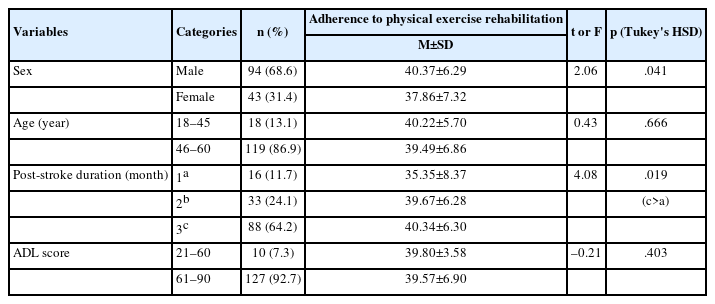
This study aimed to identify key predictive factors influencing adherence to physical exercise rehabilitation among adults during the first three months following a first-onset ischemic stroke in China. Methods: A cross-sectional descriptive study was conducted among 137 adults who attended clinical follow-up appointments within the first three months after experiencing a first-onset ischemic stroke. Predictors included family support, coping with role transition, depression, self-efficacy, and body image. Hierarchical multiple regression analysis was performed. Results: The mean adherence score for physical exercise rehabilitation was 39.58 (standard deviation=6.71), indicating a moderate adherence level (70.6%). In model 1, male sex (β=.20, p=.017) and post-stroke duration of 2 months (β=.31, p=.015) and 3 months (β=.39, p=.002) were significant predictors of adherence to physical exercise rehabilitation. Adding main predictors in model 2 resulted in a significant increase in explained variance (ΔR²=.418, p<.001), accounting for 51.5% of the total variance (R²=.515, adjusted R²=.484). Male sex (β=.15, p=.017), family support (β=.43, p<.001), self-efficacy (β=.26, p<.001), depression (β=–.24, p=.001), and coping with role transition (β=.16, p=.033) were significant predictors. Body image and post-stroke duration were not significant after adjustment. Conclusion: Efforts to promote adherence to physical exercise rehabilitation should prioritize family support, depressive symptoms, self-efficacy, and coping with role transition. Furthermore, body image may warrant attention when developing sex-specific intervention strategies.
  • 227 View
  • 9 Download
Purpose
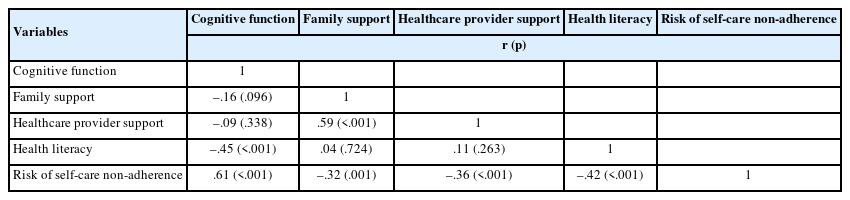
This study examined the effects of cognitive function, health literacy, and social support influence the risk of self-care non-adherence among older adults with chronic kidney disease. Methods: A cross-sectional survey was conducted using structured questionnaires. The study included 105 older adults (≥65 years) in the pre-dialysis stage, all of whom were receiving regular follow-up at a nephrology outpatient clinic in Jeonju, Jeollabuk-do, Korea. Data were collected through one-on-one interviews from April to May 2024 and analyzed using SPSS version 26.0. Predictive factors were assessed using hierarchical multiple regression analysis. Results: The risk of self-care non-adherence was significantly correlated with cognitive impairment (r=.61, p<.001), lower social support from healthcare providers (r=–.36, p<.001), and reduced health literacy (r=–.42, p<.001). Multiple regression analysis indicated that decreased physical activity (β=.25, p=.002), greater cognitive impairment (β=.29, p<.001), and lower support from healthcare providers (β=–.26, p=.008) were significant predictors of increased risk of self-care non-adherence. The model explained 46% of the variance in the risk of self-care non-adherence. In contrast, family support and health literacy were not significant predictors. Conclusion: To reduce the risk of self-care non-adherence in older adults with chronic kidney disease, routine cognitive screening and tailored education for those with cognitive impairment should be implemented in outpatient care. Promoting physical activity and strengthening support from healthcare providers are also key strategies to improve adherence in this population.
  • 1,381 View
  • 35 Download
Impact of Stigma, Social Support, and Resilience on Post-traumatic Growth among Patients with Stroke: A Cross-Sectional Study
Ga-Eul Park, Heekyung Chang
Korean J Adult Nurs 2025;37(1):13-24.   Published online February 28, 2025
DOI: https://doi.org/10.7475/kjan.2025.37.1.13
Purpose
The aim of this study was to identify the effects of stigma, social support, and resilience on post-traumatic growth in patients with stroke and to provide foundational data for developing nursing interventions that can effectively promote post-traumatic growth in this population.
Methods
This cross-sectional study employed a questionnaire-based survey. The participants were 150 patients who attended the neurology outpatient clinic three months after a stroke diagnosis. Data were collected between February and April 2024 using a structured self-report questionnaire. Analyses included descriptive statistics, reliability analysis, inferential statistics(independent t-test, one-way ANOVA, and Scheffé's test), and hierarchical multiple regression using SPSS/WIN 27.0.
Results
The mean post-traumatic growth score was 2.52±1.05 out of 5. Significant factors affecting post-traumatic growth were age, education, religion, the presence of a housemate, income, time since stroke onset, stroke type, and stroke recurrence. Post-traumatic growth was positively correlated with social support (r=.44, p<.001) and resilience (r=.53, p<.001), but not significantly correlated with stigma. Regression analysis identified resilience (β=.37, p<.001), religion (β=.29, p<.001), and stroke type (β=.23, p=.033) as significant predictors, explaining 44.2% of the variance in post-traumatic growth (F=9.45, p<.001).
Conclusion
Developing and implementing nursing interventions to increase resilience may be crucial for promoting post-traumatic growth in patients with stroke. Further research is needed to design and evaluate these interventions.
  • 1,793 View
  • 59 Download
  • 0 Scopus
Factors Influencing Resilience in Patients with Multiple Myeloma: A Cross-Sectional Study
Hae-Lyeon Jeon, Hye-Ah Yeom
Korean J Adult Nurs 2024;36(1):41-51.   Published online February 29, 2024
DOI: https://doi.org/10.7475/kjan.2024.36.1.41
Purpose
The purpose of this study was to investigate the level of resilience in multiple myeloma patients and to identify the impact of symptom experience, cancer coping, and social support on resilience. Methods: Data were collected from January 2022 to May 2022 using self-report structured questionnaires administered to 162 outpatients who were undergoing chemotherapy or follow-up care after multiple myeloma treatment. The measured variables included symptom experience, cancer coping, social support, and resilience. The collected data were analyzed using SPSS/WIN 25 for descriptive statistics, the independent t-test, one-way analysis of variance, the Scheffé test, Pearson correlation coefficients, and hierarchical regression analysis. Results: The mean resilience score of the participants was 66 out of 100 points. The levels of resilience were significantly higher in patients who had a job, recognized the importance of religion, and had a good economic status. Significantly higher levels of resilience were also observed in patients with lower physical performance status, fewer symptom experiences, more positive cancer coping, and higher support from healthcare staff. Conclusion: Monitoring the symptom experience and physical performance ability of patients with multiple myeloma is important for enhancing their resilience. Positive coping strategies need to be developed and additional support from nurses should be provided to strengthen the personal resilience of patients with multiple myeloma.
  • 832 View
  • 32 Download
  • 0 Scopus
Quality of Life in Middle-aged Men with Prostatic hyperplasia: A Structural Equation Model
Hee Nam Moon, Seung Hee Yang
Korean J Adult Nurs 2023;35(4):327-339.   Published online November 30, 2023
DOI: https://doi.org/10.7475/kjan.2023.35.4.327
Purpose
This study employed structural equation modeling to verify the suitability and causality of a hypothetical model constructed based on Wilson and Cleary's health-related quality of life model. The aim was to explain and identify the factors that influence quality of life in middle-aged men with prostatic hyperplasia.
Methods
The study included 217 middle-aged men diagnosed with prostatic hyperplasia between February and March 2022 at the urology department of a general hospital in UJB city. The measurement tools used included biological characteristics, International Prostate Symptom Scores, functional health, general health perceptions, social support, and quality of life. The data collected were analyzed using the SPSS 25.0 and AMOS 25.0 programs.
Results
The final model revealed that the variables with the highest explanatory power for quality of life in middle-aged men with prostatic hyperplasia were general health perceptions, followed by the International Prostate Symptom Score, functional health, and prostate size. The explanatory power of the variables for quality of life in middle-aged men with prostatic hyperplasia was 89.7%.
Conclusion
The model used in this study was found to be suitable for assessing quality of life in middle-aged men with prostatic hyperplasia. Based on the study's findings, it is deemed necessary to foster competencies for managing the disease through the development of educational programs, nursing interventions, and countermeasures. These should be based on general health perceptions, symptoms, and functional health, with an accurate knowledge of the characteristics of prostatic hyperplasia, as per Wilson and Cleary (1995)'s health-related quality of life theory.
  • 815 View
  • 16 Download
  • 0 Scopus
Purpose
This study aimed to determine the impact of health literacy, self-efficacy, and social support on the Health-Related Quality of Life (HRQoL) of Korean patients with Acute Coronary Syndrome (ACS) after Percutaneous Coronary Intervention (PCI).
Methods
A cross-sectional design was used, and a total of 189 participants were enrolled. Data were collected using self-reported questionnaires and patient medical records between September and November of 2021. Health literacy, self-efficacy, social support, and HRQoL were measured. The HRQoL was measured using the 12-item Short Form Survey, which included Physical Component Summary (PCS) and Mental Component Summary (MCS). Data were analyzed using hierarchical multiple regression with SPSS/WIN 26.0 program.
Results
The findings revealed statistically significant differences in the PCS according to gender, presence of hypertension, exercise, and sleep state. Furthermore, there were statistically significant differences in the MCS according to disease period and stress management. Hierarchical multiple regression analysis showed that higher social support was a significant factor of better PCS (p<.005). Higher health literacy, self-efficacy, and social support were significant factors of better MCS (p<.005).
Conclusion
Nurses should play a key role in providing social support to ACS patients, particularly to female patients and patients with hypertension and poor sleep state and no regular exercise for better PCS. Also, nurses should think about how to promote health literacy, self-efficacy, and social support for better MCS, particularly in ACS patients who had undergone PCI, had longer diagnosis periods, and had no stress management.

Citations

Citations to this article as recorded by  
  • Influence of self-efficacy in health management and resilience on treatment compliance in Korean patients undergoing percutaneous coronary intervention: a descriptive survey study
    Mi-Ra Jung, Eun Jeong, Kyung Sim Lee, Jang Hyun Cho
    Journal of Korean Biological Nursing Science.2025; 27(2): 266.     CrossRef
  • Factors influencing disease-related knowledge and health empowerment on health behavior compliance among patients after percutaneous coronary intervention in Korea: a cross-sectional study
    Hyeon-Jung Lee, Insook Lee
    Journal of Acute Care Surgery.2025; 15(2): 49.     CrossRef
  • Mediating Effects of Self-Efficacy and Social Support on the Relationship Between eHealth Literacy and Self-Care Competency in Patients Undergoing Percutaneous Coronary Interventions: A Cross-Sectional Study
    Eunhee Jo, Su-Jin Lee, Sun Hee Han
    Journal of Korean Academy of Fundamentals of Nursing.2023; 30(3): 325.     CrossRef
  • 1,101 View
  • 61 Download
  • 3 Crossref
  • 1 Scopus
Factors related to Bowel Cleanliness of Colonoscopy Examinees
Yohan Lee, Haejung Lee
Korean J Adult Nurs 2021;33(6):545-555.   Published online December 31, 2021
DOI: https://doi.org/10.7475/kjan.2021.33.6.545
Purpose
This study identified factors related to bowel cleanliness of colonoscopy examinees.
Methods
From December 2, 2020 to January 21, 2021, we surveyed 152 participants who underwent colonoscopy at a university hospital at B City. The questionnaires included participants characteristics, social cognitive determinants (knowledge on bowel preparation, severity and susceptibility for colon cancer as perceived threat, self-efficacy, and social support), and compliance with bowel preparation. For data analysis, SPSS/WIN 21.0 and AMOS 22.0 statistical programs were used. Descriptive statistics, an independent t-test, one way ANOVA, Pearson correlation coefficient, and path analysis were utilized.
Results
Participants’ knowledge level on bowel preparation was 8.49±1.57; severity, 18.49±4.43; susceptibility, 12.55±4.10; self-efficacy, 41.92±9.28; social support, 24.90±4.84; compliance with bowel preparation, 9.26±1.81; and degree of bowel cleanliness, 6.05±1.71. Factors influencing the compliance with bowel preparation included self-efficacy (β=.27, p=.007), knowledge on bowel preparation (β=.23, p=.005), marital status (β=.19, p=.048), social support (β=.17, p=.030), and age (β=-.16, p=.007). The factor directly affecting bowel cleanliness was compliance with bowel preparation (β=.17, p=.043). Indirectly affecting factors were self-efficacy (β=.05 p=.021), knowledge on bowel preparation (β=.04, p=.022), social support (β=.03, p=.026), marital status (β=.03, p=.034), and age (β=-.03, p=.018).
Conclusion
Bowel cleanliness of colonoscopy examinees can be improved by enhancing compliance with bowel preparation. Future studies should examine the effects of strategies that concern self-efficacy, knowledge on bowel preparation, social support, marital status and age on compliance with bowel preparation.
  • 695 View
  • 19 Download
  • 0 Scopus
Effect of Self-Regulation and Social Support Intervention on the Life Quality in Patients with Post-Stroke Urinary Incontinence
Heltty Heltty, Ratna Sitorus, Nury Nusdwinuringtyas, Evi Martha
Korean J Adult Nurs 2021;33(4):399-405.   Published online August 31, 2021
DOI: https://doi.org/10.7475/kjan.2021.33.4.399

Citations

Citations to this article as recorded by  
  • Social needs and resilience of post-stroke patients: an exploratory case study
    Heltty Heltty, Rahmawati Rahmawati, Taufik Taufik
    Healthcare in Low-resource Settings.2025;[Epub]     CrossRef
  • Self-efficacy, social support, and their relationship to treatment adherence in pulmonary tuberculosis: A cross-sectional study
    Heltty Heltty, Siti Masriwati, Mimi Yati, La Ode Saltar, Hasniah Dina
    The Journal of Palembang Nursing Studies.2025; 4(2): 81.     CrossRef
  • Impact of applying the theory of human becoming and self-care deficit theory of nursing on insomnia in after stroke urinary incontinence patients
    Heltty Heltty, Ratna Sitorus, Haryanto Haryanto
    Frontiers of Nursing.2024; 11(3): 259.     CrossRef
  • Booster dose of COVID-19 vaccination: Perception among elderly
    Heltty Heltty, Basso Palingrungi, Apriyanti Apriyanti
    The Journal of Palembang Nursing Studies.2023; 2(1): 20.     CrossRef
  • Patient, Family, and Peer Engagement in Nursing Care as an Effort to Improve the Functional Independence of Post-stroke Urinary Incontinence Patients: A Cross-Sectional Study
    Heltty Heltty
    Cureus.2022;[Epub]     CrossRef
  • 1,056 View
  • 8 Download
  • 5 Crossref
  • 1 Scopus
Factors Affecting Health-Promoting Behaviors among Vietnamese Students in Korea
Tran Thi Quynh Anh, Minkyung Kang, Nahyun Kim
Korean J Adult Nurs 2021;33(4):349-359.   Published online August 31, 2021
DOI: https://doi.org/10.7475/kjan.2021.33.4.349
Purpose
This study aimed to examine health-promoting behaviors among Vietnamese students in Korea and identify the factors affecting these behaviors. Methods: A survey using self-administered questionnaires was employed. Data were collected between October 2020 and May 2021 from 260 Vietnamese students whose stay in Korea has been for longer than six months and who agreed to participate in the study. Variables included health-promoting behaviors (physical activity, nutrition, stress management, and health risk behavior), self-esteem, acculturative stress, and social support. A multiple regression analysis was performed to assess the factors that might influence health-promoting behaviors. Results: Of the total participants, 56.9% were women, and the mean age was 24.60±2.58 years. The mean score of the participants on total health-promoting behaviors was 2.64±0.36, on self-esteem 2.96±0.35, on acculturative stress 2.39±0.15, and on social support 2.53±0.24. Self-esteem, acculturative stress, social support, length of stay in Korea, and education level were found to affect healthpromoting behaviors, and these variables explained 76.2% of the variance. Conclusion: There is a need to develop intervention strategies for promoting self-esteem and social support programs and coping strategies for managing acculturative stress to increase health-promoting behaviors among Vietnamese students.
  • 1,370 View
  • 11 Download
  • 0 Scopus
Factors Associated with Medication Adherence among the Elderly with Chronic Diseases
Sook Hee Kang, Eun Ko
Korean J Adult Nurs 2021;33(2):189-201.   Published online April 30, 2021
DOI: https://doi.org/10.7475/kjan.2021.33.2.189
Purpose
The study sought to investigate the relationships between beliefs about medications, self-efficacy of medication use, social support and medication adherence, and the general factors associated with medication adherence among the elderly living with chronic disease. Methods: This study took the form of a descriptive survey involving 222 elderly outpatients - aged 65 years or older - who visited S medical center, located in S city. Data were collected through self-report questionnaires from July to August 2019. Data analysis was conducted using descriptive statistics, an independent t-test, a one-way ANOVA, Pearson's correlation coefficient, and a hierarchical multiple regression via the SPSS/WIN 25.0 program. Results: The mean score for medication adherence was 61.80±10.19 (range 16~80). Participants' medication adherence positively correlated with beliefs about medications (r=.17, p=.012), self-efficacy for medication use (r=.31, p<.001) and social support (r=.20, p=.003). Frequency of alcohol consumption (β=-.20, p=.001), burden level of medical costs (β=-.18, p=.012), experience of side-effects (β=-.21, p=.001), medication-taking education (β=.17, p=.008), beliefs about medication (β=.13, p=.038), and self-efficacy for medication use (β=.19, p=.004) explained for 24.9% of medication adherence (F=6.23, p<.001). Conclusion: It is necessary to consider the beliefs about medication and self-efficacy for medication use when developing educational programs aimed at improving medication adherence among the elderly living with chronic diseases.

Citations

Citations to this article as recorded by  
  • Factors associated with health literacy in older adults aged 65 and over: a secondary data analysis of the 2021 Korea Health Panel applying the Andersen behavioural model
    Yeong Eun Kim, Ol Han, Chang Sun Moon
    BMJ Open.2025; 15(3): e085696.     CrossRef
  • Factors Influencing Medication Adherence among Adult Patients with Hypertension
    Soo Kyung Lee, Myung Sun Hyun
    The Korean Journal of Rehabilitation Nursing.2025; 28(1): 1.     CrossRef
  • Factors associated with medication adherence among older adults with multimorbidity: A culture perspective
    Eunhwa Lee, MoonKi Choi
    Geriatric Nursing.2024; 55: 297.     CrossRef
  • Factors Influencing the Medication Adherence in Patients with Pulmonary Tuberculosis in the COVID-19 Pandemic
    Bongsil Lim, Min Young Kim
    The Korean Journal of Rehabilitation Nursing.2023; 26(2): 87.     CrossRef
  • Development and effectiveness of an integrated medication management program centered on senior welfare centers for older adults with hypertension: A cross-sectional study
    Heuijeong Moon, Dukyoo Jung
    Journal of Korean Gerontological Nursing.2023; 25(3): 297.     CrossRef
  • Relationships between health literacy, self-efficacy, and medication adherence in older people with polypharmacy: A cross-sectional study
    Jee Young Cho, Sun Ju Chang
    Journal of Korean Gerontological Nursing.2023; 25(4): 357.     CrossRef
  • Effects of Changes in Multiple Chronic Conditions on Medical Costs among Older Adults in South Korea
    Soojin Park, Jin Young Nam
    Healthcare.2022; 10(4): 742.     CrossRef
  • 1,634 View
  • 85 Download
  • 7 Crossref
  • 5 Scopus
Purpose
The purpose of this study was to investigate family support and medical staff support and their mediating effects in the relationship between self-efficacy and resilience in patients with colorectal cancer with stoma. Methods: The participants were 170 patients with colorectal cancer who were hospitalized or receiving treatment for colorectal anus surgery in general hospitals located in B, D, and I cities. Data were collected from July 1 to October 25, 2019 through a structured questionnaire. Data analysis was conducted using descriptive statistics, Pearson's correlation coefficient, multiple linear regression analysis, and the bootstrapping method with SPSS/WIN 25.0 and the PROCESS macro program. Results: The mean score for resilience was 2.70±0.62 (range 0~4). Resilience was significantly associated with self-efficacy (r=.59, p<.001), family support (r=.38, p<.001), and medical staff support (r=.37, p<.001). Using Baron and Kenny's approach and PROCESS macro model 4, resilience was found to be affected by self-efficacy (β=.53, p<.001). Further, family support (β=.25, p<.001) and medical staff support (β=.39, p<.001) were affected by self-efficacy. The partial mediating effects of family support (β=.25, p<.001, 95% confidence interval 0.01~0.12) and medical staff support(β=.15, p=.022, 95% confidence interval 0.01~0.16) in the impact of self-efficacy on resilience were confirmed. Conclusion: The impact of self-efficacy on resilience was mediated by family support and medical staff support in patients with colorectal cancer with stoma. The results suggest that family and medical staff support need to be considered in developing nursing interventions to improve self-efficacy and resilience in these patients.

Citations

Citations to this article as recorded by  
  • Influences of Fatigue, Uncertainty, and Resilience on Self-Care Behaviors in Cancer Patients Undergoing Chemotherapy
    Sa-Rang Kim, Gie-Ok Noh
    Asian Oncology Nursing.2025; 25(2): 110.     CrossRef
  • 863 View
  • 34 Download
  • 1 Crossref
  • 0 Scopus
Influence of Perceived Health, Anxiety, Depression, and Social Support on Quality of Life in Patients with Meniere Disease
Young Mi Ryu, Woo Joung Joung
Korean J Adult Nurs 2020;32(4):399-408.   Published online August 31, 2020
DOI: https://doi.org/10.7475/kjan.2020.32.4.399
Purpose
This study investigated factors affecting Quality of Life (QoL) of patients with Meniere disease.
Methods
A descriptive study design was used. Data were collected from March to April 2020 through an online survey of 130 participants diagnosed with probable or definite Meniere disease from a community of online-based patients. The data were analyzed using the independent t-test, Pearson’s correlation coefficient, and multiple linear regression analysis.
Results
Perceived health, anxiety, depression, family support, and health care provider support significantly correlated with QoL. As a result of the multiple regression analysis, family support, perceived health, anxiety, and ear fullness were identified as factors influencing QoL, and these factors accounted for 65.0% of the variance in QoL. Of these variables, family support was the factor affecting the participants’ QoL the most (β=.45).
Conclusion
These results indicate a need for continuous efforts and strategies to increase family support to enhance the QoL of this population. In addition, to increase perceived health (which was the second most influencing factor on the QoL of this population), improved health care provider support (which showed a positive correlation with perceived health) is also warranted. Therefore, nursing interventions aiming to increase social support should be developed and implemented.
  • 472 View
  • 13 Download
  • 0 Scopus
Effects of Social Support, Family Support and Repulsion Related Nursing Home Use on the Well-Dying of Elderly
Young Ju Oh, Kyeong In Cha, Young Hee Jeon
Korean J Adult Nurs 2020;32(3):235-247.   Published online June 30, 2020
DOI: https://doi.org/10.7475/kjan.2020.32.3.235
Purpose
This study aimed to explore the level of well-dying in the elderly and identify the effects of social support, family support, and repulsion related nursing home on that.
Methods
The sample for this cross-sectional study consisted of 110 community-dwelling elderly and 103 nursing home residents. Data were collected using a structured questionnaire from August to October 2019. SPSS/WIN 25.0 program was used to conduct statistical analyses, including descriptive statistics, an independent t-test, a one-way analysis of variance, and stepwise multiple linear regression.
Results
The mean score for well-dying was 2.63±0.28 (range 1~4). Well-dying had a statistically significant relationship with religion (t=5.56, p<.001), household income (F=14.04, p<.001) and perceived health status (F=44.59, p<.001). Furthermore, social support (r=.71, p<.001), family support (r=.42, p<.001), and repulsion related nursing home (r=-.56, p<.001) significantly correlated with well-dying. Stepwise multiple linear regression demonstrated that social support, repulsion related nursing home, and having a religion explained 62.0% of the variance in well-dying.
Conclusion
Social support was found to have the largest influence on well-dying, followed by repulsion related nursing home and religion. The results highlight the need to develop a detailed nursing intervention that considers these factors to promote well-dying in the elderly.

Citations

Citations to this article as recorded by  
  • Predictors of preparedness for well‐dying among middle‐aged and older adults
    Sun‐Ae Kim, Jae‐Sun An, Kyung‐Hyun Suh
    Psychogeriatrics.2024; 24(6): 1335.     CrossRef
  • Factors Affecting the Well-dying Awareness of Lung Cancer Survivors
    Dong Sim Choi, Gie Ok Noh
    Asian Oncology Nursing.2023; 23(4): 225.     CrossRef
  • The effects of ego integrity and readiness for death on the preferences of care near the end-of-life of hospitalized older adults in long-term care hospitals: A cross-sectional correlation study
    Jangmi Baek, Jun-Ah Song
    Journal of Korean Gerontological Nursing.2023; 25(2): 185.     CrossRef
  • Understanding Cultural Beliefs of a Good Death by Older People in South Korea: An Integrative Review of the Literature
    Kyoungsun Yun, Minjeong Jo, Yunji Lee
    Journal of Hospice & Palliative Nursing.2022; 24(6): E265.     CrossRef
  • Effect of Life Satisfaction on Depression among Childless Married Couples: A Cross-Sectional Study
    Ju-Young Ha, Hyo-Jin Park
    International Journal of Environmental Research and Public Health.2022; 19(4): 2055.     CrossRef
  • A qualitative study of the first batch of medical assistance team’s first-hand experience in supporting the nursing homes in Wuhan against COVID-19
    Xiu-Fen Yang, Meng-qi Li, Lu-lu Liao, Hui Feng, Si Zhao, Shuang Wu, Ping Yin, Giovanni Ottoboni
    PLOS ONE.2021; 16(4): e0249656.     CrossRef
  • Subjective Perception of Long-Term Care Facilities in Home-Dwelling Older Adults: A Q Methodological Study
    Eun Ho Ha
    Korean Journal of Adult Nursing.2021; 33(3): 269.     CrossRef
  • 842 View
  • 21 Download
  • 7 Crossref
  • 6 Scopus
Structural Equation Modeling of Quality of Life in Patients With Uterine Cancer
So Yeun Jun, Il Sun Ko
Korean J Adult Nurs 2020;32(2):109-123.   Published online April 30, 2020
DOI: https://doi.org/10.7475/kjan.2020.32.2.109
Purpose
This study was conducted to determine a hypothetical model for the factors affecting uterine cancer patients’ health-related quality of life.
Methods
Data were collected from 409 patients with cervical cancer or endometrial cancer, between March 16 and May 15, 2015, using a self-administered questionnaire . The data were analyzed using SPSS v18 and AMOS v21.
Results
The model supported 14 of the 19 hypotheses for all participants. The results indicated that resilience, marital intimacy, social support, and perceived health status directly affected participants’ quality of life, while sexual function indirectly affected participants’ quality of life. Of these variables, perceived health status had the strongest direct effect on participants’ quality of life. Social support and sexual function were found to directly affect perceived health status. Somatic symptoms were found to directly affect sexual function, and resilience and marital intimacy in turn were found to directly affect somatic symptoms.
Conclusion
These results suggest that management strategies to enhance uterine cancer patients’ quality of life should address patients’ perceived health status, social support, sexual function, and marital intimacy.

Citations

Citations to this article as recorded by  
  • Self-disclosure in Adult Patients With Cancer
    Hyungran Lee, Younhee Jeong
    Cancer Nursing.2025; 48(4): 289.     CrossRef
  • Factors Influencing Health-Related Quality of Life in Patients With Atrial Fibrillation
    Hyeon-Ok Lee, Ji-Yeong Seo
    Journal of Cardiovascular Nursing.2025;[Epub]     CrossRef
  • Influencing factors on quality of life in women undergoing cancer treatment: a cross-sectional study
    Hyun Jin Jung, Yu Jin Hong, Seo Young Hong, Ju-Hee Nho
    Women's Health Nursing.2025; 31(3): 192.     CrossRef
  • Health-related quality of life in female patients with reumatoid arthritis: a structural equation model
    Bukyung Kim, Mi-Hae Sung
    Korean Journal of Women Health Nursing.2023; 29(2): 91.     CrossRef
  • Quality of Life in Middle-aged Men with Prostatic hyperplasia: A Structural Equation Model
    Hee Nam Moon, Seung Hee Yang
    Korean Journal of Adult Nursing.2023; 35(4): 327.     CrossRef
  • Factors influencing quality of life in caregivers of adolescents with developmental disabilities
    Joung Woo Joung
    Osong Public Health and Research Perspectives.2022; 13(4): 298.     CrossRef
  • Structure Equation Modeling for Resilience in Patients with Breast Cancer
    Dong Rim Hyun, So Yeun Jun, Chang Wan Jun, Sue Kyung Sohn
    Korean Journal of Adult Nursing.2021; 33(2): 87.     CrossRef
  • Influence of Perceived Health, Anxiety, Depression, and Social Support on Quality of Life in Patients with Meniere Disease
    Young Mi Ryu, Woo Joung Joung
    Korean Journal of Adult Nursing.2020; 32(4): 399.     CrossRef
  • 944 View
  • 17 Download
  • 8 Crossref
  • 5 Scopus
PURPOSE
To identify the factors influencing Quality of Life (QoL) in rectal cancer patients and to examine whether perceived social support mediates the relationship between defecation function and QoL.
METHODS
Using self-report questionnaires, a descriptive survey was conducted with 131 rectal cancer patients who underwent anal sphincter-saving resection, in a large medical center in Korea. Data were collected between September and November, 2014, using research instruments validated in the Korean language. The data were analyzed using SPSS/WIN 21.0 and AMOS 21.0.
RESULTS
The mean age and post-surgical follow-up period of the participants were 59.0±10.2 years and 15.9±9.8 months, respectively. Multiple linear regression analysis revealed that, after adjusting for age and gender, defecation function, perceived social support, and employment status predicted QoL. Path analysis showed that perceived social support partially mediated the relationship between defecation function and QoL with a significant indirect effect.
CONCLUSION
These results suggest that a positive perception of social support from family and healthcare providers is necessary to improve the QoL of patients experiencing defecation dysfunction after rectal cancer surgery. To this end, periodic counseling and education from outpatient healthcare providers, during the postoperative follow-up period, could encourage patients to perceive higher social support.

Citations

Citations to this article as recorded by  
  • Structural equation modeling of symptom clusters and health-related quality of life among patients with advanced colorectal cancer receiving chemotherapy in Bangkok, Thailand
    Savitree Suratako, Yaowarat Matchim, Mary Quinn Griffin
    Belitung Nursing Journal.2025; 11(4): 468.     CrossRef
  • A causal model of health-related quality of life in colorectal cancer patients post-surgery
    Thi Hong Hanh Tran, Sureeporn Thanasilp, Noppamat Pudtong
    European Journal of Oncology Nursing.2024; 72: 102691.     CrossRef
  • The Relationships among Social Support, Bowel Function Symptoms and Uncertainty in Rectal Cancer Patients
    Kyungmi Lee, Semi Lim
    Journal of Korean Academy of Fundamentals of Nursing.2021; 28(4): 421.     CrossRef
  • 507 View
  • 4 Download
  • 3 Crossref
  • 2 Scopus
Mediating Effects of Depression and Social Supports between Type D Personality and Quality of Life on Hemodialysis Patients
Geum Soon Kwon, Kyung Hee Lim
Korean J Adult Nurs 2019;31(4):439-448.   Published online August 31, 2019
DOI: https://doi.org/10.7475/kjan.2019.31.4.439
PURPOSE
The purpose of this study was to explore influence of Type D personality of hemodialysis patients on quality of life and to elucidate mediation effects of depression and social supports between Type D personality and quality of life.
METHODS
The subjects were 126 patients who were receiving hemodialysis treatments at four dialysis clinics in Pusan and Daegu metropolitans. Data were collected from January 22th to February 28th, 2018 and analyzed with descriptive statistics, χ2 test, independent t-test, Pearson's correlation coefficient and three-step mediated regression analysis using SPSS/WIN 22.0. Significances of mediation effects were examined using bootstrapping method based on SPSS Process Macro program.
RESULTS
The prevalence of Type D personality in hemodialysis patients were 42.9%. Type D personality in hemodialysis patients had significant effects on quality of life, showing explanatory power of 12%. Depression showed complete mediating effects and also showed 42% of substantiating probability, and social supports showed partial mediating effects and showed 19% of substantiating probability.
CONCLUSION
Summing up the result of research until now, in order to improve the quality of life for Type D personality hemodialysis patient, it is necessary to develop strategies not only to relieve depression using early evaluation on depression status, consulting therapy, cognition behavior mediation and so on, but also to enhance social supports like participating in voluntary meetings and building up social network to expand relationship with close people.

Citations

Citations to this article as recorded by  
  • The impact of illness acceptance, depression, and social support on health-related quality of life in older adults on hemodialysis: A descriptive study
    Eunha Lee, Jungmin Kim
    Journal of Korean Gerontological Nursing.2025; 27(1): 106.     CrossRef
  • Relationship Between Illness Adaptation and Type D Personality in Hemodialysis Patients
    Berna Akay, Canan Bozkurt, Nurdan Sahin
    Hemodialysis International.2025; 29(4): 655.     CrossRef
  • Relationships among Type-D Personality, Fatigue, and Quality of Life in Infertile Women
    Ju-Hee Nho, Eun Jin Kim
    Asian Nursing Research.2022; 16(4): 208.     CrossRef
  • Mediating Effects of Self-Care Competence on the Relationship between Uncertainty and Quality of Life in Hemodialysis Patients
    Yoon Jung Chae, Jun Hee Ahn, Kyung Pyo Kang, Eunhee Jo
    Korean Journal of Adult Nursing.2020; 32(1): 67.     CrossRef
  • 462 View
  • 8 Download
  • 4 Crossref
  • 5 Scopus
Factors Influencing Functional Health of Patients with Chronic Insomnia based on Theory of Unpleasant Symptoms
Eun Kyoung Han, Sunah Kim, In Young Yoon
Korean J Adult Nurs 2019;31(2):165-175.   Published online April 30, 2019
DOI: https://doi.org/10.7475/kjan.2019.31.2.165
PURPOSE
The purpose of this study was to identify factors influencing functional health of patients with chronic insomnia based on the Theory of Unpleasant Symptoms (TOUS).
METHODS
Data were collected from 184 patients with chronic insomnia who had been treated at the sleep center in hospital in South Korea. Data were collected from 23 December 2014 to 18 May 2015 through self-reported questionnaires from pre-sleep arousal, worry, perceived stress, social support, insomnia symptom, and functional health. Data were analyzes using an independent t-test, one-way ANOVA, Pearson's correlation coefficient, and hierarchical multiple regression analysis with the SPSS/WIN 21.0 program.
RESULTS
The regression model had an adjusted R2 of 50%, which indicated that pre-sleep arousal, social support, perceived stress, education, and insomnia symptom were significant predictors of functional health in patients with insomnia.
CONCLUSION
In order to improve the functional health of patient's with chronic insomnia, clinical nurses should develop and provide nursing interventions that improve social support and reduce pre-sleep arousal, stress, and insomnia symptoms.

Citations

Citations to this article as recorded by  
  • Factors influencing the health-related quality of life in Korean menopausal women: a cross-sectional study based on the theory of unpleasant symptoms
    Ji-Hyun Kang, Moon-Jeong Kim
    Korean Journal of Women Health Nursing.2022; 28(2): 100.     CrossRef
  • Nomophobia in Lebanon: Scale validation and association with psychological aspects
    Youssef Farchakh, Rabih Hallit, Marwan Akel, Clarissa Chalhoub, Maria Hachem, Souheil Hallit, Sahar Obeid, Yuka Kotozaki
    PLOS ONE.2021; 16(4): e0249890.     CrossRef
  • Influence of Sleep Quality, Coffee Consumption, and Perceived Stress on the Incidence of Thyroid Cancer in Healthy Korean Adults
    Myoyoun Kim, Seon Young Hwang
    Korean Journal of Adult Nursing.2021; 33(2): 125.     CrossRef
  • 867 View
  • 19 Download
  • 3 Crossref
  • 4 Scopus

Review Article

Factors related to Family Support for Hemodialysis Patients: A Systematic Review and Meta-analysis
Young Ran Chae, Sun Hee Lee, Young Mi Jo, Hyo Young Kang
Korean J Adult Nurs 2019;31(2):123-135.   Published online April 30, 2019
DOI: https://doi.org/10.7475/kjan.2019.31.2.123
PURPOSE
This study was conducted to explore the factors related to family support for hemodialysis patients.
METHODS
Preferred Reporting Items Systematic Reviews and Meta-Analysis (PRISMA) flow diagram was used to select 18 studies in Korea for systematic review and meta-analysis. The Effect Sizes of correlation coefficients (ESr) were determined through Fisher's Z transformation.
RESULTS
The systematic review revealed 31 factors that affect family support(including socio-economic and disease-specific factors) and 23 factors that are influenced by family support (including socio-psychological factors and physiological indicators). In the meta-analysis, 18 factors (10 socio-economic and disease-specific factors and 8 psychological factors and physiological indicators) were used. The socio-economic factors that significantly affected family support were type of medical insurance, perceived economic state, marital status, primary care giver, living together, family monthly income, education level, and job state. Disease-specific factors such as frequency of dialysis per week did not have a significant impact on family support. Family support had a positive influence over patients' self efficacy (ESr=.56), quality of life (ESr=.48), self-esteem(ESr=.42), fatigue (ESr=−.32), sick role behavior (ESr=.32), and depression (ESr=−.24).
CONCLUSION
This study showed that economic status and family characteristics of hemodialysis patients in Korea affect the level of family support that patients receive, and family support promotes patients' positive psychology and sick role behavior. The results of this study provide useful information in developing family support intervention programs for hemodialysis patients.

Citations

Citations to this article as recorded by  
  • The influence of family health on self-efficacy in patients with chronic diseases: the mediating role of perceived social support and the moderating role of health literacy
    Zhen-ni Luo, Kun Li, An-qi Chen, Yu-chi Qiu, Xi-xi Yang, Zhi-wen Lin, Jing-han Liu, Yi-bo Wu, Jiang-yun Chen
    BMC Public Health.2024;[Epub]     CrossRef
  • Variables Associated with Self-Compassion among Nurses: A Systematic Review and Meta-Analysis
    Bokeung Peun, Heeseung Choi
    STRESS.2022; 30(4): 221.     CrossRef
  • Healthy life of Korean patients with chronic kidney failure undergoing hemodialysis: A situation-specific nursing theory
    Jinhyang Yang, Myung-Ok Cho, Haeok Lee
    Applied Nursing Research.2022; 65: 151584.     CrossRef
  • Mediating effect of Maternal and Paternal Family Relationship between Neuroticism and Postpartum Depression: The Actor-Partner Interdependence Mediation Model
    Hye Gyeong Seo, Suk-Sun Kim
    Journal of Korean Academy of psychiatric and Mental Health Nursing.2021; 30(4): 400.     CrossRef
  • Effect of Hemodialysis Adequacy on Quality of Life in Older adults with Chronic Kidney Disease
    Virgianti Nur Faridah, Muhamad Syukri Ghozali, Arifal Aris, Siti Sholikhah, Masunatul Ubudiyah
    Indonesian Journal of Community Health Nursing.2021; 6(1): 28.     CrossRef
  • Quality of Life and Social Support of People on Peritoneal Dialysis: Mixed Methods Research
    Miquel Sitjar-Suñer, Rosa Suñer-Soler, Afra Masià-Plana, Emilia Chirveches-Pérez, Carme Bertran-Noguer, Concepció Fuentes-Pumarola
    International Journal of Environmental Research and Public Health.2020; 17(12): 4240.     CrossRef
  • Relationships between depression, family function, physical symptoms, and illness uncertainty in female patients with chronic kidney disease
    Oksoo Kim, Eun Yi Yeom, Hae Ok Jeon
    Nursing & Health Sciences.2020; 22(3): 548.     CrossRef
  • Factors Influencing Self-Care Behaviors of Renal Dialysis Patients
    Yoonjung Kim, Sanggeon Park
    STRESS.2019; 27(4): 320.     CrossRef
  • 762 View
  • 7 Download
  • 8 Crossref
  • 5 Scopus
Original Articles
Factors Influencing Psychosocial Adjustment in Hemodialysis Patients
Kang Sun Lee, Hye Young Kim, Myung Ha Lee
Korean J Adult Nurs 2019;31(1):38-49.   Published online February 28, 2019
DOI: https://doi.org/10.7475/kjan.2019.31.1.38
PURPOSE
The purpose of this study was to identify the factors involved in psychosocial adjustment of hemodialysis patients.
METHODS
This correlational, cross-sectional study included 172 hemodialysis patients from 11 different nephrology clinics. Data was collected from May to August 2018 using a structured questionnaire including patient' characteristics, uncertainty, social support, coping, and psychosocial adjustment. Data was analyzed using descriptive statistics, independent t-tests, one-way ANOVA, Pearson's correlation coefficient, and stepwise multiple linear regression.
RESULTS
The total score for psychosocial adjustment was 406.23±44.58 out of a maximum of 700. Psychosocial adjustment had a statistically significant relationship with occupation(t=−3.88, p < .001) and albumin (t=−2.06, p=.041). Furthermore, uncertainty (r=.45, p < .001), social support (r=−.37, p < .001), and coping (r=−.31, p < .001) were significantly correlated with psychosocial adjustment. Stepwise multiple linear regression demonstrated that uncertainty, having an occupation, social support, and being women explained 35.4% of the variance in psychosocial adjustment.
CONCLUSION
Uncertainty was found to have the largest influence on psychosocial adjustment, followed by occupation, social support, and gender. It is necessary to develop a detailed intervention that considers all these factors to promote psychosocial adjustment of patients with hemodialysis. Furthermore, the importance of the psychosocial adjustment of chronic illness needs to be stressed in nursing education.

Citations

Citations to this article as recorded by  
  • Predictors of psychosocial adaptation in haemodialysis patients according to haemodialysis vintage: a quantitative study
    Ae Kyung Chang, Ah Young Kim
    Contemporary Nurse.2025; 61(4): 377.     CrossRef
  • Association Between Dyadic Coping and Psychosocial Adjustment and the Mediation Effect of Fear of Disease Progression in Patients With Malignancy and Their Caregivers: Based on the Actor-Partner Interdependence Model
    Hualong Ma, Yongyue He, Weixin Wu, Qiuyun Ye, Qinyang Wu, Ke Hu, Xiaohao Jiang, Lu Tang, Qiaohong Yang
    Cancer Nursing.2024;[Epub]     CrossRef
  • Health Literacy and Anxiety Among Hemodialysis Patients During the Coronavirus Disease Pandemic
    In Ju Yoon, Su Jung Lee
    Psychology Research and Behavior Management.2023; Volume 16: 1051.     CrossRef
  • Factors contributing to chronic obstructive pulmonary disease patients' functional performance: Structural equation modelling based on theory of unpleasant symptoms
    Hye Suk Jun, Younhee Kang
    Nursing Open.2023; 10(5): 3132.     CrossRef
  • Development and Evaluation of an Online Self-Management Program in Patients with Chronic Kidney Failure Undergoing Hemodialysis
    Jinhyang Yang
    Journal of Korean Academy of Fundamentals of Nursing.2022; 29(4): 531.     CrossRef
  • What Factors Influence on Dermatology-Related Life Quality of Psoriasis Patients in South Korea?
    So Young Park, Kon Hee Kim
    International Journal of Environmental Research and Public Health.2021; 18(7): 3624.     CrossRef
  • Factors affecting supportive needs in hemodialysis patients: A literature review
    Attieh Nikkhah, Shohreh Kolagari, Mahnaz Modanloo
    Journal of Family Medicine and Primary Care.2020; 9(4): 1844.     CrossRef
  • Validity and Reliability of a Korean Version of the Psychological Adaptation Scale for Patients on Hemodialysis
    Minju Kim, Sunae Joung
    Korean Journal of Adult Nursing.2020; 32(6): 560.     CrossRef
  • Perceptions of resilience in patients undergoing peritoneal dialysis: A Q‐methodology study
    Mi Young Chon, Eun Ja Yeun, Kyoung Hee Jung, Young‐il Jo, Kyeong Ryong Lee
    Nursing & Health Sciences.2020; 22(1): 108.     CrossRef
  • Influence of the Meaning in Life, Depression, and Social Support on the Suicidal Ideation of Old Adult Hemodialysis Patients
    Jinhee Shin, Hyebeen Sim, Eunhee Cho
    Journal of Korean Academy of Community Health Nursing.2020; 31(3): 279.     CrossRef
  • Predictors Influencing of Medication Adherence in Hemodialysis Patients
    Hana Kim, Eunha Kim
    Korean Journal of Adult Nursing.2019; 31(3): 283.     CrossRef
  • 703 View
  • 14 Download
  • 11 Crossref
  • 12 Scopus
Factors Influencing Resilience in Hospitalized Patients with Stroke
Jong Kyung Lee, Ji Yeong Yun
Korean J Adult Nurs 2018;30(4):385-393.   Published online August 31, 2018
DOI: https://doi.org/10.7475/kjan.2018.30.4.385
PURPOSE
The purpose of this study was to identify the factors influencing resilience of patients with stroke.
METHODS
A cross-sectional descriptive research design was used. The subjects of this study were 136 hospitalized patients with stroke in Dankook university hospital in Cheonan, Korea. Data were collected from August 2016 to March 2017 using a structured questionnaire including patient's characteristics, depression, uncertainty, social support, self-efficacy, and resilience. Data were analyzed using the SPSS/WIN 21.0 program for descriptive statistics, using independent t-test, one way analysis of variance, Pearson's correlation coefficient, and multiple regression.
RESULTS
Resilience had a statistically significant relationship with education (t=−2.17, p=.032), duration of diagnosis (F=4.09, p=.019), and mobility (F=4.44, p=.014). Further, depression (r=−.30, p < .001), self-efficacy (r=.44, p < .001), and social support (r=.37, p < .001) were significantly correlated with resilience. In the multiple regression analysis, self-efficacy and social support were statistically significant factors that explained 30.3% of variance of resilience in hospitalized patients with stroke. Depression and uncertainty were not found to be significant.
CONCLUSION
The results of the study indicate that factors influencing resilience are self-efficacy and social support. Therefore, nursing intervention programs for increasing the resilience should include strategies for improving self-efficacy and social support for hospitalized patients with stroke.

Citations

Citations to this article as recorded by  
  • Factors associated with resilience among patients with end-stage kidney disease receiving hemodialysis in a teaching hospital: a cross-sectional study
    Bimala Poudel, Rekha Timalsina
    BMC Nephrology.2025;[Epub]     CrossRef
  • Impact of Stigma, Social Support, and Resilience on Post-traumatic Growth among Patients with Stroke: A Cross-Sectional Study
    Ga-Eul Park, Heekyung Chang
    Korean Journal of Adult Nursing.2025; 37(1): 13.     CrossRef
  • Influencing Factors of Psychological Resilience in Stroke Patients: A Systematic Review and Meta-Analysis
    Yuxin Wang, Hongxia Xie, Hongyu Sun, Liya Ren, Hao Jiang, Meijia Chen, Chaoqun Dong
    Archives of Clinical Neuropsychology.2024; 39(5): 644.     CrossRef
  • Hospital-acquired insomnia scale: A validity and reliability study
    Bahar Çiftçi, Güzel Nur Yıldız, Özgür Yıldız
    World Journal of Psychiatry.2023; 13(3): 113.     CrossRef
  • Psychosocial Factors Affecting Post-acute Stroke Patients’ Rehabilitation Adherence
    Hye Ji Choi, Hee Kyung Chang
    The Korean Journal of Rehabilitation Nursing.2022; 25(2): 49.     CrossRef
  • The Effect of Perceived Stress, Fine Dust Risk Perception, and Resilience on Stress Response in Patients with Respiratory and Circulatory Disorders
    Jin-Hee Park, Kuem-Sun Han
    STRESS.2021; 29(1): 21.     CrossRef
  • 507 View
  • 4 Download
  • 6 Crossref
Factors associated with Health-related Quality of Life in Patients with Peripheral Arterial Disease
Da El Jang, Yeon Soo Jang, Eui Geum Oh, Young Guk Ko
Korean J Adult Nurs 2018;30(3):266-276.   Published online June 30, 2018
DOI: https://doi.org/10.7475/kjan.2018.30.3.266
PURPOSE
The purpose of this study was to examine the characteristics of Health-Related Quality of Life (HRQoL) and its influencing factors in Koreans with Peripheral Artery Disease (PAD).
METHODS
One hundred and four participants were recruited from Severance hospital in Seoul, Korea. A PAD-specific quality of life questionnaire was used to measure HRQoL. The relevant knowledge, social support, and demographic and clinical characteristics were also measured. Descriptive analysis and multiple linear regression analysis were performed.
RESULTS
The mean scores of PAD-related knowledge and social support were high, while those of the HRQoL were low. The HRQoL was significantly higher among university graduates than those who had completed only middle school, and among those with coronary artery disease. The HRQoL in patients with PAD was significantly correlated with duration of diagnosis, the Rutherford classification, rest pain, walking pain, medical staff support, and family support. It was significantly affected by walking pain, duration of diagnosis, medical staff support, and rest pain. The regression model accounted for 38.4% of the HRQoL in this study.
CONCLUSION
Pain and medical staff support might influence HRQoL among patients with PAD. Understanding the characteristics of HRQoL may be important in developing tailored management strategies to improve HRQoL among Koreans with PAD.

Citations

Citations to this article as recorded by  
  • The Relationships between Healthy Lifestyle Behaviors, Hopelessness, and Illness Acceptance Levels Diagnosed with Peripheral Artery Disease and Related Factors
    Dilara Şahan, Yakup Akyüz, Fatma Güneyi, Damla Coşar
    Annals of Vascular Surgery.2025; 115: 117.     CrossRef
  • Health Literacy and Disease Knowledge of Patients With Peripheral Arterial Disease or Abdominal Aortic Aneurysm: A Scoping Review
    Goudje L. van Leeuwen, Maria-Annette Kooijman, Richte C.L. Schuurmann, Barbara L. van Leeuwen, Barbara C. van Munster, Hanneke van der Wal-Huisman, Jean-Paul P.M. de Vries
    European Journal of Vascular and Endovascular Surgery.2024; 67(6): 935.     CrossRef
  • A Scoping Review of Measurement Tools Evaluating Awareness and Disease-Related Knowledge in Peripheral Arterial Disease Patients
    Carolina Machado de Melo Felix, Danielle Aparecida Gomes Pereira, Maureen Pakosh, Lilian Pinto da Silva, Gabriela Lima de Melo Ghisi
    Journal of Clinical Medicine.2023; 13(1): 107.     CrossRef
  • Relationship between Uncertainty and Health-related Quality of Life in Elderly Patients Undergoing Total Knee Arthroplasty: The Mediating Effects of Sense of Coherence and Social Support
    Min-Yi Song, Min-Jeong Park
    Journal of Korean Academy of Fundamentals of Nursing.2022; 29(3): 284.     CrossRef
  • 611 View
  • 9 Download
  • 4 Crossref
  • 4 Scopus
Influencing Factors on Mid-Life Crisis
Hae Kyung Chang
Korean J Adult Nurs 2018;30(1):98-105.   Published online February 28, 2018
DOI: https://doi.org/10.7475/kjan.2018.30.1.98
PURPOSE
The purpose of this study was to describe the factors which may influence a reported mid-life crisis.
METHODS
The research design was a descriptive survey design using a convenience sampling. Data were collected from 209 middle aged men and women by using self-reported questionnaires including Korean versions of Mid-life Crisis Scale, Meaning in Life Questionnaire, Perceived Stress Scale, Ego-resiliency Scale and Multipledimensional Scale of Perceived Social Support. Data were analyzed using the SPSS/WIN 22.0 program for descriptive statistics, Pearson's correlation coefficients and hierarchical multiple regression.
RESULTS
The mean for mid-life crisis was 2.69±0.58. A mid-life crisis was statistically significant in relationship to education (F=3.79, p=.024) and to economic status (F=4.07, p=.019). Further, there were significant correlations among meaning of life (r=−.34, p < .001), health status (r=−.42, p < .001), stress (r=.46, p < .001), ego resilience (r=−.29, p < .001), social support (r=−.47, p < .001), and mid-life crisis. Social support (β=−.29, p < .001), stress (β=.27, p < .001), and health status (β=−.22, p < .001) were significant predictors which explained 34% of the variance reported in a mid-life crisis.
CONCLUSION
The results indicate that these factors influencing mid-life crisis should be considered when developing nursing intervention to cope with a mid-life crisis.

Citations

Citations to this article as recorded by  
  • Developmental Crisis Questionnaire (DCQ-12): psychometric characteristics of the Czech version among adult respondents
    Katarína Millová, Karel Rečka, Anna Khvalitska
    Current Issues in Personality Psychology.2025;[Epub]     CrossRef
  • Development and validation of the concise midlife crisis measure
    Waqar Husain, Khaled Trabelsi, Angbeen Ali, Yusma Usman, Muhammad Ahmad Husain, Farrukh Ijaz, Achraf Ammar, Haitham Jahrami
    Scientific Reports.2025;[Epub]     CrossRef
  • Higher adherence to a Mediterranean-type diet is associated with reduced psychosocial stress levels in baby boomers: a cross-sectional study
    Eun-Hee Jang, Ranmi Jung, Seungmin Lee
    Nutrition Research and Practice.2024; 18(2): 257.     CrossRef
  • Factors influencing coping skills of middle-aged adults in COVID-19, South Korea
    Minkyung Gu, Heeyoung Woo, Sohyune Sok
    Frontiers in Public Health.2024;[Epub]     CrossRef
  • The impact of the Covid-19 pandemic on the frequency of shopping and online sale of organic food among consumers of the former Yugoslavia
    Vladimir Mitić, Milica Čolović
    Food and Feed Research.2023; 50(1): 25.     CrossRef
  • Sleep‐related problems as a mediator in the association between depression and work–family conflict in middle‐aged female workers: A population‐based study
    Yoonjeong Lee, Mikyung Ryu
    Nursing Open.2023; 10(8): 5446.     CrossRef
  • Factors Influencing Life Satisfaction in Middle-Aged Women
    Hee Kyung Kim, Hae Kyung Chang
    Journal of Korean Academy of Fundamentals of Nursing.2022; 29(3): 326.     CrossRef
  • Effects of a Walking Exercise-Focused Health Promotion Program for Middle-Aged Women in the Korean Community
    Soojeong Yang, Hyunlye Kim
    International Journal of Environmental Research and Public Health.2022; 19(22): 14947.     CrossRef
  • Relationship between Andropause Syndrome and Health-Related Quality of Life in Middle-Aged Males in South Korea: Family Bond as a Mediator
    Gyoo Yeong Cho, Mi Kyung Seo
    Korean Journal of Adult Nursing.2022; 34(4): 424.     CrossRef
  • Development of an Online-Coaching Blended Couple-Oriented Intervention for Preventing Depression in Middle Adulthood: An Intervention Mapping Study
    Suk-Sun Kim, Minji Gil, Daeun Kim
    Frontiers in Public Health.2022;[Epub]     CrossRef
  • Lived Experience of Middle-Aged Patients with Complex Regional Pain Syndrome
    Young-suk Seo, Sunhee Lee
    Journal of Korean Academy of Nursing.2022; 52(6): 598.     CrossRef
  • Mediating Effects of Family Stress on the Relationship between Self-Efficacy and Midlife Crisis in Middle-Aged Men
    Mihyoung Kwon, Jihyun Oh
    Sustainability.2021; 13(7): 3761.     CrossRef
  • The health status, aging anxiety, social networking, generativity, and happiness of late middle-aged adults
    Hae Kyung Chang
    The Journal of Korean Academic Society of Nursing Education.2021; 27(4): 392.     CrossRef
  • The Effects of Stress Experienced in the Prolonged COVID-19 Situation on Psychological Distress: The Moderating Effect of Social Support
    Sora Jeon, Hoyoung Kim
    Korean Journal of Stress Research.2021; 29(4): 207.     CrossRef
  • Influence of the Perception of Aging Symptoms as a Mediator and Moderator on the Relationship between Family Function and Stress in Middle-Aged Adults
    Hyun-E Yeom, Kyoung Ok Ju
    Korean Journal of Adult Nursing.2020; 32(2): 175.     CrossRef
  • Influence of Midlife Health Condition and Awareness of Successful Aging on Preparation for Old Age
    Eun Ho Ha, Young Mi Lee
    Korean Journal of Adult Nursing.2020; 32(5): 472.     CrossRef
  • Factors Influencing Adaptation to Menopause in Middle-aged Women
    Eun Joo Lee
    Korean Journal of Women Health Nursing.2018; 24(4): 336.     CrossRef
  • 1,088 View
  • 29 Download
  • 17 Crossref
  • 15 Scopus
The Influence of Self-care Agency and Social Support on Self-care Practice among Spinal Cord Injured Patients
Soyoung Choi, Il Sun Ko
Korean J Adult Nurs 2017;29(6):569-578.   Published online December 31, 2017
DOI: https://doi.org/10.7475/kjan.2017.29.6.569
PURPOSE
The purpose of this study was to identify how self-care agency and social support influence self-care practices among spinal cord injured patients.
METHODS
106 spinal cord injured patients were recruited from April 12 to May 28, 2016. Structured questionnaires used were the Korean version of the Appraisal of the Self-Care Agency Scale Revised (ASAS-R), the Social Support Scale, and the Spinal Cord Injury Lifestyle Scale (SCILS). Data were analyzed using descriptive statistics, t-test, one-way ANOVA, Pearson correlations, and Stepwise multiple regression analysis with the SPSS/WIN 23.0 program.
RESULTS
Self-care practices had a significant association with self-care agency (β=.30, p=.002), social support (β=.24, p=.010), and monthly income (β=.18, p=.038). A total of 21.5% of the variance explained the self-care practice among spinal cord injured patients and was explained by self-care agency, social support, and monthly income. The self-care agency was the factor most influential on self-care practices among spinal cord injured patients explaining 15.4% of variance.
CONCLUSION
The result suggests that developing strategies enhance spinal cord injured patients' self-care agency and self-care practices.

Citations

Citations to this article as recorded by  
  • Relationship between Uncertainty and Health-related Quality of Life in Elderly Patients Undergoing Total Knee Arthroplasty: The Mediating Effects of Sense of Coherence and Social Support
    Min-Yi Song, Min-Jeong Park
    Journal of Korean Academy of Fundamentals of Nursing.2022; 29(3): 284.     CrossRef
  • Assistência de enfermagem em diálise peritoneal: aplicabilidade da teoria de orem - estudo de método misto
    Denise Rocha Raimundo Leone, Ana Carolina de Oliveira Jeronymo Neves, Roberta Teixeira Prado, Edna Aparecida Barbosa de Castro
    Escola Anna Nery.2021;[Epub]     CrossRef
  • Positive Mental Health and Self‐Care in Patients with Chronic Physical Health Problems: Implications for Evidence‐based Practice
    Montserrat Puig Llobet, MªAurelia Sánchez Ortega, MªTeresa Lluch‐Canut, MªCarmen Moreno‐Arroyo, Miguel Àngel Hidalgo Blanco, Juan Roldán‐Merino
    Worldviews on Evidence-Based Nursing.2020; 17(4): 293.     CrossRef
  • 483 View
  • 10 Download
  • 3 Crossref
  • 2 Scopus
Distress and Quality of Life among Elderly Patients with Gastric Cancer: The Mediating Effect of Social Support
Yoon Sun Kim, Young Sook Tae, Gum Hee Nam
Korean J Adult Nurs 2017;29(5):536-546.   Published online October 31, 2017
DOI: https://doi.org/10.7475/kjan.2017.29.5.536
PURPOSE
The purpose of this study was to describe the mediating effect of social support and its relationship between distress and quality of life (QoL) of elderly patients with gastric cancer.
METHODS
186 elderly patients who visited an inpatient/outpatient at two cancer hospitals were recruited from May 30 to July 26, 2017. Distress, social support, and QoL were measured using structured questionnaires such as Distress Thermometer and Problem list, Perceived Social Support scale, and QoL scale for Korean patients with cancer. The mediating effects were analyzed by a multiple hierarchical regression.
RESULTS
Distress was found to have significant negative correlations with social support (r=-.47, p < .001) and QoL (r=-.58, p < .001). There was a positive correlation between social support and QoL (r=.72, p < .001). The influencing factors on QoL were education, recurrence, sleep, dietary problem, distress, and social support. These variables were explained 66% of the variance in QoL. The direct effect of distress on QoL was significant (β=-.24, p < .001) and the indirect effect of distress on QoL via social support was significant (z=-4.14, p < .001).
CONCLUSION
Based on this study findings, intervention programs directed at reducing distress by focusing on bolstering social support is recommended to improve QoL in elderly patients with gastric cancer.

Citations

Citations to this article as recorded by  
  • Factors Affecting the Quality of Life in Low-Income Older Adults with Sarcopenia: A Cross-Sectional Study
    Ju-Hee Nho, Eun Jin Kim
    Journal of Korean Academy of Nursing.2023; 53(1): 1.     CrossRef
  • Predictive Factors for Psychological Distress in Patients with Lung Cancer Who Underwent Video-Assisted Thoracic Surgery Lobectomy
    Ji Eun Han, Kwhanmien Kim, Jin-Hee Park
    Asian Oncology Nursing.2023; 23(3): 136.     CrossRef
  • Factors That Influence Sleep Disturbance and the Mediating Effects of Depression on Sleep Disturbance in Patients With Rheumatoid Arthritis
    SiWon Lee, HyunSoo Oh, SooHyun Kim, Won Park, SeongRyul Kwon, Mie Jin Lim, Kyong-Hee Jung, WhaSook Seo
    Orthopaedic Nursing.2022; 41(5): 335.     CrossRef
  • Effects of the teach-back method among cancer patients: a systematic review of the literature
    Seonhwa Choi, Jahyun Choi
    Supportive Care in Cancer.2021; 29(12): 7259.     CrossRef
  • Impact of Posttraumatic Growth and Health Promoting Behavior on Quality of Life in Patients with Gastrointestinal Cancer
    Mi-Ae Kim, Hyun-Ju Lee
    Journal of Korean Academy of Fundamentals of Nursing.2021; 28(1): 32.     CrossRef
  • The Development and Evaluation of a Health Literacy-Adapted Self-Management Intervention for Elderly Cancer Patients Undergoing Chemotherapy
    Yoon Sun Kim, Young Sook Tae, Kwuy-Im Jung
    Journal of Korean Academy of Nursing.2019; 49(4): 472.     CrossRef
  • Predictors of Quality of Life and Social Support as a Mediator between Defecation Function and Quality of Life among Rectal Cancer Patients
    Jung Rang Kim, Seon Young Hwang
    Korean Journal of Adult Nursing.2019; 31(5): 487.     CrossRef
  • Symptom Distress and Depression in Patients with Recurrent Gynecologic Cancer Undergoing Chemotherapy: Mediating Effect of Resilience
    Eun Jung Yang, Ho Sihn Ryu
    Korean Journal of Adult Nursing.2019; 31(1): 28.     CrossRef
  • Oxaliplatin-induced Peripheral Neuropathy, Symptoms, Distress and Quality of Life among Korean Patients with Gastrointestinal Cancer
    Hye Jeong Jung, Soo jung Ahn, Yoo Ri Yang, Kyoung A Kim, Sang Joon Shin, Min Kyu Jung, Sang Hui Chu
    Asian Oncology Nursing.2019; 19(4): 204.     CrossRef
  • 828 View
  • 23 Download
  • 9 Crossref
  • 9 Scopus
Factors Affecting Caregivers' Burnout Caring for a Family Member in an Intensive Care Unit
Min Jeong Park, So Hee Park, Mi Young Chung
Korean J Adult Nurs 2017;29(5):517-526.   Published online October 31, 2017
DOI: https://doi.org/10.7475/kjan.2017.29.5.517
PURPOSE
The purpose of this study was to identify the factors which contribute to the burnout of a family member providing care to a family member in the intensive care unit (ICU).
METHODS
Data about participants' characteristics, stress, burden, social support and burnout were collected from March 1 to September 15, 2016. Data were collected through interviews and a self-report questionnaire. One hundred and twenty-three participants who were the primary caregiver participated in the study.
RESULTS
The reported mean stress score was 2.13±0.78 and of reported burden was 3.24±0.27. The mean score of social support was 3.17±0.59 and of burnout was 2.61±0.58. There were significant differences in education level, financial burden, assistant, and health status in burnout of the family caregivers. Burnout had significant correlations with stress (r=.76, p < .001), burden (r=.43, p < .001), and social support (r=-.62, p < .001). The influencing factors on burnout were stress (β=0.63, p < .001), burden (β=0.14, p=.010), and social support (β=-0.32, p < .001). These variables explained 71.8% of the total variance in burnout.
CONCLUSION
The results suggest that stress, burden, and social support should be considered in developing the nursing interventions to improve the burnout among family caregivers of the ICU patients.

Citations

Citations to this article as recorded by  
  • Challenges Experienced by Family Caregivers of the Adult Intensive Care Unit Patients in Korea: An Integrative Review
    JiYeon Choi, Judith A. Tate, Youn-Jung Son
    Clinical Nursing Research.2021; 30(4): 423.     CrossRef
  • Influence of Self-care on Burnout in Primary Family Caregiver of Person with Dementia
    Jeong Hwa Kwon, Gwi-Ryung Son Hong
    Journal of Korean Academy of Nursing.2021; 51(2): 217.     CrossRef
  • 761 View
  • 13 Download
  • 2 Crossref
  • 2 Scopus
Influences of Resilience and Social Support on Postoperative Recovery among Patients with Gastrointestinal Cancer
Young Man Kim, Hye Jeong Jung, Eui Geum Oh
Korean J Adult Nurs 2017;29(4):432-440.   Published online August 31, 2017
DOI: https://doi.org/10.7475/kjan.2017.29.4.432
PURPOSE
The purpose of this study was to investigate patients’ perceived postoperative recovery over time and to identify the influences of resilience and social support on postoperative recovery among patients with gastrointestinal cancer.
METHODS
101 patients with GI cancer who underwent surgery at S tertiary hospital were recruited from October 29th, 2015 to January 19th, 2016. Data was collected 3 times at postoperative day (POD)3, and POD5 in the hospital and at POD14 at home. Statistical analyses used were descriptive statistics, t-test, ANOVA, ANCOVA, correlation, and linear mixed model.
RESULTS
The patients' perceived postoperative recovery(reverse cording) decreased at home rather than time during hospital stay (POD3: 16.70, POD5: 15.74, POD14: 17.08). Postoperative recovery at POD5 showed negative correlation with resilience (r=−.36, p=.002). Postoperative recovery scores at POD14 were negatively correlated with resilience (r=−.60, p < .001) and social support (r=−.34, p=.019). There was a positive correlation (r=−.36, p=.002) between resilience and social support. Resilience was a significant associated factor with postoperative recovery over time (β=−0.29, p=.001).
CONCLUSION
Since the degree of postoperative recovery after hospital discharge was perceived lower than that of during hospital stay, nursing interventions such as nurse-led telephone follow-up programs should be applied during the transition period.

Citations

Citations to this article as recorded by  
  • Influence of Resilience and Social Support on Body Image of Patients in an Acute Stage Following Traffic Accidents
    Jihye Shin, Jieun Cha
    Journal of Korean Academy of Fundamentals of Nursing.2021; 28(2): 156.     CrossRef
  • Factors Affecting Quality of Life in Patients with Radical Prostatectomy
    Hyo Jung Park, Yoonju Lee
    Korean Journal of Adult Nursing.2019; 31(2): 190.     CrossRef
  • Predictive model for quality of life in patients with recurrent coronary artery disease
    Eunhee Jo, Sung Reul Kim, Hye Young Kim
    European Journal of Cardiovascular Nursing.2019; 18(6): 501.     CrossRef
  • 607 View
  • 11 Download
  • 3 Crossref
  • 5 Scopus
PURPOSE
The purpose of this study was to examine the mediation of Self-Esteem in the relationship between Social Support and attitude toward the Withdrawal of Life-Sustaining Treatment (WLST) for community dwelling elderly in order to provide a basis for planning nursing interventions to improve the attitude of elderly.
METHODS
The participants were 252 elderly residing in Seoul. The data were collected through a questionnaire survey distributed in March, 2016. The survey included scales on Social Support, attitude towards WLST and measures of Self-esteem. Collected data were analyzed using SPSS/WIN 21.0 program.
RESULTS
The mean score for the attitude towards WLST was 73.83. Self-Esteem was 29.44. Overall Social Support was 42.51. There were significant correlations among the three variables. Self-esteem was directly affected by the attitude (R²=24%). Attitude towards WLST was directly affected by Family Support. Family Support and Self-esteem affected by the attitude on WLST (R²=19%). Self-esteem had a partial mediating effect (β=.23, p < .001) in the relationship between Family Support and reported attitude from the WLST (Sobel test: Z=4.93, p < .001).
CONCLUSION
Based on the findings of this study, programs can be created focusing on Social Support and Self-Esteem improvement. The programs may positively change the elderly's attitude towards WLST.

Citations

Citations to this article as recorded by  
  • Influence of Advance Directives' Self-efficacy of Community-dwelling Older Adults on the Completion of Advance Directives: Mediating the Effect of Intention for Advance Directives: A Cross-Sectional Study
    Hyun Sook Kim, Gye Jeong Yeom
    Journal of Korean Gerontological Nursing.2022; 24(2): 133.     CrossRef
  • Mediating Effects of Role Perception of Life-sustaining Treatment in the Relationship between Knowledge of Lifesustaining Treatment Plans and Attitudes toward Withdrawal of Life-sustaining Treatment among Nursing College Students
    Youngmi Park, Keumhee Nam, Joohee Bae
    The Korean Journal of Hospice and Palliative Care.2021; 24(1): 36.     CrossRef
  • Preferences for life-sustaining treatment in Korean adults: a cross-sectional study
    HyunChul Youn, Suk-young Lee, Han-yong Jung, Shin-Gyeom Kim, Seung‑Hyun Kim, Hyun-Ghang Jeong
    BMJ Open.2021; 11(1): e039470.     CrossRef
  • Family's Perception of Proxy Decision Making to Authorize Do Not Resuscitate Order of Elderly Patients in Long Term Care Facility: A Q-Methodological Study
    Hyeon Jin Cho, Jiyeon Kang
    Journal of Korean Academy of Nursing.2021; 51(1): 15.     CrossRef
  • Relationships among Perceptions of Dying Well, Attitudes toward Advance Directives, and Preferences for Advance Directives among Elderly Living Alone
    Eun-Jin Ryu, So-Eun Choi
    The Korean Journal of Hospice and Palliative Care.2020; 23(4): 241.     CrossRef
  • Effects of Advance Care Planning on End-of-Life Decision Making: A Systematic Review and Meta-Analysis
    Minju Kim, Jieun Lee
    The Korean Journal of Hospice and Palliative Care.2020; 23(2): 71.     CrossRef
  • Influence of Older Person's Ego Integrity and Knowledge of Advance Directives on their Attitude toward Withdrawal from Life-sustaining Treatment
    Eun Yi Yeom, Kum Sook Seo
    Journal of Korean Gerontological Nursing.2019; 21(3): 173.     CrossRef
  • The Relationship among Attitudes toward the Withdrawal of Life-sustaining Treatment, Death Anxiety, and Death Acceptance among Hospitalized Elderly Cancer Patients
    YeonMi Seo, Sujin Shin
    Asian Oncology Nursing.2019; 19(3): 142.     CrossRef
  • 495 View
  • 7 Download
  • 8 Crossref
  • 3 Scopus
PURPOSE
The purpose of this study was to examine whether the uncertainty mediates relationship between rehabilitation motivation and social support.
METHODS
Participants were 123 adults patients diagnosed as stroke in a hospital located in a Metropolitan City. Data were collected by self-administered questionnaires measuring uncertainty, family support and medical team support as social support, rehabilitation motivation. Data were analyzed using t-test, one-way ANOVA, Pearson's correlation, and multiple regression analyses. The significance of mediating effect was analyzed by Sobel test.
RESULTS
Family support and uncertainty, respectively, were influential on rehabilitation motivation (β=.39, p < .001, β=-.18, p=.011). Uncertainty showed partial mediating effect on relationship between family support and rehabilitation motivation, however, the effect was not significant (Z=1.63, p=.103).
CONCLUSION
Interventions improving family support and decreasing uncertainty may be helpful in enhancing rehabilitation motivation.

Citations

Citations to this article as recorded by  
  • Mediating Effects of Rehabilitation Motivation between Social Support and Health-Related Quality of Life among Patients with Stroke
    Yaeram Lee, Mihwa Won
    International Journal of Environmental Research and Public Health.2022; 19(22): 15274.     CrossRef
  • Psychosocial Factors Affecting Post-acute Stroke Patients’ Rehabilitation Adherence
    Hye Ji Choi, Hee Kyung Chang
    The Korean Journal of Rehabilitation Nursing.2022; 25(2): 49.     CrossRef
  • Psychosocial Factors Related to Stroke Patients’ Rehabilitation Motivation: A Scoping Review and Meta-Analysis Focused on South Korea
    Moon Joo Cheong, Yeonseok Kang, Hyung Won Kang
    Healthcare.2021; 9(9): 1211.     CrossRef
  • The Perceived Marital Intimacy of Spouses Directly Influences the Rehabilitation Motivation of Hospitalized Stroke Survivors
    Kil Je Moon, Misook L. Chung, Seon Young Hwang
    Clinical Nursing Research.2021; 30(4): 502.     CrossRef
  • Mediating Effects of Self-Care Competence on the Relationship between Uncertainty and Quality of Life in Stroke Patients
    Eunhee Jo, Su-Jin Lee, Jung-Hwa Jo
    Korean Journal of Adult Nursing.2021; 33(1): 56.     CrossRef
  • Factors Influencing Rehabilitation Motivation of Veterans after a Stroke
    Min-Young Seo, Jinhyang Yang
    Journal of Korean Academy of Fundamentals of Nursing.2020; 27(3): 215.     CrossRef
  • A Prediction Model of Rehabilitation Motivation in Middle-Aged Survivors of Stroke in Rehabilitation Facilities in Korea
    Soo Yong Oh, Seon Young Hwang, Misook L. Chung, Terry A. Lennie
    Journal of Cardiovascular Nursing.2020; 35(5): 475.     CrossRef
  • 919 View
  • 30 Download
  • 7 Crossref
  • 6 Scopus
PURPOSE
This study was designed to identify factors affecting depression among hospitalized older adults prior to discharge from an acute care hospital.
METHODS
This descriptive study included adults aged 65 or older who were hospitalized in a general hospital in Seoul, Korea. Depression was measured by the Short Form Geriatric Depression Scale and illness perception was evaluated by the Brief Illness Perception Questionnaire. Social support was examined using the Perceived Geriatric Social Support Scale. Data were collected from August 25 to October 12, 2015. Data analysis included descriptive statistics, independent t-test, Kruskal-Wallis test, Pearson's correlation coefficient, and hierarchical multiple regression.
RESULTS
Among a total of 120 participants, 57 patients (47.5%) experienced depression. Mean depression score was 7.37±3.67. Depression was associated with illness perception (r=.53, p < .001), social support (r=-.19, p=.043), number of admission due to the recurrence (r=.31, p=.001), and time to recognize discharge plan (r=.25, p=.044). In hierarchical multiple regression, illness perception (β=.45, p < .001) and time to recognize discharge plan (β=.21, p=.039) were predictors of depression (F=7.68, p < .001, Adjusted R²=.38).
CONCLUSION
The findings of this study suggest that management of illness perception and timely notice of discharge are important to reduce depression in hospitalized elderly patients.

Citations

Citations to this article as recorded by  
  • The Mediating Effects of Health Concern and Depression in the Relation between Self-quarantined People’s COVID-19 Stress and Fatigue
    Sun Hwa Shin, Eun Hye Lee
    Journal of Korean Academy of Community Health Nursing.2022; 33(1): 43.     CrossRef
  • Mediating Effect of Stress on the Relationship between Illness Perception and Sleep in Patients at Risk of Metabolic Syndrome
    Hyun-E Yeom, Jee-Won Shin
    Korean Journal of Adult Nursing.2019; 31(4): 449.     CrossRef
  • The Level of Successful Aging and Influencing Factors of the Community Elderly
    Kyeong-Sook Cha, Hung Sa Lee, Chunmi Kim, Eun Man Kim
    Korean Journal of Health Promotion.2019; 19(1): 39.     CrossRef
  • Distress and Quality of Life among Elderly Patients with Gastric Cancer: The Mediating Effect of Social Support
    Yoon Sun Kim, Young Sook Tae, Gum Hee Nam
    Korean Journal of Adult Nursing.2017; 29(5): 536.     CrossRef
  • 626 View
  • 2 Download
  • 4 Crossref
  • 4 Scopus
Factors Influencing Self Determination for Withdrawing Life-Sustaining Treatment of the Community Dwelling Elderly
Hyun Sook Kim, Hye Kyoung Jang, Sung Rae Shin
Korean J Adult Nurs 2016;28(3):334-342.   Published online June 30, 2016
DOI: https://doi.org/10.7475/kjan.2016.28.3.334
PURPOSE
This study was conducted to identify factors that influence on self-determination for withdrawal of life-sustaining treatment in the community dwelling elderly.
METHODS
This study used a descriptive correlational design. A convenience sample of 201 elderly were recruited from a welfare center located in Seoul, Korea. Data collection was done from September 1 to September 18, 2015. Four survey questionnaires were used: Multidimensional Scale of Perceived Social Support (MSPSS), Life Satisfaction Index-Z (LSI-Z), Attitude on Do Not Resuscitate (DNR), and Self-determination for Withdrawing Life-sustaining Treatment. Data analysis was done by t-test, ANOVA, Pearson's correlation, and hierrarchical multiple regression.
RESULTS
Hierarchial multiple regression showed that the factors predicting the level of self-determination for withdrawing life-sustaining treatment were educational level, DNR experience in family, life satisfaction, and DNR attitude. These factors explained 44% of the self-determination for withdrawing life-sustaining treatment in community dwelling elderly.
CONCLUSION
The results of this study suggest developing educational programs aiming at changing elderly's DNR attitude positive ways so that they can enhance self-determination for withdrawing life-sustaining treatment. Further study is needed with more elderly population in extended areas.

Citations

Citations to this article as recorded by  
  • Influence of Advance Directives' Self-efficacy of Community-dwelling Older Adults on the Completion of Advance Directives: Mediating the Effect of Intention for Advance Directives: A Cross-Sectional Study
    Hyun Sook Kim, Gye Jeong Yeom
    Journal of Korean Gerontological Nursing.2022; 24(2): 133.     CrossRef
  • Factors influencing intention to use life-sustaining treatment of community-dwelling older adults using the 2020 national survey of older Koreans: Secondary analysis research
    Yun Hee Hwang, Hye Jung Jun, Hye-Ryeon Park
    Journal of Korean Gerontological Nursing.2022; 24(4): 424.     CrossRef
  • Influence of Older Person's Ego Integrity and Knowledge of Advance Directives on their Attitude toward Withdrawal from Life-sustaining Treatment
    Eun Yi Yeom, Kum Sook Seo
    Journal of Korean Gerontological Nursing.2019; 21(3): 173.     CrossRef
  • 428 View
  • 5 Download
  • 3 Crossref
  • 2 Scopus
PURPOSE
The objective of this study was to identify factors related to self-care adherence in symptomatic patients with heart failure (HF).
METHODS
Using a cross-sectional design, a convenience sample 209 outpatient clinic patients were recruited at two medical centers. Between October 2011 and August 2012, data were collected using the structured questionnaire. Factors related to self-care adherence were examined using hierarchical multiple regression.
RESULTS
Mean age of participants was 67.71 years and a half of them (53.6%) were female. They showed relatively low self-care adherence with mean scores of 61.88±12.92. Lower self-care adherence was reported in asking for low sodium items, weighing oneself, checking for ankle edema, and exercising for 30 minutes. The overall model significantly explained 23.9% of variance in self-care adherence. Among the predictors, education, New York Heart Association functional classification, and social support were statistically significant in influencing self-care adherence. The variable of negative emotional status such as anxiety and depression were not found to be significant.
CONCLUSION
These findings demonstrate that social support could help self-care adherence among symptomatic patients with HF. Thus, programs targeting self-care adherence in this population should consider the strategies improving social support.

Citations

Citations to this article as recorded by  
  • An Integrated Literature Review on Cardiac Rehabilitation Program for Patients with Coronary Artery Disease
    Hong-A Lim, Yeoungsuk Song
    Journal of Health Informatics and Statistics.2024; 49(3): 205.     CrossRef
  • Self-care model based on the theory of unpleasant symptoms in patients with heart failure
    In-Suk Yang, Younhee Kang
    Applied Nursing Research.2018; 43: 10.     CrossRef
  • 431 View
  • 4 Download
  • 2 Crossref
  • 2 Scopus
Factors Influencing Maternal Depression: Secondary Data Analysis
Chul Gyu Kim, Mi Young Choi
Korean J Adult Nurs 2016;28(3):288-301.   Published online June 30, 2016
DOI: https://doi.org/10.7475/kjan.2016.28.3.288
PURPOSE
The purpose of this study was to identify association between maternal depression and multiple contextual factors in 1,519 mothers in Korea who participated in the 2009 Panel Study of Korean Children (PSKC).
METHODS
The second wave data which was a comprehensive longitudinal data set with a nationally representative birth cohort was analyzed using SAS 9.3 software. Kessler depression scale was used for this study.
RESULTS
Of the mothers, 23.0% reported being mild to moderate depression and 4.5% of the mothers reported severe depression. The factors influencing maternal depression include; mother's self-efficacy, mother's marital conflict, mother's social support, infant's and toddler's emotionality, mother's smoking and infant's feeding & eating of daily routine. These variables explained 39.5% of maternal depression.
CONCLUSION
The results of this study suggest that the identified factors for maternal depression should be included in an intervention program to reduce the risk of depression.

Citations

Citations to this article as recorded by  
  • The longitudinal effects of children’s temperament on maternal depression: A hierarchical linear modeling approach
    Chul-Gyu Kim, Mi-Young Choi
    The Journal of Korean Academic Society of Nursing Education.2022; 28(1): 91.     CrossRef
  • The Influence of Ego-identity, Parenting Efficacy and Stress Coping Style on Depression in Mothers of Toddlers
    Hyun-Yi Chai, Mi-Young Choi
    Child Health Nursing Research.2019; 25(2): 196.     CrossRef
  • Effects of Psychological, Parenting and Relational Characteristics of Mothers of Preschool Children on Their Depression Levels
    Hye Young Song, Won Jin Ju, Yanghee Pang
    Journal of Korean Academy of Community Health Nursing.2018; 29(4): 393.     CrossRef
  • 511 View
  • 1 Download
  • 3 Crossref
Factors Influencing the Quality of Life in Families of Patients with Liver Transplantation
So Young Kim, Yun Mi Lee
Korean J Adult Nurs 2016;28(3):279-287.   Published online June 30, 2016
DOI: https://doi.org/10.7475/kjan.2016.28.3.279
PURPOSE
The purpose of this study was to identify factors influencing a family's quality of life (QoL) when one member has a liver transplantation.
METHODS
A total of 98 families were asked questions about characteristics, stress, social support and QoL. The instruments used for this study were the Stress Scale for Families of Liver Transplantation Recipients, the Personal Resources Questionnaire, the Korean version of QoL Simple Type Scale. Data were analyzed by t-test, ANOVA, Pearson's correlation coefficient and multiple regression.
RESULTS
The mean scores of stress was 2.58±0.75 and of social support was 4.81±0.87. The mean of the QoL was 3.39±0.60. Quality of life had significant correlations with stress and social support. Using multiple regression analysis, the QoL was significantly influenced by social support, stress and monthly average household income.
CONCLUSION
The results suggest that social support, stress and income should be considered in developing the nursing interventions to improve the QoL of families of patients with liver transplantation.

Citations

Citations to this article as recorded by  
  • The Caring Experience of Family Caregivers for Patients of Living Donor Liver Transplantation from the Family Members
    Miseon Bang, Suhye Kwon
    Journal of Korean Academy of Nursing.2022; 52(4): 435.     CrossRef
  • Impact of Self-esteem and Social support on Self-care Performance in Liver Transplantation Recipients
    Hyun Jung Jung, Young-Ju Kim
    The Korean Journal of Rehabilitation Nursing.2020; 23(2): 132.     CrossRef
  • 369 View
  • 1 Download
  • 2 Crossref
Factors Related to Posttraumatic Growth in Patients with Colorectal Cancer
Hyeon Ju Lee, Seong Sook Jun
Korean J Adult Nurs 2016;28(3):247-255.   Published online June 30, 2016
DOI: https://doi.org/10.7475/kjan.2016.28.3.247
PURPOSE
The purpose of this study was to investigate the influencing factors on Posttraumatic Growth(PTG) in patients with colorectal cancer.
METHODS
Eighty patients who were diagnosed with colorectal cancer at least twelve months ago were recruited from the oncology outpatient clinic of university hospital in Y city. Participants completed four survey questionnaires: Korean versions of PTG Index, Korean versions of Cancer Coping Questionnaire, Multidimensional Scale of Perceived Social Support, and a Resilience Scale. The data were analyzed by ANOVA, Pearson-correlation coefficient, and multiple regression analysis.
RESULTS
The mean score of PTG in these patients was 51.16 indicating relatively high growth. Posttraumatic Growth had significant correlations with coping, social support, and resiliency. In addition to the variables of age and education that are found to be associated with the PTG, the PTG was significantly influenced by resilience, coping, and importance of religion. Forty-nine percent of the variations in the PTG were explained by these three variables.
CONCLUSION
The identified factors influencing colorectal cancer related to PTG could be considered in developing nursing interventions to promote positive psychological changes in response to adversity which colorectal cancer survivors might experience.

Citations

Citations to this article as recorded by  
  • Pathways to post-traumatic growth in Korean female cancer patients: the mediation effects of coping strategies and resilience
    Sumi Choi, Dongil Kim, Ahyoung Cho, Sohyun An, Changhyun Kim, Inhwa Yoo
    European Journal of Psychotraumatology.2023;[Epub]     CrossRef
  • Effects of Post Traumatic Growth on Successful Aging in Breast Cancer Survivors in South Korea: The Mediating Effect of Resilience and Intolerance of Uncertainty
    Su Jeong Yi, Ku Sang Kim, Seunghee Lee, Hyunjung Lee
    Healthcare.2023; 11(21): 2843.     CrossRef
  • Development and effects of a post-traumatic growth program for patients with breast cancer
    Sung Hee Choi, Young Whee Lee, Hwa Soon Kim, Soo Hyun Kim, Eun-Hyun Lee, Eun Young Park, Young Up Cho
    European Journal of Oncology Nursing.2022; 57: 102100.     CrossRef
  • Effects of Meaning in Life and Social Support on Posttraumatic Growth in Pancreatic Cancer Survivors
    Youjin Kim, Boyoung Hwang
    Journal of Korean Academy of psychiatric and Mental Health Nursing.2021; 30(4): 330.     CrossRef
  • Factors influencing posttraumatic growth in ovarian cancer survivors
    Jeong Min Oh, Yoonjung Kim, Yeunhee Kwak
    Supportive Care in Cancer.2021; 29(4): 2037.     CrossRef
  • What Affects Quality of Life for People with Type 1 Diabetes?: A Cross-Sectional Observational Study
    Mi-Kyoung Cho, Mi-Young Kim
    International Journal of Environmental Research and Public Health.2021; 18(14): 7623.     CrossRef
  • Structural Equation Model of the Quality of Working Life among Cancer Survivors Returning to Work
    Ju Hyun Jin, Eun Ju Lee
    Asian Nursing Research.2021; 15(1): 37.     CrossRef
  • Factors associated with post-traumatic growth in male patients with rectal cancer: A cross-sectional study
    Yuri Kim, Yoonjung Kim, Yeunhee Kwak
    European Journal of Oncology Nursing.2021; 54: 102028.     CrossRef
  • Relationship between Self-efficacy and Resilience among Patients with Colorectal Cancer with Stoma: Mediating Effects of Family Support and Medical Staff Support
    Mi Na Yun, Kyoung Mi Kim
    Korean Journal of Adult Nursing.2020; 32(6): 599.     CrossRef
  • Resilience in Koreans With Cancer
    Shin-Young Lee, Haeok Lee, Jacqueline Fawcett, Jeong-Hwan Park
    Journal of Hospice & Palliative Nursing.2019; 21(5): 358.     CrossRef
  • Psychosocial Adjustment in Korean Colorectal Cancer Survivors
    Hyejin Sun, Jia Lee
    Journal of Korean Academy of Nursing.2018; 48(5): 545.     CrossRef
  • Factors Influencing Posttraumatic Growth in Cancer Survivors
    Jeong-Sook Park, You-Jeong Kim, Young-Seun Ryu, Mi-Hyang Park
    Asian Oncology Nursing.2018; 18(1): 30.     CrossRef
  • Influence of Post-traumatic Stress Disorders on Quality of Life among Patients with Ostomy: Focused on the Mediating Effect of Resilience
    Jee Hye Shin, Hyang Sook So, Eun A Kim
    Korean Journal of Adult Nursing.2017; 29(6): 657.     CrossRef
  • 489 View
  • 4 Download
  • 13 Crossref
  • 13 Scopus
PURPOSE
This study aimed to examine the relationships among social support(family support, medical team support), hope, anxiety, and depression in patients with hematologic cancers before they received hematopoietic stem cell transplantation (HSCT) to obtain baseline data for developing a nursing intervention.
METHODS
The participants were 70 adult patients expecting to receive HSCT from 5 university hospitals in Seoul, Gyeonggi-do, and Jeollanam-do regions. A cross-sectional survey was done using standardized instruments for social support (Tae's Family Support Scale and Professional Medical Support Scale), hope (Kim & Lee Hope Scale), anxiety and depression (Hospital Anxiety and Depression Scale). The data were analyzed by SPSS/WIN 19.0 program using frequency, percentage, item mean and standard deviation, t-test, ANOVA, and Pearson's correlation coefficient.
RESULTS
Hope was significantly correlated with social support (r=.40, p=.001), anxiety (r=-.40, p<.001) and depression (r=-.58, p<.001). Anxiety was correlated with depression (r=.54, p<.001).
CONCLUSION
The findings of this study show greater social support for patients who expect to receive HSCT is significantly correlated to a higher level of hope, as well as low levels of anxiety and depression. In nursing practice, clinical nurses may develop a nursing intervention to reinforce social support and hope, as well as reduce anxiety and depression for patients preparing for HSCT.

Citations

Citations to this article as recorded by  
  • Relationship between perceived depression, suicidal ideation, and return to work among cancer survivors in South Korea: A national survey analysis
    Haeryun Cho, Hye Suk Jun
    Asia-Pacific Journal of Oncology Nursing.2025; 12: 100611.     CrossRef
  • Construção de protocolo de cuidados de enfermagem à criança no pós-transplante de células-tronco hematopoiéticas
    Jéssica Alline Pereira Rodrigues, Maria Ribeiro Lacerda, Cristina Maria Galvão, Ingrid Meireles Gomes, Marcia Regina Cubas, Ana Paula Pereira Fernandes
    Revista Gaúcha de Enfermagem.2022;[Epub]     CrossRef
  • Symptom Experience, Social Support, and Quality of Life in Patients with Hematologic Malignancies Undergoing Chemotherapy
    Ga Eun Kim, Ju-Eun Song, Mi-Ae You, Jin-Hee Park
    Asian Oncology Nursing.2022; 22(1): 29.     CrossRef
  • Construction of a nursing care protocol for children in post-hematopoietic stem cell transplantation
    Jéssica Alline Pereira Rodrigues, Maria Ribeiro Lacerda, Cristina Maria Galvão, Ingrid Meireles Gomes, Marcia Regina Cubas, Ana Paula Pereira Fernandes
    Revista Gaúcha de Enfermagem.2022;[Epub]     CrossRef
  • Experiences of Unrelated Hematopoietic Stem-cell Donors and Experts of Relevant Institutions
    Soyoung Yu, Miok Kim, Tai-Gyu Kim, Su-Hee Beom
    Korean Journal of Adult Nursing.2019; 31(5): 522.     CrossRef
  • 727 View
  • 3 Download
  • 5 Crossref
PURPOSE
The purpose of this study was to determine the relationships among health locus of control, resilience, social support, and health promoting behavior in patients with coronary artery diseases.
METHODS
This study utilized a descriptive correlational design using a survey method. The subjects were 165 coronary artery disease patients at the cardiology out-patient clinic of the C university hospital. Data were collected through Health Locus of Control Scale, Resilience Scale, ENRICHD Social Support Instrument, Health Promoting Lifestyle Profile scale. Data were analyzed using descriptive statistics, t-test, ANOVA, Pearson's correlation coefficient and hierarchial regression.
RESULTS
There were significant positive bivariate correlations of health promoting behavior with internal health locus of control, doctors health locus of control, resilience and social support respectively, and correlation between resilience and social support. Among predictors, internal health locus of control (beta=.28), social support (beta=.28) and resilience (beta=.25) had statistically significant influences on health promoting behavior.
CONCLUSION
These results proposed that internal health locus of control, social support and resilience have important influences on health promoting behavior. Nursing interventions to enhance internal health locus of control, resilience and social support might be essential for patients with coronary artery disease in order to promote their health behaviors.

Citations

Citations to this article as recorded by  
  • Self-Care, Resilience, and Uncertainty in Patients After Coronary Artery Bypass Graft Surgery
    Eun-Hye Park, JiYeon Choi, Phill Ja Kim, Jiyeon Lee
    Journal of Cardiovascular Nursing.2025;[Epub]     CrossRef
  • The Association Between Clinical Nurses’ Work Environment, Job Stress, and Health Locus of Control and Presenteeism in South Korea
    Jin-Young Park, Yong-Sook Eo
    Healthcare.2024; 12(22): 2293.     CrossRef
  • Effects of health perception, health literacy, and resilience on health behaviors among elderly women
    Yong Mi Kim, Min Sun Song
    Korean Journal of Health Education and Promotion.2024; 41(2): 79.     CrossRef
  • The effects of self-efficacy, a health-promoting lifestyle, and social support on resilience of patients receiving percutaneous coronary intervention: A descriptive survey study
    Su-Jin Kim, Jeong-soo Kim
    Journal of Korean Gerontological Nursing.2024; 26(4): 403.     CrossRef
  • Associations Between Psychological Factors and Adherence to Health Behaviors After Percutaneous Coronary Intervention: The Role of Cardiac Rehabilitation
    Emma R Douma, Willem J Kop, Nina Kupper
    Annals of Behavioral Medicine.2024; 58(5): 328.     CrossRef
  • Psychological separation, health locus of control, and transition readiness in adolescents and young adults with type I diabetes
    Nuri Kang, Sunhee Lee
    Journal of Pediatric Nursing.2024; 76: 38.     CrossRef
  • Factors Influencing Resilience in Patients with Multiple Myeloma: A Cross-Sectional Study
    Hae-Lyeon Jeon, Hye-Ah Yeom
    Korean Journal of Adult Nursing.2024; 36(1): 41.     CrossRef
  • Health-Promoting Behaviors, Relationship Satisfaction, and Resilience Among a Community Sample
    Chelsey L. Holden, Pam Rollins, Mosiah Gonzalez
    Contemporary Family Therapy.2023; 45(2): 146.     CrossRef
  • Self-Management Behaviors for Chronic Low Back Pain in Patients with Spinal Disease: A Structural Equation Modeling Analysis
    Jeom Suk Jung, Gwang Suk Kim
    Korean Journal of Adult Nursing.2023; 35(4): 340.     CrossRef
  • Predictive and Protective Role of Grit, Internal Locus of Control and Social Support in Mental Health of Cardiac Patients
    Syed Messum Ali Kazmi, Fatima Murtaza, Farhan Hashmi, Masooma Iftikhar, Muhammad Nasar Iqbal, Awais Nasir
    Pakistan Journal of Health Sciences.2023; : 34.     CrossRef
  • Factors Influencing the Dementia-Preventive Behaviors among Middle-Aged Persons with Chronic Diseases in Korea
    Jisung Park, Juh Hyun Shin
    International Journal of Environmental Research and Public Health.2021; 18(6): 2936.     CrossRef
  • Factors related to Bowel Cleanliness of Colonoscopy Examinees
    Yohan Lee, Haejung Lee
    Korean Journal of Adult Nursing.2021; 33(6): 545.     CrossRef
  • Factors affecting frailty among community-dwelling older adults: A multi-group path analysis according to nutritional status
    Eunjung Kim, Sohyune R. Sok, Chang Won Won
    International Journal of Nursing Studies.2021; 115: 103850.     CrossRef
  • Vitamin D levels are associated with trait resilience but not depression in a general population sample
    Jan Terock, Anke Hannemann, Deborah Janowitz, Jasmin Müller, Henry Völzke, Hans J. Grabe
    Brain and Behavior.2020;[Epub]     CrossRef
  • Resilience and its correlates among first ischemic stroke survivors at acute stage of hospitalization from a tertiary hospital in China:a cross-sectional study
    Zhihui Liu, Xuan Zhou, Wei Zhang, Lanshu Zhou
    Aging & Mental Health.2020; 24(5): 828.     CrossRef
  • Korean frailty and aging cohort study (KFACS): cohort profile
    Chang Won Won, Seoyoon Lee, Jinhee Kim, Doukyoung Chon, Sunyoung Kim, Chang-O Kim, Mi Kyung Kim, Belong Cho, Kyung Mook Choi, Eun Roh, Hak Chul Jang, Sang Joon Son, Jin-Hee Lee, Yong Soon Park, Sam-Gyu Lee, Bong Jo Kim, Hyeon Ju Kim, Jaekyung Choi, Hyuk G
    BMJ Open.2020; 10(4): e035573.     CrossRef
  • Prevalence of Physical Frailty and Its Multidimensional Risk Factors in Korean Community-Dwelling Older Adults: Findings from Korean Frailty and Aging Cohort Study
    Heeeun Jung, Miji Kim, Yunhwan Lee, Chang Won Won
    International Journal of Environmental Research and Public Health.2020; 17(21): 7883.     CrossRef
  • Factors Influencing the Improvement in Lifestyle Among Patients with Colorectal Cancer
    Song Ok Lim, Sangeun Jun
    Korean Journal of Adult Nursing.2019; 31(3): 325.     CrossRef
  • Predictive model for quality of life in patients with recurrent coronary artery disease
    Eunhee Jo, Sung Reul Kim, Hye Young Kim
    European Journal of Cardiovascular Nursing.2019; 18(6): 501.     CrossRef
  • Gender Comparison Factors Influencing Regular Exercise Adherence in Patients with Coronary Artery Disease: Data from the 6th Korea National Health and Nutrition Examination Survey (2013~2015)
    Hyekyung Jin, Minju Kim
    Journal of Korean Academy of Fundamentals of Nursing.2018; 25(2): 134.     CrossRef
  • Effects of Birth Control Empowerment Program for Married Immigrant Vietnamese Women in South Korea
    Jihyun Kim, Nam Cho Kim
    Korean Journal of Women Health Nursing.2017; 23(1): 1.     CrossRef
  • The Effects of Smart Program for Patients Who Underwent Percutaneous Coronary Intervention (SP-PCI) on Disease-Related Knowledge, Health Behavior, and Quality of Life: A Non-Randomized Controlled Trial
    Jueun Lee, Haejung Lee
    Journal of Korean Academy of Nursing.2017; 47(6): 756.     CrossRef
  • The Mediating Effect of Resilience on Depression and Rehabilitation Motivation in Stroke Patients
    Eun Sil Choi, Eun Nam Lee, Jeong Lim Cho
    Journal of muscle and joint health.2016; 23(1): 19.     CrossRef
  • The Effect of Physical and Psychological, and Social factors on Health Promotion Behavior among the stroke patients
    Eun-Ju Kim
    Journal of the Korea Academia-Industrial cooperation Society.2015; 16(12): 8525.     CrossRef
  • 878 View
  • 8 Download
  • 24 Crossref
Self-care, Social Support, and Biological Markers in Liver Transplant Recipients
Hyunkyung Kim, Mona Choi, So Sun Kim, Soon Il Kim
Korean J Adult Nurs 2015;27(2):170-179.   Published online April 30, 2015
DOI: https://doi.org/10.7475/kjan.2015.27.2.170
PURPOSE
To examine the relationships between self-care, social support, and biological markers in liver transplant recipients.
METHODS
The participants included 118 liver transplant recipients who visited outpatient clinic at Y University Hospital in Seoul from April to May, 2013. Questionnaires consisted of self-care and social support scales. The biological markers were collected by reviewing electronic medical records. Data were analyzed with descriptive statistics, t-test, ANOVA with Scheffe post-hoc test, and Pearson's correlation.
RESULTS
The self-care score was significantly higher in a patient group within 6 months post-transplant when compared to a patient group post-transplant 3 to 5 years (F=3.10, p=.018). The self-care showed positive correlation with social support with statistical significance (r=.36, p<.001).
CONCLUSION
As the self-care in liver transplant recipients had a positive correlation with social support from family and healthcare providers, the development of comprehensive long-term nursing intervention systems including counseling, education, and support in consideration of progress of time period after transplantation is necessary to enhance self-care behaviors among this population.

Citations

Citations to this article as recorded by  
  • Mothers’ experiences of caring for their children with liver transplantation: From sorrow to new determination
    Sooyoung Kim, Sook Jung Kang
    Journal of Child Health Care.2025; 29(2): 456.     CrossRef
  • Impact of Mobile Health Literacy, Stroke-Related Health Knowledge, Health Beliefs, and Self-Efficacy on the Self-Care Behavior of Patients with Stroke
    Hana Kim, Aro Han, Hyunjung Lee, Jiwoo Choi, Hyohjung Lee, Mi-Kyoung Cho
    Healthcare.2024; 12(19): 1913.     CrossRef
  • Factors Influencing the quality of life of lung transplant patients
    Byung Hee Hwang, Hye Sook Min
    Journal of Korean Critical Care Nursing.2023; 16(3): 73.     CrossRef
  • Sleep Quality and Related Factors Among Liver Transplant Recipients in Korea: A Cross-Sectional Study
    Serah LIM, Mona CHOI, Heejung KIM, Jong Man KIM
    Journal of Nursing Research.2023; 31(4): e286.     CrossRef
  • Effects of a smartphone-based self-care health diary for heart transplant recipients: A mixed methods study
    Hye Jin Yoo, Eunyoung E. Suh
    Applied Nursing Research.2021; 58: 151408.     CrossRef
  • Impact of Self-esteem and Social support on Self-care Performance in Liver Transplantation Recipients
    Hyun Jung Jung, Young-Ju Kim
    The Korean Journal of Rehabilitation Nursing.2020; 23(2): 132.     CrossRef
  • Effects of Self-efficacy and Transplant-related Knowledge on Compliance with a Therapeutic Regimen for Recipients of Liver Transplant
    So Jung Moon, Hyun-Ju Kim
    Journal of Korean Academy of Fundamentals of Nursing.2019; 26(3): 166.     CrossRef
  • Nutritional Status of Liver Transplantation Recipients and Factors Influencing Nutritional Status
    SinYoung Hwang, Smi Choi-Kwon
    Journal of Korean Academy of Nursing.2019; 49(3): 340.     CrossRef
  • Structural Equation Modeling of Self-Management of Liver Transplant Recipients
    Mi-Kyeong Jeon, Yeon-Hwan Park
    Journal of Korean Academy of Nursing.2017; 47(5): 663.     CrossRef
  • 519 View
  • 12 Download
  • 9 Crossref
  • 9 Scopus
Factors Influencing Quality of Life of People with Noncongenital Spinal Cord Injury
Hye Min Hwang, Myungsun Yi
Korean J Adult Nurs 2014;26(4):444-454.   Published online August 31, 2014
DOI: https://doi.org/10.7475/kjan.2014.26.4.444
PURPOSE
The purpose of the study was to examine the relationships among pain belief, perceived social support, coping strategies, and quality of life of people with noncongenital spinal cord injury and to identify factors influencing quality of life.
METHODS
A correlational predictive design was used. The data were collected from 197 people with noncongenital spinal cord injury with questionnaires in 2012 in Korea. The data were analyzed using descriptive statistics, t-tests, one-way ANOVA, Pearson's correlation coefficients, and stepwise multiple regression using SPSS/WIN 18.0.
RESULTS
Pain belief, perceived social support, and coping strategies were correlated significantly with the quality of life. As a result of stepwise multiple regression analysis, pain belief, perceived social support, coping strategies, damaged area, and time since injury were discovered to account for 59.1% variance of the quality of life. The variable that most affected the quality of life was pain belief followed by perceived social support and coping strategies.
CONCLUSION
The results of the study clearly demonstrate the importance of pain control, social support, and coping skills in order to improve quality of life among people with noncongenital spinal cord injury.

Citations

Citations to this article as recorded by  
  • Depression and Cancer Pain: Mediating Roles of Anxiety and Pain Beliefs
    Eun-Jung Shim, Hyeju Ha, Chan-Woo Yeom, Kyung-Lak Son, Won-Hyoung Kim, Bong-Jin Hahm
    Journal of Pain and Symptom Management.2025;[Epub]     CrossRef
  • Quality of Life in Middle-aged Men with Prostatic hyperplasia: A Structural Equation Model
    Hee Nam Moon, Seung Hee Yang
    Korean Journal of Adult Nursing.2023; 35(4): 327.     CrossRef
  • Access and engagement with places in the community, and the quality of life among people with spinal cord damage
    Ali Lakhani, Sanjoti Parekh, David P. Watling, Peter Grimbeek, Ross Duncan, Susan Charlifue, Elizabeth Kendall
    The Journal of Spinal Cord Medicine.2022; 45(4): 522.     CrossRef
  • 438 View
  • 1 Download
  • 3 Crossref
Influence of Perceived Health, Parental Stress, and Social Support on Quality of Life in Grandparent Caregivers
Woo Joung Joung, Myungsun Yi
Korean J Adult Nurs 2014;26(3):310-319.   Published online June 30, 2014
DOI: https://doi.org/10.7475/kjan.2014.26.3.310
PURPOSE
The purpose of this study was to examine the relationships among perceived health, parental stress, social support, and quality of life of grandparent caregivers and to identify the factors influencing quality of their life.
METHODS
A descriptive correlational design was used. The data were collected by questionnaires from a convenience sample of 130 participants taking care of their grandchildren from ten children's daycare centers in Seoul, Korea from August to September, 2013. Data were analyzed using t-test, ANOVA, Pearson's correlation efficients, and multiple regressions.
RESULTS
Perceived health, parental stress and social support were correlated significantly with quality of life. As a result of the multiple regression analysis, education level, age of grandchildren, perceived health, parental stress and social support accounted for 48% of the variance in quality of life. Perceived health, parental stress, and social support were identified as factors influencing quality of life and the variable that most affected quality of life was perceived health.
CONCLUSION
The results of the study indicate that health of people taking care of their grandchildren must be promoted while relieving their parental stress with appropriate social support in order to improve quality of life.

Citations

Citations to this article as recorded by  
  • Understanding Grandparent Caregiving in Korean and U.S. Culture: An Analysis Using Role Theory
    Youjung Lee, Nancy Mendoza, Sok An
    The International Journal of Aging and Human Development.2024;[Epub]     CrossRef
  • Korean Grandparents Raising Grandchildren: The Influence of Cultural Factors
    Youjung Lee, Sok An, Nancy Mendoza
    Journal of Intergenerational Relationships.2024; : 1.     CrossRef
  • Intensity of Grandparent Caregiving, Health, and Well-Being in Cultural Context: A Systematic Review
    Athena C Y Chan, Sun-Kyung Lee, Jingchen Zhang, Jasmine Banegas, Scott Marsalis, Abigail H Gewirtz, Patricia C Heyn
    The Gerontologist.2023; 63(5): 851.     CrossRef
  • Factors influencing quality of life in caregivers of adolescents with developmental disabilities
    Joung Woo Joung
    Osong Public Health and Research Perspectives.2022; 13(4): 298.     CrossRef
  • Caregiver Stress and Related Factors in Korean Households Utilizing Childcare Support by Grandmothers
    Eun‐Jeong Kim
    Asian Social Work and Policy Review.2016; 10(1): 113.     CrossRef
  • 522 View
  • 3 Download
  • 5 Crossref
  • 5 Scopus
Influence of Spiritual Wellbeing and Social Support on Depression in Middle-aged Women
Je Eun Heo, Young Sook Tae
Korean J Adult Nurs 2014;26(2):181-190.   Published online April 30, 2014
DOI: https://doi.org/10.7475/kjan.2014.26.2.181
PURPOSE
This study was to identify the impact of spiritual wellbeing and social support on the depression among middle-aged women. Descriptive study design was used.
METHODS
The subjects completed the structured questionnaires: the 'Spiritual Well-being Scale', developed by Paloutzian & Ellison, 'the Social Support Scale' developed by Park, and 'the CES-D Scale' developed by Radloff. Data were collected from 216 middle aged women in B metropolitan city and J city. The data were analyzed using t-test, ANOVA, Scheffe test, Pearson's correlation coefficients, and multiple regressions.
RESULTS
Participants with higher depression had lower scores for spiritual wellbeing (r=-.57, p<.001) and lower scores for social support (r=-.49, p=.011). The influencing factors on depression were spiritual wellbeing, social support, and utilization of spare time. These variables were explained 46% of the variance in depression.
CONCLUSION
The depression of the middle-aged women can be reduced when spiritual wellbeing and social support are improved. Therefore, we suggested to develop nursing intervention programs in order to improve spiritual wellbeing and social support of middle-aged women for reducing their depressions.

Citations

Citations to this article as recorded by  
  • ‘Sauna Is My Nest!’: Sense of Community Among Korean Middle-Aged Women Enjoying Sauna Bathing
    Mina Woo, Incheol Jang, Milae Lee, Toni Liechty
    Leisure Sciences.2025; : 1.     CrossRef
  • The Relationship between Marital Satisfaction and Spiritual Well-Being of Chinese Older Adults: The Mediating Effect of Psychological Security and Aging Expectations
    Longxing Tang, Yachi Yang, Zhiwei An, Yalian Huang, Ping Tang
    Behavioral Sciences.2024; 14(10): 949.     CrossRef
  • Experiences on Psycho-social Health Support of Middle-aged Women
    Jeong-Soo KIM, Euna PARK
    JOURNAL OF FISHRIES AND MARINE SCIENCES EDUCATION.2019; 31(5): 1432.     CrossRef
  • A study on Symptom Experience, Spiritual Well-Being, and Depression in Patients Undergoing Hemodialysis
    Ju Yeon Song, Pok-Ja Oh
    Journal of the Korea Academia-Industrial cooperation Society.2016; 17(5): 660.     CrossRef
  • Factors Influencing Middle-aged Women's Depression
    Hung Sa Lee, Chunmi Kim, Dohyun Lee
    Korean Journal of Health Promotion.2016; 16(1): 1.     CrossRef
  • Sociopsychological factors associated with depressive symptoms among some urban middle-aged men and women: focused on social support and stress coping strategy
    Seo-Heui Jeon, Kyoung Ok Park
    Korean Journal of Health Education and Promotion.2015; 32(3): 43.     CrossRef
  • 498 View
  • 6 Download
  • 6 Crossref
  • 2 Scopus
Impact of Stress on Depression among University Students: Testing for Moderating Effect of Social Support
Young Rye Park, Eun Hee Jang
Korean J Adult Nurs 2013;25(5):549-558.   Published online October 31, 2013
DOI: https://doi.org/10.7475/kjan.2013.25.5.549
PURPOSE
The purpose of this study was to identify impact of stress on depression among university students and the moderating effect of social support in the relationship between stress and depression in university students.
METHODS
A total of 445 subjects were participated from May to July 2011. Data were collected by self-reported questionnaires and t-test, ANOVA, and stepwise multiple regression with SPSS/WIN 20.0 were used to analyze the data.
RESULTS
The results indicate that depression was increased by stress and decreased with social support. Social support included four type of social support behavior; emotional support, informational support, material support, and appraisal support. Multiple regression analysis showed that moderating effect of emotional support was significant when provided by friends but not by parents.
CONCLUSION
These finding indicate the importance of emotional support of friends on depression in university students.

Citations

Citations to this article as recorded by  
  • The Effect of Stress and Impulsivity on Drinking Problem in College Student: The Moderated Mediation Effect of Social Support
    Dong-Jun LEE, Su-Gyun SEO
    THE JOURNAL OF FISHERIES AND MARINE SCIENCES EDUCATION.2022; 34(6): 1042.     CrossRef
  • The Moderating Effect of Social Support on Parental Stress and Depression in Mothers of Children with Disabilities
    Gyeong-A Park, Oan Na Lee, Claudia Hilton
    Occupational Therapy International.2022; 2022: 1.     CrossRef
  • The Effects of Acculturative Stress, Career Stress, and Social Support on Depression in Korean International Students in China
    Ah Ra Lee, Hye Kyung Lee
    Journal of Korean Academy of Community Health Nursing.2020; 31(1): 96.     CrossRef
  • Moderating Effect of Mindfulness on the Influence of Stress on Depression According to the Level of Stress among University Students in South Korea
    Kwang-Hi Park, Hyunlye Kim, Jaehee Kim
    International Journal of Environmental Research and Public Health.2020; 17(18): 6634.     CrossRef
  • A Mediator Effect of Social Support in the Association between Stress for College Life and Depression among Nursing Students
    Kyung Hee Yoo
    Journal of Korean Academic Society of Nursing Education.2019; 25(1): 125.     CrossRef
  • Self-efficacy, Depression and Health Promotion Behaviors of Nursing and Non-nursing Female College Students
    Yeon Hee Jeong, Min Sun Song
    Journal of Korean Academic Society of Nursing Education.2018; 24(3): 290.     CrossRef
  • The Relationship between Subjective Sleep, Emotions, Social Support and Excessive Daytime Sleepiness in Female Undergraduate Students
    Jiyoung Lee, Sooyeon Suh
    Journal of Sleep Medicine.2017; 14(1): 36.     CrossRef
  • University Students' Health Behavior, Depression, and Ego-resilience
    Keum Suk Park, Hae Min Yoon
    Journal of Korean Academy of Psychiatric and Mental Health Nursing.2016; 25(2): 113.     CrossRef
  • Dysfunctional attitude mediates the relationship between psychopathology and Internet addiction among Korean college students: A cross‐sectional observational study
    Dabok Noh, Sunah Kim
    International Journal of Mental Health Nursing.2016; 25(6): 588.     CrossRef
  • A Path Analysis of Factors Influencing Health-related Quality of Life among Male Adults
    Bo-Kyoung Cha
    Journal of Korean Academy of Community Health Nursing.2016; 27(4): 399.     CrossRef
  • Analysis of Convergent Influence of Positive Emotion, Negative Emotion and Job Seeking Stress on Depression among College Women of Health Affiliated Educations
    Sang-Yun Bae, Seung-Hee Kim
    Journal of Digital Convergence.2016; 14(3): 269.     CrossRef
  • Analysis of Convergent Factors Related to Depression among Some College Women of Health Affiliated Educations
    Seung-Hee Kim, Sang-Yun Bae
    Journal of Digital Convergence.2015; 13(10): 367.     CrossRef
  • A Study on the Mediation Effects of Depression and Self-efficacy on College Students' Stress and Subjective Happiness
    Seong-Ah Ahn, Mi-Young Sim
    Journal of the Korea Academia-Industrial cooperation Society.2015; 16(10): 7021.     CrossRef
  • Social support moderates stress effects on depression
    Xingmin Wang, Lin Cai, Jing Qian, Jiaxi Peng
    International Journal of Mental Health Systems.2014;[Epub]     CrossRef
  • 803 View
  • 11 Download
  • 14 Crossref
  • 9 Scopus
The Impact of Acculturation and Social Support on Mental Health among Korean-American Registered Nurses
Kumsook Seo, Miyoung Kim, Gunjeong Lee, Jinhwa Park, Jungmin Yoon
Korean J Adult Nurs 2013;25(2):157-169.   Published online April 30, 2013
DOI: https://doi.org/10.7475/kjan.2013.25.1.157
PURPOSE
This study was to examine the impact of acculturation and social support on the mental health among Korean-American registered nurses.
METHODS
Data were collected with a convenience sample of 203 Korean-American registered nurses living in New York state and New Jersey state from 8th May to 25th August in 2012. The structured questionnaires measured the degree of acculturation, social support, and mental health. Data analysis was conducted using t-test, ANOVA, Pearson correlation efficient, and Stepwise multiple regression.
RESULTS
Lower level of integration and higher level of marginalization were associated with the lower mental health. Social support was also positively related to mental health and had mediating effect on the relationship between acculturation and mental health. The five variables, including participants' educational background, work shift, integration, marginalization, and social support were significant to predict the level of mental health among Korean-American registered nurses, accounting for 41% of the variability.
CONCLUSION
The results imply that higher level of social support and strong identity of both home and host culture will enable Korean-American registered nurses to maintain sound mental health.
  • 162 View
  • 0 Download
Factors Influencing Resilience of Patients with Hematologic Malignancy
So Young Kwak, Young Soon Byeon
Korean J Adult Nurs 2013;25(1):95-104.   Published online February 28, 2013
DOI: https://doi.org/10.7475/kjan.2013.25.1.95
PURPOSE
The purpose of this study was to investigate the level of resilience, family support, anxiety and depression in patients with hematologic malignancy, and to determine modifiable psychosocial factors that affect their resilience.
METHODS
Data were collected from 104 patients undergoing curative therapy at 'S' hospital in Seoul. The data were collected from April to May, 2012. The questionnaires included Korean Version of Connor-Davidson Resilience Scale, Family Support Scale and Hospital Anxiety-Depression Scale. The data were analyzed using descriptive statistics, t-test, ANOVA, Pearson correlation and stepwise multiple regression.
RESULTS
Resilience had statistically significant correlation with family support (r=.43, p<.001), anxiety (r=-.49, p<.001) and depression (r=-.52, p<.001). Factors influencing resilience were depression, family support, anxiety and time since diagnosis with R-sq. value of 36%.
CONCLUSION
The results of the study show that family support, anxiety and depression have important influences on resilience of patients with hematologic malignancy. Thus, family support needs to be reinforced when developing and implementing nursing intervention, and nurses need to intervene to reduce anxiety and depression of patients with hematologic malignancy.

Citations

Citations to this article as recorded by  
  • Comparative Analysis of Chemotherapy‐Induced Oral Mucositis, Nutritional Status, and Depression in Patients With Acute Leukemia
    Juhee Song, Hannah Yu, Eunjung Ryu, Liren Qian
    European Journal of Cancer Care.2025;[Epub]     CrossRef
  • Factors associated with meaning in life of patients with multiple myeloma in Korea
    Yoorin Cho, Yangsook Yoo
    Psychology, Health & Medicine.2025; : 1.     CrossRef
  • Factors Influencing Resilience in Patients with Multiple Myeloma: A Cross-Sectional Study
    Hae-Lyeon Jeon, Hye-Ah Yeom
    Korean Journal of Adult Nursing.2024; 36(1): 41.     CrossRef
  • The effects of self-efficacy, a health-promoting lifestyle, and social support on resilience of patients receiving percutaneous coronary intervention: A descriptive survey study
    Su-Jin Kim, Jeong-soo Kim
    Journal of Korean Gerontological Nursing.2024; 26(4): 403.     CrossRef
  • Effects of Family Support and Health Promotion Behaviors on Quality of Life of Cancer Patients after Gastrectomy
    Eun Hee Yang, Jeong Hee Kang
    Asian Oncology Nursing.2024; 24(4): 196.     CrossRef
  • Factors Affecting the Well-dying Awareness of Lung Cancer Survivors
    Dong Sim Choi, Gie Ok Noh
    Asian Oncology Nursing.2023; 23(4): 225.     CrossRef
  • Participation and Influencing Factors in the Decision-Making of Life-Sustaining Treatment: A Focus on Deceased Patients with Hematologic Neoplasms
    Jae Eun Jang, Jeong Moon Ryu, Min Hee Heo, Do Eun Kwon, Ji Yeon Seo, Dong Yeon Kim
    The Korean Journal of Hospice and Palliative Care.2023; 26(2): 69.     CrossRef
  • Comparing Perceptions, Determinants, and Needs of Patients, Family Members, Nurses, and Physicians When Making Life-Sustaining Treatment Decisions for Patients with Hematologic Malignancies
    Semi Kim, Eun Hye Ham, Dong Yeon Kim, Seung Nam Jang, Min kyeong Kim, Hyun Ah Choi, Yun A Cho, Seung A Lee, R.N. Min Jeong Yun
    The Korean Journal of Hospice and Palliative Care.2022; 25(1): 12.     CrossRef
  • Factors Affecting Intensive Care Unit Nurses’ Care Burden of Patients with Hematologic Neoplasm
    Jiwon Lee, Da Seul Jeong, Hyunji Jeon, Jin Hee Kim, Dong Yeon Kim
    Asian Oncology Nursing.2022; 22(4): 235.     CrossRef
  • Influence of anxiety and resilience on depression among hospital nurses: A comparison of nurses working with confirmed and suspected patients in the COVID‐19 and non‐COVID‐19 units
    Eun‐Young Doo, Miyoung Kim, Soyoung Lee, Su Young Lee, Ka Young Lee
    Journal of Clinical Nursing.2021; 30(13-14): 1990.     CrossRef
  • Structure Equation Modeling for Resilience in Patients with Breast Cancer
    Dong Rim Hyun, So Yeun Jun, Chang Wan Jun, Sue Kyung Sohn
    Korean Journal of Adult Nursing.2021; 33(2): 87.     CrossRef
  • Health Related Quality of Life among Blood Cancer Patients in Pakistan: A Cross Sectional Survey
    Madeeha Malik, Ifrah Rizwan, Azhar Hussain
    INQUIRY: The Journal of Health Care Organization, Provision, and Financing.2021;[Epub]     CrossRef
  • Relationship between Self-efficacy and Resilience among Patients with Colorectal Cancer with Stoma: Mediating Effects of Family Support and Medical Staff Support
    Mi Na Yun, Kyoung Mi Kim
    Korean Journal of Adult Nursing.2020; 32(6): 599.     CrossRef
  • Examining the Relative Influences of the Risk Factors and Protective Factors That Affect Firefighter Resilience
    Yunjo Song, Jung Hee Ha, Juliet Jue
    Sage Open.2020;[Epub]     CrossRef
  • Resilience in Koreans With Cancer
    Shin-Young Lee, Haeok Lee, Jacqueline Fawcett, Jeong-Hwan Park
    Journal of Hospice & Palliative Nursing.2019; 21(5): 358.     CrossRef
  • Factors influencing quality of life in patients with multiple myeloma
    Hee-Young Kang, Eun-Young Choi
    Contemporary Nurse.2019; 55(2-3): 109.     CrossRef
  • Symptom Distress and Depression in Patients with Recurrent Gynecologic Cancer Undergoing Chemotherapy: Mediating Effect of Resilience
    Eun Jung Yang, Ho Sihn Ryu
    Korean Journal of Adult Nursing.2019; 31(1): 28.     CrossRef
  • Resilience as a Moderator and Mediator of the Relationship between Symptom Experience and Quality of Life in Hemodialysis Patients
    Yeon Hee Cho, Yun Mi Lee
    Korean Journal of Adult Nursing.2019; 31(1): 68.     CrossRef
  • Effects of Mobile Navigation Program in Colorectal Cancer Patients based on Uncertainty Theory
    Kyengjin Kim, Wanju Park
    Journal of Korean Academy of Nursing.2019; 49(3): 274.     CrossRef
  • Factors Influencing Resilience in Hospitalized Patients with Stroke
    Jong Kyung Lee, Ji Yeong Yun
    Korean Journal of Adult Nursing.2018; 30(4): 385.     CrossRef
  • Factors Influencing Resilience of Burn Patients in South Korea
    Mi Heui Jang, Jongui Park, Mi Kyong Chong, Sohyune R. Sok
    Journal of Nursing Scholarship.2017; 49(5): 478.     CrossRef
  • Factors Influencing on Resilience of Elderly Gastric Cancer Patients
    Mi-Seon Bang, Ji-Hyun Lee
    Asian Oncology Nursing.2017; 17(3): 170.     CrossRef
  • Factors Influencing Quality of Sleep among Patients with Colorectal Cancer Receiving Chemotherapy
    Hee Soon Jang, Eun Ok Choi
    Asian Oncology Nursing.2016; 16(2): 103.     CrossRef
  • Effects of a Navigation Program for Patients with Newly Diagnosed Gastric Cancer: A Randomized Controlled Trial
    Yeon Seo Hong, Jeong Yun Park, So Hee Kim, Sun A Kim, Yeon Hee Kim
    Asian Oncology Nursing.2016; 16(3): 132.     CrossRef
  • The Structural Equation Model on Resilience of Breast Cancer Patients Receiving Chemotherapy
    Jeong Ha Yang, Ok Soo Kim
    Journal of Korean Academy of Nursing.2016; 46(3): 327.     CrossRef
  • The Relationships among Social Support, Hope, Anxiety, and Depression in Patients Expecting to Receive Hematopoietic Stem Cell Transplantation
    Ka Ryeong Bae, Sue Kim
    Korean Journal of Adult Nursing.2016; 28(1): 30.     CrossRef
  • Effects of the Symptoms, Anxiety, and Depression on the Quality of Sleep of Benign Prostate Hyperplasia Patients
    Na-Rae Lee, Kyung-Hee Kim, Yeun-Hee Kwak, Yoon-Jung Kim
    The Journal of the Korea Contents Association.2015; 15(1): 338.     CrossRef
  • A study on the effect of self bedside exercise program on resilience and activities of daily living for patients with hemiplegia
    Yang-Chool Lee, Eun-Surk Yi, Won-Ho Choi, Byung-Mun Lee, Sung-Bo Cho, Ji-Youn Kim
    Journal of Exercise Rehabilitation.2015; 11(1): 30.     CrossRef
  • Resilience and Related Factors for Patients with Breast Cancer
    Eunmi Kim, Sanghee Kim, Sue Kim, Yoonju Lee
    Asian Oncology Nursing.2015; 15(4): 193.     CrossRef
  • The Effectiveness of a Forest-experience-integration Intervention for Community Dwelling Cancer Patients' Depression and Resilience
    Yeon Hee Choi, Young Sun Ha
    Journal of Korean Academy of Community Health Nursing.2014; 25(2): 109.     CrossRef
  • 554 View
  • 2 Download
  • 30 Crossref
  • 19 Scopus
The Effect of the Perception of Self-efficacy and Social Support on Organizational Citizenship Behavior among Nurses in Hospital
Su Jeong Han
J Korean Acad Adult Nurs 2010;22(6):606-614.   Published online December 31, 2010
PURPOSE
The purpose of this study was to identify the predictors of Organizational Citizenship Behavior (OCB) among hospital nurses.
METHODS
Participants in this study were 231 nurses from two hospitals. The self-reported questionnaire was used to assess the level of self-efficacy, social support and OCB. The data were analyzed using descriptive statistics, Pearson's correlation coefficient, t-test, ANOVA and multiple regression.
RESULTS
The mean score of OCB was 4.82, self-efficacy was 4.65, and social support was 4.56. The OCB was statistically significant according to position (t=-1.97, p=.049). The OCB was positively correlated with self-efficacy (r=.558, p<.001) and social support (r=.245, p<.001). The self-efficacy and social support explained 33.0% of the variance for OCB.
CONCLUSION
The findings suggest that developing programs to improve self-efficacy and social support might be useful. Furthermore, more studies are needed to explore variables that influence nurses' Organizational Citizenship Behavior.
  • 140 View
  • 3 Download
The Factors Related to Depression of the Elderly patients in Four Geriatric Hospital Located in B Metropolitan City
Ga Bin Yoon, Young Ju Jee, Yoon ji Kim
J Korean Acad Adult Nurs 2010;22(6):561-569.   Published online December 31, 2010
PURPOSE
The purpose of this study was to identify the factors related to depression of elderly patients in geriatric hospitals.
METHODS
The subjects were 195 elderly patients who met the inclusion criteria of scores more than 18 on the K-MMSE score and no reported mental disease. The data were collected from February 20 to March 20, 2009. The research instruments utilized in this study were depression (GDSSF-K), activities of daily living and self esteem (RSES), social support, life satisfaction. Data were analyzed Pearson correlation and Multiple Stepwise Regression using SPSS 15.0.
RESULTS
Depression score were negatively correlation with ADL, social support, life satisfaction and self-esteem. Among the factors studied related to depression, life satisfaction had highest explanatory power of 36.5% and it was followed by physical health status and activity of daily living. These explained 43.7% of the depression.
CONCLUSION
The mean GDSSF-K 8.94, which indicates the higher than middle levels of depression. The findings suggest that it is important to develop educational programs to increase life satisfaction, physical health status and activity of daily living. Nursing interventions, including volunteer activities, health promotion program, and sports program could be useful in enhancing these factors.
  • 140 View
  • 1 Download
Sense of Control, Social Support, Depression, and Adjustment of Nursing Home Residents
Ae kyung Chang, Yeon Hwan Park
J Korean Acad Adult Nurs 2010;22(5):519-528.   Published online October 31, 2010
PURPOSE
The purposes of this study were to examine the relationships among the sense of control, social support, depression and nursing home adjustment, and to identify the influencing factors of nursing home adjustment in nursing home residents.
METHODS
The study design was a cross-sectional descriptive study. Data were collected from May to June of 2010 using structured questionnaires from 212 elderly residents without dementia from 15 nursing homes.
RESULTS
The levels of nursing home adjustment depended on the self-rated health, the voluntary institutionalization, and the length of stay. The nursing home adjustment was significantly correlated with a sense of control, social support and depression. The five most influential factors affecting adjustment were self-rated health, placement decision maker, the length of stay, a sense of control and depression, which explained about 51.5% of the variances.
CONCLUSION
The findings reflect the importance of voluntary institutionalization, a sense of control, avoiding depressive mood and social support which facilitate residents' adjustment. These results can provide guidance for nursing interventions to facilitate nursing home adjustment.
  • 182 View
  • 10 Download
A Comparative Study on Self Efficacy, Social Support, and Quality of Life between Middle-Aged Korean and Chinese Women
Kwuy Bun Kim, Sohyune R Sok
J Korean Acad Adult Nurs 2010;22(4):365-374.   Published online August 31, 2010
PURPOSE
This study was designed to explore and compare the self efficacy, social support, and quality of life between middle-aged Korean and Chinese women. METHODS: The sample included 430 (Korean: 220, Chinese: 210) middle-aged women. Study instruments were the Self Efficacy Scale developed by Shere et al (1982), the Social Support Scale modified and based on Interpersonal Support Evaluation List (ISEL) developed by Cohen and Hoberman (1983), and The Quality of Life Scale (SF-36) developed by Ware and Book (1981). Data were analyzed by SPSS/WIN 16 version. RESULTS: Korean women reported more self efficacy and better quality of life than the Chinese women. The quality of life scores between middle-aged Korean and Chinese women showed a statistical significant difference. Self efficacy and quality of life scores reported by middle-aged Korean and Chinese women were below the reported standards of the instruments. In contrast to the other scores, Chinese women reported more social support than Korean women. CONCLUSION: The findings add to the body of literature about Chinese and Korean middle aged women. Additional research is needed to explain the differences among the two groups but the findings can inform the practicing nurse who works with these populations.
  • 122 View
  • 1 Download
Changes in Stress Hormone, Lymphocytes, and Neutrophils Related to Examination and Social Support in University Students
Joohyun Kim, Young Ran Chae
J Korean Acad Adult Nurs 2010;22(1):11-18.   Published online February 28, 2010
PURPOSE
The purpose of the study was to identify levels of anxiety, stress hormone, lymphocytes, and neutrophils of the nursing students before an examination and to examine effects of social support on those variables related to taking examinations.
METHODS
Thirty eight healthy nursing students participated. They completed the questionnaire including state anxiety, test anxiety (VAS scale) and social support two weeks before the exam and again just before the exam. Simultaneously, a venous sample for ACTH, cortisol, lymphocytes & neutrophils count was drawn by a trained nurse. Descriptive statistics, paired t-test, student t-test, and Pearson's correlation with SPSS/WIN 14.0 were used to analyze the data.
RESULTS
Test anxiety scores and cortisol level on the exam day showed a significant increment compared with those on the non-exam day. The participants with higher levels of total social support scores showed significantly lower state anxiety on the exam day than those with lower levels of total social support scores.
CONCLUSION
These data indicate a possible alteration in cortisol responsiveness to academic stress in nursing students. Social support would play an important role in modulation of academic stress.
  • 141 View
  • 2 Download
Factors Influencing Family Functioning of Couples with Breast Cancer in the Middle Adaptation Stage: Trajectory of Chronic Illness
Jinsun Yong, Im sun Seo
J Korean Acad Adult Nurs 2009;21(6):666-677.   Published online December 31, 2009
PURPOSE
This study was to test a theoretical model examining the relationships among social support, illness demands, marital adjustment, family coping and family functioning in couples more than three years after breast cancer diagnosis.
METHODS
A causal modeling methodology was used to test the specified relationships in the recursive theoretical model. A total of 60 couples with breast cancer were recruited from January to April 2005. Five standardized questionnaires were used to measure the theoretical concepts: social support (ISSB), illness demands (DOII), marital adjustment (DAS), family coping (F-COPES), and family functioning (FACESII).
RESULTS
Path analysis results from the wives and the husbands revealed different patterns. Three hypotheses were supported in the wife model as predicted: social support and family coping, family coping and family functioning, and social support and marital adjustment (trend). Five hypotheses were supported in the husband model as predicted: social support and illness demands, also social support and marital adjustment, illness demands and marital adjustment, marital adjustment and family coping, and family coping and family functioning.
CONCLUSION
This study provides valuable information for developing various interventions with social support for improving family functioning of breast cancer couples in the middle adaption stage (more than three years after diagnosis).
  • 130 View
  • 0 Download
The Effectiveness of Perceived Stress and Social Support on the Quality of Life for Kidney Transplantation Recipients
Hye Sook Kim
J Korean Acad Adult Nurs 2009;21(3):293-302.   Published online June 30, 2009
PURPOSE
This study is descriptive study that confirms the affect of the factors of perceived stress and social support of the kidney transplantation recipient affect on the quality of life.
METHODS
167 subjects who have received kidney transplantation in a university hospital in G city. Data obtained are analyzed by SPSS Win 13.0.
RESULTS
The perceived stress based on transplantation related characteristics and general traits of kidney transplantation has significant differences only in frequency of admission. The subjects who had been supported by acquittances have more significant social support index. The quality of life has significant differences in number of admissions, gender and occupation. Also, when the perceived stress of kidney transplantation recipients is lower and social support is higher, the quality of life is higher. The perceived stress has 28.1% increment of quality of life. Adding social support, both of them affect 34.8% increment of quality of life.
CONCLUSION
To decrease the factor to cause the stress of kidney transplantation recipients, it is necessary to have social support networks and to develop plans and programs to increase the quality of life of recipients.
  • 136 View
  • 0 Download
TOP