
• KSAN
  • Contact us
  • E-Submission
ABOUT
BROWSE ARTICLES
EDITORIAL POLICY
FOR CONTRIBUTORS

Page Path

125
results for

"Nurse"

Filter

Article category

Keywords

Publication year

Authors

Funded articles

"Nurse"

Original Articles

Experiences of Nurse Managers in Clinical Nursing Education during Emerging Infectious Disease Outbreaks: A Qualitative Study
Soojin Chung, Ju-Young Park, Jeongim Lee
Korean J Adult Nurs 2025;37(3):276-286.   Published online August 29, 2025
DOI: https://doi.org/10.7475/kjan.2025.0321
Purpose
The purpose of this study was to examine the experiences of nurse managers in clinical nursing education during an emerging infectious disease outbreak. Methods: Individual semi-structured interviews were conducted with 12 nurse managers from seven general or tertiary hospitals, each with 300 or more beds, in South Korea. Data were collected between February 17 and June 10, 2023, and analyzed using qualitative content analysis. Results: Four themes and 11 subthemes were identified. Nurse managers faced significant challenges in departmental management during the infectious disease outbreak, encountered a wide range of student attitudes toward learning, adapted their teaching methods flexibly in response to changing infectious disease conditions, and ultimately found meaning in the irreplaceable value of clinical practice education. Conclusion: During the emerging infectious disease outbreak, nurse managers not only encountered substantial difficulties but also experienced professional growth as clinical nursing educators. To enhance clinical nursing education in such challenging environments, it is essential to minimize uncertainty caused by infectious diseases and foster positive perceptions among nursing students regarding clinical practice education under restrictive circumstances. Institutional support is also necessary to reduce the work burden on nurse managers.
  • 788 View
  • 17 Download
Purpose
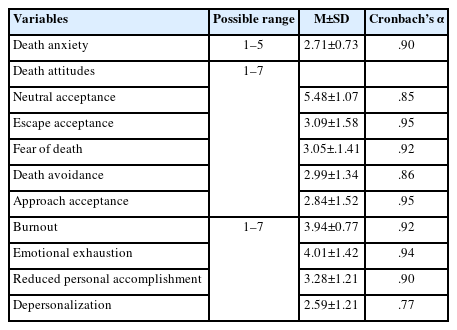
This study aimed to examine the relationships among death anxiety, attitudes toward death, and burnout in nurses working in hemodialysis units. Methods: A cross-sectional, self-report questionnaire-based survey was conducted. Eighty-six nurses, each with more than one year of experience in hemodialysis units across six general hospitals, participated. Data were collected from July to December 2021. Statistical analyses included Pearson correlation coefficients and multivariate linear regression. Results: The mean death anxiety score was 2.71±0.73 out of 5. Among attitudes toward death, neutral acceptance was most prevalent, with a mean score of 5.48±1.07 out of 7. The average burnout score was 3.94±0.77 out of 7. Death anxiety showed a significant negative correlation with neutral acceptance of death (r=–.33, p=.002) and a significant positive correlation with fear of death attitudes (r=.65, p<.001). Multiple regression analysis identified marital status (being married) (β=–.35, p=.005) and the death attitude of escape acceptance (β=.37, p=.002) as significant predictors of burnout, together explaining 22.3% of the variance (F=2.43, p=.005). Conclusion: Attitudes toward death among hemodialysis nurses may be linked to burnout. Burnout management programs for nurses in hemodialysis units should provide opportunities for neutral discussions and emotional expression regarding death, and should address strategies to mitigate escape acceptance attitudes.
  • 1,776 View
  • 57 Download
Effects of the Abdominal Draw-in Maneuver and Body Mechanics on Low Back Pain Relief in Nurses: A Quasi-Experimental Study
Saeun Cheon, Seung-bin Park, Insoon Kang
Korean J Adult Nurs 2025;37(2):165-176.   Published online May 30, 2025
DOI: https://doi.org/10.7475/kjan.2025.0217
Purpose
This study evaluated the effectiveness of an intervention combining the abdominal draw-in maneuver (ADIM) and body mechanics for nurses with chronic low back pain (LBP).
Methods
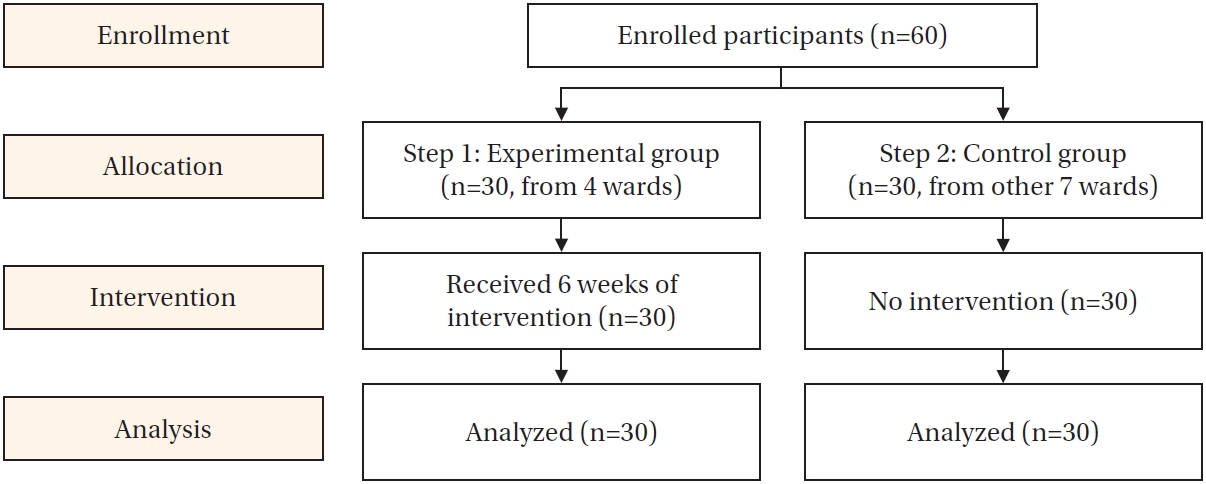
A non-equivalent control group pretest-posttest design was used, with data collected from August 30 to December 29, 2023. Participants were nurses experiencing chronic LBP (≥3 months) from a university hospital. Participants were allocated by ward units, with the experimental group (n=30) enrolled first, followed by the control group (n=30). The experimental group received ADIM and body mechanics training, performed ADIM exercises three times weekly for 6 weeks, and received daily text reminders. Exercise adherence and body mechanics usage were monitored weekly. The control group received educational materials upon request after study completion. Outcomes included LBP intensity, LBP disability, lumbar flexibility, and body mechanics performance, analyzed using SPSS version 27.0 through descriptive statistics, the chi-squared test, the Fisher exact tests, the independent t-test, the Mann-Whitney U test, and analysis of covariance.
Results
Compared to the control group, the experimental group showed significant reductions in LBP intensity (Z=4.65, p<.001) and LBP disability (F=7.04, p=.010), as well as improvements in lumbar flexibility (t=6.15, p<.001) and body mechanics performance (t=6.91, p<.001).
Conclusion
The intervention effectively alleviated LBP, reduced disability due to LBP, and improved lumbar flexibility and body mechanics performance. Thus, integrating ADIM with body mechanics may represent a practical and beneficial approach for reducing pain and enhancing functional outcomes among nurses experiencing chronic LBP in clinical settings.
  • 1,675 View
  • 50 Download
Purpose
Over 10% of intensive care unit (ICU) patients die; however, research aimed at assessing and improving the quality of their deaths remains scarce. This study investigated the impact of communication among healthcare professionals and person-centered care provided by ICU nurses on the quality of dying and death (QODD) experienced by ICU patients.
Methods
We measured general characteristics of ICU nurses, interprofessional communication, and person-centered care, and identified their impact on the quality of death for patients who died in the ICU. Participants consisted of 103 ICU nurses employed at two tertiary hospitals in South Korea. Data were collected between January and May 2023. Descriptive statistics, the t-test, analysis of variance, the Mann-Whitney U test, Pearson correlation coefficients, and multiple linear regression analyses were conducted using SPSS version 23.0.
Results
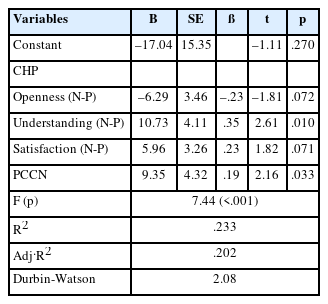
The mean QODD score was 44.73±21.26. QODD was positively correlated with openness (nurse-physician), understanding (nurse-physician), satisfaction (nurse-physician), and person-centered care. Factors significantly influencing QODD included nurse-physician communication, specifically understanding (β=.35, p=.010), and person-centered care (β=.19, p=.033), explaining 20.2% of the total variance (F=7.44, p<.001).
Conclusion
Improved communication among healthcare professionals and enhanced person-centered care are essential for improving the QODD for ICU patients. To achieve this, educational initiatives focusing on end-of-life care and communication training programs for healthcare professionals should be implemented.
  • 3,013 View
  • 58 Download
Purpose
This study identified the mediating effect of resilience on the relationship between job stress and the professional quality of life of hospice and palliative care nurses.
Methods
The participants included 136 hospice and palliative care nurses from 13 inpatient hospice and palliative care wards at a tertiary hospital in a metropolitan city in South Korea. Data were collected from February 2022 to March 2022. Hayes' PROCESS macro 3.5 was used to test the significance of the parameter's indirect effects. Professional quality of life was divided into three subdomains: compassion satisfaction, secondary traumatic stress, and burnout.
Results
As a mediator, resilience had both direct and indirect effects on the relationship between job stress and the compassion satisfaction of hospice and palliative care nurses. Furthermore, there were both direct and indirect effects on the relationship between job stress and secondary traumatic stress. Finally, although there was no direct effect on the relationship between job stress and burnout, there was an indirect mediating effect.
Conclusion
This study confirmed the direct effect of compassion satisfaction on job stress and the professional quality of life of hospice and palliative care nurses, as well as the mediating effect of resilience on job stress and burnout. To improve the professional quality of life of hospice and palliative care nurses, it is necessary to develop and apply programs that enhance resilience in order to promote its mediating effects on compassion satisfaction and burnout.
  • 3,019 View
  • 76 Download
  • 0 Scopus
Purpose
The purpose of this study was to develop and validate a tool to evaluate slow nursing performance for older adults in long-term care hospitals.
Methods
The search period was set from March 2013, when the term "slow nursing" was first used in the literature, to October 2021. A slow nursing tool was developed in two phases: development and verification. In the tool development phase, 29 items were developed through an extensive literature review and in-depth interviews with seven long-term care hospital nurses. Construct validity testing was performed by a 10-member expert panel, and a pilot survey was conducted on long-term care hospital nurses. In the tool validation phase, the construct validity, criterion validity, and reliability of the tool were tested by applying it to 181 nurses in long-term care hospitals .
Results
The final tool comprised five factors and 23 items, with an overall explanatory power of 56.8%. Construct validity was examined using confirmatory factor analysis, and the model fit was good. Known-group validity was established by the observation of a significant difference in the slow nursing score between intensive care unit and long-term care hospital nurses, and criterion validity was established by a significant correlation between the slow nursing and person-centered assessment scores. Internal consistency reliability was shown by a Cronbach's ⍺ coefficient of .781.
Conclusion
The concept of slow nursing has been clarified, improving the understanding and implementation of slow nursing care by nurses in long-term care hospitals. The Slow Nursing Tool for Long-term Care Hospital Nurses (SNT-LCHN) is expected to increase interest in and contribute to the effectiveness of slow nursing practices. It will serve as a valuable tool for improving nursing performance in these settings.
  • 1,153 View
  • 27 Download
  • 1 Scopus
Factors Influencing Sleep Quality in Patients with Hepatocellular Carcinoma Undergoing Transarterial Chemoembolization: A Cross-Sectional Study
Ji Young Park, Myoung Soo Kim, Han Byeol Lim
Korean J Adult Nurs 2024;36(2):160-170.   Published online May 31, 2024
DOI: https://doi.org/10.7475/kjan.2024.36.2.160
Purpose
Patients with hepatocellular carcinoma may experience poor sleep quality following Transarterial Chemoembolization (TACE). This study aimed to identify factors influencing sleep quality in patients undergoing transarterial chemoembolization.
Methods
The study participants comprised 49 patients who underwent TACE and 45 nurses who cared for them. Patient data were collected through a face-to-face survey before and after TACE, as well as a review of electronic medical records. Data from nurses were collected using an online survey.
Results
The mean sleep quality score of patients with hepatocellular carcinoma undergoing TACE was 5.04±1.76. Sleep quality was negatively correlated with the number of antipyretics used (r=-.31, p=.029), anxiety (r=-.40, p=.004), postembolization syndrome (r=-.30, p=.034), and fatigue (r=-.63, p<.001), and positively correlated with the nurse’s perception of patient’s fatigue (r=.45, p=.001). In multiple regression analysis, fatigue (β=-.47, p=.001) and the number of antipyretics used (β=-.33, p=.005) explained 43.5% of the variance in patients’ sleep quality.
Conclusion
The sleep quality of patients undergoing TACE was found to be relatively low. Fatigue affects sleep quality, with more fatigued patients exhibiting poorer sleep quality. Therefore, nurses must pay attention to patient fatigue and anxiety and provide more comfortable nursing care.
  • 886 View
  • 24 Download
  • 0 Scopus
Purpose
This study describes the attitudes toward Personal Protective Equipment (PPE), physical discomfort with wearing PPE, obsession with Coronavirus Disease 2019 (COVID-19), and perceived psychosocial stress among operating room nurses during the COVID-19 pandemic and identifies factors affecting perceived psychosocial stress.
Methods
This study used a descriptive, cross-sectional design to evaluate physical discomfort experienced when wearing PPE, attitudes toward PPE, and obsession with COVID-19. We collected the data between December 2020 and January 2021. The participants were 127 nurses who worked in operating rooms at three hospitals in South Korea. Perceived psychosocial stress was assessed using the Psychosocial Well-being Index Short Form. Data were analyzed using descriptive statistics, the independent t-test, one-way analysis of variance, Pearson correlation coefficients, and multiple linear regression.
Results
Having a bachelor's degree (β=.28, p=.031), attitude toward PPE (β=-.22, p=.011), experiencing shortness of breath while wearing PPE (β=.26, p=.008), and obsession with COVID-19 (β=.23, p=.006) were identified as factors affecting the psychosocial stress of nurses who wore PPE and participated in surgery.
Conclusion
Nurses who had a negative attitude toward PPE, experienced shortness of breath while wearing it, and had a high level of obsession with COVID-19 had higher psychosocial stress. To reduce the psychosocial stress of nurses who wear PPE and participate in surgery, we suggest research on education that can reduce repetitive thinking about infectious diseases, such as obsession with COVID-19. Additionally, support is needed to improve positive attitudes toward PPE and alleviate physical discomfort.
  • 1,061 View
  • 8 Download
  • 0 Scopus
Effects of Clinical Nurses' Responses to Violence on Burnout: The Moderating Role of Positive Psychological Capital
Haejun Choi, Sujin Shin, Seungji Kim, Sungran Kim
Korean J Adult Nurs 2023;35(4):406-417.   Published online November 30, 2023
DOI: https://doi.org/10.7475/kjan.2023.35.4.406
Purpose
The purpose of this study was to investigate the moderating role of positive psychological capital on the effects of clinical nurses' responses to violence on burnout and to provide basic date for an intervention program that reduces nurse burnout.
Methods
The participants in this study were 172 nurses recruited through convenience sampling at one general hospital in Seoul. Data were collected from June 5 to 10, 2023 using structured questionnaires. The collected data were analyzed using SPSS/WIN 26.0.
Results
Burnout was positively correlated with violence responses and negatively correlated with positive psychological capital among clinical nurses. Verbal violence experience (β=.14, p=.014), job satisfaction (β=.31, p<.001), social violence response (β=.15, p=.035) and positive psychological capital (β=-.39, p<.001) were identified as factors significantly influencing clinical nurses' burnout. The interaction term between social violence response and positive psychological capital significantly influenced burnout (β=.18, p=.044).
Conclusion
Social violence response affected burnout among clinical nurses, and positive psychological capital was identified as a moderating factor in burnout. Therefore, hospital and nursing organizational efforts such as fostering an appropriate organizational atmosphere, providing social support that encourages trust and creativity among organizational members, and implementing various educational and mentoring programs are required to reduce nurses' social violence response and enhance positive psychological capital.
  • 1,741 View
  • 40 Download
  • 0 Scopus
Purpose
This study identified the experiences of self-reflection of a general ward nurses on the experience of end-of-life care for a patient who decided to suspend life-sustaining treatment and these experiences’ nature and meaning. Methods: van Manen's hermeneutic phenomenology research method was used to qualitatively analyze the data. The study participants were 20 nurses with more than three years of working in general wards of tertiary general hospitals. Data were collected through face-to-face in-depth interviews and direct observation by the researchers. Social distancing was practiced in accordance with COVID-19 social distancing policy. Results: Four existences were identified from which 5 main and 14 sub-themes were derived. Five essential themes emerged from the analysis: 1) Hoping to return to an undamaged body and knowing the preciousness of the body, 2) Realize that the ability to care for the dying patient becomes more mature with the increase in career, 3) The death in the treatment room like a death on street makes regrettable the absence of end-of-life rooms, 4) Seeing the preciousness of my life in accompaniment with death, and 5) Become aware of growing up as a professional nurse. Conclusion: The results of this study provided an in-depth understanding of the end-of-life experiences of patients who decided to suspend life-sustaining treatment in general ward nurses. It can be used to develop end-of-life nursing education for nurses and students and develop nursing interventions for end-of-life patients.
  • 2,117 View
  • 42 Download
  • 0 Scopus
Purpose
This study was conducted to provide fundamental data for improving the quality of care by investigating the relationships of critical reflection competency, nursing practice environment, job crafting, and person-centered care among tertiary hospital nurses. Additionally, the study sought to identify the factors influencing person-centered care. Methods: Data were collected from 132 tertiary hospital nurses with at least 1 year of work experience via an online survey conducted in January 2023. Results: Person-centered care varied significantly according to age, clinical experience, and department. Significant correlations of person-centered care with critical reflection competency (r=.77, p<.001), nursing practice environment (r=.46, p<.001), and job crafting (r=.71, p<.001) were observed. Factors contributing to person-centered care among tertiary hospital nurses included critical reflection competency (β=.46, p<.001) and job crafting (β=.40, p<.001), with an explanatory power of 70.2%. Conclusion: To provide ethically enhanced person-centered care in tertiary hospitals, various training programs must be developed to strengthen nurses' critical reflection competency and job crafting skills.

Citations

Citations to this article as recorded by  
  • Impact of Work–Life Balance and Nursing Reflection on the Nursing Performance of Nurses in a Tertiary Hospital
    Yoo Jin Hwang, Won Hee Jun
    International Journal of Nursing Practice.2025;[Epub]     CrossRef
  • Nurses' Patient‐Centered Care Competencies and Care Perceptions of the Patients They Care for: A Cross‐Sectional Study
    Vildan Kocatepe, Rakibe Ceyda Çetin, Beyza Buğday, Beyza Dikici
    Scandinavian Journal of Caring Sciences.2025;[Epub]     CrossRef
  • Cultural Competence and Nursing Work Environment: Impact on Culturally Congruent Care in Portuguese Multicultural Healthcare Units
    Gisela Teixeira, Ricardo Picoito, Filomena Gaspar, Pedro Lucas
    Healthcare.2024; 12(23): 2430.     CrossRef
  • Factors associated with critical reflection competency among clinical nurse educators
    Sujin Shin, MiJi Lee, Eunmin Hong
    Teaching and Learning in Nursing.2024; 19(4): e630.     CrossRef
  • Factors Influencing Person-Centered Care Among Psychiatric Nurses in Hospitals
    Ji Su Lee, Mi Heui Jang, Min Jung Sun
    Healthcare.2024; 12(22): 2269.     CrossRef
  • Proactive behaviors and health care workers: A systematic review
    Alden Yuanhong Lai, Kenneth Z. Wee, Jemima A. Frimpong
    Health Care Management Review.2024; 49(3): 239.     CrossRef
  • 2,681 View
  • 45 Download
  • 6 Crossref
  • 5 Scopus
Purpose
This descriptive survey study aimed to identify the influences of person-centered perioperative nursing and patient safety competency on patient safety management activities among operating room nurses.
Methods
Data were collected from June 14 to July 14, 2021, covering 158 operating room nurses working at six general hospitals. Data were analyzed using hierarchical multiple regression to identify the influencing factors of patient safety management activities.
Results
The mean scores of person-centered perioperative nursing, patient safety competency, and patient safety management activities were 3.86, 3.88, and 4.55, respectively. These scores increased with increased age and clinical experience. Person-centered perioperative nursing (β=.22, p=.014) and patient safety competency (β=.22, p=.014) influenced patient safety management activities.
Conclusion
Therefore, to improve the patient safety management activities of operating room nurses, an efficient nursing work environment must be created along with systematic and continuous education and programs to enhance person-centered perioperative nursing and patient safety competency.

Citations

Citations to this article as recorded by  
  • Impact of Delirium-Related Stress, Self-Efficacy, Person-Centred Care on Delirium Nursing Performance Among Nurses in Trauma Intensive Care Units: A Cross-Sectional Descriptive Survey Study
    Ga-Hee Seong, Hyung-Ran Park
    Healthcare.2025; 13(11): 1243.     CrossRef
  • Novice Perioperative Nurses’ Perceptions of Nursing Competence and Strategies Used to Enhance Competence: A Phenomenographic Study
    Seo Jin Kwon, Sung Ok Chang, Boo Hyo Park
    AORN Journal.2025; 121(3): 186.     CrossRef
  • Effectiveness of metaverse-based nursing education on operating room patient safety
    Jieun Shin, Nam-Yi Kim, Amir Karimi
    PLOS One.2025; 20(8): e0329650.     CrossRef
  • Assessing the impact of nurses’ patient safety competencies on key performance indicators (KPIs) for patient safety outcomes at Tamale Teaching Hospital: the mediating role of leadership and barriers to competency development
    Mudasir Mohammed Ibrahim, Fatima Abdul-Rahaman, Mohammed Sherif Sayibu, Dora Nyamekye Alhassan, Ruhaima Tunteya Awudu, Iddrisu Mohammed Sisala, Abubakari Wuni, Abdul-Malik Abdulai
    BMC Health Services Research.2025;[Epub]     CrossRef
  • Effects of Clinical Nurses Critical Reflection Competency, Professional Pride, and Person-Centered Care Practice on Patient Safety Management Activities
    Subin Lee, Sujin Shin
    Journal of Korean Critical Care Nursing.2023; 16(3): 87.     CrossRef
  • 4,328 View
  • 117 Download
  • 5 Crossref
  • 2 Scopus
Purpose
This study was conducted to identify factors affecting person-centered care among tertiary hospital nurses caring for patients with COVID-19.
Methods
Study participants comprised 152 tertiary hospital nurses with experience caring for patients with COVID-19. Data were collected from September 1 to October 5, 2022 and analyzed using independent t-test, correlation coefficient, and hierarchical multiple regression with SPSS/WIN 26.0.
Results
Person-centered care showed a statistically significant positive correlation with the nursing work environment (r=.46, p<.001) and teamwork (r=.49, p<.001). Hierarchical multiple regression analysis revealed that the variables of position (β=.20 p=.014) in model 1 (F=6.20, p=.014), teamwork (β=.47 p<.001) in model 2 (F=24.94, p<.001), and teamwork (β=.33 p=.002) in the final model influenced person-centered nursing (F=18.19, p<.001), and the explanatory power was 25.5%.
Conclusion
The significance of nurses' teamwork has been emphasized because of the COVID-19 pandemic. Teamwork can be promoted by reviewing protocols for responding to severely ill patients with infectious diseases, which were revised during the COVID-19 period, and establishing appropriate systems to follow.

Citations

Citations to this article as recorded by  
  • A Predictive Model for Person-Centered Care in Intensive Care Units in South Korea: A Structural Equation Model
    Sunmi Kwon, Kisook Kim
    Korean Journal of Adult Nursing.2025; 37(4): 467.     CrossRef
  • 1,359 View
  • 20 Download
  • 1 Crossref
  • 0 Scopus
The Effects of Professional Autonomy, Job Satisfaction, and Perceived Patient-Safety Culture on Nurses' Patient-Safety Management Activities: A Cross-Sectional Study
Bokja Koak, Junglim Seo, Eunji Song, Haneul Shin, Jaehee Jeon
Korean J Adult Nurs 2023;35(2):117-126.   Published online May 31, 2023
DOI: https://doi.org/10.7475/kjan.2023.35.2.117
Purpose
This study aims to confirms the relationship between nurses' professional autonomy, job satisfaction, perceived patient-safety culture, and patient-safety management activities; it also identifies factors that influence their patient-safety management activities.
Methods
A cross-sectional study design was adopted. The participants were 164 nurses from at five hospitals in two G provinces, Korea, who participated in the study voluntarily. Data were collected between November and December 2022 via a 120-question structured questionnaire and analyzed using SPSS/WINdows software version 25.0. The data were measured by frequency, percentage, and mean and standard deviation, using an independent t-test, one-way ANOVA, Pearson's correlation coefficients, and multiple regression analysis.
Results
The average age of the participants was 35.54±8.42 years; 143 (87.2%) were women. The following factors influenced their patient-safety management activities: level of education (β=.16, p=.018), experience of patient-safety education (β=.15, p=.014), and perceived patient-safety culture (β=.56, p<.001). The explanatory power of the nurses' patient-safety management activities was 44.0%.
Conclusion
Hospital managers should enable nurses to carry out patient-safety procedures competently by providing continuous patient-safety education; they should also revise regulations and systems to promote good patient-safety management practices and create an environment that supports patient safety. In addition, a program should be designed and implemented to improve nurses' perceived patient-safety culture.

Citations

Citations to this article as recorded by  
  • Patient Safety Culture and Perceived Self-Efficacy in Nurses from Two Health Institucions in Lima-Peru
    Paola Barbara Pinedo Albines, Monica Elisa Meneses-La-Riva
    Journal of Lifestyle and SDGs Review.2025; 5(4): e05994.     CrossRef
  • The relationship between attitudes towards professional autonomy and nurse–nurse collaboration: A cross‐sectional study
    Merve Tarhan
    International Nursing Review.2025;[Epub]     CrossRef
  • Standardizing Clinical Nursing Practice and Delivery Method for the Management of United States-Bound Refugees in Uganda
    Shanna Miko, Sarah J. Hoffman, Mathika Thongkhamkitcharoen, Susan B. Dicker, Warren Dalal, Alexander Klosovsky, Erin M. Mann, MPH, Michelle Mathiason, Shailey Prasad
    Journal for Nurses in Professional Development.2025; 41(2): 108.     CrossRef
  • Job satisfaction among hospital nurses: An updated literature review
    Yang Zhao, Hong Lu, Xiu Zhu, Guihua Xiao
    International Journal of Nursing Studies.2025; 162: 104964.     CrossRef
  • Nurses' Autonomy and Its Determinants in Clinical Practice: A Scoping Review
    Hani Tuasikal, Inge Dhamanti, Mahmudah
    Health Leadership and Quality of Life.2025; 4: 700.     CrossRef
  • 4,667 View
  • 90 Download
  • 5 Crossref
  • 5 Scopus
Purpose
According to the Ministry of Health and Welfare, the turnover rate of nurses working at regional trauma centers is 27.6%, which is almost double the turnover rate of 13.8% of all nurses in 2018. The turnover of nurses lowers the morale of the remaining nurses and increases their workload, negatively affecting hospital operation. This study aimed to investigate the mediation effect of grit on the relationship between the working environment and intention to stay at work among regional trauma center nurses, to reduce the turnover rate and improve their intention to stay at work.
Methods
The participants were 185 nurses with more than six months of clinical experience working at 16 regional trauma centers in South Korea. The data were collected using structured questionnaires from July 1, 2022 to July 31, 2022, and analysis was conducted using SPSS/WIN 25.0 programs.
Results
The intention to stay at work among regional trauma center nurses was different depending on age (F=6.32, p=.002), marital status (F=-3.66, p<.001), education level (F=5.29, p=.006), and total clinical experience (F=4.22, p=.007). Grit was found to have a complete mediating effect on the relationship between work environment and intention to stay at work (Z=4.49, p<.001).
Conclusion
To lower the turnover rate of trauma nurses and increase their intention to stay at work, it is necessary to subdivide the intervention program for various ages and clinical career, and to develop a mediation program that can improve nurses' grit by improving the working environment.

Citations

Citations to this article as recorded by  
  • Role of violence exposure on altruistic behavior and grit among emergency nurses in rural hospitals
    Mohamed Hussein Ramadan Atta, Shimmaa Mohamed Elsayed, Heba Emad El‐Gazar, Naglaa Gamal Eldien Abdelhafez, Mohamed Ali Zoromba
    International Nursing Review.2025;[Epub]     CrossRef
  • 3,447 View
  • 48 Download
  • 1 Crossref
  • 1 Scopus
Factors Influencing Nursing Graduate Students’ Perception and Behavior Related to Climate Change and Health: A Secondary Data Analysis
Min Kyung Park, Seoyoung Baek, Da Woon Jeong, Gwang Suk Kim
Korean J Adult Nurs 2023;35(1):71-83.   Published online February 28, 2023
DOI: https://doi.org/10.7475/kjan.2023.35.1.71
Purpose
This study aimed to identify nursing graduate students’ perception and behavior related to climate change and health and the factors affecting them. Methods: This secondary analysis used research data on the development of a Korean version of Climate Health and Nursing Tool. The participants were 220 graduate nursing students who were currently working. The dependent variable, which is the climate-health related perception and behavior, consisted of 20 items on awareness, concern, motivation, behaviors at home, and behaviors at work related to climate change. Results: The mean score on the climate-health related perception and behavior was 73.52, which ranged from 41 to 100. Multiple linear regression showed that climate-health related perception and behavior were predicted by an optimistic attitude toward climate change response (β=.20, p=.002), experience in climate change- related extreme events (β=.18, p=.010), number of exposure pathways for climate change-related information (β=.17, p=.008), education level (β=.16, p=.015), and current work area (β=.15, p=.027). Conclusion: An optimistic attitude toward climate change response was identified as the most influential factor that explained nursing students’ climate-health related perception and behavior. Interventions that reinforce positive feelings about climate change-related behaviors and an optimistic attitude that climate change can be adapted to and mitigated through appropriate behaviors would significantly improve climate-health related perception and behavior.

Citations

Citations to this article as recorded by  
  • Climate change perceptions and behaviors among Korean nurses: The role of organizational initiatives
    Dukhyun Back, Kihye Han, Jieun Kim, Hyang Baek
    Nursing Outlook.2025; 73(3): 102383.     CrossRef
  • Nurses' Perceptions and Behaviours Regarding Climate Change and Health: A Quantile Regression Analysis
    Min Kyung Park, Seoyoung Baek, Da Woon Jeong, Gwang Suk Kim
    Journal of Advanced Nursing.2025; 81(12): 8218.     CrossRef
  • Nurses' educational needs regarding climate change and health by type of institutions: A descriptive cross-sectional study
    Min Kyung Park, Gwang Suk Kim, Da Woon Jeong, Seoyoung Baek
    Nurse Education in Practice.2025; 87: 104473.     CrossRef
  • Climate change health communication and its association with awareness and behaviors in South Korea
    Hyeyun Kim, Sumi Chae
    The Journal of Climate Change and Health.2025; 26: 100583.     CrossRef
  • Factors related to perceptions of climate health impact and climate action: Focusing on the Health Belief Model
    Hansol Lee, Jaehee Kim, Yuri Lee
    Korean Journal of Health Education and Promotion.2024; 41(2): 31.     CrossRef
  • 2,077 View
  • 68 Download
  • 5 Crossref
Factors Influencing Performance of End-of-Life Care by ICU Nurses: A Descriptive Survey Study
Gyo Seon Lim, Yang Gyeong Yoo
Korean J Adult Nurs 2023;35(1):47-60.   Published online February 28, 2023
DOI: https://doi.org/10.7475/kjan.2023.35.1.47
Purpose
The purpose of this descriptive survey study was to investigate the relationship between death awareness, life-sustaining nursing stress, end-of-life care competency and performance, and resilience. Additionally, the factors influencing end-of-life care performance by ICU nurses were identified. Methods: Data were collected from one tertiary and two general hospitals in J province from July 1 to July 30, 2022. Nurses working in Intensive Care Units (ICU) for more than three months who had experience in end-of-life care were selected through convenience sampling. A total of 188 responses to the survey were included in the final analysis. An IBM SPSS program was used for the data analysis. Results: Factors impacting end-of-life care performance (with an explanatory power of 31.9%) were as follows: higher knowledge and behavioral competency in end-of-life care, higher relational patterns in resilience, higher levels of death positivity in death awareness, and clinical experience of less than a year compared to that of three to five years were associated with higher end-of-life care performance. Conclusion: These findings point to the urgent need for increasing end-of-life care performance among nurses in clinical practice; therefore, practical strategies must be developed and actively implemented to strengthen relevant competencies and resilience and promote death positivity. Based on these findings, future studies are needed to develop an intervention program to improve the spiritual scope of end-of-life care and verify the effects.

Citations

Citations to this article as recorded by  
  • Predictors of end-of-life care among emergency nurses: A cross-sectional study in Korea
    Ji Seon Lee, Sook Jung Kang
    Australasian Emergency Care.2025;[Epub]     CrossRef
  • 955 View
  • 46 Download
  • 1 Crossref
  • 0 Scopus
Purpose
The purpose of this study is to identify the characteristics of Korean nurses' research participation experiences; their resulting consent satisfaction; pressure to participate; satisfaction in participating; and the factors influencing research participation satisfaction. Methods A descriptive cross-sectional design was used. Data were collected using a questionnaire distributed to nurses who are employed at hospitals or higher medical institutions nationwide and have participated in nursing research at least once. 197 nurses participated in this study. 173 data were analyzed using descriptive statistics, correlation, and regression. Results Senior nurses made the most participation requests (21.4%). The coercion to participate in the research (2.67±0.64) was lower than normal (3). However, the coercion level to participate in the study was significantly higher when notified by the institution or department (F=5.29, p<.001), the department head requested participation (F=5.17, p<.001), or senior nurses instructed other nurses to participate (F=7.96, p<.001). Satisfaction with informed consent (β=.55, p<.001) and coercion to participate in the research (F=93.16, p<.001) were significant variables influencing the satisfaction with research participation (R2=.52). Conclusion In order to protect the rights of nurses as research participants, it is necessary to improve researcher awareness and quality of nursing research, as well as provide ethical research environments for research participants.
  • 927 View
  • 35 Download
  • 0 Scopus
Development of the Knowledge Scale of the Life-Sustaining Treatment for Clinical Nurses
Sojung Park, Mihyun Park, Suyoun Hong
Korean J Adult Nurs 2022;34(5):488-497.   Published online October 31, 2022
DOI: https://doi.org/10.7475/kjan.2022.34.5.488
Purpose
It is necessary for nurses who perform tasks related to life-sustaining treatment to play a supporting role in the decision-making process of life-sustaining treatment for patients and guardians based on their knowledge of decisions and implementation, such as cessation of life-sustaining treatment. Therefore, the Knowledge Scale of the Life-Sustaining Treatment (KS-LST) was developed and reliability and validity were verified.
Methods
Our methodological study aimed at developing tools to measure the knowledge of nurses´ life-saving medical decision system and to verify their reliability and validity. To this end, preliminary questions were constructed through literature review. In this regard, content validity, face validity, k-group comparison, and composition validity through item analysis were verified, and reliability was derived from KR-20.
Results
A total of 26 questions were derived from the 35 preliminary questions through content validity and facial validity; depending on whether they were educated or not, there was a significant difference between the two groups (p=.004). The final 23 questions were derived by deleting 3 questions with low discrimination, and KR-20 was .62.
Conclusion
Using the KS-LST that was developed through this study, we can measure the nurses´ knowledge of the life-sustaining medical decision system and provide education in the deficient areas. We expect nurses with accurate knowledge to provide accurate information to patients and caregivers to help patients make the right choices.

Citations

Citations to this article as recorded by  
  • Factors associated with disaster nursing competence among emergency department nurses: the roles of disaster preparedness, self-efficacy, and communication ability
    Gyu Bong Noh, Sun Hyoung Bae
    BMC Nursing.2025;[Epub]     CrossRef
  • Knowledge, Attitudes and Nursing Stress Related to Life-Sustaining Treatment among Oncology Nurses
    Seul Lee, Suyoun Hong, Sojung Park, Soojung Lim
    The Journal of Hospice and Palliative Care.2023; 26(3): 112.     CrossRef
  • 1,051 View
  • 36 Download
  • 2 Crossref
  • 0 Scopus
Purpose
This study aims to determine a hypothetical model concerning factors affecting hospital nurses’compliance with the guidelines of antineoplastic drugs safety management based on the theory of planned behavior.
Methods
Data were collected from 339 nurses managing antineoplastic drugs through an online survey conducted from March 23 to April 2, 2022. The data were analyzed using SPSS 28.0 and AMOS 25.0.
Results
The hypothetical model had the goodness of fit indices of χ2 =370.13 (df=140, p<.001), CFI=.94, SRMR=.07, and RMSEA=.07. Compliance with the guidelines was significantly influenced by compliance intention. Compliance intention and perceived behavioral controls’ explanatory power was 59.9% to explain compliance with the guidelines. In addition, compliance intention was significantly influenced by perceived behavioral control. Perceived behavioral control, attitude toward behavior, and subjective norm had an explanatory power of 65.2% to explain compliance intention. Moreover, perceived behavioral control was influenced by the knowledge of antineoplastic drugs safety management.
Conclusion
These findings suggest that for promoting hospital nurses’ compliance with the antineoplastic drugs safety management guidelines, an intervention strategy is required to enhance compliance intention, perceived behavior control, and antineoplastic drugs safety management knowledge.

Citations

Citations to this article as recorded by  
  • Factors Affecting Radiation Protective Behaviors in Perioperative Nurses Applying the Theory of Planned Behavior: Path Analysis
    Se Young Jang, Hee Sun Kim, Seok Hee Jeong, Young Man Kim
    Journal of Korean Academy of Nursing.2023; 53(2): 222.     CrossRef
  • 847 View
  • 47 Download
  • 1 Crossref
  • 1 Scopus

Review Article

Effectiveness of Delirium Education Programs for Nurses in Acute Hospitals: A Systematic Review and Meta-Analysis
Jungyeon Roh, Sujin Shin, Eunmin Hong
Korean J Adult Nurs 2022;34(5):435-449.   Published online October 31, 2022
DOI: https://doi.org/10.7475/kjan.2022.34.5.435
Purpose
This study aimed to review the effectiveness of delirium education programs for nurses in acute hospitals.
Methods
The inclusion criteria were studies on delirium education programs for nurses published in English and Korean from 2012 to 2022. A literature search was conducted in the RISS, KISS, DBpia, PubMed, CINAHL, PsycINFO, and Web of Science databases using the key words of "delirium", "nurse", and "education". Qualitative appraisal of studies was conducted using the revised Cochrane risk-of-bias tool for randomized trials (RoB 2) and the Risk of Bias in Non-randomized Studies of Interventions (ROBINS-I) tool translated by National Evidence-based Healthcare Collaborating Agency (NECA). For meta-analysis, the effect size of the intervention was calculated as standardized mean difference.
Results
Eighteen studies were selected for the systematic review. While the contents of the education programs were similar, the teaching methods were different. Interventions implemented included traditional learning, e-learning, and blended learning. Teaching methods of delirium education programs for nurses included lecture, discussion, practice, simulation, role-play, and coaching. The systematic review found that delirium education programs for nurses effectively increased post-intervention outcomes in 17 studies. Delirium education programs for nurses have benefits regarding delirium knowledge and performance. In four studies, delirium education program interventions improved delirium nursing performance (95% CI: 0.48~2.44, p=.003).
Conclusion
These results demonstrate the need for a standardized delirium education program. It is recommended that further studies evaluating the patient outcome effects of delirium education programs should be conducted.

Citations

Citations to this article as recorded by  
  • The influence of delirium knowledge, critical thinking disposition, and compassion competence on delirium nursing performance in general hospital clinical nurses: A cross-sectional descriptive study
    Hyang Sook Lee, Jeong Eun Yang
    Journal of Korean Gerontological Nursing.2025; 27(1): 95.     CrossRef
  • Educational programs to improve nursing competency of patient- and family-centered care in intensive care units: A systematic review
    Youngshin Joo, Eugene Han, Yeonsoo Jang
    Nurse Education Today.2025; 151: 106699.     CrossRef
  • Performance, Knowledge, and Barrier Awareness of Medical Staff Regarding the Prevention and Management of Pain, Agitation/Sedation, Delirium, Immobility, and Sleep Disruption in Adult Critical Care Patients: A Cross-Sectional Study
    Hyo-Geun Song, Duckhee Chae, Sung-Hee Yoo
    Korean Journal of Adult Nursing.2023; 35(4): 379.     CrossRef
  • 1,593 View
  • 94 Download
  • 3 Crossref
  • 3 Scopus

Original Articles

Factors Influencing the Performance of Person-centered Care Among Nurses in Designated COVID-19 Hospitals
Hyun-Joung Yun, Jaehee Jeon
Korean J Adult Nurs 2022;34(4):413-423.   Published online August 31, 2022
DOI: https://doi.org/10.7475/kjan.2022.34.4.413
Purpose
In this study, factors influencing the performance of person-centered care among nurses in designated COVID-19 hospitals were examined. Methods A total of 182 nurses providing care to COVID-19 patients at six public hospitals in Gyeonggi-do the designated hospital for infectious diseases participated in the study. Data were collected from February to March 2021 using a 152-question structured questionnaire, and analyzed using SPSS/WINdows software, version 25.0 by frequency and percentage, mean and standard deviation, independent t-test, one-way ANOVA, Pearson’s correlation coefficients, and multiple regression. Results The factors influencing the respondents’ performance of person-centered care were organizational culture for infection control (β=.35, p<.001), empathic ability (β=.16, p=.027), and the charge nurse position (β=.14, p=.035); these explained 20.8% of their person-centered care. Conclusion It is necessary to consider strategies to improve the organizational culture for infection control and empathic ability to promote the performance of person-centered care among nurses at designated COVID-19 hospitals. It is also necessary to design a program that can facilitate the implementation of person-centered care by nurses who hold positions junior to that of the charge nurse at designated COVID-19 hospitals.

Citations

Citations to this article as recorded by  
  • Factors Influencing Nurses’ Person-Centered Care: A Cross-sectional Descriptive Study
    Heesun Jang, Young A Kim
    Korean Journal of Adult Nursing.2025; 37(3): 344.     CrossRef
  • Experiences of Person‐Centred Care Among Nurses in COVID‐19 Wards: A Qualitative Study
    Myoungsuk Kim, Yongmi Lee, Hyun‐Ju Kang
    Nursing Open.2025;[Epub]     CrossRef
  • Exploring research trends in nursing organizational culture using topic modeling
    Eun-Jun Park, Chan Sook Park
    The Journal of Korean Academic Society of Nursing Education.2024; 30(4): 371.     CrossRef
  • Factors Influencing Person-Centered Care among Nurses in COVID-19 Special Care Units at Tertiary General Hospitals: A Cross-Sectional Descriptive Study
    Kisook Kim, Sunmi Kwon
    Korean Journal of Adult Nursing.2023; 35(2): 127.     CrossRef
  • 1,251 View
  • 25 Download
  • 4 Crossref
  • 2 Scopus
Factors Influencing the Implementation of Anticancer Drug Safety Management Guidelines for Nurses
Dong Ju Min, Mi Ran Kim
Korean J Adult Nurs 2022;34(3):313-323.   Published online June 30, 2022
DOI: https://doi.org/10.7475/kjan.2022.34.3.313
Purpose
This descriptive survey study was conducted to determine the degree of implementation of anticancer drug safety management guidelines by nurses handling anticancer drugs, safety motivation, safety control, ward safety culture, and anticancer drug safety guidelines.
Methods
The subjects of this study were 136 nurses working in the designated ward for anticancer drug treatment, and data collection was conducted from November 3rd to November 16, 2021. Collected data were analyzed using the IBM SPSS statistics 28.0 program by frequency and percentage, mean and standard deviation, independent sample t-test, one-way ANOVA, Scheffé test, Pearson's correlation coefficients, and multiple regression analysis.
Results
As a result of analyzing the effects of the subjects’ knowledge of anticancer drug safety management guidelines, safety motivation, safety control, and ward safety culture on the implementation of anticancer drug safety guidelines, it was found to be knowledge of anticancer drug safety management guidelines (β=.22), with 7.0% of the explanatory power.
Conclusion
The factors influencing the implementation of anticancer drug safety management guidelines were found to be anticancer drug safety management guidelines, and it is suggested that follow-up studies be conducted to develop educational programs and interventions to improve anticancer drug safety guidelines.

Citations

Citations to this article as recorded by  
  • Development and Validation of the Short Form of Core Competencies Scale of Nursing Care for Cancer Patients Undergoing Chemotherapy
    Sung Hae Kim, Seyong Lee, Sang Hee Kim, Jung Ok Choi, Gie Ok Noh
    Asian Oncology Nursing.2024; 24(4): 184.     CrossRef
  • 647 View
  • 28 Download
  • 1 Crossref

Review Article

Experiences of Nurses Caring for Hemodialysis Patients: A Qualitative Meta-Synthesis Study
Ye-Na Lee, Eun Young Kim
Korean J Adult Nurs 2022;34(2):168-177.   Published online April 30, 2022
DOI: https://doi.org/10.7475/kjan.2022.34.2.168
Purpose
We aimed to systematically review and synthesize qualitative evidence on the experiences of nurses caring for hemodialysis patients.
Methods
We used Noblit and Hare’s meta-ethnography. Seven databases (PubMed, EMBASE, CINAHL, Web of Science, RISS, KISS, National Assembly Electronic Library) were used for the literature search. There were no restrictions placed on publication dates. A total of 10 studies published in English and Korean up until July 2021 were finally selected for review.
Results
Three themes were identified from the literature review, which were then divided into six subthemes: acquiring the technical skills of hemodialysis, responsibility for prolonging patients’ lives, and maintaining stable hemodialysis in patients’ daily lives.
Conclusion
The results of this study provide basic data that emphasizes the specific role of nurses in the hemodialysis unit, a specialized area of nursing, and can be utilized as educational material for hemodialysis unit nurse education.

Citations

Citations to this article as recorded by  
  • A Qualitative Study on Nurses' Caring Experiences With Individuals With Kidney Failure Receiving Haemodialysis
    Edward Appiah Boateng, Bernice Bodua‐Mango, Joana Kyei‐Dompim, Philemon Adoliwine Amooba
    Journal of Renal Care.2025;[Epub]     CrossRef
  • Cherubims in Rdu: Experiences of Novice Nurses in Renal Dialysis Unit Among Tertiary Hospitals in Davao City
    ANNALIE G. CUEVA, SAMUEL F. MIGALLOS
    International Journal of Latest Technology in Engineering Management & Applied Science.2025; 14(4): 438.     CrossRef
  • Nurses’ perspectives and experience in caring for patients undergoing hemodialysis at Benjamin Mkapa hospital in Dodoma, Tanzania: A qualitative study
    Stephania Mbunda, Neema E. Mawi, Masunga K. Iseselo, Jordan Llego
    PLOS One.2025; 20(6): e0325501.     CrossRef
  • Improving assessment and escalation of threatened haemodialysis access: results of a nursing-led program
    Dana Forcey, Dan Tran, Jenny Connor, Piriya Kusuma Na Ayudhya, Christian Ocampo, Craig Nelson, Sandra Crikis
    BMC Nephrology.2023;[Epub]     CrossRef
  • 2,993 View
  • 96 Download
  • 4 Crossref
  • 2 Scopus

Original Articles

Factors Influencing Burnout of Nurses Working in a Hospital Nationally Designated for COVID-19 Patients
Hwasoon Kim, Doa Kim, Minsook Kim, Yiseul Kim, Soojin Bang, Gine Lee, Miso Won, Dajung Joo
Korean J Adult Nurs 2022;34(1):74-84.   Published online February 28, 2022
DOI: https://doi.org/10.7475/kjan.2022.34.1.74
Purpose
This study aimed to investigate nurses’ burnout working in a hospital for Coronavirus Disease 2019 (COVID-19) patients, and identify factors influencing nurses’ burnout. Methods We recruited 162 nurses working in a nationally designated hospital for COVID-19 patients. Data were collected on general characteristics, burnout, social support, healthcare safety climate, and job stress using a questionnaire. Data were analyzed using descriptive statistics, an independent t-test, a one-way ANOVA, the Scheffé test, Pearson correlation coefficient, multiple regression, and Cronbach’s α using IBM SPSS Statistics version 26.0 for Windows. Results The mean scores for burnout, social support, healthcare safety climate, and job stress were 2.96, 3.74, 4.08, and 2.69, respectively. Working department and job stress were significant factors affecting nurses’ burnout and these variables explained 26.0% of burnout variance. Conclusion To reduce burnout of nurses working in the COVID-19 frontline, efforts are needed to reduce nurses’ job stress. In nursing research, further study on what makes a difference in burnout between intensive care units and medical/surgical wards in current COVID-19 situation are needed. The results will be used as basic data to develop intervention and reduce nurses’ burnout during future infectious disease outbreaks.

Citations

Citations to this article as recorded by  
  • Long COVID symptoms and associated factors in registered nurses with COVID-19
    Ga Eun Park, Yeon-Hwan Park
    The Journal of Korean Academic Society of Nursing Education.2024; 30(1): 49.     CrossRef
  • Effects of stress on burnout among infection control nurses during the COVID-19 pandemic: the mediating effects of social support and self-efficacy
    Su-jin Lee, Ju-Young Park, Seo-Hyeon Kim
    BMC Nursing.2024;[Epub]     CrossRef
  • Influence of Job Stress and Resilience on Burnout of Clinical Nurses Working in Small and Medium-Sized Hospital: Focusing on Comparing National Safety Hospital and COVID-19 Dedicated Hospital
    Su-Young Jang, Young Ko
    Korean Journal of Health Promotion.2023; 23(2): 65.     CrossRef
  • The Influence of Infection Control Knowledge, Emergency Nursing Competency, and Infection Prevention Environment on Burnout among Psychiatric Nurses Caring for Patients with COVID-19
    Hyeran Cho, Suyon Baek
    Journal of Korean Academy of psychiatric and Mental Health Nursing.2023; 32(4): 482.     CrossRef
  • Burnout in healthcare workers in COVID-19-dedicated hospitals
    Young E Choi, Seung H Lee, Yun J Kim, Jeong G Lee, Yu H Yi, Young J Tak, Gyu L Kim, Young J Ra, Sang Y Lee, Young H Cho, Eun J Park, Young I Lee, Jung I Choi, Sae R Lee, Ryuk J Kwon, Soo M Son, Yea J Lee, Min J Kang
    Journal of Public Health.2023; 45(3): e510.     CrossRef
  • Awareness of the epidemiological investigation tasks of the nurse in charge of COVID-19 epidemiological investigations
    Haeng-Mi Son, Won-Hee Choi, Hye-Ryun Yang, Young-Hui Hwang
    The Journal of Korean Academic Society of Nursing Education.2022; 28(4): 433.     CrossRef
  • Tuberculosis Education for Nurse Practitioner Students: Where We Are and Where We Need to Go
    Ramona Benkert, Barbara Resnick, Margaret Brackley, Terri Simpson, Betty Fair, Trudy Esch, Kim Field
    Journal of Nursing Education.2009; 48(5): 255.     CrossRef
  • 1,159 View
  • 20 Download
  • 7 Crossref
  • 4 Scopus
The Role Experience of Clinical Practice Nurses in a University Hospital
Sosun Kim, Mi Jung Ryu, Ain Kim
Korean J Adult Nurs 2022;34(1):15-26.   Published online February 28, 2022
DOI: https://doi.org/10.7475/kjan.2022.34.1.15
Purpose
The purpose of this study was to describe clinical practice nurse’s role experience working in a university hospital. Clinical practice nurses are a mix of certified and non-certified nurses. They perform some of the duties of physicians in addition to the work they do as nurses. In the future, such nurses may become advanced practice registered nurses. Methods Focus group interviews were conducted with three groups, each consisting of eight participants. The interview lasted two and a half hours per group. Data were analyzed using a thematic analysis method. Results The analysis yielded four categories and 14 themes. The four categories were “seeking an escape from the repeated routines as a nurse”, “pioneering and developing new roles as a clinical practice nurse”, “confusion about professional identity due to ambiguity in role boundaries”, and “securing oneself as a team member and establishing a role as a clinical practice nurse”. Conclusion The scope of advanced practice registered nurses’ roles was meant to have been established in 2020, but this was not achieved. Thus, studying the role experience of clinical practice nurses and their experiences is worthwhile and the results can inform legislation. The results of the study will also help establish a customized curriculum for advanced practice nurses and ultimately improve the quality of nursing services for patients.

Citations

Citations to this article as recorded by  
  • Exploring the Difficulties and Educational Needs of Surgical Unit Nurses in Caring for Surgical Patients: A Qualitative Content Analysis
    Ki Nam Kwon, Seon Young Hwang
    Journal of Korean Academy of Fundamentals of Nursing.2025; 32(1): 24.     CrossRef
  • A study on the job performance, importance, and educational needs of clinical practice nurses in tertiary hospitals
    Hyemi Lee, Youngmee Ahn, Min Sohn, Minhee Suh
    The Journal of Korean Academic Society of Nursing Education.2025; 31(3): 315.     CrossRef
  • The Influence of Clinical Practice Nurses' Self-Leadership, Role Conflict, and Practice Environment on Patient Safety Competency
    Jeong Hwa Heo, Ji Hyun Sung
    Journal of Korean Academy of Nursing Administration.2025; 31(4): 458.     CrossRef
  • Role Conflict of Physician Assistants with Nursing Licenses in Korea
    Byeongkwan Kim, Wonhee Jung
    Journal of Korean Academy of Nursing Administration.2024; 30(2): 141.     CrossRef
  • 1,740 View
  • 60 Download
  • 4 Crossref
  • 2 Scopus
Nurses’ Experiences of Care for Patients in Coronavirus Disease 2019 Infection Wards during the Early Stages of the Pandemic
Nanhui Kim, Youngran Yang, Junhee Ahn
Korean J Adult Nurs 2022;34(1):109-121.   Published online February 28, 2022
DOI: https://doi.org/10.7475/kjan.2022.34.1.109
Purpose
The purpose of this study is to understand the experiences of nurses caring for Coronavirus Disease 2019 (COVID-19) patients in infection wards dedicated to COVID-19 through an in-depth exploration of the patient experience and meaning of care.
Methods
This study is a qualitative study analyzed by conventional content analysis. The study participants were 14 nurses who took direct care of COVID-19 patients in the early stages of the pandemic at a dedicated COVID-19 ward. The data were collected from July 4 to August 30, 2020, using face-to-face interviews.
Results
The analysis 6 categories: ‘struggling to prepare an infection ward’, ‘fear and anxiety about infection’, ‘the weight of pressure from patient care’, ‘efforts to protect patients’, ‘maturity of professional identity as a nurse’, and ‘a quarantine community that we create together’.
Conclusion
These study findings promote a broader understanding of nursing barriers, to patient care during an initial outbreak of a novel infectious disease, based on nurses' experiences with COVID-19 patients, and consequently, improve the quality of care received by such patients. Finally, nursing leaders, health policymakers, and governments should utilize these findings to inform practical strategies for nursing practice in current or future pandemics.

Citations

Citations to this article as recorded by  
  • The Moderating Effect of Calling in the Relationship between Post-Traumatic Stress and Turnover Intention of Nurses Who Cared for COVID-19 Patients
    Min Ju Woo, Bu Kyung Park
    Journal of Korean Academy of Nursing Administration.2025; 31(1): 75.     CrossRef
  • Experiences of Person‐Centred Care Among Nurses in COVID‐19 Wards: A Qualitative Study
    Myoungsuk Kim, Yongmi Lee, Hyun‐Ju Kang
    Nursing Open.2025;[Epub]     CrossRef
  • Improving Emerging Infectious Disease Control Based on the Experiences of South Korean Nurses During the COVID-19 Pandemic: A Qualitative Systematic Review
    Ha-Young Park, In-Sun Yeom
    Journal of Korean Academy of Fundamentals of Nursing.2024; 31(1): 1.     CrossRef
  • Factors Influencing Depression Among Nurses in General Hospitals During the COVID-19 Pandemic: Focus on Job Demands, Post-traumatic Stress, and Social and Organizational Support
    Si Hyun Baek, Jeong-Hee Kim
    Journal of Korean Academy of Nursing Administration.2024; 30(3): 306.     CrossRef
  • Experiences of Nurses Working as Helpers in a Dedicated COVID-19 Ward of a Certified Tertiary Hospital
    Eun Hyang Park, Hee Kyung Chang
    Journal of Korean Association for Qualitative Research.2024; 9(2): 93.     CrossRef
  • The COVID-19 Pandemic Experience of A Cohort of Quarantined University Hospital Nurse Managers
    Soon-Youl Lee, Suk Jung Han, Hee Jung Hong
    Journal of Korean Public Health Nursing.2024; 38(2): 205.     CrossRef
  • Experiences of Psychiatric Nurses Working in a Closed Psychiatric Unit during the COVID-19 Pandemic
    Ji Young Kim, Hyun Kyung Kim
    Journal of Korean Academy of psychiatric and Mental Health Nursing.2023; 32(4): 374.     CrossRef
  • Factors Affecting COVID-19 Incidences and Deaths of Geriatric Hospital Patients in Korea
    Juh Hyun Shin, Sunok Jung, Jung Eun Kim
    Research in Gerontological Nursing.2023; 16(6): 302.     CrossRef
  • The Impact of Resilience on Post-Traumatic Growth among Nurses in COVID-19-Designated Hospitals: The Mediating Effect of Meaning in Life
    Suk-Jung Han, Young-Ran Yeun, Hyunseung Roh
    Healthcare.2023; 11(21): 2895.     CrossRef
  • Perspectives of Frontline Nurses Working in South Korea during the COVID-19 Pandemic: A Combined Method of Text Network Analysis and Summative Content Analysis
    SangA Lee, Tae Wha Lee, Seung Eun Lee
    Journal of Korean Academy of Nursing.2023; 53(6): 584.     CrossRef
  • A topic modeling analysis for Korean online newspapers: Focusing on the social perceptions of nurses during the COVID-19 epidemic period
    Soo Jung Chang, Sunah Park, Yedong Son
    The Journal of Korean Academic Society of Nursing Education.2022; 28(4): 444.     CrossRef
  • Factors Influencing the Educational Needs and Nursing Intention Regarding COVID-19 Patient Care among Undergraduate Nursing Students
    Eun-Joo Ji, Eun-Kyung Lee
    International Journal of Environmental Research and Public Health.2022; 19(23): 15671.     CrossRef
  • 1,102 View
  • 10 Download
  • 12 Crossref
  • 9 Scopus
Working Experience of Nurses at a COVID-19 Dedicated Hospital
In Ohg Oh, Soo Jin Yoon, Kyoung A Nam
Korean J Adult Nurs 2021;33(6):657-669.   Published online December 31, 2021
DOI: https://doi.org/10.7475/kjan.2021.33.6.657
Purpose
The study was conducted to explore nurses’ working experiences during the pandemic at a Coronavirus Disease 2019 (COVID-19) dedicated hospital in Korea.
Methods
Twenty registered nurses who provided care for the COVID-19 affected patients participated in this study. Data were collected using three focus groups with 19 participants, and in-depth interviews with 11. Data were analyzed by qualitative content analysis.
Results
Seven categories and 18 subcategories were extracted. The seven categories were ‘Hesitating to move forward’, ‘Standing up with the name of nurse’, ‘Experiencing unfamiliarity and confusion’, ‘Walking on thin ice every day’, ‘Getting used to working’, ‘Growing one step further’ and ‘Being left with an unsolved issue’. The experiences of participants changed over time. In the preparation phase the participants experienced fear of the unknown, but eventually they decided to enter the COVID-19 battlefield. After the opening of the COVID-19 wards, participants were confused and felt nervous because everything was unfamiliar and undefined. While they gradually adapted to work and they felt that they grew as nurses through these experiences. They were also concerned about several unresolved issues, including ethical dilemmas about patient care, optimal working environment and compensation for work.
Conclusion
This study provides an understanding of nurses’ working experiences at a COVID-19 dedicated hospital over a time interval. These findings suggest multidimensional implications for future studies and policy making on nursing management issues and on patients care in the pandemic era.

Citations

Citations to this article as recorded by  
  • Experiences of Person‐Centred Care Among Nurses in COVID‐19 Wards: A Qualitative Study
    Myoungsuk Kim, Yongmi Lee, Hyun‐Ju Kang
    Nursing Open.2025;[Epub]     CrossRef
  • A Delphi Study on the Changes in Work, Organizational Culture, and Health Issues of Nurses at Tertiary Hospitals in South Korea during the COVID‐19 Pandemic
    MiRa Yun, WonJong Kim, Boas Yu, Eun-Hi Choi, Paolo C. Colet
    Journal of Nursing Management.2024;[Epub]     CrossRef
  • Korean Hospital Nurses’ Experiences with COVID-19: A Meta-Synthesis of Qualitative Findings
    Suk-Jung Han, Hee-Jung Hong, Bok-Soon Shin
    Healthcare.2024; 12(9): 903.     CrossRef
  • Nurses’ intention to care of COVID-19 patients in hospitals dedicated to infectious disease in South Korea: application of the theory of planned behavior and verification of the moderating effect of ethical nursing competence
    Mira Mo, Seongmi Moon, Eun Kyeung Song
    BMC Nursing.2024;[Epub]     CrossRef
  • An Integrated Review of Difficulties and Response Strategies Experienced by Korean Nurses during the COVID-19 Outbreak: Based on Qualitative Research
    Jayoung YOU, Dan Bi CHO
    Korean Journal of Medical Ethics.2024; 27(1): 27.     CrossRef
  • Improving Emerging Infectious Disease Control Based on the Experiences of South Korean Nurses During the COVID-19 Pandemic: A Qualitative Systematic Review
    Ha-Young Park, In-Sun Yeom
    Journal of Korean Academy of Fundamentals of Nursing.2024; 31(1): 1.     CrossRef
  • Experiences of Nurses Working as Helpers in a Dedicated COVID-19 Ward of a Certified Tertiary Hospital
    Eun Hyang Park, Hee Kyung Chang
    Journal of Korean Association for Qualitative Research.2024; 9(2): 93.     CrossRef
  • Exploring the Status and Experiences of School Nurses’ Response to the COVID-19 Pandemic: A Mixed Method Study
    Hyojin Park, Juyoung Ha
    Asian Nursing Research.2024; 18(5): 489.     CrossRef
  • Experiences of Psychiatric Nurses Working in a Closed Psychiatric Unit during the COVID-19 Pandemic
    Ji Young Kim, Hyun Kyung Kim
    Journal of Korean Academy of psychiatric and Mental Health Nursing.2023; 32(4): 374.     CrossRef
  • Perspectives of Frontline Nurses Working in South Korea during the COVID-19 Pandemic: A Combined Method of Text Network Analysis and Summative Content Analysis
    SangA Lee, Tae Wha Lee, Seung Eun Lee
    Journal of Korean Academy of Nursing.2023; 53(6): 584.     CrossRef
  • Burnout among Nurses in COVID-19 Designated Units Compared with Those in General Units Caring for Both COVID-19 and Non-COVID-19 Patients
    Kyung Ah Woo, Eun Kyoung Yun, JiSun Choi, Hye Min Byun
    Journal of Korean Academy of Nursing Administration.2023; 29(4): 374.     CrossRef
  • Factors Influencing Post-traumatic Growth of Nurses at Nationally Designated Infectious Disease Hospital
    Ji Eun Oh, Ju Young Park
    Journal of Korean Academy of Nursing Administration.2022; 28(5): 499.     CrossRef
  • 903 View
  • 12 Download
  • 12 Crossref
  • 9 Scopus
Factors Associated with Nurses’ Nursing Intention toward COVID-19 Patients
Do Eun Kyung, Yong Soon Shin
Korean J Adult Nurs 2021;33(4):376-386.   Published online August 31, 2021
DOI: https://doi.org/10.7475/kjan.2021.33.4.376
Purpose
The purpose of this study was to determine the factors related to nurses’ intentions toward Coronavirus Disease 2019 (COVID-19) patients. Methods: The participants were 227 nurses, from three hospitals in Seoul and Gyeonggi-do, Korea, who cared for patients directly. Based on the theory of planned behavior, nursing intention, key factors, and belief factors were measured using the modified nurses’ intention to care for patients with severe acute respiratory syndrome. Anxiety was measured using the State-Trait Anxiety Inventory, and depression by the Korean-Beck Depression Inventory. Data were collected via an online survey and analyzed using multiple regression. Results: The mean of the nursing intention scores for COVID-19 patients was 0.54±1.41. The predictors of nursing intention were perceived behavioral control (β=.38), attitude toward behavior (β=.28), and normative beliefs (β=.13) (Adj. R2 =.49, F=27.89, p<.001). However, anxiety and depression did not affect nursing intentions. Conclusion: To effectively manage the current COVID-19 pandemic, institutional and educational strategies must be developed to help nurses enhance their nursing practices and adopt a positive attitude toward the care of patients infected with COVID-19.

Citations

Citations to this article as recorded by  
  • Nurses’ intention to care of COVID-19 patients in hospitals dedicated to infectious disease in South Korea: application of the theory of planned behavior and verification of the moderating effect of ethical nursing competence
    Mira Mo, Seongmi Moon, Eun Kyeung Song
    BMC Nursing.2024;[Epub]     CrossRef
  • Factors influencing nurses' intent to provide care involved in coronavirus disease 2019: Theory of planned behaviour perspectives
    Areum Hwang, Donghee Kim
    Journal of Clinical Nursing.2024; 33(1): 333.     CrossRef
  • Factors associated with intention to use care robots among people with physical disabilities
    Sang H. Jung, Yong Soon Shin
    Nursing Outlook.2024; 72(3): 102145.     CrossRef
  • Factors Affecting the Preparedness to Care for Patients with Highly Infectious Diseases among Nursing Staff in Long-term Care Hospitals: A Cross-Sectional Descriptive Study
    Ye Seul Lee, Min Hye Lee
    Korean Journal of Adult Nursing.2023; 35(1): 35.     CrossRef
  • Stress, COVID‐19 related knowledge, attitude, and infection control performance of nurses at long‐term care hospitals
    Ji Ae Shim, Sun Young Jeong
    Nursing & Health Sciences.2023; 25(2): 247.     CrossRef
  • Development and testing effectiveness of a simulation program to control COVID-19 infections in nursing students
    Kino Kang, Mihae Im, Miyoung Jang, Jaewoon Lee, Okjong Lee
    Journal of Korean Critical Care Nursing.2023; 16(2): 54.     CrossRef
  • The Influence of Long-term Care Hospital Nurses' Nursing Professionalism and Knowledge of COVID-19 on Nursing Intentions for COVID-19 Patients
    Mi Aie Lee, Hyun Ju Park, Bonghwa Kim
    Journal of Korean Academy of Fundamentals of Nursing.2023; 30(1): 35.     CrossRef
  • Factors Influencing Psychosocial Well-being of General Hospital Nurses Following the COVID-19 Pandemic: A Cross-sectional Study
    Na Rae Park, Sa Ra Lee, Ju Young Park
    Journal of Korean Academy of Fundamentals of Nursing.2023; 30(4): 469.     CrossRef
  • Factors Affecting Infection Control Performance of School Health Nurses During the COVID-19 Pandemic in South Korea
    Mi-Ra Yim, Boyoung Kim
    Journal of Multidisciplinary Healthcare.2022; Volume 15: 805.     CrossRef
  • Factors Affecting Nursing Intention for Patients with Emerging Infectious Diseases among Nurses in Hospitals Dedicated to COVID-19: A Focus on the Mediating Effects of Job Crafting
    Yu Na Lim, Ju Young Park
    Journal of Korean Academy of Fundamentals of Nursing.2022; 29(1): 105.     CrossRef
  • Factors Influencing the Educational Needs and Nursing Intention Regarding COVID-19 Patient Care among Undergraduate Nursing Students
    Eun-Joo Ji, Eun-Kyung Lee
    International Journal of Environmental Research and Public Health.2022; 19(23): 15671.     CrossRef
  • Mental Health and Quality of Life for Disaster Service Workers in a Province under COVID-19
    Ji-Won Na, Chan-Mo Yang, Sang-Yeol Lee, Seung-Ho Jang
    Journal of Clinical Medicine.2022; 11(6): 1600.     CrossRef
  • The Influencing Factor of Motivation to Transfer, Work Value, Social Responsibility on Nursing Intention for Patients with Emerging Communicable Diseases among Nursing Students
    Da-Hye Park, Wanju Park
    Journal of Korean Academy of psychiatric and Mental Health Nursing.2022; 31(3): 339.     CrossRef
  • Mediating Effects of Psychological States on Work Performance of Visiting Nurses According to COVID-19 Workplace Quarantine Measures: A Multi-Group Path Analysis Study
    Jee-Hyun Hwang
    International Journal of Environmental Research and Public Health.2021; 19(1): 444.     CrossRef
  • 840 View
  • 12 Download
  • 14 Crossref
  • 13 Scopus
Korean Undergraduate Nursing Education: Current Status and Developmental Strategies as Perceived by Nursing Educators and Nurses
Suk Jeong Lee, Young Man Kim, Eui Geum Oh
Korean J Adult Nurs 2021;33(4):360-375.   Published online August 31, 2021
DOI: https://doi.org/10.7475/kjan.2021.33.4.360
Purpose
The aims of this study are to identify current problems of nursing education as perceived by nursing educators and nurses, and to suggest developmental strategies for effective undergraduate nursing education in Korea. Methods: This study is a descriptive study to investigate how nursing education is perceived by nursing educators and nurses, including the performance of core competencies, and curriculum improvement points, and gaps between the two. We surveyed 71 faculties in nursing colleges, and 282 nurses with less than three years of clinical experience in general and tertiary hospitals. Statistical analyses were conducted using descriptive statistics, independent two-sample t-test, and Importance-Performance Analysis (IPA). Results: According to the majority of nursing educators (91.4%), there is a necessity of curriculum reform toward an integrated curriculum based on concepts (58.9%), and the keywords for future nursing education are professionalism, leadership, and ethics. They also impressed upon the necessity of information technology as an additional field of education (73.2%). Nurses responded that the most helpful theoretical and practical subjects were adult nursing (35.5%), and simulation practicum (35.4%), respectively. Both nursing educators and nurses expressed the necessity of high-fidelity simulation. The IPA results showed that performance was low compared to importance in all items. The statistically significant gaps between nursing educators and nurses were core knowledge and technical skill. Conclusion: Based on the findings of this study, future undergraduate nursing education should consider a concept-based curriculum, field-oriented clinical practice, learner-centered education, competency-based curriculum, information technology education, and inter-professional education to respond preemptively to future healthcare environments.

Citations

Citations to this article as recorded by  
  • Effects of Discussion-Based Legality-Focused Nursing Record Education on Nursing Students’ Knowledge, Self-Confidence, and Nursing Record Performance
    Dohye Kim, Kyoungrim Kang, Jeongyeong Jeon
    Journal of Korean Academy of Fundamentals of Nursing.2025; 32(1): 14.     CrossRef
  • Factors Influencing Self-Confidence and Educational Needs in Electrocardiographic Monitoring Among Emergency Room and Intensive Care Unit Nurses
    Miji Kim, Jaeyong Yoo
    Healthcare.2025; 13(3): 277.     CrossRef
  • Factors Influencing Spirituality and Nursing Performance Ability and Their Effect on the Spiritual Care Competency of Nursing Students
    Jinsook Kim
    Journal of Korean Public Health Nursing.2025; 39(2): 208.     CrossRef
  • Assessing Needs for Practical Training in Intensive Care Unit to Enhance Nursing Education: A Focus Group Interview
    Sunah Park, Bokyoung Kim
    Journal of Korean Critical Care Nursing.2024; 17(2): 55.     CrossRef
  • A Systematic Review and Meta-Analysis of Studies on Psychiatric Nursing Simulation Program-Focused on Scenario
    Geun Myun Kim, Eun Joo Kim, Ji Young Lim, Soo Jung Chang, Ok Kyun Lee, Seong Kwang Kim
    Journal of Korean Academy of psychiatric and Mental Health Nursing.2024; 33(2): 150.     CrossRef
  • Simulation-Based Education for Recognizing and Responding to Deteriorating Patients in Korean Nursing Curricula: A Scoping Review
    Yi Kyung Ha, Hye Jin Kang
    Korean Journal of Adult Nursing.2024; 36(4): 261.     CrossRef
  • Social support for nursing students: A concept analysis study
    Mi-Young Choi, Sunghee Park, Gie Ok Noh
    Nurse Education Today.2024; 132: 106038.     CrossRef
  • Efficacy of an error reporting-based education program on nursing students’ skill confidence, immersion, and satisfaction
    Youngsook Lim, Sunae Kim, Ohsoon Yoon, SunJung Park
    International Journal of ADVANCED AND APPLIED SCIENCES.2023; 10(10): 200.     CrossRef
  • The Need for and Perceptions of Interprofessional Education and Collaboration Among Undergraduate Students in Nursing and Medicine in South Korea
    Hee-Young Song, Kyoung A Nam
    Journal of Multidisciplinary Healthcare.2022; Volume 15: 847.     CrossRef
  • Nursing students' motivational and self‐regulated learning during the COVID‐19 pandemic: A cross‐sectional study
    Sunhee Cho, Sun Joo Jang
    Nursing & Health Sciences.2022; 24(3): 699.     CrossRef
  • 2,900 View
  • 70 Download
  • 10 Crossref
  • 9 Scopus
Relationship between Clinical Nurses’ Job Stress and Medication Safety Performance: Mediating Effect of Fatigue
Se Yeong Park, Hea Kung Hur
Korean J Adult Nurs 2021;33(3):283-293.   Published online June 30, 2021
DOI: https://doi.org/10.7475/kjan.2021.33.3.283
Purpose
This study aimed to identify the mediating effect of fatigue in the relationship between clinical nurses’ job stress and medication safety performance.
Methods
For this cross-sectional study, 122 registered nurses were recruited through convenience sampling. The results were collected from August to September 2020 using self-reported structured questionnaires, analyzed with IBM SPSS Statistics 25.0 and using descriptive statistics, independent t-tests, one-way analysis of variance and Pearson correlation coefficient, and hierarchical multiple regression analysis. The mediating effect was analyzed using PROCESS macro with a 95.0% bias-corrected bootstrap confidence interval (5,000 bootstraps re-sampling).
Results
Significant positive correlation was observed between job stress and fatigue (r=.57, p<.001). Significant negative correlations were observed between job stress and medication safety performance (r=-.27, p=.003), fatigue, and medication safety performance (r=-.55, p<.001). Fatigue has a mediating effect between job stress and medication safety performance in nurses (indirect effect=-0.11, 95% Boot confidence interval=-0.16~-0.07).
Conclusion
To improve the medication safety performance of clinical nurses who experience job stress and fatigue, early detection and periodic observation of nurses’ job stress and fatigue should be made. Moreover, job stress and fatigue should be considered together in devising relevant interventions.

Citations

Citations to this article as recorded by  
  • The Mediating Effect of Self-Transcendence on the Relationship between Job Stress and Wellness among Nurses
    Sung Mi Kim, Da Eun Kim
    Journal of Korean Academy of Nursing Administration.2025; 31(4): 394.     CrossRef
  • Factors influencing job stress in pediatric nurses during the pandemic period: Focusing on fatigue, pediatric nurse−parent partnership
    Bo Yeong Jeon, Sun Jeong Yun, Hye Young Kim
    Journal for Specialists in Pediatric Nursing.2024;[Epub]     CrossRef
  • Comparison of methods for testing mediation effects under structural equation modeling framework: Percentile bootstrap and bias-corrected bootstrap
    Mikyung Sim, Youngsuk Suh, Su-Young Kim
    The Korean Journal of Psychology: General.2022; 41(2): 103.     CrossRef
  • 1,053 View
  • 46 Download
  • 3 Crossref
  • 1 Scopus
Purpose
This study aims to explore the mediating effect of burnout and the moderating effect of nursing work environment in the relationship between nursing competence and patient-centered care among nurses caring for patients with chronic disease. Methods: This study uses a cross-sectional descriptive research design. The participants were 150 nurses at a general hospital. The data were collected from February 10 to May 10, 2020. The questionnaire consisted of measuring tools for general characteristics, patient-centered care, nursing competency, nursing work environment, and burnout. The SPSS/25.0 program was used to analyze the data using descriptive statistics, Pearson's correlation coefficient, independent t-test, one-way ANOVA, Scheffé test, and hierarchical multiple regression. Results: The average score of patient-centered care was found to be 3.75±0.44. Nursing competency had a mean score of 3.64±0.44, nursing work environment of 3.04±0.43, and burnout of 2.91±0.68. Patient-centered care was significantly associated with nursing competency, nursing work environment, and burnout. In the relationship between nursing competency and patient-centered care, burnout had a partial mediating effect. The relationship between nursing competency and patient-centered care showed that nursing work environment had no moderating effect. Conclusion: The results revealed that patient-centered care was performed well if nursing competency was high. It is necessary to lower burnout and increase nursing competency such that patient-centered care can be performed better. In addition, since nursing work environment has a significant effect on nursing competency and patient-centered care, it is necessary to improve nursing work environment to improve nursing competency and patient-centered care performance.

Citations

Citations to this article as recorded by  
  • How the nursing work environment moderates the relationship between clinical judgment and person-centered care among intensive care unit nurses
    Mi Hwa Seo, Eun A. Kim, Hae Ran Kim, Mohammad Jamil Rababa
    PLOS ONE.2025; 20(1): e0316654.     CrossRef
  • A Predictive Model for Person-Centered Care in Intensive Care Units in South Korea: A Structural Equation Model
    Sunmi Kwon, Kisook Kim
    Korean Journal of Adult Nursing.2025; 37(4): 467.     CrossRef
  • Influence of Clinical Nursing Competency and Nursing Working Environment of Psychiatric Nurses on Person-Centered Care
    Pan Heui Kim
    Journal of Korean Academy of psychiatric and Mental Health Nursing.2024; 33(3): 229.     CrossRef
  • Effects of ageism on burnout among clinical nurses
    Sukjae Park, Hyunmin Lee, Minsook Seo, Hee Kyung Kim, Eunhee Shin, Antony Bayer
    PLOS ONE.2024; 19(11): e0313043.     CrossRef
  • Effects of Nursing Competence on Job Satisfaction across Career Stages
    Eun Young Oh, Mi Won Kim, Heon Ju Yoo, Seung Hee Choi, Sa Rang Lee, Chung Sook Kim
    Journal of Korean Academy of Nursing Administration.2023; 29(3): 258.     CrossRef
  • The impacts of nurses' attitudes towards dementia, critical reflection competency, and nursing work environment on person-centered nursing in acute care hospitals: A descriptive study
    Minkyung Kim, Sujin Shin
    Journal of Korean Gerontological Nursing.2023; 25(4): 346.     CrossRef
  • Development and Validation of the Job Competency Scale for Insurance Review Nurses Working in Hospital
    Song Hwa Nam, Eun A Kim
    Journal of Korean Academy of Nursing Administration.2023; 29(5): 588.     CrossRef
  • Structural Equation Modeling of Person-Centered Nursing in Hospital Nurses
    Yeon Hee Bae, Hye-Ah Yeom
    Healthcare.2022; 10(3): 514.     CrossRef
  • Effects of Compassionate Competence, Communication Skills, and Nursing Work Environment on Person-centered Care in General Hospital Nurses who Care for Cancer Patients
    Mi Jin Han, Seonho Kim
    The Korean Journal of Rehabilitation Nursing.2022; 25(1): 11.     CrossRef
  • Factors Influencing the Performance of Person-centered Care Among Nurses in Designated COVID-19 Hospitals
    Hyun-Joung Yun, Jaehee Jeon
    Korean Journal of Adult Nursing.2022; 34(4): 413.     CrossRef
  • The Effects of Communication Ability and Nursing Work Environment on Geriatric Nursing Practices of Nurses in Comprehensive Nursing Care Service Wards: A Cross-Sectional Study
    Kum-Ock Kwon, Hye-Young Jang
    Journal of Korean Gerontological Nursing.2022; 24(2): 123.     CrossRef
  • Factors Affecting Psychological Burnout in Nurses Caring for Terminal Cancer Patients
    Na-Ri Seo, Hyun-E Yeom
    The Korean Journal of Hospice and Palliative Care.2022; 25(4): 159.     CrossRef
  • Factors associated with the person-centered care competence of nursing students
    Ju Young Park, Chung Hee Woo
    The Journal of Korean Academic Society of Nursing Education.2022; 28(1): 48.     CrossRef
  • 1,898 View
  • 142 Download
  • 13 Crossref
  • 11 Scopus
Risk Factors for Delirium in Trauma Intensive Care Unit Patients
Jongran Kim, Jeong-Ah Ahn
Korean J Adult Nurs 2020;32(6):623-631.   Published online December 31, 2020
DOI: https://doi.org/10.7475/kjan.2020.32.6.623
Purpose
This descriptive study aimed to present the incidence of delirium and identify risk factors for delirium in Trauma Intensive Care Unit (TICU) patients. Methods: The participants were 184 patients who were hospitalized in the TICU at a Regional Trauma Center in Gyeonggi-do. Data were collected between April and November 2019. For delirium measurement, the author used the Confusion Assessment Method for the Intensive Care Unit (CAM-ICU). Diverse dependent variables were collected through electronic medical records. Data were analyzed using descriptive statistics, independent t-test, x 2 -test, and binomial logistic regression. Results: Incidence of delirium in TICU patients was 34.8%. Logistic regression analysis showed that the risk factors for delirium in TICU patients were hemoglobin (Odds Ratio [OR]=0.62, 95% Confidence Interval [CI]=0.43~0.88), injury severity score (OR=1.10, 95% CI=1.01~1.20), length of TICU stay (OR=1.15, 95% CI=1.03~1.29), administered sedatives (OR=6.04, 95% CI=2.47~14.76), and use of restraints (OR=5.75, 95% CI=2.29~14.42). Conclusion: Based on the results of this study, healthcare providers, especially TICU nurses, should try to detect the signs and symptoms of delirium as early as possible, taking into account the specified risk factors of the patient. Preventive and practical intervention programs considering the risk factors must also be developed to prevent and alleviate delirium in TICU patients in the future.

Citations

Citations to this article as recorded by  
  • Comparison of the Validity of the PRE-DELIRIC model and the E-PRE-DELIRIC model for Predicting Delirium in patients after Cardiac Surgery
    Eun Ju Cho, Myoung Soo Kim
    Journal of Korean Academy of Fundamentals of Nursing.2024; 31(3): 275.     CrossRef
  • Investigation of Delirium Occurrence and Intervention Status in Intensive Care Unit at a Hospital and Perception of Delirium by Medical Staff
    Yi-Seul Kang, Soon-Hee Kim, Min-Jeoung Lee, Hyo-Jin Lee, Oak-Bun Lim, Sang-Bum Hong, Hye-Ran Choi
    Journal of Korean Critical Care Nursing.2023; 16(1): 71.     CrossRef
  • Intensive Care Experience of Critical Care Patients and Its Related Factors : A Secondary Analysis Study
    Jiyeon Kang, Hyojeong Woo
    Journal of Korean Critical Care Nursing.2023; 16(3): 11.     CrossRef
  • Characteristics and Risk Factors for Pressure Ulcers in Severe Trauma Patients Admitted to the Trauma Intensive Care Unit
    Seung-yeon Lim, Young-min Jeong, So-young Jeong
    Journal of Acute Care Surgery.2023; 13(2): 47.     CrossRef
  • Factors Affecting Delirium in ICU Patients
    I Seul Jeong, Mi-Kyoung Cho
    International Journal of Environmental Research and Public Health.2023; 20(10): 5889.     CrossRef
  • Risk factors for postoperative delirium in patients with colorectal cancer
    Hyunhwa Kim, Heeok Park, Eun Kyung Kim
    Journal of Clinical Nursing.2022; 31(1-2): 174.     CrossRef
  • Differences in Associated Factors according to the Time of Occurrence of Pressure Ulcers in Intensive Care Unit Patients
    Mijung Lee, Eunjeoung Seo, Miok Kim, Jeongok Park, Seonmi Lee, Hyunkyung Shin, Ilsim Yun, Mina Cho, Youngcha Cho, Bomi Kang, Hyunmi Seo, Misoon Lee, Sira Lee, Hyejoo Jang, Hyunsuk Jung, Jeong-Ah Ahn
    Journal of Korean Critical Care Nursing.2021; 14(3): 26.     CrossRef
  • 1,138 View
  • 52 Download
  • 7 Crossref
  • 3 Scopus

Review Article

Research Trends in Korea on Integrated Nursing Care Service: A Scoping Review
Ju i Kim, Hyoung Shim Choi
Korean J Adult Nurs 2020;32(5):455-471.   Published online October 31, 2020
DOI: https://doi.org/10.7475/kjan.2020.32.5.455
Purpose
This study aimed to analyze the domestic studies on Integrated Nursing Care Services (INCS) to confirm research trends and present future directions.
Methods
This study used the scoping review method, which comprises six stages: 1) identifying the research question, 2) identifying relevant studies, 3) study selection, 4) charting the data, 5) collating, summarizing, and reporting results, 6) consultation.
Results
Studies related to INCS were multiplying and could be categorized into five themes: patient experience, risks to patient, nursing experience, risks to nurse, and environment of INCS unit. Research has primarily focused on investigating the phenomenon, with nurses as the predominant subjects. Although various variables were investigated for nurses, the results were controversial. Research on patients’ experiences and risks is insufficient, and research variables are limited.
Conclusion
Further research is needed on INCS regarding patients and environments. Research on nurses also requires repeated studies after controlling for various situations.

Citations

Citations to this article as recorded by  
  • Understanding the Association Between Comprehensive Nursing Care Service Policy and Patient Outcomes
    Sung-Heui Bae
    Journal of Nursing Care Quality.2025;[Epub]     CrossRef
  • Analysis of Factors Affecting the Inpatient Satisfaction in Integrated Nursing Care Service Wards using a Healthcare Service Survey Database
    Young Shin Cho, Jiwon Hong
    Journal of Korean Critical Care Nursing.2024; 17(3): 76.     CrossRef
  • Cancer-Oriented Comprehensive Nursing Services in Republic of Korea: Lessons from an Oncologist’s Perspective
    Suk Hun Ha, Moonho Kim, Hyojin Kim, Boram No, Ara Go, Miso Choi, Seol Lee, Yongchel Ahn
    Medicina.2023; 59(1): 144.     CrossRef
  • Comparison of Nursing Needs and Nursing Performance Perceived by Patients and Nurses in Integrated Nursing Care Service Wards in Small and Medium-Sized Hospitals: A Cross-Sectional Descriptive Study
    Hee-Sun Choi, Young Shin Cho
    Korean Journal of Adult Nursing.2023; 35(3): 234.     CrossRef
  • The trends on research articles related to health promotion policy in South Korea
    Ju Yul Lee, Don Hyung Lee, Su Jin Lee, Insung Cho, Su Young Kim
    Korean Journal of Health Education and Promotion.2021; 38(4): 53.     CrossRef
  • 2,746 View
  • 67 Download
  • 5 Crossref
  • 3 Scopus

Original Articles

Factors Influencing Performance of Pain Assessment and Pain Intervention for Dementia Patients among Long-term Care Hospital Nurses
Mi Seon Jeon, Chi Eun Song, Jeong Min Park, Weon Gyeong Kim
Korean J Adult Nurs 2020;32(3):283-291.   Published online June 30, 2020
DOI: https://doi.org/10.7475/kjan.2020.32.3.283
Purpose
This study aimed to identify factors influencing performance of pain assessment and pain intervention for dementia patients among long-term care hospital nurses.
Methods
In this descriptive study, participants were 106 nurses working in seven long-term care hospitals. Data were collected from August 13 to August 30, 2019. Nurses’ performance of pain assessment and pain intervention, attitude toward dementia, empathy, and knowledge about dementia-related pain were measured through self-reported questionnaires.
Results
The factors influencing performance of pain assessment were a total clinical career of 5 to 9 years (β=.29, p=.013) and a total clinical career of more than 15 years (β=.31, p=.013), which together explained 15.9% of the variance in the model. The factor influencing performance of pain intervention was attitude toward dementia (β=.31, p=.018), and explained 8.7% of the variance in the model. Empathy and knowledge about dementia-related pain were not found to be significant factors in either of the models.
Conclusion
The study findings suggest that a specialized education program for nurses with short clinical careers should be developed. Additionally, when designing the education program, it is recommended that varied content that can induce psychological and emotional attitude changes be included, as well as knowledge-oriented content. Finally, the more effective the pain assessment for dementia patients, the more appropriate the pain intervention and its performance will be. Thus, it is necessary to provide systematic training to enhance the pain assessment skills through a case study-based approach.

Citations

Citations to this article as recorded by  
  • The Status and Challenges of Pain Assessment in Hospitalized Patients: A Cross-Sectional Study
    Xiaofeng Xu, Hongxiu Chen, Jing Xu, Yue'er Zhang, Renrong Gong, Xiuying Hu
    Pain Management Nursing.2025; 26(2): e124.     CrossRef
  • Development of the Korean Version of the Pain Assessment Tool in Impaired Cognition (KPAIC-15) for Patients with Dementia: A Scale Development
    Sun Young Lim, Su Jung Lee, Sung Ok Chang
    Journal of Korean Gerontological Nursing.2022; 24(2): 218.     CrossRef
  • 611 View
  • 17 Download
  • 2 Crossref
  • 2 Scopus
PURPOSE
Critical care nurses are often exposed to many stressors, which may predispose them to develop work-related Post-Traumatic Stress Disorder (PTSD). Hence, this study's purpose was to identify factors associated with PTSD among nurses in the Intensive Care Unit (ICU), who had experienced trauma events.
METHODS
For this descriptive study, 169 subjects were recruited at the C University Hospital, where data were collected through the intranet from February 1 to March 16, 2018. Based on the stress, appraisal-coping model, well-structured questionnaires were used to measure PTSD as the dependent variable; and Type D personality, resilience, communication ability, problem solving ability, stress coping style, stress inducing events, and social support as independent variables. Multiple logistic regression was used to analyze PTSD related factors.
RESULTS
The mean of PTSD symptoms was 15.52±12.94; with 20.7% and 45.6% of participants falling in the PTSD high risk and Type D personality groups, respectively. Moreover, resilience was found to be 107.41±12.79, traumatic events to be 28.25±7.07, and social support to be 80.22±12.20, while the following parameters were associated with PTSD: D type personality (Odds Ratio [OR]=4.27, 95% Confidence Interval [CI]=1.62~11.21), experience of traumatic events (OR=1.08, 95% CI=1.02~1.15), resilience (OR=0.96, 95% CI=0.92~0.99), and social support (OR=0.96, 95% CI=0.92~0.99).
CONCLUSION
While examining risk factors associated with PTSD, Type D personality and the occurrence of trauma events should be considered when nurses are assigned to ICUs, along with the improvements required in hospital culture for enhancing resilience and social support.

Citations

Citations to this article as recorded by  
  • The Effects of Operating Room Nurses’ Experiences of Verbal Violence, Resilience, and Social Support on Post-Traumatic Stress
    Do Kyun Kim, Sung Hee Shin
    Healthcare.2025; 13(16): 2027.     CrossRef
  • The impact of intensive care unit nurses’ deliberate rumination, resilience, and social support on post-traumatic growth
    Mi Hee Jin, Youngji Kim
    The Journal of Korean Academic Society of Nursing Education.2025; 31(4): 496.     CrossRef
  • Professional quality of life, resilience, posttraumatic stress and leisure activity among intensive care unit nurses
    Noori Shin, Yun‐Jung Choi
    International Nursing Review.2024; 71(1): 94.     CrossRef
  • The Moderating Role of Perceived Social Support in the Relation between Type D Personality and PTSD Symptoms among ICU and ER Nurses
    Sohyeon Kim, Myung-Ho Hyun
    STRESS.2023; 31(4): 197.     CrossRef
  • Psychopathological Factors Associated With Burnout in Intensive Care Nurses: A Cross-Sectional Study
    Erman Yıldız
    Journal of the American Psychiatric Nurses Association.2023; 29(2): 122.     CrossRef
  • Relationship among Post-traumatic Stress Disorder, Resilience, and Retention Intention in Nurses who had Perceived Traumatic Events
    Jin Young Lee, Ja Yun Choi
    Korean Journal of Adult Nursing.2022; 34(4): 403.     CrossRef
  • The Impact of Social Supports on the Excessive Alcohol Use of the Middle-Aged Adults in South Korea: Do All Types of Social Supports Have Positive Effects on Excessive Alcohol Users?
    Seong-Jun Maeng, Kwang-Hyun Kim, Jun-Hyeok Kang
    International Journal of Environmental Research and Public Health.2022; 19(19): 12624.     CrossRef
  • Post-traumatic Growth and it’s associations with Deliberate Rumination, Self-disclosure, and Social Support among Intensive Care Unit Nurses
    Sae Mi Min, Hee Jun Kim, Chun-Ja Kim, Jeong-Ah Ahn
    Journal of Korean Critical Care Nursing.2022; 15(2): 50.     CrossRef
  • Experience of Violence and Factors Influencing Response to Violence Among Emergency Nurses in South Korea: Perspectives on Stress-Coping Theory
    Seung-Yi Choi, Hyunlye Kim, Kwang-Hi Park
    Journal of Emergency Nursing.2022; 48(1): 74.     CrossRef
  • The Influence of Traumatic Events on Turnover Intention among Nurses Working in Intensive Care Units: The Moderating Effect of Emotional Intelligence
    Hyunmi Kim, Jiyoung Park
    Journal of Korean Critical Care Nursing.2021; 14(2): 70.     CrossRef
  • Predictors of posttraumatic growth of intensive care unit nurses in Korea
    Ae Kyung Chang, Hyejin Yoon, Ji Hyun Jang
    Japan Journal of Nursing Science.2021;[Epub]     CrossRef
  • Effect of Expressive Writing on Professional Quality of Life and Resilience among Intensive Care Unit Nurses
    Danbi You, Hye-Ja Park
    Journal of Health Informatics and Statistics.2021; 46(3): 276.     CrossRef
  • 779 View
  • 36 Download
  • 12 Crossref
  • 7 Scopus
PURPOSE
The purpose of this study was to identify factors that influence the performance of cancer pain management among nurses in an oncology unit.
METHODS
The participants of this study were nurses working in an oncology unit at an oncology hospital located in Busan city. Data was collected between January 10 and February 10, 2018 from questionnaire responses received 101 nurses. Measures used for this study assessed knowledge and attitudes toward cancer pain management, patient-centered care, and the performance of cancer pain management. Data were analyzed using descriptive statistics, an independent t-test, a one-way ANOVA, Pearson's correlation coefficient, and multiple linear regression analysis.
RESULTS
Performance of cancer pain management was significantly correlated with knowledge (r=.21, p=.032), attitudes toward cancer pain management (r=.21, p=.034), and patient-centered care (r=.33, p=.001). In addition, performance of cancer pain management was influenced by knowledge of cancer pain management (β=.27, p=.008), patient-centered care (β=.33, p=.001), and working in the surgery department (β=.24, p=.012). The explanatory power of this model was 29.3%.
CONCLUSION
These results suggest the need for programs to improve patient-centered care, and continual education on cancer pain management guidelines, in order to provide organized and effective pain management.

Citations

Citations to this article as recorded by  
  • Developing and Validating a Knowledge, Attitude, and Practice (KAP) Questionnaire for Pain Management
    Bashar I. Alzghoul, Hussam M. Seedahmed, Khalid Mohamad Ibraheem
    The Open Public Health Journal.2025;[Epub]     CrossRef
  • Development and Effectiveness of a Clinical Decision Support System for Postembolization Syndrome after Transarterial Chemoembolization: A Randomized Controlled Trial
    Myoung Soo Kim, Minkyeong Kang
    Asian Nursing Research.2025; 19(3): 291.     CrossRef
  • Competence and training needs in cancer pain management among nurses: a cross-sectional study
    Ting Dong, Lingcao Ma, Xiaolin Song, Sisi Wang, Hanqing Dai, Kunhua Hou
    Frontiers in Medicine.2025;[Epub]     CrossRef
  • Nurses’ Knowledge and Attitude Regarding Patient-controlled Analgesia in Tertiary Hospital
    Summayah Mohammed Fallatah, Hadeel Khalid Alotaibi, Noor Ali Busaleh, Raghad Mubarak Almutairi, Ghadah Saud Alqasim, Khadijah Mohammed Alsulaimi
    Journal of Advanced Trends in Medical Research.2025; 2(3): 494.     CrossRef
  • Assessing healthcare professionals’ perceptions of pain concepts and beliefs
    Sejun Oh, Yeonji Gu, Inbeom Kim, Euha Kwon, Sangheon Lee, Kyounghae Kim
    NeuroRehabilitation.2024; 55(1): 117.     CrossRef
  • Development of a nurse navigation program for cancer pain
    Miyoung Yoo, Eunyoung E. Suh, Mi Jang, Sunsil Kang
    Asia-Pacific Journal of Oncology Nursing.2024; 11(7): 100528.     CrossRef
  • Managing Postembolization Syndrome Through a Machine Learning–Based Clinical Decision Support System
    Minkyeong Kang, Myoung Soo Kim
    CIN: Computers, Informatics, Nursing.2024; 42(11): 817.     CrossRef
  • Understanding of Dense Breast and Perception of Breast Cancer Risk of Nurses with or without Dense Breast Notification
    Seon Mi Yoon, Jeong Hee Kang
    Asian Oncology Nursing.2023; 23(2): 75.     CrossRef
  • Nurses’ knowledge and attitudes toward patient-controlled analgesia for postoperative pain control in a tertiary hospital in South Korea
    Mi-Ra Kang, Youn-Ju Kwon
    BMC Nursing.2022;[Epub]     CrossRef
  • Factors Affecting Nurses’ Performance of Cancer Pain Management in a Tertiary Hospital
    Minhwa Kang, Minjeong Seo
    The Korean Journal of Hospice and Palliative Care.2022; 25(3): 99.     CrossRef
  • Factors Influencing Oncology Nurses’ Pain Management of Cancer Patients
    Hoi Sook Seo, Eun Young Park, Se Jin Park, Bo Ra Han, Myung Jin Jang
    Asian Oncology Nursing.2021; 21(4): 213.     CrossRef
  • The Knowledge, Attitudes, Performance, and Barriers of Nurses to Pain in Oncology Settings: A Multi-Center Study
    Hyekyung Kim, Soeun Choi, Sue Kim, Jiyeon Lee, Sun-Hee Kim, Insook Lee, Yoonjung Shin, Hye-Young Jang
    Asian Oncology Nursing.2021; 21(1): 15.     CrossRef
  • Pain Assessment of Lung Cancer Patients in the Emergency Department: A Case Report
    Nayung Youn
    Asian Oncology Nursing.2021; 21(4): 194.     CrossRef
  • 1,064 View
  • 34 Download
  • 13 Crossref
  • 4 Scopus
Factors associated with Person-centered Care for Elderly in Long-term Care Hospital Nurses
So Bun Kim, Youngrye Park
Korean J Adult Nurs 2019;31(6):618-627.   Published online December 31, 2019
DOI: https://doi.org/10.7475/kjan.2019.31.6.618
PURPOSE
The purposes of this study were to examine the relationships between person-centered care, nursing workplace spirituality, stress for elderly care, and nursing practice environment and to identify factors associated with person-centered care in long-term care hospital nurses.
METHODS
The participants of this study were nurses at long-term care hospitals in Jeollabuk-do and Chungcheongnan-do. Data was collected between July 20 and August 20, 2018 from questionnaire responses received 171 nurses. Data were analyzed using descriptive statistics, independent t-test, one-way ANOVA, Pearson's correlation coefficient, and enter multiple regression with SPSS/WIN 22.0 program.
RESULTS
The mean score of person-centered care was 2.98±0.55 out of 5 points, nursing workplace spirituality scored 4.83±0.78 out of 7 points, stress for elderly care scored 2.96±0.37 out of 4 points, and nursing practice environment scored 2.40±0.42 out of 4 points. Person-centered care showed statistically significant positive correlations with nursing workplace spirituality (r=.51, p<.001) and nursing practice environment (r=.63, p<.001). Nursing practice environment showed a significant positive correlation with nursing workplace spirituality (r=.49, p<.001). Nursing practice environment, nursing workplace spirituality, and years of experience as nurse were significantly associated with person-centered care in long-term care hospital nurses.
CONCLUSION
Based on the results of this study, strategies are needed to improve the nursing practice environment and nursing workplace spirituality in order to enhance the person-centered care of long-term care hospital nurses. Moreover, it is necessary to explore educational measures to strengthen the person-centered care skills according to nursing career.

Citations

Citations to this article as recorded by  
  • Factors influencing person-centered care among nurses in long-term care hospitals in South Korea: a cross-sectional study
    Suhye Kwon, Hyochol Brian Ahn, Miseon Bang
    Journal of Korean Biological Nursing Science.2025; 27(3): 412.     CrossRef
  • Influence of Clinical Nursing Competency and Nursing Working Environment of Psychiatric Nurses on Person-Centered Care
    Pan Heui Kim
    Journal of Korean Academy of psychiatric and Mental Health Nursing.2024; 33(3): 229.     CrossRef
  • Influence of Person-Centered Perioperative Nursing and Patient Safety Competency on Patient Safety Management Activities among Operating Room Nurses: A Descriptive Survey Study
    Ji Yong Shin, Eun Hee Jang
    Korean Journal of Adult Nursing.2023; 35(2): 97.     CrossRef
  • Does Context Count? The Association Between Quality of Care and Job Characteristics in Residential Aged Care and Hospital Settings: A Systematic Review and Meta-Analysis
    Batoul Hodroj, Kïrsten A Way, Theresa L Scott, April L Wright, Asmita Manchha, Patricia C Heyn
    The Gerontologist.2023; 63(6): 1012.     CrossRef
  • Factors Influencing the Performance of Person-centered Care Among Nurses in Designated COVID-19 Hospitals
    Hyun-Joung Yun, Jaehee Jeon
    Korean Journal of Adult Nursing.2022; 34(4): 413.     CrossRef
  • Effects of Compassionate Competence, Communication Skills, and Nursing Work Environment on Person-centered Care in General Hospital Nurses who Care for Cancer Patients
    Mi Jin Han, Seonho Kim
    The Korean Journal of Rehabilitation Nursing.2022; 25(1): 11.     CrossRef
  • The Influence of Moral Distress, Empowerment and Nursing Practice Environment on Nurses’ Person-centered Care in Long-term Care Hospitals: A Cross-Sectional Study
    Se Ryoung Jung, Hae Young Min
    Journal of Korean Gerontological Nursing.2022; 24(3): 291.     CrossRef
  • Structural Equation Modeling of Person-Centered Nursing in Hospital Nurses
    Yeon Hee Bae, Hye-Ah Yeom
    Healthcare.2022; 10(3): 514.     CrossRef
  • The Effect of Nursing Competence on Patient-Centered Care among Nurses Caring for Patients with Chronic Disease: The Mediating Effect of Burnout and the Moderating Effect of Nursing Work Environment
    Jin-Yeong Ahn, Young Eun
    Korean Journal of Adult Nursing.2021; 33(2): 134.     CrossRef
  • A predictive model of the perceptions of patient-centered care among nurses in long-term care hospitals: A cross-sectional study
    Myonghwa Park, Hyun Jeong, Thi-Thanh-Tinh Giap
    Geriatric Nursing.2021; 42(3): 687.     CrossRef
  • Impact of Job Engagement on the Quality of Nursing Services: The Effect of Person-Centered Nursing in South Korean Nurses
    Hyesun Kim, Kawoun Seo
    Healthcare.2021; 9(7): 826.     CrossRef
  • The Effects of the Nursing Practice Environment and Self-leadership on Person-centered Care Provided by Oncology Nurses
    Sun-Ui Shin, Hyun-E Yeom
    The Korean Journal of Hospice and Palliative Care.2021; 24(3): 174.     CrossRef
  • Conceptualization of Person-Centered Care in Korean Nursing Literature: A Scoping Review
    Ji Yea Lee, Sewon Lee, Eui Geum Oh
    Korean Journal of Adult Nursing.2020; 32(4): 354.     CrossRef
  • Lived experiences toward moral distress among long-term care hospital nurses: A phenomenological approach
    So young Lee, Jung A Kim
    The Journal of Korean Academic Society of Nursing Education.2020; 26(2): 167.     CrossRef
  • 985 View
  • 22 Download
  • 14 Crossref
  • 11 Scopus
Influence of Hospital Nurse Staffing Levels on the Colorectal Cancer Evaluation Grades, Mortality, and Length of Stay
Yunmi Kim, Se Young Kim
Korean J Adult Nurs 2019;31(5):479-486.   Published online October 31, 2019
DOI: https://doi.org/10.7475/kjan.2019.31.5.479
PURPOSE
In Korea, cancer is the leading cause of death, and colorectal cancer accounts for a third of deaths caused by cancer. This study aimed to analyze the influence of hospital nurse staffing level on colorectal cancer evaluation grades, mortality rate, and the length of stay of patients who underwent surgery for colorectal cancer.
METHODS
Secondary data collected in 2016, 2018 from the Health Insurance Review and Assessment Service, was used to measure nurse staffing, based on the adjusted nursing grade in general units and was then categorized as adhering with or violating the Medical Service Act. The influence of the nurse staffing on colorectal cancer evaluation grades, and the mortality rate in 129 hospitals was analyzed using multivariate logistic regression and multivariate gamma regression, respectively, and its influence on length of stay was analyzed through hierarchical multiple regression.
RESULTS
Hospitals that adhered to the Medical Service Act in nurse staffing had significantly lower odds for poor colorectal cancer evaluation grades. Hospitals which nurse staffing adhered to the Medical Service Act had a significantly lower mortality rate than those that violated it (B=−0.51, p=.019), and had a significantly shorter length of stay (β=−.19, p=.034).
CONCLUSION
Improvement of nurse staffing levels, in compliance with the Medical Service Act is crucial to provide high-quality nursing services to patients undergoing colorectal cancer surgery and to decrease the mortality rate, and shorten the hospitalization period required for surgery and recovery.

Citations

Citations to this article as recorded by  
  • Machine Learning in Optimising Nursing Care Delivery Models: An Empirical Analysis of Hospital Wards
    Manar Aslan, Ergin Toros
    Journal of Evaluation in Clinical Practice.2025;[Epub]     CrossRef
  • Mortality in orthopedic patients: a retrospective review of 333 medical records
    Kamran Shirbache, Asma Mafhoumi, Nazanin Anaraki, Elham Madreseh, Seyyed Hossein Shafiei, Nima Bagheri, Leila Oryadi Zanjani, Ahmadreza Nezameslami, Gholamreza Garmroudi, Mohammad Hossein Nabian
    European Journal of Orthopaedic Surgery & Traumatology.2025;[Epub]     CrossRef
  • Factors Associated with In-Hospital Mortality in Acute Care Hospital Settings: A Prospective Observational Study
    Ana María Porcel-Gálvez, Sergio Barrientos-Trigo, Eugenia Gil-García, Olivia Aguilera-Castillo, Antonio Juan Pérez-Fernández, Elena Fernández-García
    International Journal of Environmental Research and Public Health.2020; 17(21): 7951.     CrossRef
  • 733 View
  • 7 Download
  • 3 Crossref
  • 3 Scopus
Oncology Nurses' Knowledge Regarding Fertility Preservation for Patients with Cancer
Miok Kim, Ju Hee Nho, Aeran Lee
Korean J Adult Nurs 2019;31(3):315-324.   Published online June 30, 2019
DOI: https://doi.org/10.7475/kjan.2019.31.3.315
PURPOSE
Cancer diagnosis and treatment affect patient fertility. Although the reproductive method has been well studied, early assessment of fertility and discussions of infertility-related issues are not very common. This study evaluated oncology nurses' knowledge regarding fertility preservation for patients with cancer.
METHODS
This study was conducted from March 11 to May 13, 2015 using a convenience sample of nurses who were caring for patients with cancer at a tertiary hospital in South Korea. We recruited 123 oncology nurses and used questionnaires to collect cross-sectional data regarding their knowledge about the causes of fertility impairment (Cause score), fertility preservation in general (General score), and methods of fertility preservation (Method score).
RESULTS
The mean total score of fertility preservation knowledge was 15.46±3.64, and the mean Cause, General, and Method scores were 6.28±1.86 out of 11, 5.72±1.50 out of 8, and 3.54±1.19 out of 6, respectively. Significant differences in knowledge levels were found according to nurses' marital status and total nursing experience. Nurses who assessed the issue of fertility upon the first encounter with patients and provided active nursing care had the greatest knowledge.
CONCLUSION
Oncology nurses should have in-depth understanding of fertility preservation and must discuss the topic with patients with cancer. Nurses should also identify each patient's individual needs through continuous assessment and provide referrals to appropriate specialists both before and during treatment.

Citations

Citations to this article as recorded by  
  • Oncofertility Experience in Young Women with Breast Cancer
    Jisung Park, Aekyung Kim
    Journal of Korean Academy of Fundamentals of Nursing.2025; 32(1): 82.     CrossRef
  • Insights into the Knowledge and Barriers of Oncofertility Among Oncology Nurses in Saudi Arabia
    Isamme AlFayyad, Muawiyah Yaqub, Mohamad AlTannir
    Journal of Cancer Education.2025;[Epub]     CrossRef
  • Psychometric properties of the Korean version of the oncofertility barriers scales among nurses: A methodological study
    Hae Jeong An, Yoonjung Kim
    Asia-Pacific Journal of Oncology Nursing.2023; 10(9): 100275.     CrossRef
  • 738 View
  • 16 Download
  • 3 Crossref
  • 3 Scopus
PURPOSE
Although many studies have reported the high-stress levels of clinical nurses, there are few studies regarding the stress of clinical nurses who are concurrently working and studying as graduate students. This study investigated the stress, self-efficacy, and context of stress experienced by clinical nurses in graduate school.
METHODS
Explanatory sequential strategy of mixed method was used. Stress and self-efficacy were quantitatively analyzed by general and academic characteristics of 61 nurses. The effect of self-efficacy on stress and the conditional effect of the years employed were investigated through conditional process analysis. Stress and related contextual aspects were explored through focus group interviews, differentiated by the number of years employed, with 22 nurses in June of 2018.
RESULTS
The average score of self-efficacy was 3.42±0.53, and stress was 2.88±0.60, out of 5 points. There were no differences in self-efficacy and stress according to demographics and academic characteristics. The moderation effect of the number of years employed on stress was present for those nurses with under 8.88 years of experience. Nurses who had under 9 years of work experience endured a busy schedule full of study and work. On the other hand, participants with more than 9 years of work experience reported having household chores or childcare, so their academic career was less of a priority, and they faced incrementally increasing physical illness or strain in their family life.
CONCLUSION
Since graduate school provides clinical nurses with the opportunity to further advance within the nursing field, a supportive environment is imperative.

Citations

Citations to this article as recorded by  
  • Experiences of Career Nurses Balancing Clinical Nursing with Ongoing Studies
    Yunhyung Kim, Yeonsook Joo, Eun Hee Kang, Jeong Hye Kim
    Journal of Korean Association for Qualitative Research.2024; 9(3): 215.     CrossRef
  • Experience of Work-Study Balance among Clinical Nurses in a Nursing Doctoral Program: A Qualitative Study
    Suyeon Noh, Yeongbin Yu, Sunyeob Choi
    Journal of Korean Academy of Fundamentals of Nursing.2023; 30(2): 193.     CrossRef
  • Evaluation of the Effectiveness of Mobile App-Based Stress-Management Program: A Randomized Controlled Trial
    Won Ju Hwang, Hyun Hee Jo
    International Journal of Environmental Research and Public Health.2019; 16(21): 4270.     CrossRef
  • 719 View
  • 6 Download
  • 3 Crossref
  • 2 Scopus
PURPOSE
Nurses lead Evidence-Based Practice (EBP) in the healthcare system. To facilitate the evidence-based nursing process, nurses must have the knowledge and skills to formulate clinical questions in a searchable format. The purpose of this study was to develop an e-learning program on steps of EBP, especially focusing on clinical questioning to assess its effects.
METHODS
This research utilized a quasi-experimental study with a nonequivalent control group pre-post test design. The experimental group was provided an e-learning program with case-based animation. The control group was provided written material about EBP. The e-learning program was performed from October to November 2015. To evaluate the effects of the program, knowledge of EBP, attitude towards EBP, practice of EBP, clinical questioning confidence, and clinical questioning knowledge were evaluated.
RESULTS
There were significant differences in attitude towards EBP (t=2.08, p=.042), practice of EBP (t=2.06, p=.044), clinical questioning confidence (t=2.05, p=.045) and clinical questioning knowledge (t=2.08, p=.042). However, there was no significant difference between the experimental and control groups in knowledge of EBP (t=1.20, p=.237).
CONCLUSION
The e-learning program with case-based animation was an effective method to provide the EBP education to nurses. Further researches are needed to disseminate the case-based education to nurses and nursing students and to develop more diverse educational media.

Citations

Citations to this article as recorded by  
  • Exploring the Difficulties and Educational Needs of Surgical Unit Nurses in Caring for Surgical Patients: A Qualitative Content Analysis
    Ki Nam Kwon, Seon Young Hwang
    Journal of Korean Academy of Fundamentals of Nursing.2025; 32(1): 24.     CrossRef
  • Evaluating the performance of an integrated evidence-based nursing knowledge management (I-EBNKM) platform in real-world clinical environments
    Myonghwa Park, Insook Jang, Sung Lim Kim, Wonjae Lim, Ga Ae Kim, Gyeongho Bae, Yerin Kim
    International Journal of Medical Informatics.2023; 179: 105239.     CrossRef
  • THE EFFECT OF PICO GAME ON NURSING DIAGNOSIS AND PROBLEM-SOLVING SKILLS OF STUDENTS
    Hale SEZER, Elif GÜNAY İSMAİLOĞLU
    SDÜ Tıp Fakültesi Dergisi.2022; 29(2): 197.     CrossRef
  • Disseminating implementation science: Describing the impact of animations shared via social media
    Michael Sykes, Lucia Cerda, Juan Cerda, Tracy Finch, Christopher Carroll
    PLOS ONE.2022; 17(7): e0270605.     CrossRef
  • The effect of case-based e-learning on academic performance and problem-solving ability in nursing students
    Rita Rezaee, Fateme Haveshki, Reza Barati-Boldaji, Manoosh Mehrabi
    Journal of Education and Health Promotion.2022; 11(1): 302.     CrossRef
  • Development and Evaluation of a Web-based Learning Course for Clinical Nurses: Anticancer Chemotherapy and Nursing
    Mi Yeong Mun, Seon Young Hwang
    Korean Journal of Adult Nursing.2020; 32(4): 364.     CrossRef
  • Web-based experiential learning strategies to enhance the evidence-based-practice competence of undergraduate nursing students
    Myonghwa Park, Miri Jeong, Mihyun Lee, Laura Cullen
    Nurse Education Today.2020; 91: 104466.     CrossRef
  • Effects of a Case-Based Dementia Education Program for Nursing Staff in Long-Term Care Hospitals
    Soo Yeon Kim, Hyun Joo Yang
    Journal of Korean Gerontological Nursing.2020; 22(4): 304.     CrossRef
  • 931 View
  • 16 Download
  • 8 Crossref
  • 7 Scopus
Nurses' Views on Infection Control in Long-Term Care Facilities in South Korea: A Focus Group Study
Chi Young Lee, Min Hye Lee, Seong Hyeon Lee, Yeon Hwan Park
Korean J Adult Nurs 2018;30(6):634-642.   Published online December 31, 2018
DOI: https://doi.org/10.7475/kjan.2018.30.6.634
PURPOSE
Nurses' infection prevention and control responsibilities have been emphasized owing to the increasing infection rate in long-term care facilities in South Korea. The aim of this study was to explore nurses' perspectives on challenging situations and the areas of improvement related to their role in infection management.
METHODS
An exploratory descriptive qualitative study was conducted with a purposive sample of 15 nursing staff from five long-term care facilities. A focus group interview with semi-structured questions was conducted between January and May 2017. The study participants' discussions were analyzed using conventional content analysis with line-by-line coding.
RESULTS
The participants discussed the breadth of challenges interfering with their ability to provide optimal infection care, from practical human resource management issues to organizational and environmental barriers, and laid a foundation based on which lacking areas can be improved. The analysis produced key themes centered on healthcare personnel-related professionalism, professional role boundaries, daily workflow and management, interdisciplinary collaboration, standards and protocols, and technological infrastructure.
CONCLUSION
Although participants expressed negative feelings toward the constraints in long-term care facilities, they demonstrated the willingness to create a positive change and offered suggestions for improvement and support to improve resident safety and care management. Therefore, special attention should be paid to nurses' perspectives on their work and roles regarding infection control practices and supporting them with available sources.

Citations

Citations to this article as recorded by  
  • The Multiple Determinants of Infection Prevention and Control Practices in Nursing Homes: A Scoping Review
    Kanako Fujimoto, Momoe Utsumi, Toshiyuki Swa, Aoi Furuya, Ayumi Ikuji, Ayami Nakanishi, Nahoko Harada
    Journal of the American Medical Directors Association.2025; 26(6): 105593.     CrossRef
  • Development of an infection control competency scale for clinical nurses: an instrument design study
    Yong Hwan Hyeon, Kyoung Ja Moon
    BMC Nursing.2024;[Epub]     CrossRef
  • Beyond the control of the care home: A meta‐ethnography of qualitative studies of Infection Prevention and Control in residential and nursing homes for older people
    Gavin Daker‐White, Maria Panagioti, Sally Giles, Thomas Blakeman, Victoria Moore, Alex Hall, Paul P. Jones, Oliver Wright, Bethany Shears, Natasha Tyler, Stephen Campbell
    Health Expectations.2022; 25(5): 2095.     CrossRef
  • Nurses’ Outlook on Healthcare-associated Infection Surveillance: Findings from Focus Group Discussions
    Soumya Christabel, Christopher Sudhaker , Muralidhar Varma
    Africa Journal of Nursing and Midwifery.2022;[Epub]     CrossRef
  • Nurses’ perceptions of the potential evolution of their role in antibiotic stewardship in nursing homes: a French qualitative study
    Céline Bridey, Gaëlle Le Dref, Aurélie Bocquier, Stéphanie Bonnay, Céline Pulcini, Nathalie Thilly
    JAC-Antimicrobial Resistance.2022;[Epub]     CrossRef
  • The factors contributing to missed care and non-compliance in infection prevention and control practices of nurses: A scoping review
    Lauren McCauley, Marcia Kirwan, Anne Matthews
    International Journal of Nursing Studies Advances.2021; 3: 100039.     CrossRef
  • Omissions of Care in Nursing Home Settings: A Narrative Review
    Aaron M. Ogletree, Rikki Mangrum, Yael Harris, David R. Gifford, Rouguia Barry, Linda Bergofsky, Deborah Perfetto
    Journal of the American Medical Directors Association.2020; 21(5): 604.     CrossRef
  • 1,707 View
  • 18 Download
  • 7 Crossref
  • 9 Scopus
Inattentional Blindness as Experienced by Hospital Nurses: A Focus Group Study
Jaewon Park, Mi Mi Park, Kyoung Ja Kim
Korean J Adult Nurs 2018;30(6):586-598.   Published online December 31, 2018
DOI: https://doi.org/10.7475/kjan.2018.30.6.586
PURPOSE
The purpose of this study was to explore Inattentional Blindness (IB) as experienced by hospital nurses.
METHODS
Data were collected from August 3 to October 30, 2017 through focus group interviews with 24 nurses working in a university hospital in Seoul, Korea. Four focus group interviews were conducted and all interviews were recorded. Data were analyzed through qualitative content analysis.
RESULTS
Three categories and seven subcategories were identified from 96 units of analysis, as follows: 1) occurrence of IB (preoccupation with specific factors, pressure from external factors, unexpected event); 2) triggers of IB (distraction, low expectation of error); and 3) influences due to exposure to IB (continuous self-surveillance, perceived need for thinking expansion).
CONCLUSION
The findings of this study show that nurses experienced IB directly and indirectly while performing their duties. IB occurred especially in common nursing situations, such as health assessment and medication administration. The results also suggest that it is necessary to develop strategies to prevent IB in the clinical setting, which can be useful not only to ensure patient safety but also to help patients regain their health.

Citations

Citations to this article as recorded by  
  • Effects of patient deterioration simulation using inattentional blindness for final year nursing students: A randomized controlled trial
    Jaewon Park, Kyoung-Ja Kim
    Nurse Education Today.2021; 106: 105080.     CrossRef
  • 668 View
  • 2 Download
  • 1 Crossref
  • 1 Scopus
Factors Affecting Sleep Quality of Clinical Nurses Working in a Hospital
Minjeong An, JinShil Kim, Seongkum Heo, Seon Hee Kim, Yoon Young Hwang
Korean J Adult Nurs 2018;30(2):126-135.   Published online April 30, 2018
DOI: https://doi.org/10.7475/kjan.2018.30.2.126
PURPOSE
The purpose of this study was to identify factors affecting sleep quality in nurses working in a tertiary hospital in Korea.
METHODS
The sample of two hundred and sixty three nurses was drawn from one tertiary care hospital in Korea. Using a descriptive study design, clinical nurses completed the standardized questionnaires, including sleep quality, depressive symptoms, and resilience. Descriptive statistics were computed to describe the sample and study variables. Logistic regression analyses were used to identify factors affecting sleep quality which was classified into two categories.
RESULTS
A total of 263 registered nurses participated in this study. Most of the participants were female (n=252, 95.8%) and single (n=148, 75.9%), with a mean age of 30.09±7.51 years. The average score of sleep quality was 8.57±3.24. Using a cut-off point of 5.0, 84.0% (n=221) were poor sleepers. After controlling for demographic and job-related variables, the depressive symptoms and resilience were associated with poor sleep quality among clinical nurses (Odds Ratio [OR]=4.56, 95% Confidence Interval [CI]=1.02~20.49; OR=0.97, 95% CI=0.94~0.99, respectively). This model explained 19.5% of the variance in sleep quality.
CONCLUSION
The two factors reported to impact the quality of sleep were increased depressive symptoms and lower resilience levels. In order to improve nurses' sleep quality, researchers and nursing administrators need to develop and provide some strategies for decreasing depressive symptoms and enhancing their resilience.

Citations

Citations to this article as recorded by  
  • Prevalence of sleep disturbances among intensive care nurses: A systematic review and meta‐analysis
    Fengxiang Gong, YuChen Mei, Yuting He, Chao Tang
    Nursing in Critical Care.2025;[Epub]     CrossRef
  • Burden of poor sleep quality, stress, anxiety, and depression among staff nurses working in tertiary hospitals of Puducherry: a pilot study
    Yogeswaran Nehru S., Prahankumar R., Avudaiappan S., Kripa Angeline A.
    International Journal Of Community Medicine And Public Health.2025; 12(7): 3276.     CrossRef
  • AI-powered hybrid self-management coaching for adults with early-onset Type 2 diabetes in Korea: A randomized clinical trial protocol
    EunSeok Cha, Nak-Hoon Son, Young Eun Huh, Hyesun Jang, HyuKyoung Park, Gowoon Sung, Gahyun Kim, Gwangyeol Baek, Junhwan Kim, Yun-A Shin, Min-Sun Jeon, Kyong Hye Joung
    Contemporary Clinical Trials.2025; 159: 108132.     CrossRef
  • Mediating effects of fatigue on the relationship between sleep quality and the quality of life of shift-working nurses
    Jeongwon Yeom, Insun Yeom
    Chronobiology International.2023; 40(4): 450.     CrossRef
  • Comparisons of Psycho-Behavioral Factors, Body Composition, and Clinical Outcomes in Adults With Type 2 Diabetes by Perceived Hypoglycemia
    EunSeok Cha, Kyong Hye Joung, Yun-A Shin, Nak-Hoon Son, Hyun Jin Kim, Melissa Spezia Faulkner
    The Science of Diabetes Self-Management and Care.2023; 49(5): 351.     CrossRef
  • Factors Associated with Gastrointestinal Symptoms among Rotating Shift Nurses in South Korea: A Cross-Sectional Study
    Sun-Kyung Hwang, Yun-Ji Lee, Min-Eun Cho, Bo-Kyoung Kim, Yea-In Yoon
    International Journal of Environmental Research and Public Health.2022; 19(16): 9795.     CrossRef
  • The Mediating Effects of Flexibility on the Relationship between Job Stress, Sleep Quality and Mental Well-being of Psychiatric Hospital Workers
    Subin Lee, Chung Hee Woo
    Journal of Korean Academy of psychiatric and Mental Health Nursing.2022; 31(3): 349.     CrossRef
  • A systematic review and meta-analysis to assess the relationship between sleep duration/quality, mental toughness and resilience amongst healthy individuals
    Teresa Arora, Ian Grey, Linda Östlundh, Asma Alamoodi, Omar M. Omar, Kin-Bong Hubert Lam, Michael Grandner
    Sleep Medicine Reviews.2022; 62: 101593.     CrossRef
  • Effect of Sleep Quality and Depression on Married Female Nurses’ Work–Family Conflict
    Eunhee Hwang, Yeongbin Yu
    International Journal of Environmental Research and Public Health.2021; 18(15): 7838.     CrossRef
  • The Impact of Practice Environment and Resilience on Burnout among Clinical Nurses in a Tertiary Hospital Setting
    Dzifa Dordunoo, Minjeong An, Min Sun Chu, Eun Ja Yeun, Yoon Young Hwang, Miran Kim, Yeonhu Lee
    International Journal of Environmental Research and Public Health.2021; 18(5): 2500.     CrossRef
  • Rotating between day and night shifts: Factors influencing sleep patterns of hospital nurses
    Seunghwa Shin, SuHyun Kim
    Journal of Clinical Nursing.2021; 30(21-22): 3182.     CrossRef
  • Secondary Data Analysis on the Quality of Sleep and Related Factors of Novice and Experienced Shift Work Nurses
    Minjeong Yu, Smi Choi-Kwon
    Journal of Korean Academy of Nursing.2020; 50(5): 646.     CrossRef
  • Influence of Resilience and Workplace Bullying on Depression of Hospital Nurses
    Suniy Jeon, Moonhee Gang
    Journal of Korean Academy of psychiatric and Mental Health Nursing.2020; 29(1): 43.     CrossRef
  • Correlation between Neck and Shoulder Pain, Neck and Shoulder Disability, Headache and Smartphone Addiction in Adults with Sleep Disorders
    Sei-Youn Park, Tae-Seok Choi, Dae-Hun Kim, Byeong-Ho Ryu, Sang-Bin Lee
    Journal of The Korean Society of Physical Medicine.2020; 15(3): 43.     CrossRef
  • Mediating Effect of Stress on the Relationship between Illness Perception and Sleep in Patients at Risk of Metabolic Syndrome
    Hyun-E Yeom, Jee-Won Shin
    Korean Journal of Adult Nursing.2019; 31(4): 449.     CrossRef
  • Work-related Characteristics and Sleep Quality of Nurses in Comprehensive Nursing Care Units of Small-medium Sized Hospitals
    Sujin Shin, Inyoung Lee, Jeonghyun Kim, Sung-Heui Bae
    Journal of Korean Academy of Fundamentals of Nursing.2019; 26(4): 260.     CrossRef
  • Emotional Effects of the Duration, Efficiency, and Subjective Quality of Sleep in Healthcare Personnel
    María del Carmen Pérez-Fuentes, María del Mar Molero Jurado, María del Mar Simón Márquez, Ana Belén Barragán Martín, José Jesús Gázquez Linares
    International Journal of Environmental Research and Public Health.2019; 16(19): 3512.     CrossRef
  • Systematic Review of the Pittsburgh Sleep Quality Index used for Measuring Sleep Quality among Adults with Trauma Experiences
    Go-Un Kim, Ju Hee Lee
    Korean Journal of Adult Nursing.2019; 31(4): 337.     CrossRef
  • 1,229 View
  • 47 Download
  • 18 Crossref
  • 15 Scopus
PURPOSE
The aim of this study was to impact describe the perception of safety and barriers to adverse drug reactions (ADR) reporting on clinical nurses' monitoring practice for ADR.
METHODS
A cross-sectional descriptive study was conducted for 270 nurses working at two major general hospitals by convenience sampling. Data were collected using self-report structured questionnaires from May to June, 2017 and analyzed using the SPSS/WIN 22.0 program.
RESULTS
The nurses' mean score of perceived safety climate was identified towards the hospital organization level (34.41±7.12), towards the work unit level (66.32±9.42), towards the individual level (7.56±1.50) and towards the ADR monitoring practice (32.68±5.42). ADR monitoring practices are positively correlated with that of perceived safety climate at the work unit level and negatively correlated with the barriers to ADR reporting both at the individual and organizational (p < .001) levels. Multiple regression analysis showed that perceived safety climate at the work unit level (β=.37), at the hospital organization level (β=−.18) and the individual barriers to ADR reporting (β=−.42) were found to be predictors of ADR monitoring practice (Adj R2=.36, F=16.38, p < .001).
CONCLUSION
These findings suggest that an effective educational program needs to be developed to assist the clinical nurses' ADR monitoring practice by improving the nurses' perception of safety climate at the work unit level and reducing the barriers to ADR reporting.

Citations

Citations to this article as recorded by  
  • Predictors of Adverse Drug Reaction Monitoring Practices Among Hospital Nurses
    Anyeong Kim, Duckhee Chae
    JONA: The Journal of Nursing Administration.2025; 55(5): 267.     CrossRef
  • Influences of Organizational Communication Satisfaction and Safety Climate on Medication Safety Competence in Hospital Nurse
    Garam Song, Oksoo Kim
    Journal of Korean Academy of Nursing Administration.2022; 28(3): 297.     CrossRef
  • Validity and Reliability of a Korean Version of the ConCom Safety Management Scale
    Mi Young Kwon, Nam Yi Kim
    International Journal of Environmental Research and Public Health.2021; 18(23): 12514.     CrossRef
  • Effect of A Pharmacovigilance Practice Training Course for Future Doctors of Korean Medicine on Knowledge, Attitudes and Self Efficacy
    Mikyung Kim
    Journal of Korean Medicine.2020; 41(1): 21.     CrossRef
  • 549 View
  • 5 Download
  • 4 Crossref
  • 3 Scopus
Mediating Effect of Resilience on the Association between Violence Experience and Violence Response among Nurses
Cheol Jeong, Eun Nam Lee
Korean J Adult Nurs 2018;30(1):41-48.   Published online February 28, 2018
DOI: https://doi.org/10.7475/kjan.2018.30.1.41
PURPOSE
The purpose of this study was to investigate resiliency and its mediating effect on the association between violence experience and violence response among nurses in intensive care units (ICU) and emergency departments (ED).
METHODS
Nurses working in ICU and ED were recruited from five hospitals in Busan city. Data were collected from 1st July to 31st August 2016 using structured questionnaires about violence experiences of nurses in the last three months and nurses' resilience including Korean Version of the Assault Response Questionnaire (ARQ-K). Data from 195 nurses were analyzed using the SPSS/WIN 21.0 program. Baron & Kenny's 3-step hierarchical regression analysis was used to test the mediating effect of resilience on the relationship between violence experience and violence response.
RESULTS
A positive correlational relationship between nurses' violence experience and violence response was significant (r=.37, p < .001). Negative correlational relationships were found between nurses' violence experience and resilience (r=−.19, p=.008) and between resilence and violence response (r=−.38, p < .001). This study found a partial mediating effect of resilience on the association between violence experience and violence response (z=2.49, p=.013).
CONCLUSION
There is a need to develop a variety of intervention programs that can improve resilience in reducing violence response of nurses.

Citations

Citations to this article as recorded by  
  • Violence against healthcare professionals in intensive care units: a systematic review and meta-analysis of frequency, risk factors, interventions, and preventive measures
    Sebastian Berger, Pascale Grzonka, Anja I. Frei, Sabina Hunziker, Sira M. Baumann, Simon A. Amacher, Caroline E. Gebhard, Raoul Sutter
    Critical Care.2024;[Epub]     CrossRef
  • Effects of a Remote Videoconferencing-based Expressive Writing Program on Posttraumatic Stress, Resilience, and Post-traumatic Growth among Traumatized Nurses
    Nam Hee Chae, Ji Young Kim
    Journal of Korean Academy of Nursing Administration.2024; 30(2): 152.     CrossRef
  • Hemşirelerin İş Yerinde Yaşadıkları Psikolojik Şiddet ile Psikolojik Sağlamlılıkları Arasındaki İlişki
    Fatma GÜNDOGDU, Aybüke ULAŞ, Ecem TAŞ, Vildan ÇARDAK, İrem Yaren ŞANDIR, Muhammed DURMAZ, Mehmet Salim ECER
    Ordu Üniversitesi Hemşirelik Çalışmaları Dergisi.2023; 6(3): 608.     CrossRef
  • Relationships between Violence Experience, Resilience, and the Nursing Performance of Emergency Room Nurses in South Korea
    Sarang Kim, Minkyung Gu, Sohyune Sok
    International Journal of Environmental Research and Public Health.2022; 19(5): 2617.     CrossRef
  • Experience of Violence and Factors Influencing Response to Violence Among Emergency Nurses in South Korea: Perspectives on Stress-Coping Theory
    Seung-Yi Choi, Hyunlye Kim, Kwang-Hi Park
    Journal of Emergency Nursing.2022; 48(1): 74.     CrossRef
  • Verbal violence and turnover intention among new nurses in Korea: A time‐lagged survey
    Ae Kyung Chang, Ah Young Kim
    Journal of Nursing Management.2022; 30(6): 1823.     CrossRef
  • Factors Affecting on Turnover Intentions of Emergency Department Nurses who have Experienced Verbal Abuse
    Gyoo-Yeong CHO, Mi-Kyung SEO
    JOURNAL OF FISHRIES AND MARINE SCIENCES EDUCATION.2021; 33(2): 314.     CrossRef
  • Influence of Resilience and Workplace Bullying on Depression of Hospital Nurses
    Suniy Jeon, Moonhee Gang
    Journal of Korean Academy of psychiatric and Mental Health Nursing.2020; 29(1): 43.     CrossRef
  • Mediating Effect of Resilience on the Relationship between Psychological Stress and Burnout among Workers with Violence Experiences in Community Mental Health Welfare Center
    Su Young Kim, Mi Kyung Yun, Myung Sun Hyun
    Journal of Korean Academy of psychiatric and Mental Health Nursing.2020; 29(4): 347.     CrossRef
  • Effects of Hospital-Based Violence-Prevention and Coping Programs on Nurses' Violence Experience, Violence Responses, Self-Efficacy, and Organizational Commitment
    Yu Jeong Yang, Jeong-Hee Kim
    Journal of Korean Academy of Nursing Administration.2020; 26(5): 550.     CrossRef
  • Relationship of Workplace Violence to Turnover Intention in Hospital Nurses: Resilience as a Mediator
    Hyun-Jung Kang, Jaeyong Shin, Eun-Hyun Lee
    Journal of Korean Academy of Nursing.2020; 50(5): 728.     CrossRef
  • 697 View
  • 9 Download
  • 11 Crossref
  • 9 Scopus

Review Article

Related Factors of Turnover Intention among Korean Hospital Nurses: A Systematic Review and Meta-Analysis
Youngock Lee, Jiyeon Kang
Korean J Adult Nurs 2018;30(1):1-17.   Published online February 28, 2018
DOI: https://doi.org/10.7475/kjan.2018.30.1.1
PURPOSE
The purpose of this study was to conduct a systematically review of factors related to the reported intention of hospital nurses in Korea to leave their positions.
METHODS
Appropriate studies in the recent ten years were selected from databases. A total of 263 studies were selected for the systematic review on the basis of the PRISMA flow. The correlational effect size of 35 studies was analyzed through meta-analysis using CMA 3.0.
RESULTS
Through systematic review, 52 related factors were classified by ecological system: 18 individual, 12 microsystem, 11 mesosystem, 8 exosystem, and 3 macrosystem. The overall effect size of turnover intention was 3.26. The total correlational effect size of related factors was 0.28: 0.14 for individual, 0.50 for microsystem, 0.25 for mesosystem and 0.40 for exosystem. Among single factors with larger effect size, emotional labor, role conflict, and work-home conflict were classified into contributors whereas organizational commitment, job satisfaction, and internal marketing were classified as inhibitors.
CONCLUSION
Previous studies focused on the individual and the microsystem in the quantitative respect. In addition, the effect size was relatively greater for the microsystem and the exosystem. It is therefore necessary to conduct further research on the systems with larger effects.

Citations

Citations to this article as recorded by  
  • Impact of Professional Quality of Life on Turnover Intention among General Hospital Nurses: A Comparative Study Using Linear and Nonlinear Analysis Methods
    Mi-Jin Park, Il-Ok Kim
    Journal of Korean Academy of Nursing Administration.2025; 31(1): 132.     CrossRef
  • Nurses' Hospital Selection within a Dual Labor Market Framework: The Dilemma of Professional Identity
    Hyun-Ji Bae, Hyoung Suk Kim, Hwal Lan Bang
    Journal of Korean Academy of Nursing Administration.2025; 31(1): 14.     CrossRef
  • Effects of Auricular Acupressure on Nurses’ Perceived Stress, Sleep Quality, and Presenteeism
    Hyunseo Sim, Younghee Park
    Holistic Nursing Practice.2025; 39(1): 15.     CrossRef
  • The Influence of Socio-Cognitive Mindfulness, Job Stress and Social Support on Turnover Intention in General Hospital Nurses
    Chun Ha Kim, Mikyoung Lee
    Journal of Korean Academy of Nursing Administration.2025; 31(2): 155.     CrossRef
  • What is behind the high turnover intention among hospital nurses during the full liberalization of COVID-19 and the postpandemic era in China: a 2-wave multicentre cross-sectional comparison study
    Julan Xiao, Lili Liu, Yueming Peng, Xia Lyu, Chunfeng Xing, Yanling Tao, Shening Zhu, Aihuan Mai, Lijun Liang, Hongying Hu, Yi Fan, Weisi Peng, Haishan Xie, Jun Ren, Weixiang Luo
    BMC Nursing.2025;[Epub]     CrossRef
  • Influence of COVID-19–Induced Anxiety on Job Turnover Intention among Emergency Room Nurses during the COVID-19 Pandemic, the Mediating Effect of Needs Satisfaction: A Cross-Sectional Study
    YuJin Seo, Myung Kyung Lee
    Korean Journal of Adult Nursing.2025; 37(2): 104.     CrossRef
  • Factors affecting the turnover intention of newly graduated Generation Z nurses in Korea: multilevel analysis
    Mee Sun Lee, Sujin Shin
    Human Resources for Health.2025;[Epub]     CrossRef
  • Effect of Nursing Professionalism on Turnover Intention among Nurses: The Mediating Effect of Job Embeddedness
    Ja In Kim, Seok Hee Jeong, Hyoung Eun Chang, Sunmi Kim
    Journal of Korean Academy of Nursing Administration.2025; 31(4): 446.     CrossRef
  • The Influence of Work-Life Balance and Job Embeddedness on Turnover Intention among Nurses Caring for Cancer Patients
    Jin-young Park, Yeunhee Kwak, Jiwoo Jung, Seoung-Wha Lim
    Journal of Korean Critical Care Nursing.2025; 18(3): 28.     CrossRef
  • Mediating Effect of Leader-Member Exchange on the Ethical Leadership of Nursing Unit Managers and Turnover Intention of Clinical Nurses: A Nationwide Survey using Proportional Quota Sampling
    Jihun Kim, Sunmi Kim, Nara Han, Seok Hee Jeong
    Journal of Korean Academy of Nursing Administration.2024; 30(1): 42.     CrossRef
  • Examining the experiences of mid-career nurses in hospitals: a phenomenological study
    Yukyung Ko, Soyoung Yu, Bohyun Park
    Contemporary Nurse.2024; 60(4): 333.     CrossRef
  • Effect of Work-Family Conflict on Turnover Intention among Married Female Nurses: The Mediating Effect of Nursing Work Environment
    Min Gyeong Jeong, So Young Choi
    Journal of Korean Academy of Nursing Administration.2024; 30(5): 451.     CrossRef
  • Experiences of Career Nurses Balancing Clinical Nursing with Ongoing Studies
    Yunhyung Kim, Yeonsook Joo, Eun Hee Kang, Jeong Hye Kim
    Journal of Korean Association for Qualitative Research.2024; 9(3): 215.     CrossRef
  • The Influence of Positive Psychological Capital, Perceived Value of Work, and Nurse Practice Environment on Retention Intention in Small-Medium Sized Hospital Nurses
    Su Hye Kwon, Miseon Bang, Young Kyoung Kim
    Journal of Korean Academy of Nursing Administration.2024; 30(3): 189.     CrossRef
  • Exploring nurses' experiences: Abandoning the profession and migrating for improved opportunities
    Paola Galbany-Estragués, Miquel Àngel Giménez-Lajara, Glòria Jodar-Solà, Rocio Casañas, Maria Romeu-Labayen, Encarnación Gomez-Gamboa, Olga Canet-Vélez
    Applied Nursing Research.2024; 77: 151787.     CrossRef
  • Effect of Transition Shock on Intention to Stay in Newly Graduated Nurses : The Mediating Effect of Positive Psychological Capital
    Hyuna Kam, Chanhee Kim, Yeonok Yoon, Heeyoung Shin, Junghwa Lee, Myoungohk Kim
    Journal of Korean Critical Care Nursing.2024; 17(3): 25.     CrossRef
  • Research Trends on Doctors’ Competencies in Korea Using Text Network Analysis
    Youngjon Kim, Jea Woog Lee, So Jung Yune
    Korean Medical Education Review.2024; 26(Suppl 1): S84.     CrossRef
  • Analysis of issues related to nursing law: Examination of news articles using topic modeling
    JooHyun Lee, Hyoung Eun Chang, Jaehyuk Cho, Seohyun Yoo, Joonseo Hyeon, Andrea Cioffi
    PLOS ONE.2024; 19(8): e0308065.     CrossRef
  • Structural Equation Modeling of Advanced Beginner-Stage Nurses' Intention to Continue Employment
    Seung-Hee Lee, Hwasoon Kim
    Journal of Korean Academy of Nursing Administration.2023; 29(5): 517.     CrossRef
  • An Exploratory Study of Psychological Distress, Professional Quality of Life, Effort-Reward Imbalance, and Turnover Intention of Hospital Nurses during the COVID-19 Pandemic
    Suk-Jung Han, Soon-Youl Lee, Sie-Eun Kim
    Healthcare.2023; 11(19): 2695.     CrossRef
  • Comparative Study on Work-Life Balance, Nursing Work Environment, Nursing Organizational Culture, and Job Satisfaction before Turnover among Nurses Leaving Hospital: Current Clinical Nurses versus Non-clinical Nurses
    Yejin Seo, Mi Yu
    Journal of Korean Academy of Nursing Administration.2023; 29(4): 385.     CrossRef
  • Effects of Job Crafting, Burnout, and Job Satisfaction on Nurses' Turnover Intention: A Path Analysis
    Mihee Chung, Sujeong Han
    Journal of Korean Academy of Fundamentals of Nursing.2023; 30(2): 281.     CrossRef
  • Effects of perceived spiritual management, work engagement, and organizational commitment on job satisfaction among clinical nurses: the mediating role of perceived spiritual management
    Eun-Hye Lee, Hea-Jin Yu
    BMC Nursing.2023;[Epub]     CrossRef
  • Effects of Nursing Work Environment on Intention to Stay of Hospital Nurses: A Two-Mediator Serial Mediation Effect of Career Motivation and Job-Esteem
    Yu Na Lee, Eungyung Kim
    Journal of Korean Academy of Nursing.2023; 53(6): 622.     CrossRef
  • Development of a Nurse Turnover Prediction Model in Korea Using Machine Learning
    Seong-Kwang Kim, Eun-Joo Kim, Hye-Kyeong Kim, Sung-Sook Song, Bit-Na Park, Kyoung-Won Jo
    Healthcare.2023; 11(11): 1583.     CrossRef
  • Factors Influencing Occupational Retention of Nurses in Their 20s and 30s
    Eunmi Lee, Yujeong Kim, Haeyoung Lee
    Sage Open.2023;[Epub]     CrossRef
  • Effect of the Nursing Work Environment on Turnover Intention: Serial Mediation Effects of Career Motivation and Job Satisfaction
    Young Deok Park, Sun Ju You
    Journal of Korean Academy of Nursing Administration.2023; 29(5): 529.     CrossRef
  • Safeguarding the retention of nurses: A systematic review on determinants of nurse's intentions to stay
    Charlene Pressley, Joanne Garside
    Nursing Open.2023; 10(5): 2842.     CrossRef
  • Technology-based interactive communication simulation for Korean nurses: A randomized controlled repeated-measures design
    Heeseung Choi, Yeseul Jeon, Ujin Lee, Junggeun Ahn, Hannah Kim
    Nurse Education Today.2023; 128: 105879.     CrossRef
  • Predicting Nurse Turnover for Highly Imbalanced Data Using the Synthetic Minority Over-Sampling Technique and Machine Learning Algorithms
    Yuan Xu, Yongshin Park, Ju Dong Park, Bora Sun
    Healthcare.2023; 11(24): 3173.     CrossRef
  • The Experiences of Overcoming Turnover Intention among Experienced Nurses
    Min Jeong Kwon, Kyung Mi Sung
    Journal of Korean Academy of Nursing Administration.2023; 29(1): 32.     CrossRef
  • Research Topic Trends on Turnover Intention among Korean Registered Nurses: An Analysis Using Topic Modeling
    Jung Lim Lee, Youngji Kim
    Healthcare.2023; 11(8): 1139.     CrossRef
  • Mediating Effect of Job Satisfaction on the Relationship between Nursing Practice Environment and Turnover Intention of Nurses in a National Forensic Psychiatic Hospital
    Moonhee Gang, Donghyeon Gwak
    Journal of Korean Academy of psychiatric and Mental Health Nursing.2023; 32(3): 307.     CrossRef
  • Effects of External Employment Opportunities, Nursing Professionalism, and Nursing Work Environments on Korean Hospital Nurses’ Intent to Stay or Leave
    Mi-Aie Lee, So-Hee Lim
    International Journal of Environmental Research and Public Health.2023; 20(5): 4026.     CrossRef
  • Research Trends on Doctor’s Job Competencies in Korea Using Text Network Analysis
    Young-Jon Kim, Jea Woog Lee, Sojung Yune
    Korean Medical Education Review.2022; 24(2): 93.     CrossRef
  • Effects of Leadership Styles of Nursing Managers on Turnover Intention of Hospital Nurses: A Systematic Review and Meta-Analysis
    Yunjeong Cho, Seok Hee Jeong, Hee Sun Kim, Young Man Kim
    Journal of Korean Academy of Nursing.2022; 52(5): 479.     CrossRef
  • Effect of an Age-Stratified Working Environment and Hospital Characteristics on Nurse Turnover
    Yoseb Lee, Jeong Lim Kim, So Hee Kim, Jungmi Chae
    Health Insurance Review & Assessment Service Research.2022; 2(1): 106.     CrossRef
  • Trajectories of subjective health status among married postmenopausal women based on the ecological system theory: a longitudinal analysis using a latent growth model
    Eun Jin Kim, Ju-Hee Nho
    Korean Journal of Women Health Nursing.2022; 28(2): 123.     CrossRef
  • Verbal violence and turnover intention among new nurses in Korea: A time‐lagged survey
    Ae Kyung Chang, Ah Young Kim
    Journal of Nursing Management.2022; 30(6): 1823.     CrossRef
  • The effect of sleep disturbance on the association between work–family conflict and burnout in nurses: a cross-sectional study from South Korea
    Sujeong Han, Sungjung Kwak
    BMC Nursing.2022;[Epub]     CrossRef
  • The Influence of Role Conflict, Head Nurses' Super Leadership, and Nursing Organizational Culture on Organizational Commitment of Male Nurses
    Mingi Chang, Yujeong Kim
    Journal of Korean Academy of Nursing Administration.2022; 28(5): 558.     CrossRef
  • Relationship of Job Stress to Turnover Intention in Hospital Nurses of Rural Areas: Job Embeddedness as a Mediator
    Eun Hee Kang, Im Sun Seo
    Journal of Korean Academy of Nursing Administration.2022; 28(5): 534.     CrossRef
  • The Effect of Occupational Stress among Occupational Groups Related to Healthcare Accreditation on Turnover Intention
    So-Hee Nam, Yeon-Jeong Heo
    Quality Improvement in Health Care.2022; 28(1): 55.     CrossRef
  • The Factors That Affect Turnover Intention According to Clinical Experience: A Focus on Organizational Justice and Nursing Core Competency
    Hanna Choi, Sujin Shin
    International Journal of Environmental Research and Public Health.2022; 19(6): 3515.     CrossRef
  • Effects of resilience, burnout, and work-related physical pain on work-life balance of registered nurses in South Korean nursing homes: A cross-sectional study
    Deulle Min
    Medicine.2022; 101(30): e29889.     CrossRef
  • Assessing the effect of nursing stress factors on turnover intention among newly recruited nurses in hospitals in China
    Lulin Zhou, Arielle Doris Kachie Tetgoum, Prince Ewudzie Quansah, Joseph Owusu‐Marfo
    Nursing Open.2022; 9(6): 2697.     CrossRef
  • Effect of Sleep Quality and Depression on Married Female Nurses’ Work–Family Conflict
    Eunhee Hwang, Yeongbin Yu
    International Journal of Environmental Research and Public Health.2021; 18(15): 7838.     CrossRef
  • Strategies for reducing hospital nurse turnover in South Korea: Nurses' perceptions and suggestions
    Mi Ra Yun, Boas Yu
    Journal of Nursing Management.2021; 29(5): 1256.     CrossRef
  • The Influence of Traumatic Events on Turnover Intention among Nurses Working in Intensive Care Units: The Moderating Effect of Emotional Intelligence
    Hyunmi Kim, Jiyoung Park
    Journal of Korean Critical Care Nursing.2021; 14(2): 70.     CrossRef
  • Factors Influencing Turnover Intention among Male Nurses in Korea
    Su Ol Kim, Sun-Hee Moon
    International Journal of Environmental Research and Public Health.2021; 18(18): 9862.     CrossRef
  • A meta‐analysis on predictors of turnover intention of hospital nurses in South Korea (2000–2020)
    Hyeoneui Kim, Eun Gyung Kim
    Nursing Open.2021; 8(5): 2406.     CrossRef
  • Nursing stress factors affecting turnover intention among hospital nurses
    Eun‐Kyoung Lee, Ji‐Soo Kim
    International Journal of Nursing Practice.2020;[Epub]     CrossRef
  • Effects of Academic Motivation on Clinical Practice-Related Post-Traumatic Growth among Nursing Students in South Korea: Mediating Effect of Resilience
    Mi Ra Yun, Eun Ju Lim, Boas Yu, Sookja Choi
    International Journal of Environmental Research and Public Health.2020; 17(13): 4901.     CrossRef
  • Mixed Method Research Investigating Turnover Intension with ICU Nurses
    Jung-Hoon Lee, Yeoungsuk Song
    Journal of Korean Academy of Fundamentals of Nursing.2020; 27(2): 153.     CrossRef
  • A study on the intent to leave and stay among hospital nurses in Korea: A cross‐sectional survey
    Mi‐Aie Lee, Young‐Hee Ju, So‐Hee Lim
    Journal of Nursing Management.2020; 28(2): 332.     CrossRef
  • Current Trends in Nursing Research Across Five Locations: The United States, South Korea, Taiwan, Japan, and Hong Kong
    Eun‐Ok Im, Reiko Sakashita, Chia‐Chin Lin, Tae‐Hwa Lee, Hsiu‐Min Tsai, Jillian Inouye
    Journal of Nursing Scholarship.2020; 52(6): 671.     CrossRef
  • Reliability and Validity of the Bullying Measurement in Korean Nurses' Workplace
    Hyo-Suk Song, So-Hee Lim
    Journal of Korean Academy of Nursing Administration.2020; 26(5): 478.     CrossRef
  • An Exploratory Analysis of Domestic ICT Workers’ Dissatisfaction with their Jobs and Differences between Former and Incumbent Employees: Application of Topical Modeling
    Jae Yoon Chang, Yeon Jae Choi, Ji-Yeon Kang
    The Korean Journal of Psychology: General.2020; 39(3): 445.     CrossRef
  • The Effect of Work-Life Balance on Job Satisfaction and Turnover Intention of Hospital Nurses: Compared to Female Wage Workers
    Dong Min Son, Young-Il Jung
    Stress.2019; 27(3): 268.     CrossRef
  • A Topic Modeling Analysis for Online News Article Comments on Nurses' Workplace Bullying
    Jiyeon Kang, Soogyeong Kim, Seungkook Roh
    Journal of Korean Academy of Nursing.2019; 49(6): 736.     CrossRef
  • Influences of Occupational Stress, Ethical Dilemma, and Burnout on Turnover Intention in Hospital Nurses
    Myoung Yi Choi, Hyang Sook So, Eun Ko
    Journal of Korean Academy of Fundamentals of Nursing.2019; 26(1): 42.     CrossRef
  • Nurses’ emotions, emotional labor, and job satisfaction
    Mikyoung Lee, Keum-Seong Jang
    International Journal of Workplace Health Management.2019; 13(1): 16.     CrossRef
  • Factors related to Family Support for Hemodialysis Patients: A Systematic Review and Meta-analysis
    Young Ran Chae, Sun Hee Lee, Young Mi Jo, Hyo Young Kang
    Korean Journal of Adult Nursing.2019; 31(2): 123.     CrossRef
  • Relationship between Career Plateau, Career Planning, Social Support, and Turnover Intention in Nurses
    Jeonga Ko, Heeyoung Kim
    Journal of Korean Academy of Nursing Administration.2018; 24(1): 97.     CrossRef
  • 3,612 View
  • 52 Download
  • 64 Crossref
  • 54 Scopus
Original Articles
Adjusting Process of Nurses to an Oriental Medical Unit
Mee Hun Lee, Hyoung Sook Park, Jae Hyun Ha
Korean J Adult Nurs 2017;29(6):615-625.   Published online December 31, 2017
DOI: https://doi.org/10.7475/kjan.2017.29.6.615
PURPOSE
The purpose of this study was to understand and describe the adjustment experiences of nurses to an oriental medical unit.
METHODS
Fourteen nurses who worked or were working in oriental medical units participated. Data were collected through in-depth interviews from April to December, 2013. Analyses of the transcribed interviews were done using Corbin and Strauss's grounded theory.
RESULTS
Through the constant comparative analysis method, the central phenomenon was identified as ‘constant mental fluctuation’. Nurses reported their adjustment to an oriental medical unit through four stages. The stages were described as ‘the discouraged’ stage, ‘the conflicted’ stage, ‘the restructuring’ stage and lastly ‘the coexistence’ stage.
CONCLUSION
As the participants reported the process of adjusting, they reported continuous constant conflicts and struggles with the oriental medical doctors, the nursing department, patients and their guardians and lastly with themselves. The process of becoming integrated into an oriental medical unit is a complex study and should be studied further in terms of whether this process is the same or different adjusting to other units.

Citations

Citations to this article as recorded by  
  • Experience of Clinical Adaptation among Nurses in Intensive Care Unit
    Jin Young Hong, Sue Kyung Sohn
    Journal of Korean Critical Care Nursing.2024; 17(1): 1.     CrossRef
  • The Effect of Coffee Aromatherapy on Reducing Fatigue and Stress Levels of Female Caregivers Caring for the Elderly in Hospitals
    Roxsana Devi Tumanggor, Anna Kasfi, Nur Baiti, Diah Lestari Nasution
    Open Access Macedonian Journal of Medical Sciences.2022; 10(G): 382.     CrossRef
  • Effects of aromatherapy on stress, fructosamine, fatigue, and sleep quality in prediabetic middle-aged women: A randomised controlled trial
    Myung-Haeng Hur, Jun Hwa Hong, SeongHee Yeo
    European Journal of Integrative Medicine.2019; 31: 100978.     CrossRef
  • Comparing the effects of relaxation technique and inhalation aromatherapy on fatigue in patients undergoing hemodialysis
    Mohammadali Hassanzadeh, Fatemeh Kiani, Salehoddin Bouya, Mohammad Zarei
    Complementary Therapies in Clinical Practice.2018; 31: 210.     CrossRef
  • Effect of aromatherapy via inhalation on the sleep quality and fatigue level in people undergoing hemodialysis
    Gamze Muz, Sultan Taşcı
    Applied Nursing Research.2017; 37: 28.     CrossRef
  • Effects of Aroma Massage on Pruritus, Skin pH, Skin Hydration and Sleep in Elders in Long-term Care Hospitals
    So Young Roh, Kye Ha Kim
    Journal of Korean Academy of Nursing.2013; 43(6): 726.     CrossRef
  • 499 View
  • 5 Download
  • 6 Crossref
  • 0 Scopus
Attitudes and Type Analysis of Cardiopulmonary Resuscitation among Hospital Nurses in Emergency Room and Intensive Care Units
Eun Ho Ha, Kyoung Soon Hyun
Korean J Adult Nurs 2017;29(5):484-495.   Published online October 31, 2017
DOI: https://doi.org/10.7475/kjan.2017.29.5.484
PURPOSE
Subjective Attitudes toward cardiopulmonary resuscitation (CPR) can be diverse. The purpose of this study was to identify subjective attitudes toward CPR among hospital nurses working in emergency room and intensive care units.
METHODS
The Q methodology was used. The 42 Q-statements selected by each of the 38 participants were classified into a shape of normal distribution. The collected data were analyzed using a QUANL program.
RESULTS
Three types of attitudes emerged: ‘TypeI, CPR requires professionalism(medical personnel-centered)’, ‘Type II, CPR requires reality (patient-centered)’, and ‘Type III, CPR requires ethicality (human dignity-centered)’.
CONCLUSION
The findings suggest that nursing intervention programs for the three types should be developed. Mandatory repeat education programs for TypeI, Development of guidelines for the prohibition and termination of CPR for TypeII. Continuing education on wills and advance directives for TypeIII can be helpful.

Citations

Citations to this article as recorded by  
  • Nurses’ Experiences of Cardiopulmonary Resuscitation: An Integrative Review of Qualitative Studies
    Myunghwa Jeon, Hyeonji Kang, Sanghee Kim
    Journal of Korean Academy of Nursing Administration.2025; 31(1): 110.     CrossRef
  • Predicting nurses' intentions in allowing family presence during resuscitation: A cross‐sectional survey
    Ju Young Park, Jiyeon Ha
    Journal of Clinical Nursing.2021; 30(7-8): 1018.     CrossRef
  • 498 View
  • 2 Download
  • 2 Crossref
TOP