
• KSAN
  • Contact us
  • E-Submission
ABOUT
BROWSE ARTICLES
EDITORIAL POLICY
FOR CONTRIBUTORS

Page Path

54
results for

"Neoplasms"

Filter

Article category

Keywords

Publication year

Authors

Funded articles

"Neoplasms"

Original Articles

Purpose
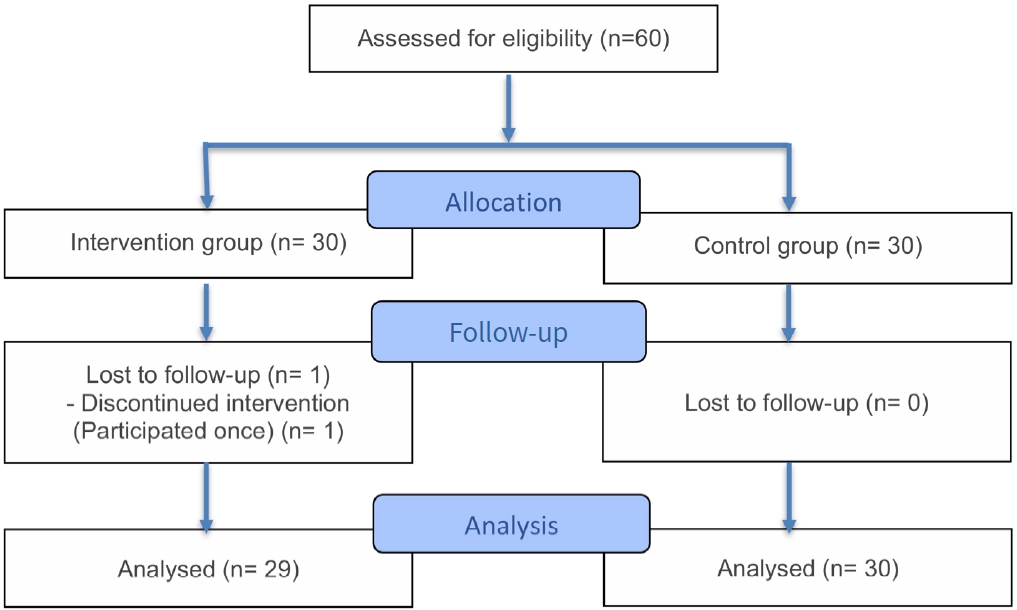
This study aimed to develop and evaluate the effectiveness of a therapeutic communication program based on King’s goal attainment theory, specifically designed for nurses providing care to patients with hematological oncology in a tertiary hospital setting. Methods: A non-equivalent control group design was employed, involving 59 nurses (intervention group: 29, control group: 30) with experience in hematological cancer care. The therapeutic communication program, developed according to the theoretical constructs of King’s theory, consisted of eight weekly sessions. Outcome variables included problem-solving ability, communication self-efficacy, and interaction satisfaction. The effects of the intervention were analyzed using the independent- and paired-samples t-test as well as a Wilcoxon signed-rank test. Results: In between-group comparisons of pre–post changes, communication self-efficacy increased significantly more in the intervention group than in the control group (p=.027). However, no significant between-group differences were found for problem-solving ability or interaction satisfaction. These findings suggest that the program effectively enhances therapeutic communication competencies among nurses in hematological oncology wards. Conclusion: The therapeutic communication program significantly improved problem-solving ability, communication self-efficacy, and interaction satisfaction among nurses in the intervention group within the hematological oncology ward. This theory-based intervention provides an evidence-based framework for strengthening clinical nursing practice and education.
  • 207 View
  • 20 Download
Influencing Factors of Fear of Cancer Recurrence among Adult Breast Cancer Survivors: A Cross-Sectional Study
Kyunghwa Lee, Eun-Jeong Park, Jung Ok Choi
Korean J Adult Nurs 2025;37(4):401-411.   Published online November 13, 2025
DOI: https://doi.org/10.7475/kjan.2025.0417
Purpose
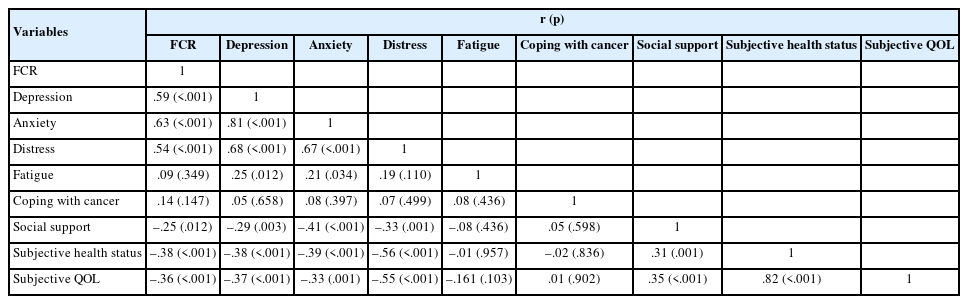
This study aimed to examine the level of fear of cancer recurrence (FCR) among adult breast cancer survivors and to identify factors influencing it. Methods: This cross-sectional study included 104 adult breast cancer survivors who were no longer receiving active treatment. Data were collected through self-report questionnaires addressing FCR, depression, anxiety, distress, fatigue, coping with cancer, social support, subjective health status, subjective quality of life, demographic characteristics, and disease-related characteristics. Surveys were administered both face-to-face and online between March and September 2024. Data analysis was conducted using descriptive statistics, frequencies, the independent t-test, one-way analysis of variance, Pearson’s correlation, and multiple regression. Results: The mean total FCR score was 78.83±25.71 (range, 0–168), reflecting a moderate level. Among participants, 22.1% scored above the cutoff for depression, 34.6% for mild anxiety, and 27.9% for severe distress. More than 70% of participants reported fatigue. Levels of coping with cancer, social support, subjective health status, and subjective quality of life were moderate or higher. Anxiety (β=.56, p<.001), fatigue (≤34) (β=.18, p=.019), and subjective quality of life (β=–.18, p=.022) significantly influenced FCR. Conclusion: Ongoing assessments and tailored interventions are essential to address FCR and to promote psychological well-being in breast cancer survivors following completion of active treatment.
  • 374 View
  • 14 Download
Purpose
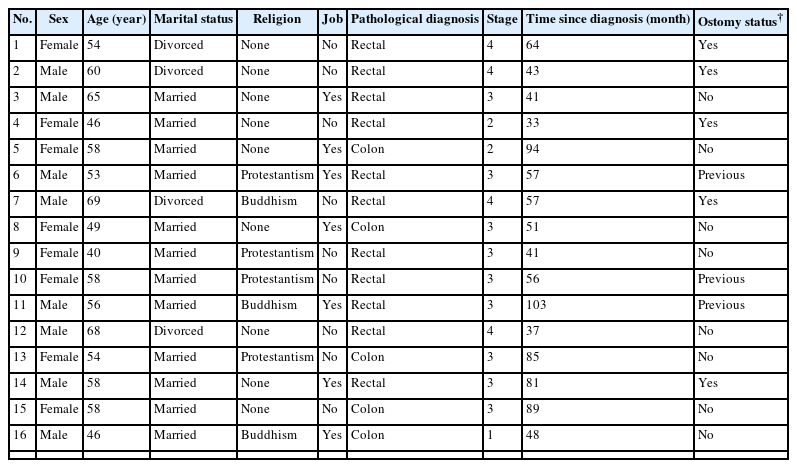
Colorectal cancer (CRC) survivors face significant challenges after completing treatment, including returning to work, concerns about the future, and financial difficulties. Understanding how inner strength developed after treatment affects survivors’ lives is crucial for informing patient-centered care. This study explored the unique inner strength exhibited by CRC survivors during their transition to a “new normal.” Methods: We recruited 16 patients from Korea who had completed treatment, to explore their experiences of managing their health. We conducted a qualitative study from July 4, 2022 to July 25, 2022 using individual interviews and directed content analysis. Transcribed interview data were analyzed to interpret meaning from the data, consistent with the naturalistic paradigm. Results: Participants described their transition to a new normal by reframing the cancer experience, struggling to return to normal life, experiencing growth promoted by supportive relationships, and encountering both positive and negative life changes. Throughout these experiences as survivors, inner strength played a critical role in adapting to a new normal. Conclusion: Our findings suggest that inner strength serves as a dynamic psychological resource, enabling CRC survivors to reframe their illness, regain disrupted roles, and reconstruct a meaningful life despite ongoing physical and emotional challenges. In doing so, inner strength facilitates their adaptation to a new normal.
  • 455 View
  • 18 Download
Psychological Distress and Influencing Factors in Newly Diagnosed Patients with Breast Cancer: A Cross-Sectional Study
Jin-Hee Park, Yong Sik Jung, Min Hee Hur, Yu Jin Jeong
Korean J Adult Nurs 2024;36(4):311-319.   Published online November 30, 2024
DOI: https://doi.org/10.7475/kjan.2024.36.4.311
Purpose
Cancer diagnosis is associated with psychological distress, which often leads to a significant reduction in adaptation and quality of life. This study aimed to identify the prevalence and related factors of psychological distress in newly diagnosed breast cancer patients.
Methods
The study included 138 women scheduled for surgery or neoadjuvant chemotherapy following a recent breast cancer diagnosis at a university hospital in Korea. Psychological distress was assessed using the National Comprehensive Cancer Network Distress Thermometer and problem lists. Data collection occurred from November 1, 2021, to November 30, 2022. Descriptive statistics and logistic regression analysis were utilized for data analysis.
Results
The average age of the participants was 51.72 years. Among the 138 participants, 67.4% (n=93) reported moderate to severe levels of psychological distress. Multivariate logistic regression analysis identified financial burden (Odds Ratio [OR]=4.32), fears (OR=5.35), and nervousness (OR=5.50) as predictors of moderate to severe psychological distress.
Conclusion
Approximately two-thirds of newly diagnosed breast cancer patients experienced significant psychological distress. Nervousness, fears, and financial burden were significant factors influencing this distress. Therefore, management of psychological distress should be implemented for patients experiencing financial burdens or emotional problems, such as nervousness and fear, from the time of diagnosis.

Citations

Citations to this article as recorded by  
  • Impact of fragmented care on cancer outcomes among korean women with breast and cervical cancer: a focus on regional and economic disparities
    Sun Jung Kim, Noorhee Son, Woo-Ri Lee, Dong-Woo Choi, Seojin Park, Kyu-Tae Han
    International Journal for Equity in Health.2025;[Epub]     CrossRef
  • Family roles and limitations as mediators in medical communication for cancer patients: A qualitative study
    Yeori Park, Jiyeon Kang, Yeonju Kim, Young Su Park, Sang-Ho Yoo, Taiwo Opeyemi Aremu
    PLOS One.2025; 20(10): e0333669.     CrossRef
  • 2,707 View
  • 76 Download
  • 2 Crossref
  • 0 Scopus

Review Article

Symptom Clusters among Lung Cancer Patients: A Scoping Review
Yun Young Choi, Jotsna Akter, Jiyeon Lee
Korean J Adult Nurs 2024;36(4):271-297.   Published online November 30, 2024
DOI: https://doi.org/10.7475/kjan.2024.36.4.271
Purpose
Lung cancer (LC) is the leading cause of cancer-related death globally, and understanding symptom clusters (SCs) among LC patients could improve symptom management. This scoping review provides a comprehensive summary of the most common SCs and their compositions identified in studies specifically investigating SCs of LC patients.
Methods
A scoping review was conducted following the Joanna Briggs Institute methodology. The study included LC patients as participants, SCs as the concept, and studies with distinct aim to investigate LC SCs as the context. We searched studies from inception to September 2022 in PubMed, Embase, PsycINFO, CINAHL, and the Cochrane Library databases using the terms: "lung cancer," "cancer survivors, " and "symptom cluster." Results: Of 41 reviewed reports, 188 SCs were identified. Both a priori and de novo method were used to identify LC SCs, with exploratory factor analysis being the most commonly used statistical method in the de novo approach. The three most frequent SCs were respiratory, gastrointestinal (GI), and psychological SCs. The most common respiratory SC included cough + dyspnea. Nausea + vomiting was the most prevalent cluster membership among GI SCs. Sad + feeling irritable + feeling nervous + worrying was the most common cluster membership among psychological SCs.
Conclusion
Respiratory, GI, and psychological SCs were common among LC patients, and addressing these clusters could improve symptom management strategies. Further research on SCs across the lung cancer trajectory is essential to enhance our understanding about SCs and facilitate effective symptom management throughout the disease course.
  • 1,837 View
  • 64 Download
  • 0 Scopus

Original Article

Purpose
This study investigated differences in inner strength, multiple identities, and quality of life among colorectal cancer survivors, considering gender and the presence of an ostomy. It also focused on identifying factors that influenced their quality of life.
Methods
In this cross-sectional study, 170 colorectal cancer survivors were recruited. Inner strength, multiple identities, and quality of life were assessed through an online survey. Within each subgroup, comparisons were made in two ways: (a) between women and men; and (b) between ostomy and non-ostomy groups.
Results
The quality of life for colorectal cancer survivors was higher among men than women. For inner strength, men reported higher levels of anguish and searching, whereas women showed higher levels of connectedness. The quality of life was higher in the non-ostomy group than the ostomy group. However, the non-ostomy group had a higher level of anguish and searching than the ostomy group. Inner strength emerged as the most powerful factor influencing quality of life after adjusting for age and gender.
Conclusion
This study emphasizes the significance of inner strength in colorectal cancer survivors. It provides a deeper understanding of quality of life in colorectal cancer survivors by examining factors that influence it and considering how these effects differ based on gender and the presence of an ostomy. To improve the quality of life of colorectal cancer survivors, it is essential to comprehend the roles of factors such as gender and ostomy and develop individualized interventions tailored to their specific characteristics.

Citations

Citations to this article as recorded by  
  • The Role of Inner Strength in Korean Colorectal Cancer Survivors on the Journey from Treatment to New Normal: A Qualitative Study
    Hannah Yu, Eunjung Ryu
    Korean Journal of Adult Nursing.2025; 37(3): 332.     CrossRef
  • Cultural Adaptation of a Web-Based Ostomy Care Intervention for Hispanic Cancer Patients and Caregivers: A Mixed Methods Study (Preprint)
    Xiaomeng Wang, Lixin Song, Amy Vondenberger, Fei Yu, Jia Liu, Roxana Delgado, Robert Svatek,  Natalia Villegas Rodriguez, Lurheinna Rosado Rivera, Mark Bonnen
    JMIR Cancer.2024;[Epub]     CrossRef
  • 942 View
  • 18 Download
  • 2 Crossref

Review Article

Patient Activation in Cancer Patients: Concept Analysis
Se Young Jang, Eun Sun Lee
Korean J Adult Nurs 2024;36(1):15-27.   Published online February 29, 2024
DOI: https://doi.org/10.7475/kjan.2024.36.1.15
Purpose
The aim of this study was to better understand the concept of patient activation in patients with cancer by identifying its dimensions and attributes and clarifying its definition through concept analysis. Methods: This concept analysis study used the method of Walker and Avant (2019), and systematically reviewed dictionary entries and 30 studies in various academic fields. Results: The concept of patient activation in patients with cancer was found to have four attributes: seeking health information, participating in treatment decision-making, confidence in health care, self-management behaviors. The antecedents identified were cancer history, fear of recurrence, information and resources provided by healthcare professionals, access to healthcare providers, negative perceptions of cancer, social support, and sociodemographic status. The consequences were appropriate treatment implementation, satisfaction with treatment, improved physical and mental health conditions, improved quality of life, reduced healthcare costs, and reduced stress. Conclusion: The development of patient activation measurements tailored to the characteristics of the disease and the goal of strengthening the role of patients, as well as the development and implementation of policies, programs, and guidelines to promote patient activation, will improve the medical experience and outcomes of cancer patients and adopt a more person-centered treatment approach.
  • 1,360 View
  • 33 Download
  • 0 Scopus

Original Articles

Mediating Effect of Resilience between Supportive Care Needs and Quality of Life of Female Genital Cancer Patients
Yu-Jung Son, Keum-Hee Nam
Korean J Adult Nurs 2022;34(3):269-279.   Published online June 30, 2022
DOI: https://doi.org/10.7475/kjan.2022.34.3.269
Purpose
This study aimed to confirm the relationship between supportive care needs and resilience of female genital cancer patients, and to investigate the mediating effect of resilience in the relationship between supportive care needs and quality of life.
Methods
This study was conducted with 105 outpatients and inpatients who were receiving treatment for female genital cancer at K University Hospital in B City. Data were collected from July 22, 2021 to August 17, 2021 and analyzed by using the SPSS/WIN 23.0 program. The correlation between the patients’ supportive care needs, resilience, and quality of life was analyzed by Pearson's correlation coefficients, and SPSS Process Macro was used for the significance of parameter indirect effects.
Results
The quality of life of female genital cancer patients showed a significant negative correlation with supportive care needs (r=-.68, p<.001), and a significant positive correlation with resilience (r=.53, p<.001). Moreover, resilience partially mediated the relationship between supportive care needs and quality of life (95% CI -0.009~-0.032).
Conclusion
Based on the results of this study, improving the resilience of female genital cancer patients may act as an additional coping strategy to reduce supportive care needs and establish an enhanced quality of life.

Citations

Citations to this article as recorded by  
  • Validity and Reliability of the Korean Version of Supportive Care Needs Survey-Short Form 34 for Patients With Cancer: A Methodological Study
    Eun Ji Park, Hye Young Kim, Ju-Hee Nho, Eun Ko, Allison W. Boyes
    Asian Nursing Research.2025; 19(1): 60.     CrossRef
  • Influences of Distress and Uncertainty on Supportive Care Needs in Preoperative Gynecological Cancer Patients in the Early Stages of Diagnosis
    Lee Na Yun, Jeong Hye Kim
    Asian Oncology Nursing.2025; 25(2): 53.     CrossRef
  • Influences of Fatigue, Uncertainty, and Resilience on Self-Care Behaviors in Cancer Patients Undergoing Chemotherapy
    Sa-Rang Kim, Gie-Ok Noh
    Asian Oncology Nursing.2025; 25(2): 110.     CrossRef
  • Factors influencing the supportive care needs of female patients with genital cancer in South Korea
    Yu-Jung Son, Keum-Hee Nam, JaeLan Shim
    Medicine.2023; 102(51): e36650.     CrossRef
  • 994 View
  • 22 Download
  • 4 Crossref
  • 2 Scopus
Structural Equation Model for Psychosocial Adjustment of Breast Cancer Survivors Based on Family Resilience Model
Jiyoung Seo, Myungsun Yi
Korean J Adult Nurs 2022;34(2):178-195.   Published online April 30, 2022
DOI: https://doi.org/10.7475/kjan.2022.34.2.178
Purpose
This study aimed to construct and test a hypothetical model which explains the psychosocial adjustment of breast cancer survivors using the family resilience model suggested by McCubbin and McCubbin.
Methods
The study participants were 242 breast cancer survivors who had finished active treatments within the past five years. Data were collected from September to October 2017 from an offline breast cancer self-help group survey and an online breast cancer support group. Data were analyzed using SPSS version 22.0 and AMOS version 23.0.
Results
The model fit indices for the modified hypothetical model were suitable for the recommended level: x2 =223.80 (df=88, p<.001), x2 /df=2.54, RMR=.04, GFI=.90, IFI=.93, CFI=.93, and RMSEA=.08. Symptoms and posttraumatic growth directly affected psychosocial adjustment. Symptoms were found to be the most influential factors in the psychosocial adjustment. All three family resilience factors-family hardiness, problem-solving communication, and problem-solving coping-directly affected posttraumatic growth and indirectly affected psychosocial adjustment through posttraumatic growth. These variables explained 81.2% of breast cancer survivors’ psychosocial adjustment.
Conclusion
Health care professionals need to continue to provide interventions for symptom relief and support to improve the psychosocial adjustment of breast cancer survivors. Additionally, practical nursing interventions should be prepared for individuals and families of breast cancer survivors to promote recovery and reinforce family resilience. This will ultimately improve the quality of life for breast cancer survivors and their families.

Citations

Citations to this article as recorded by  
  • Validation of the Korean Version of Patient-Centered Care Tool: For Outpatients
    Yeo Ju Kim, Gunjeong Lee, Sunyeob Choi
    Patient Preference and Adherence.2023; Volume 17: 1525.     CrossRef
  • Do spouse burden of care, family resilience, and coping affect family function in gynecologic cancer in Korea?: a cross-sectional study
    Minkyung Kim, Sukhee Ahn
    Korean Journal of Women Health Nursing.2022; 28(3): 197.     CrossRef
  • 777 View
  • 19 Download
  • 2 Crossref
  • 2 Scopus

Review Article

Sleep Disturbance in Patients with Prostate Cancer: A Scoping Review
Seoyoung Baek, Sungho Park, Hyein Kim, Sue Hyon Kim, Sanghee Kim
Korean J Adult Nurs 2022;34(1):1-14.   Published online February 28, 2022
DOI: https://doi.org/10.7475/kjan.2022.34.1.1
Purpose
Patients with prostate cancer have high survival rates, but report low Quality of Life (QOL) due to sleep difficulties. This scoping review aimed to explore and identify current publication trends, major concepts, measurements, and interventions regarding sleep disturbance in patients with prostate cancer. Methods Using the Arksey & O’Malley scoping review method, structured searches for articles published from 2000 to 2021 were conducted on six electronic databases using a combination of the terms “prostate cancer”, “malignant neoplasm of prostate”, “sleep*”, “circadian rhythm”, and “insomnia”. Results Thirty-one studies were reviewed. The publication rate has increased from 6.5% (2000~2005) to 51.6% (2016~2021). The Insomnia Severity Index (ISI) was the most frequently used subjective measurement. Objective measurements to measure sleep quality or sleep disturbance included actigraphy and Polysomnography (PSG). The incidence of sleep disturbance in patients with prostate cancer was 8.0% to 75.9%, and hormone and radiation therapy, hot flashes, and nocturia were identified as influencing factors. Intervention strategies presented were Cognitive Behavioral Therapy (CBT), Mindfulness-Based Cognitive Therapy (MBCT), Acceptance and Commitment Therapy (ACT), and qigong or tai chi programs. Conclusion Interest in sleep disturbance in patients with prostate cancer is increasing. Further studies are expected to measure the prevalence of sleep disturbance using objective and subjective measurements in various ways. Nurses must consider tailored interventions based on the individual characteristics of patients with prostate cancer.

Citations

Citations to this article as recorded by  
  • Predictors of sleep quality components in patients undergoing transarterial chemoembolisation: a cross-sectional study
    Ji Young Park, Myoung Soo Kim, Jung Mi Ryu
    Supportive Care in Cancer.2024;[Epub]     CrossRef
  • Research Trends of Non-Pharmacological Interventions for Sleep-Wake Disturbances in Cancer Patients
    Moon Ju Oh, Hee Sun Kim
    Asian Oncology Nursing.2022; 22(3): 163.     CrossRef
  • 910 View
  • 33 Download
  • 2 Crossref
  • 1 Scopus

Original Articles

Structure Equation Modeling for Resilience in Patients with Breast Cancer
Dong Rim Hyun, So Yeun Jun, Chang Wan Jun, Sue Kyung Sohn
Korean J Adult Nurs 2021;33(2):87-101.   Published online April 30, 2021
DOI: https://doi.org/10.7475/kjan.2021.33.2.87
Purpose
This study was conducted so as to determine a hypothetical model concerning factors affecting breast cancer patients' resilience. Methods: Data were collected via a self-administered questionnaire from 212 patients with breast cancer between July 25 and August 24, 2020. The data were analyzed using SPSS/WIN 20.0 and AMOS 21.0. Results: The model supported 7 of the 11 presented hypotheses for all participants. Test results indicated that “hope”, “uncertainty”, and “symptom experience” all directly affected participants' resilience, and that “uncertainty” also affected participants', “depression” and “hope”. “Spiritual well-being” affected participants' sense of “hope” and “symptom experience”. Of these variables, “hope” had the strongest direct influence on resilience across all participants. “Uncertainty” was found to directly and indirectly affect participants, whereas “spiritual well-being” indirectly affected the resilience of all participants. “Uncertainty” and “spiritual well-being” indirectly affected the resilience of all participants. Conclusion: These results suggest that management strategies to enhance breast cancer patients' resilience should address patients' uncertainty, spiritual well-being, hope, and symptom experience.

Citations

Citations to this article as recorded by  
  • Analysis of Educational Needs Related to Chemotherapy among Patients with Solid Tumors
    Se-Na Lee
    Asian Oncology Nursing.2025; 25(2): 89.     CrossRef
  • Resilience-related Breast Cancer: A Concept Analysis
    Fitria Endah Janitra, Nur Aini, Anggi Lukman Wicaksana
    Nurse Media Journal of Nursing.2023; 13(1): 31.     CrossRef
  • 877 View
  • 16 Download
  • 2 Crossref
  • 1 Scopus
Concept Analysis of Spiritual Distress in Cancer Patients Using a Hybrid Model
Jin Sook Kim, Il-Sun Ko
Korean J Adult Nurs 2021;33(2):169-188.   Published online April 30, 2021
DOI: https://doi.org/10.7475/kjan.2021.33.2.169
Purpose
This study was intended to clarify the concept of spiritual distress in cancer patients using the hybrid model of Schwarz-Barcott and Kim. Methods: The hybrid model was used to clarify the dimension, attributes, and definition of spiritual distress. In the theoretical phase, a systemic literature review of nursing and other disciplines was conducted. In the fieldwork phase, individual in-depth interviews were held with six cancer patients. In the final analytic phase, the results of the theoretical and fieldwork phases were integrated after comparing and reviewing. Results: The concept of spiritual distress was analyzed in three domains: a changed relationship with God, a changed relationship with the self, and a changed relationship with others. Also, 10 attributes were clarified. The changed relationship with God domain had two attributes: “low connectedness in relationship with God” and a “feeling of guilt”. The changed relationship with the self domain had five attributes: “loss of self-identity”, “changed meaning of life”, “loss of inner peace”, “dwelling on the cause of unsloved suffering”, and “avoidance of confronting death”. The changed relationship with others domain had three attributes: “shrunk relationships”, “the feeling of being unloved and unforgivable”, and “burden on family”. Conclusion: The concept of spiritual distress in patients with cancer encompasses multidimensional domains and 10 attributes. To assess spiritual distress in patients with cancer based on the findings of this study, it is necessary to develop a suitable spiritual distress assessment scale.

Citations

Citations to this article as recorded by  
  • The Development of a Tool for Assessment of Spiritual Distress in Cancer Patients
    Jin Sook Kim, Il-Sun Ko, Su Jin Koh
    Journal of Korean Academy of Nursing.2022; 52(1): 52.     CrossRef
  • A Concept Analysis of Stress in Hemodialysis Patients
    Bomi Kim, Hyeyoung Kim, Jisun Lee
    Korean Journal of Adult Nursing.2021; 33(6): 601.     CrossRef
  • 1,249 View
  • 8 Download
  • 2 Crossref
  • 2 Scopus
Effects of Hand Press Pellet on Constipation in Patients with Breast Cancer Receiving Chemotherapy
Dawoon Jung, Hyojung Park
Korean J Adult Nurs 2021;33(2):145-155.   Published online April 30, 2021
DOI: https://doi.org/10.7475/kjan.2021.33.2.145
Purpose
The purpose of this study was to evaluate whether hand press pellet is effective for constipation in breast cancer patients receiving chemotherapy. Methods: This was a quasi-experimental study that used non-equivalent control group pretest-posttest design. Participants were 52 breast cancer patients-26 each in the experimental and control groups. The intervention was conducted thrice a week for 6 weeks; for the experimental group, a hand press pellet was applied to the corresponding points (A1, A5, A8, A12, A16, N18, E22, K9, F6, D2, D6, H2, L4, B7, B19) of the left hand (palm and back) to alleviate constipation. Three and 6 weeks after the intervention, outcomes were measured by using the Constipation Assessment Scale, Bristol Stool Form Scale, and Patient Assessment of Constipation-Quality of Life questionnaire. Results: A significant difference was observed between the two groups on the Constipation Assessment Scale (χ2=44.38, p<.001) and Bristol Stool Form Scale (χ2=33.24, p<.001). Patient assessment of constipation-quality of life of the experimental group were statistically significant compared with that of the control group (F=37.23, p<.001). Conclusion: Hand press pellet can be used as an effective nursing intervention to alleviate constipation in breast cancer patients.

Citations

Citations to this article as recorded by  
  • Effects of hand-press pellet on pain and daily life of elders with chronic lower back pain: randomized controlled trial
    Hyojung Park, Hyejin Lee
    BMC Complementary Medicine and Therapies.2024;[Epub]     CrossRef
  • 752 View
  • 19 Download
  • 1 Crossref
  • 1 Scopus
Purpose
This study aimed to examine the influence of lifestyle-related factors, such as sleep quality, eating habits, and perceived stress, on the incidence of thyroid cancer in healthy adults. Methods: This study is a cross-sectional case-control study comparing lifestyle-related factors in thyroid cancer and healthy groups. Outpatients with thyroid cancer were recruited from 2012 to 2013, 3~6 months after thyroidectomy at a tertiary hospital in Seoul, Korea (n=468). For the control group, 935 healthy adults were recruited by propensity score matching on demographic characteristics in a 1:2 ratio from hospital health checkup data. The effect of sleep quality, eating habits, and perceived stress on the incidence of thyroid cancer was determined through multiple logistic regression analysis and backward stepwise variable selection. Results: Sleep disturbance and mild/moderate daytime dysfunction were found to have a 1.22 and 1.66/1.77-fold influence, respectively, in patients with thyroid cancer than in healthy controls (p<.05). Coffee consumers who drink 3~6 times/day showed reduced cancer incidence than those who drink very little (odds ratio=0.53, 95% confidence interval=0.32~0.87). Perceived stress was a significant risk factor in univariate (p=.004), but not in multivariate analysis. Conclusion: These findings highlight the need for evaluating sleep quality, especially in high-risk adults and patients with thyroid cancer. Preventive measures should be adopted to lower stress levels and improve sleep quality.

Citations

Citations to this article as recorded by  
  • Development and Effects of a Smartphone Application to Improve Self-Management in Workers Who Underwent Thyroid Cancer Surgery
    Myoyoun Kim, Seon Young Hwang
    Cancer Nursing.2025;[Epub]     CrossRef
  • Multidimensional Prediction Method for Thyroid Cancer Based on Spatiotemporally Imbalanced Distribution Data
    Zhiwei Jia, Yuqi Huang, Yanhui Lin, Min Fu, Chenhao Sun
    IEEE Access.2024; 12: 4674.     CrossRef
  • Determining the spatial non-stationarity underlying social and natural environment in thyroid cancer in China
    Xiyu Zhang, Yongqiang Lai, Xiaodan Bai, Bing Wu, Wenjing Xiang, Chenxi Zhang, Guihong Geng, Wenqing Miao, Qi Xia, Qunhong Wu, Huiying Yang, Yanjie Wang, Wanxin Tian, Yu Cao, Xinwei Liu, Hongyu Li, Yulu Tian, Zhe Song, Ziwen Zhao, Zhipeng Huang, Xiaonan Ch
    Science of The Total Environment.2023; 870: 162009.     CrossRef
  • Sleep quality, stress and thyroid cancer: a case–control study
    S. Afrashteh, M. Fararouei, M. T. Parad, A. Mirahmadizadeh
    Journal of Endocrinological Investigation.2022; 45(6): 1219.     CrossRef
  • 963 View
  • 18 Download
  • 4 Crossref
  • 4 Scopus
Purpose
Patient outcomes should improve through patient involvement and improved interactions with healthcare providers during the care process. This study aimed to examine factors affecting the perceived health status of patients with cancer, focused on their treatment experiences, and explored the differences in treatment-related experiences according to the patients’ characteristics. Methods: This cross-sectional study used the 2015 Korea National Health and Nutrition Examination Survey, which assesses patients’ general characteristics, treatment-related experiences, and perceived health status. Data from 255 cancer survivors aged 19 years or older were used in this study. Descriptive statistics, independent t-tests, and multiple regression were used for the data analyses. Results: Cancer patients’ perception of a lower health resulted from the following factors: insufficient information provision during the care process (β=-.13, p=.026), less participation in the treatment-related decision-making (β=-.25, p=.005), and more comorbidities (β=-.31, p=.018). A higher education level (β=.68, p<.001) was associated with higher perceived health status. The set of significant factors explained 19% of the total variance of the perceived health status. Conclusion: Sufficient information provision during the care process and patients’ participation in treatment-related decision-making affected the perceived health status of cancer patients. Hence, providing cancer patients with information and involving them in decision-making may improve illness self-management capabilities and health status.
  • 494 View
  • 3 Download
  • 0 Scopus
Purpose
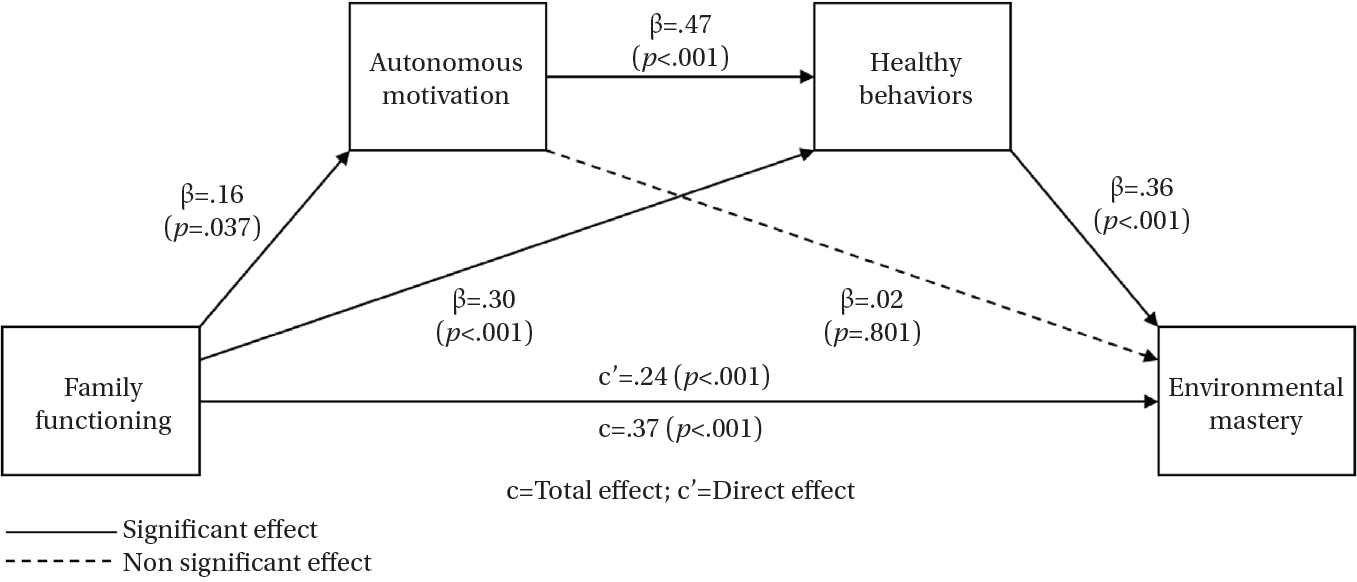
The purpose of this study was to investigate family support and medical staff support and their mediating effects in the relationship between self-efficacy and resilience in patients with colorectal cancer with stoma. Methods: The participants were 170 patients with colorectal cancer who were hospitalized or receiving treatment for colorectal anus surgery in general hospitals located in B, D, and I cities. Data were collected from July 1 to October 25, 2019 through a structured questionnaire. Data analysis was conducted using descriptive statistics, Pearson's correlation coefficient, multiple linear regression analysis, and the bootstrapping method with SPSS/WIN 25.0 and the PROCESS macro program. Results: The mean score for resilience was 2.70±0.62 (range 0~4). Resilience was significantly associated with self-efficacy (r=.59, p<.001), family support (r=.38, p<.001), and medical staff support (r=.37, p<.001). Using Baron and Kenny's approach and PROCESS macro model 4, resilience was found to be affected by self-efficacy (β=.53, p<.001). Further, family support (β=.25, p<.001) and medical staff support (β=.39, p<.001) were affected by self-efficacy. The partial mediating effects of family support (β=.25, p<.001, 95% confidence interval 0.01~0.12) and medical staff support(β=.15, p=.022, 95% confidence interval 0.01~0.16) in the impact of self-efficacy on resilience were confirmed. Conclusion: The impact of self-efficacy on resilience was mediated by family support and medical staff support in patients with colorectal cancer with stoma. The results suggest that family and medical staff support need to be considered in developing nursing interventions to improve self-efficacy and resilience in these patients.

Citations

Citations to this article as recorded by  
  • Influences of Fatigue, Uncertainty, and Resilience on Self-Care Behaviors in Cancer Patients Undergoing Chemotherapy
    Sa-Rang Kim, Gie-Ok Noh
    Asian Oncology Nursing.2025; 25(2): 110.     CrossRef
  • 865 View
  • 34 Download
  • 1 Crossref
  • 0 Scopus
Stigma, Adjustment, and Quality of Life of Middle-aged Male Patients with Lung Cancer
Mi young Yoo, Eunyoung E. Suh
Korean J Adult Nurs 2020;32(5):494-503.   Published online October 31, 2020
DOI: https://doi.org/10.7475/kjan.2020.32.5.494
Purpose
To investigate the relationship between stigma, adjustment, and quality of life of middle-aged male patients with lung cancer and the influences of those factors on the patients’ quality of life.
Methods
A descriptive survey design was used. A total of 120 male patients between 45 to 64 years participated in the study. They answered a self-reported survey composed of Cataldo Lung Cancer Stigma Scale, Korean Mini-Mental Adjustment to Cancer Scale, and The Functional Assessment of Cancer Therapy Scale-General Version 4. The data were analyzed using Pearson’s correlation coefficients, stepwise multiple regression by the SPSS 25 version.
Results
The stigma showed a positive correlation with “helplessness-hopelessness” and “anxious preoccupation” (r=.30, p=.001; r=.41, p<.001, respectively), and a negative correlation with emotional well-being (r=-.24, p=.008). “Helplessness-hopelessness” and “anxious preoccupation” were negatively correlated with quality of life (r=-.61, p<.001; r=-.46, p<.001, respectively). “Fatalism”, “fighting spirit”, and “cognitive avoidance” showed positive correlations with quality of life (r=.37, p<.001; r=.42, p<.001; r=.19, p=.035, respectively). Factors influencing quality of life by multiple regression were identified as helpless-hopelessness, fatalism, performance status, and anxious preoccupation (F=35.76, p<.001, Adjusted R2 =54%).
Conclusion
Maximizing positive adjustment response and improving performance status were effective in improving quality of life of middle-aged male patients with lung cancer. The development of nursing interventions focusing on psychological adjustment and physical activity should be warranted for the given patient population.

Citations

Citations to this article as recorded by  
  • Factors Affecting Quality of Life Among Patients with Primary Lung Cancer
    Mideum Kang, Myung Sun Hyun, Sun Hyoung Bae, Sunjoo Boo
    Asian Oncology Nursing.2024; 24(3): 144.     CrossRef
  • 630 View
  • 18 Download
  • 1 Crossref
  • 0 Scopus
Effects of a Medication Adherence Promotion Program in Breast Cancer Patients under Adjuvant Hormonal Therapy
Seung Hee Yu, Jeong Hee Kang
Korean J Adult Nurs 2020;32(3):223-234.   Published online June 30, 2020
DOI: https://doi.org/10.7475/kjan.2020.32.3.223
Purpose
The objective of this study was to assess effects of a medication adherence promotion program for breast cancer patients receiving adjuvant hormonal therapy.
Methods
This study used a randomized control group repeated measures design. A total of 79 participants were recruited from an outpatient clinic in the Chonbuk National University Hospital, Jeonju city. The program's effects on medication adherence, perceived stress, depression, and fatigue were assessed at three points: before, at the 9th week, and again at the 16th week of the program application. The data were collected from July 3 to November 9, 2017.
Results
Statistically significant differences in changes in medication adherence, perceived stress, and depression over the assessment points between experimental and control groups were revealed. Scores on medication adherence in the experimental group improved at the 9th week mark and lowered a little at the 16th week, but remained higher than before the program application, however. Scores on perceived stress and depression in the experimental group improved at the 9th week and stayed almost at the same level at the 16th week.
Conclusion
It is clear that consistent nursing interventions are needed to promote and maintain medication adherence and associated symptoms, particularly for breast cancer patients who require long-term hormonal therapy.
  • 489 View
  • 10 Download
  • 1 Scopus
Structural Equation Modeling of Quality of Life in Patients With Uterine Cancer
So Yeun Jun, Il Sun Ko
Korean J Adult Nurs 2020;32(2):109-123.   Published online April 30, 2020
DOI: https://doi.org/10.7475/kjan.2020.32.2.109
Purpose
This study was conducted to determine a hypothetical model for the factors affecting uterine cancer patients’ health-related quality of life.
Methods
Data were collected from 409 patients with cervical cancer or endometrial cancer, between March 16 and May 15, 2015, using a self-administered questionnaire . The data were analyzed using SPSS v18 and AMOS v21.
Results
The model supported 14 of the 19 hypotheses for all participants. The results indicated that resilience, marital intimacy, social support, and perceived health status directly affected participants’ quality of life, while sexual function indirectly affected participants’ quality of life. Of these variables, perceived health status had the strongest direct effect on participants’ quality of life. Social support and sexual function were found to directly affect perceived health status. Somatic symptoms were found to directly affect sexual function, and resilience and marital intimacy in turn were found to directly affect somatic symptoms.
Conclusion
These results suggest that management strategies to enhance uterine cancer patients’ quality of life should address patients’ perceived health status, social support, sexual function, and marital intimacy.

Citations

Citations to this article as recorded by  
  • Self-disclosure in Adult Patients With Cancer
    Hyungran Lee, Younhee Jeong
    Cancer Nursing.2025; 48(4): 289.     CrossRef
  • Factors Influencing Health-Related Quality of Life in Patients With Atrial Fibrillation
    Hyeon-Ok Lee, Ji-Yeong Seo
    Journal of Cardiovascular Nursing.2025;[Epub]     CrossRef
  • Influencing factors on quality of life in women undergoing cancer treatment: a cross-sectional study
    Hyun Jin Jung, Yu Jin Hong, Seo Young Hong, Ju-Hee Nho
    Women's Health Nursing.2025; 31(3): 192.     CrossRef
  • Health-related quality of life in female patients with reumatoid arthritis: a structural equation model
    Bukyung Kim, Mi-Hae Sung
    Korean Journal of Women Health Nursing.2023; 29(2): 91.     CrossRef
  • Quality of Life in Middle-aged Men with Prostatic hyperplasia: A Structural Equation Model
    Hee Nam Moon, Seung Hee Yang
    Korean Journal of Adult Nursing.2023; 35(4): 327.     CrossRef
  • Factors influencing quality of life in caregivers of adolescents with developmental disabilities
    Joung Woo Joung
    Osong Public Health and Research Perspectives.2022; 13(4): 298.     CrossRef
  • Structure Equation Modeling for Resilience in Patients with Breast Cancer
    Dong Rim Hyun, So Yeun Jun, Chang Wan Jun, Sue Kyung Sohn
    Korean Journal of Adult Nursing.2021; 33(2): 87.     CrossRef
  • Influence of Perceived Health, Anxiety, Depression, and Social Support on Quality of Life in Patients with Meniere Disease
    Young Mi Ryu, Woo Joung Joung
    Korean Journal of Adult Nursing.2020; 32(4): 399.     CrossRef
  • 945 View
  • 17 Download
  • 8 Crossref
  • 5 Scopus
Quality of Life and Supportive Care Needs of Back-to-Work Breast Cancer Survivors
Su Jeong Han, Hye Won Kim, Dae Sung Yoon, Mi Ran Kim
Korean J Adult Nurs 2019;31(5):552-561.   Published online October 31, 2019
DOI: https://doi.org/10.7475/kjan.2019.31.5.552
PURPOSE
The purpose of this study was to identify the relationship between the supportive care needs and quality of life of back-to-work breast cancer survivors, and determine the factors that affect their quality of life.
METHODS
Data were collected from 146 patients who had undergone surgery and treatment for breast cancer at Konyang University Hospital in Daejeon city and were receiving outpatient care from December 21, 2017 to November 30, 2018. The collected data were analyzed using the SPSS/WIN 21.0 program with descriptive statistics, an independent t-test, a one-way ANOVA, the Duncan test, Pearson's correlation coefficient, and hierarchical multiple regression.
RESULTS
Back-to-work breast cancer survivors show higher physical and mental health indices, which reflect quality of life, when they have fewer physical supportive care needs. Additionally, their physical and mental health indices based on the characteristics of the illness differed according to the cancer stage.
CONCLUSION
It is necessary to develop and test the effectiveness of health education programs that meet the supportive care needs and improve the quality of life of breast cancer survivors returning to work.

Citations

Citations to this article as recorded by  
  • Return-to-Work Support Needs and Influencing Factors Among Korean Young Adult Cancer Survivors: A Cross-Sectional Study
    Kisook Kim, Hyohyeon Yoon
    Oncology Nursing Forum.2025; 52(2): 151.     CrossRef
  • Validity and Reliability of the Korean Version of Supportive Care Needs Survey-Short Form 34 for Patients With Cancer: A Methodological Study
    Eun Ji Park, Hye Young Kim, Ju-Hee Nho, Eun Ko, Allison W. Boyes
    Asian Nursing Research.2025; 19(1): 60.     CrossRef
  • Factors affecting return to work in breast cancer survivors in Korea: a cross-sectional study
    Kate J. Sohn, Sung Hae Kim, Hyojin Lee, Sue Kim
    Women's Health Nursing.2024; 30(4): 277.     CrossRef
  • The Impact of Symptom Burden, Social Support, Self-Efficacy, and eHealth Literacy on the Quality of Life of Patients Undergoing Breast Cancer Treatment: A Cross-Sectional Study
    Bang-Eun Lee, Ju-Yeon Uhm
    Journal of Korean Academy of Fundamentals of Nursing.2023; 30(3): 345.     CrossRef
  • Unmet supportive care needs of breast cancer survivors: a systematic scoping review
    Rongrong Fan, Lili Wang, Xiaofan Bu, Wenxiu Wang, Jing Zhu
    BMC Cancer.2023;[Epub]     CrossRef
  • Impact of post-treatment symptoms on supportive care needs among breast cancer survivors in South Korea
    Unhee Kim, Ju-Young Lee
    Asia-Pacific Journal of Oncology Nursing.2023; 10(10): 100295.     CrossRef
  • Factors associated with the quality of work life among working breast cancer survivors
    Juhyun Jin
    Asia-Pacific Journal of Oncology Nursing.2022; 9(2): 97.     CrossRef
  • Cancer Survivorship Care and Roles of Oncology Nurses
    Eun Young Park
    Asian Oncology Nursing.2022; 22(3): 121.     CrossRef
  • Supportive care needs of patients after breast cancer surgery
    Slobodan Tomić, Sanja Tomić, Milena Mikić, Goran Malenković
    Sestrinska rec.2022; 25(84): 4.     CrossRef
  • Factors Influencing Supportive Care Needs of Colorectal Cancer Survivors
    Hyekyung Kim, Yang-Sook Yoo
    Asian Nursing Research.2021; 15(1): 60.     CrossRef
  • Factors Influencing Quality of Life among Cancer Survivors: Based on the Korean National Health and Nutrition Examination Survey (KNHANES) for 2019
    Hee Jung Kim
    The Korean Journal of Rehabilitation Nursing.2021; 24(2): 109.     CrossRef
  • Factors Affecting Quality of Work Life in a Sample of Cancer Survivor Female Nurses
    Ju Hyun Jin, Eun Ju Lee
    Medicina.2020; 56(12): 721.     CrossRef
  • A Narrative Inquiry into the Adjustment Experiences of Male Bladder Cancer Survivors with a Neobladder
    So Hee Kim, Eunjung Ryu, Eun-Ju Kim
    International Journal of Environmental Research and Public Health.2020; 17(21): 8260.     CrossRef
  • 751 View
  • 12 Download
  • 13 Crossref
  • 0 Scopus
PURPOSE
To identify the factors influencing Quality of Life (QoL) in rectal cancer patients and to examine whether perceived social support mediates the relationship between defecation function and QoL.
METHODS
Using self-report questionnaires, a descriptive survey was conducted with 131 rectal cancer patients who underwent anal sphincter-saving resection, in a large medical center in Korea. Data were collected between September and November, 2014, using research instruments validated in the Korean language. The data were analyzed using SPSS/WIN 21.0 and AMOS 21.0.
RESULTS
The mean age and post-surgical follow-up period of the participants were 59.0±10.2 years and 15.9±9.8 months, respectively. Multiple linear regression analysis revealed that, after adjusting for age and gender, defecation function, perceived social support, and employment status predicted QoL. Path analysis showed that perceived social support partially mediated the relationship between defecation function and QoL with a significant indirect effect.
CONCLUSION
These results suggest that a positive perception of social support from family and healthcare providers is necessary to improve the QoL of patients experiencing defecation dysfunction after rectal cancer surgery. To this end, periodic counseling and education from outpatient healthcare providers, during the postoperative follow-up period, could encourage patients to perceive higher social support.

Citations

Citations to this article as recorded by  
  • Structural equation modeling of symptom clusters and health-related quality of life among patients with advanced colorectal cancer receiving chemotherapy in Bangkok, Thailand
    Savitree Suratako, Yaowarat Matchim, Mary Quinn Griffin
    Belitung Nursing Journal.2025; 11(4): 468.     CrossRef
  • A causal model of health-related quality of life in colorectal cancer patients post-surgery
    Thi Hong Hanh Tran, Sureeporn Thanasilp, Noppamat Pudtong
    European Journal of Oncology Nursing.2024; 72: 102691.     CrossRef
  • The Relationships among Social Support, Bowel Function Symptoms and Uncertainty in Rectal Cancer Patients
    Kyungmi Lee, Semi Lim
    Journal of Korean Academy of Fundamentals of Nursing.2021; 28(4): 421.     CrossRef
  • 508 View
  • 4 Download
  • 3 Crossref
  • 2 Scopus
Influence of Hospital Nurse Staffing Levels on the Colorectal Cancer Evaluation Grades, Mortality, and Length of Stay
Yunmi Kim, Se Young Kim
Korean J Adult Nurs 2019;31(5):479-486.   Published online October 31, 2019
DOI: https://doi.org/10.7475/kjan.2019.31.5.479
PURPOSE
In Korea, cancer is the leading cause of death, and colorectal cancer accounts for a third of deaths caused by cancer. This study aimed to analyze the influence of hospital nurse staffing level on colorectal cancer evaluation grades, mortality rate, and the length of stay of patients who underwent surgery for colorectal cancer.
METHODS
Secondary data collected in 2016, 2018 from the Health Insurance Review and Assessment Service, was used to measure nurse staffing, based on the adjusted nursing grade in general units and was then categorized as adhering with or violating the Medical Service Act. The influence of the nurse staffing on colorectal cancer evaluation grades, and the mortality rate in 129 hospitals was analyzed using multivariate logistic regression and multivariate gamma regression, respectively, and its influence on length of stay was analyzed through hierarchical multiple regression.
RESULTS
Hospitals that adhered to the Medical Service Act in nurse staffing had significantly lower odds for poor colorectal cancer evaluation grades. Hospitals which nurse staffing adhered to the Medical Service Act had a significantly lower mortality rate than those that violated it (B=−0.51, p=.019), and had a significantly shorter length of stay (β=−.19, p=.034).
CONCLUSION
Improvement of nurse staffing levels, in compliance with the Medical Service Act is crucial to provide high-quality nursing services to patients undergoing colorectal cancer surgery and to decrease the mortality rate, and shorten the hospitalization period required for surgery and recovery.

Citations

Citations to this article as recorded by  
  • Machine Learning in Optimising Nursing Care Delivery Models: An Empirical Analysis of Hospital Wards
    Manar Aslan, Ergin Toros
    Journal of Evaluation in Clinical Practice.2025;[Epub]     CrossRef
  • Mortality in orthopedic patients: a retrospective review of 333 medical records
    Kamran Shirbache, Asma Mafhoumi, Nazanin Anaraki, Elham Madreseh, Seyyed Hossein Shafiei, Nima Bagheri, Leila Oryadi Zanjani, Ahmadreza Nezameslami, Gholamreza Garmroudi, Mohammad Hossein Nabian
    European Journal of Orthopaedic Surgery & Traumatology.2025;[Epub]     CrossRef
  • Factors Associated with In-Hospital Mortality in Acute Care Hospital Settings: A Prospective Observational Study
    Ana María Porcel-Gálvez, Sergio Barrientos-Trigo, Eugenia Gil-García, Olivia Aguilera-Castillo, Antonio Juan Pérez-Fernández, Elena Fernández-García
    International Journal of Environmental Research and Public Health.2020; 17(21): 7951.     CrossRef
  • 739 View
  • 7 Download
  • 3 Crossref
  • 3 Scopus

Review Article

PURPOSE
This systematic review and meta-analysis was performed to confirm the effects of exercise on Breast Cancer-Related Lymphedema (BCRL) in breast cancer survivors.
METHODS
Totally, 1,614 articles were retrieved from databases including PubMed, Ovid MEDLINE, Embase, Cochrane CENTRAL, CINAHL, Korea Med, Kmbase, KISS, NDSL, KiSTi, and academic journals related to nursing in Korea between June 17 and 18, 2019. Fifteen Randomized Controlled Trials (RCTs) were selected for the analysis from June 19 to July 12, 2019. Cochrane's Risk of Bias assessed the quality and risk of bias of selected articles. Review Manager version 5.3 was used for the meta-analysis.
RESULTS
Studies were published since 2006 including a total of 1,109 participants who were diagnosed with or at risk of BCRL or had undergone surgery for breast cancer treatment. Although exercises were found ineffective for reducing upper extremity edema (Z=0.37, 95% Confidence Interval [CI]=−0.06~0.04, p=.710), they significantly improved shoulder Range of Motion (ROM), especially flexion (Z=5.88, 95% CI=3.06~6.12, p<.001) and abduction (Z=3.41, 95% CI=2.71~10.06, p<.001), upper extremity function (Z=4.02, 95% CI=−12.09~−4.17, p<.001), and Quality of Life (QoL) (Z=3.00, 95% CI=0.13~0.61, p=.003). Egger's regression test assessed publication bias (Intercept=3.75, t=1.79, df=8, p=.111).
CONCLUSION
Results suggest that exercise is beneficial to BCRL management, especially improvement of shoulder ROM, upper extremity function, and QoL. However, exercise must be performed carefully to prevent side effects. Therefore, nurses should continuously observe signs and symptoms related to BCRL and educate breast cancer survivors on safely performing exercise.

Citations

Citations to this article as recorded by  
  • A Narrative Inquiry of the Difficulties by Breast Cancer Survivors in the Sports Participating
    Ji Yeon Suh, Seami Lim, Junho Lee
    IJASS(International Journal of Applied Sports Sciences).2022; : 203.     CrossRef
  • Funcionalidad y marcha en pacientes con linfedema de miembro inferior tratados mediante un programa de ejercicio terapéutico: serie de casos
    P. Toro, P. Araya-Castro, E. Srur
    Fisioterapia.2021; 43(3): 143.     CrossRef
  • 1,227 View
  • 44 Download
  • 2 Crossref
  • 1 Scopus
Original Articles
Factors Influencing the Improvement in Lifestyle Among Patients with Colorectal Cancer
Song Ok Lim, Sangeun Jun
Korean J Adult Nurs 2019;31(3):325-336.   Published online June 30, 2019
DOI: https://doi.org/10.7475/kjan.2019.31.3.325
PURPOSE
This study aimed to investigate the improvement in lifestyle of patients with Colorectal Cancer (CRC) by examining their lifestyle before and after diagnosis, and to identify the factors influencing lifestyle improvement to prevent the recurrence of CRC.
METHODS
The participants were 125 patients with CRC who visited the outpatient clinic of Kyungpook National University Chilgok Hospital in Daegu from December 2017 to March 2018. Questionnaires consisted of items on CRC-related lifestyle, knowledge of lifestyle risks for CRC, beliefs of lifestyle improvement (perceived benefits and barriers), self-efficacy, and fear of cancer recurrence. Lifestyle improvement referred to the score given to the improved lifestyle through the score difference in the measure of lifestyle related to CRC before and after diagnosis. The collected data were analyzed using SPSS/WIN 21.0 program.
RESULTS
The factors influencing lifestyle improvement were gender (β=.46, p<.001), age (β=.31, p<.001), knowledge of lifestyle risks for CRC (β=.20, p=.005), perceived benefits of lifestyle improvement (β=.19, p=.008), and number of discomforts(symptoms) that impede lifestyle improvement (β=.17, p=.016). These variables explained 38% of CRC patients' lifestyle improvement.
CONCLUSION
These findings suggest that we need to find ways to provide knowledge of the lifestyle risks for CRC to patients with CRC and improve their perceptions of the benefits of lifestyle improvement to promote lifestyle improvement and help prevent the recurrence of CRC after CRC diagnosis.

Citations

Citations to this article as recorded by  
  • Health-promoting lifestyle among Chinese patients with colorectal polyps: a cross-sectional study
    Jingru Zhou, Yanjun Liu, Fang Yang, Yanfen Wang, Yan Liu, Wenwen Ming, Sisi Guo, Dan Zhou, Lin He, Xiaoli Zhong
    Scientific Reports.2025;[Epub]     CrossRef
  • The Proliferation Inhibitory Effect of Postbiotics Prepared from  Probiotics with Antioxidant Activity against HT-29 Cells
    Yeeun Kim, Hak Jun Kim, Keunho Ji
    Applied Sciences.2022; 12(24): 12519.     CrossRef
  • What is the prevalence of fear of cancer recurrence in cancer survivors and patients? A systematic review and individual participant data meta‐analysis
    Yvonne L. Luigjes‐Huizer, Nina M. Tauber, Gerry Humphris, Nadine A. Kasparian, Wendy W. T. Lam, Sophie Lebel, Sébastien Simard, Allan Ben Smith, Robert Zachariae, Yati Afiyanti, Katy J. L. Bell, José A. E. Custers, Niek J. de Wit, Peter L. Fisher, Jacquel
    Psycho-Oncology.2022; 31(6): 879.     CrossRef
  • Convalescent Hospital Use among Young and Older Female Cancer Survivors
    Hyesun Park, Kisook Kim
    International Journal of Environmental Research and Public Health.2021; 18(5): 2744.     CrossRef
  • 641 View
  • 19 Download
  • 4 Crossref
  • 4 Scopus
Oncology Nurses' Knowledge Regarding Fertility Preservation for Patients with Cancer
Miok Kim, Ju Hee Nho, Aeran Lee
Korean J Adult Nurs 2019;31(3):315-324.   Published online June 30, 2019
DOI: https://doi.org/10.7475/kjan.2019.31.3.315
PURPOSE
Cancer diagnosis and treatment affect patient fertility. Although the reproductive method has been well studied, early assessment of fertility and discussions of infertility-related issues are not very common. This study evaluated oncology nurses' knowledge regarding fertility preservation for patients with cancer.
METHODS
This study was conducted from March 11 to May 13, 2015 using a convenience sample of nurses who were caring for patients with cancer at a tertiary hospital in South Korea. We recruited 123 oncology nurses and used questionnaires to collect cross-sectional data regarding their knowledge about the causes of fertility impairment (Cause score), fertility preservation in general (General score), and methods of fertility preservation (Method score).
RESULTS
The mean total score of fertility preservation knowledge was 15.46±3.64, and the mean Cause, General, and Method scores were 6.28±1.86 out of 11, 5.72±1.50 out of 8, and 3.54±1.19 out of 6, respectively. Significant differences in knowledge levels were found according to nurses' marital status and total nursing experience. Nurses who assessed the issue of fertility upon the first encounter with patients and provided active nursing care had the greatest knowledge.
CONCLUSION
Oncology nurses should have in-depth understanding of fertility preservation and must discuss the topic with patients with cancer. Nurses should also identify each patient's individual needs through continuous assessment and provide referrals to appropriate specialists both before and during treatment.

Citations

Citations to this article as recorded by  
  • Oncofertility Experience in Young Women with Breast Cancer
    Jisung Park, Aekyung Kim
    Journal of Korean Academy of Fundamentals of Nursing.2025; 32(1): 82.     CrossRef
  • Insights into the Knowledge and Barriers of Oncofertility Among Oncology Nurses in Saudi Arabia
    Isamme AlFayyad, Muawiyah Yaqub, Mohamad AlTannir
    Journal of Cancer Education.2025;[Epub]     CrossRef
  • Psychometric properties of the Korean version of the oncofertility barriers scales among nurses: A methodological study
    Hae Jeong An, Yoonjung Kim
    Asia-Pacific Journal of Oncology Nursing.2023; 10(9): 100275.     CrossRef
  • 738 View
  • 16 Download
  • 3 Crossref
  • 3 Scopus
Influence of Social Cognitive Factors on Physical Activity among Breast Cancer Survivors
Hyenam Hwang
Korean J Adult Nurs 2019;31(2):211-218.   Published online April 30, 2019
DOI: https://doi.org/10.7475/kjan.2019.31.2.211
PURPOSE
To measure the degree of physical activity among breast cancer survivors and to identify how it was influenced by social cognitive factors, as defined in Bandura's social cognitive theory.
METHODS
A total of 128 breast cancer survivors were recruited for this descriptive study and answered the survey questionnaire. The collected data covered general characteristics, physical activity, and social cognitive factors, such as self-efficacy, outcome expectations, goal setting, and socio-structural factors (social support and negative impact of cancer). Data collection was conducted from July to October 2017.
RESULTS
The degree of physical activity among breast cancer survivors was moderate. The participants' level of physical activity differed according to their Body Mass Index (BMI) and type of surgery. Physical activity was significantly correlated with exercise goal setting, exercise self-efficacy, outcome expectations, and family support. Exercise goal setting (β=.55, p<.001), BMI (kg/m2) (β=−.21, p=.003), and exercise self-efficacy (β=.15, p=.040) were identified as factors influencing physical activity.
CONCLUSION
Intervention programs to increase the degree of physical activity among breast cancer survivors will need to consider various aspects, including goal setting, BMI regulation, and self-efficacy improvement. Repeated studies on the social recognition of breast cancer survivors and extended studies on health promotion activities are recommended.

Citations

Citations to this article as recorded by  
  • Predictor Scales of Cognitive Factors Affecting Physical Activity in Individuals Surviving Cancer: Psychometric Properties of Turkish Versions
    Şura Kaya, Melek Nihal Esin
    Rehabilitation Oncology.2025; 43(1): 10.     CrossRef
  • Using the transtheoretical model of behaviour change to analyse the impact of stopping exercise: a reflection
    Lucy Scott, Tanya Andrewes
    British Journal of Nursing.2021; 30(20): 1203.     CrossRef
  • 590 View
  • 7 Download
  • 2 Crossref
  • 3 Scopus
Concept Analysis of Fighting Spirit in Korean Patients with Cancer
Kyung Ok Kim, Jung A Kim
Korean J Adult Nurs 2019;31(1):50-60.   Published online February 28, 2019
DOI: https://doi.org/10.7475/kjan.2019.31.1.50
PURPOSE
The purpose of this study was to better understand the concept of fighting spirit in Korean patients with cancer by identifying its dimensions and attributes and clarifying its definition through concept analysis.
METHODS
The hybrid model was used to perform the concept analysis of fighting spirit in patients with cancer. Through a review of 11 studies in the theoretical phase and interviews of 12 patients with cancer in the field phase, the derived results were brought together in the integration phase. The interviews were conducted from April 2017 to March 2018.
RESULTS
The concept of fighting spirit in Korean patients with cancer was found to have four dimensions with eight attributes: personal factors (acceptance, self-control, goals of life, change in belief, and positive attitude), sociocultural factors (supportive relationships), environmental factors (therapeutic environment), and spiritual factors (reliance on faith).
CONCLUSION
In this study, fighting spirit in Korean patients with cancer was characterized as the belief in overcoming cancer by accepting it as a part of life, having a goal in life, maintaining self-control with a positive attitude, and continuing to maintain health with social and spiritual support in a therapeutic environment. Based on the results, future studies should develop a tool for measuring the fighting spirit of patients with cancer and effective programs for improving patients' fighting spirit.

Citations

Citations to this article as recorded by  
  • A North Korean Defector’s Experience With Becoming A Nurse in South Korea
    Sang Hui Chu, Jinsook Kim
    Journal of Korean Public Health Nursing.2024; 38(2): 220.     CrossRef
  • The Effects of Coping Strategies Between Uncertainty and Quality of Life of Korean Women With Gynecological Cancer
    Eungil Ko, Yaelim Lee
    Advances in Nursing Science.2024; 47(3): E84.     CrossRef
  • Perceptions of the meaning of life among Korean patients with advanced cancer: A mixed-methods study
    Su-Jin Koh, Kyung-Ah Kang, Hyeyeong Kim, Jaekyung Cheon, Hyeon-Su Im, Jae-Hon Lee, Minsu Ock, Juhee Cho, Eun-Hye Lee
    Palliative and Supportive Care.2023; 21(4): 658.     CrossRef
  • “When I Sing, I Feel Peaceful”: Experiences of Older Choral Singers From North Korea
    Jinmoo Heo, Sanghee Lee, Sua Im, Jaeyoon Bae
    Journal of Applied Gerontology.2022; 41(1): 245.     CrossRef
  • Family Caregiver Suffering in Caring for Patients with Amyotrophic Lateral Sclerosis in Korea
    Juyeon Oh, Jung-A Kim, Min Sun Chu
    International Journal of Environmental Research and Public Health.2021; 18(9): 4937.     CrossRef
  • Predictors of Breast Self Examination Practice among North Korean Immigrant Women
    Mi Yeul Hyun, Hyo Jeong Song, Eun Joo Lee, Seong Chul Hong, Sung Yob Kim, Chang Hyun Lee
    Korean Journal of Health Promotion.2015; 15(1): 9.     CrossRef
  • 643 View
  • 1 Download
  • 6 Crossref
PURPOSE
The purpose of this study was to investigate resilience and its mediating effect on the association between symptom distress and depression among recurrent gynecologic cancer patients undergoing chemotherapy.
METHODS
A purposive sample of 113 patients diagnosed with recurrent gynecologic cancer was recruited. A cross-sectional survey design was used. The data were collected through a structured questionnaire from September to November 2014.
RESULTS
There was a positive correlation between symptom distress and depression. Negative correlational relationships were found between symptom distress and resilience and between resilience and depression. Resilience showed a partial mediating effect between symptom distress and depression (Z=2.34, p=.019).
CONCLUSION
The results suggest that the negative effects of symptom distress on depression can be reduced by improving the resilience. Further, it is necessary to explore the multidimensional constructs of resilience and develop intervention programs that can improve the resilience among recurrent gynecologic cancer patients.

Citations

Citations to this article as recorded by  
  • Mediating Effect of Resilience between Supportive Care Needs and Quality of Life of Female Genital Cancer Patients
    Yu-Jung Son, Keum-Hee Nam
    Korean Journal of Adult Nursing.2022; 34(3): 269.     CrossRef
  • Symptoms, resilience, coping, and psychosocial adjustment in women with gynaecological cancer in South Korea: A cross sectional study
    Sun Young Yu, Ju-Hee Nho, Mi Hyun Jung, Hyun Yi Kim, Hyun Jin An, Hyun Ah Choi
    European Journal of Oncology Nursing.2022; 56: 102097.     CrossRef
  • 533 View
  • 3 Download
  • 2 Crossref
  • 2 Scopus
PURPOSE
Sleep disturbances related to multiple conditions are common in patients with cancer while undergoing chemotherapy. The quality of life in these patients may be negatively affected due to sleep disturbances. Therefore, by analyzing nursing records, this study aimed to examine factors influencing sleep disturbances among hospitalized patients with colorectal cancer undergoing chemotherapy.
METHODS
This study was a retrospective review of nursing records of 231 patients with colorectal cancer who were hospitalized for chemotherapy in 2015. Data were collected from electronic medical records, and analyzed using the independent t-test, χ2 test, and logistic regression.
RESULTS
Thirty-five (15.2%) patients had sleep disturbances. Nursing records related to sleep (n=85) consisted of 32 (37.6%) assessments and 53 (62.4%) interventions. Pharmacological interventions for sleep disturbances (98.1%) were used more often as compared to non-pharmacological interventions (1.9%). In logistic regression analysis, sleep disturbances were related to the body mass index (Odds Ratio [OR]=0.86, 95% Confidence Interval [CI]=0.76~0.98), targeted therapy(OR=2.62, 95% CI=1.09~6.32), and length of hospital stay (OR=1.08, 95% CI=1.02~1.14).
CONCLUSION
Sleep disturbances were influenced by body mass index, targeted therapy, and length of hospital stay. Thus, nutritional and psycho-emotional status after metastasis or recurrence should be closely monitored in patients with colorectal cancer undergoing chemotherapy, especially during prolonged hospitalization. Further, in addition to the use of pharmacological interventions, various non-pharmacological nursing interventions to promote sleep health should be developed.

Citations

Citations to this article as recorded by  
  • Effect of Healing Beats Program on Stress, Heart Rate and Sleep Quality of Colorectal Cancer Patients Treated with Chemotherapy: A Randomized Controlled Trial
    Eun-Jeong Hong
    Asian Oncology Nursing.2024; 24(1): 32.     CrossRef
  • The Effect of a Supportive Educational Intervention Through Virtual Social Networks on Sleep Quality and Insomnia of Patients with Cancer
    Elahe Sarlak, Jamshid Ansari, Rahmatollah Moradzadeh, Nazi Nejat
    Journal of Cancer Education.2023; 38(5): 1675.     CrossRef
  • Systematic Review of the Pittsburgh Sleep Quality Index used for Measuring Sleep Quality among Adults with Trauma Experiences
    Go-Un Kim, Ju Hee Lee
    Korean Journal of Adult Nursing.2019; 31(4): 337.     CrossRef
  • 543 View
  • 12 Download
  • 3 Crossref
  • 2 Scopus
A Prospective Study of Extending the Implanted Port Heparin Flushing Cycle in Outpatients with Solid Tumors
Hyekyung Kim, Hyunkyung Ku, So Eun Choi
Korean J Adult Nurs 2018;30(2):216-225.   Published online April 30, 2018
DOI: https://doi.org/10.7475/kjan.2018.30.2.216
PURPOSE
This prospective study was done to determine if it is possible to extend the implanted port heparin flushing cycle.
METHODS
Patients enrolled in the study had their port flushed once 8 weeks or more in a tertiary hospital between July 2015 and November 2016. They were observed until they had completed six scheduled flushes or developed any port-related complication. Functional outcomes at heparin flushing were evaluated by using port infection, normal saline injection, blood aspiration and patient's posture during heparin administration.
RESULTS
A total of 24 patients were enrolled and total of 72 cases of heparin flush were observed. The median heparin flushing interval was 95 days. No infection of port or problem with saline injection occurred. But there were 6 cases of initial difficult and 1 case of difficult in blood aspiration. However, there was not any case to get rid of the heparin flush, nor were there any patients noted who were not able to use it.
CONCLUSION
It was confirmed that there was no problem in the status and function of the implanted port, even if the heparin flush cycle was extended to 8 weeks or more.

Citations

Citations to this article as recorded by  
  • Is it feasible to prolong the flushing interval for totally implantable venous access devices (TIVADs)? A systematic review and meta-analysis
    Lei Liu, Junli Liang, Zhanlun Liu, Yinghui Jin, Cuicui Ma, Xiaoyan Zhao, Mingyi Qin, Jinwei Wei, Xinsheng Li, Yanli Xie, Fengxia Liu, Laiyou Li, Jianxin Wang
    International Journal of Clinical Oncology.2025; 30(1): 40.     CrossRef
  • Prolonged flushing and locking interval for totally implantable vascular access device: A systematic review and meta-analysis
    Zhao-yu Xiong, Hui-min Zhou, Su-yun Li
    The Journal of Vascular Access.2021; 22(6): 969.     CrossRef
  • 843 View
  • 8 Download
  • 2 Crossref
  • 2 Scopus
PURPOSE
This study aimed to evaluate effects of heated-humidified anesthetic gas on body temperature, acid-base balance, blood cortisol, and lymphocyte in the elderly patients with colorectal cancer during laparoscopic surgery.
METHODS
This study utilized an experimental design with a randomized controlled trial. A total of 60 patients with colorectal cancer were randomly assigned to one of two groups: either to the heated-humidified anesthetic gas group or to the usual anesthetic gas group. The following variables were measured: body temperature, acid-base balance, blood cortisol, and lymphocyte. The data were analyzed with independent t-test, χ2 test, ANCOVA, and repeated ANOVA using SPSS/WIN 20.0.
RESULTS
There was a significant difference in body temperature between the experimental group and the control group during laparoscopic surgery (F=41.18, p < .001). However, no statistically significant differences were found in acid-base balance, blood cortisol, and lymphocyte between two groups.
CONCLUSION
In this study, the body temperature during laparoscopic surgery was more effectively maintained with the heated-humidified anesthetic gas compared with the regular anesthetic gas. Therefore, the heated-humidified anesthetic gas might be considered to maintain the body temperature during laparoscopic surgery especially in the elderly population.

Citations

Citations to this article as recorded by  
  • The effects of warmed carbon dioxide pneumoperitoneum nursing care on core body temperature, acid-base balance, and lymphocytes in older patients with cancer in Korea: a randomized controlled trial
    Hyosun Park, Nayeon Shin, Jeong-Heum Baek
    Journal of Korean Biological Nursing Science.2025; 27(4): 598.     CrossRef
  • Living experiences of older patients with cancer amid the COVID-19 pandemic: A phenomenological study
    Yong Hwan Hyeon, Kyoung Ja Moon
    Journal of Korean Gerontological Nursing.2024; 26(1): 54.     CrossRef
  • 542 View
  • 12 Download
  • 2 Crossref
  • 1 Scopus
Stigma and Distress among Cancer Patients: The Mediating Effect of Self-blame
Kyung Mi Yang, Myeong Jeong Chae, Hyang Sook So
Korean J Adult Nurs 2018;30(1):89-97.   Published online February 28, 2018
DOI: https://doi.org/10.7475/kjan.2018.30.1.89
PURPOSE
The purpose of this study was to identify the mediating effect of reported self-blame in the relationship between stigma and distress among cancer patients.
METHODS
A convenience sample of 247 inpatients and outpatients diagnosed with one of the five major cancers was recruited. A cross-sectional survey design was used. Data were collected from June 2013 to November 2013. The instruments used for data collection were the Korean Cancer Stigma Scale, the Psychological Symptom Inventory, and the Social Shame and Guilt Scale. Data were analyzed using descriptive statistics, correlation, and multiple regression using Baron and Kenny steps for mediation.
RESULTS
The mean score reported for cancer stigma was 35.34, the mean score for distress was 13.77, and the mean for self-blame was 19.25. There was a significant correlation among stigma, distress, and self-blame. Self-blame was directly affected by stigma (R2=34.3%). Distress was directly affected by stigma (R2=13.0%). Stigma and self-blame impacted reported distress (R2=20.9%). Self-blame had a partial mediating effect (β=.35, p < .001) in the relationship between stigma and distress (Sobel test: Z=3.64, p < .001).
CONCLUSION
Based on the findings of this study, nursing intervention programs focusing on reducing stigma and decreasing self-blame may relieve the distress reported by patients with cancer.

Citations

Citations to this article as recorded by  
  • Perceived stigmatization in cancer patients during the first year after diagnosis: the role of socioeconomic status
    Jochen Ernst, Anne-Kathrin Köditz, Ute Goerling, Tanja Zimmermann, Beate Hornemann, Franziska Springer, Anja Mehnert-Theuerkauf
    Journal of Cancer Survivorship.2025;[Epub]     CrossRef
  • Influences of Distress and Uncertainty on Supportive Care Needs in Preoperative Gynecological Cancer Patients in the Early Stages of Diagnosis
    Lee Na Yun, Jeong Hye Kim
    Asian Oncology Nursing.2025; 25(2): 53.     CrossRef
  • Development of a Scale to Assess Cancer Attitude in the Community
    Neşe Uysal, Filiz Ünal Toprak
    Seminars in Oncology Nursing.2024; 40(6): 151728.     CrossRef
  • Disease Perception, Stigma, Distress, Physical Symptom Experience and Quality of Life in Colorectal Cancer Patients Undergoing Chemotherapy: A Cross-Sectional Study
    Eun-Hee Lee, Dongwon Choi
    Journal of Korean Academy of Fundamentals of Nursing.2024; 31(4): 494.     CrossRef
  • Trajectories of Depressive Symptoms Among Patients Undergoing Chemotherapy for Breast, Gastrointestinal, Gynecological, or Lung Cancer
    Johanna A. Suskin, Steven M. Paul, Ashley R. Stuckey, Yvette P. Conley, Jon D. Levine, Marilyn J. Hammer, Christine Miaskowski, Laura B. Dunn
    Cancer Nursing.2024;[Epub]     CrossRef
  • Turkish validity and reliability of the Cancer Stigma Scale (CASS-T)
    Banu Çevik, Sultan Kav, Pelinsu Kaynar, Zeynep Kübra Sahin, Büşra Tekcan, Şeymanur Ülker
    Palliative and Supportive Care.2023; 21(1): 100.     CrossRef
  • The Relationship between Self-Perceived Health and Physical Activity in the Mental Health of Korean Cancer Survivors
    Sungjung Kwak, Jieun Shin, Jong-Yeup Kim
    Healthcare.2023; 11(11): 1549.     CrossRef
  • Factors associated with distress among female cancer survivors at the workplace: A cross-sectional study
    Juhyun Jin, Eunju Lee, Suin Lee
    Journal of Occupational Health.2022;[Epub]     CrossRef
  • Factors associated with the quality of work life among working breast cancer survivors
    Juhyun Jin
    Asia-Pacific Journal of Oncology Nursing.2022; 9(2): 97.     CrossRef
  • Structural Equation Model of the Quality of Working Life among Cancer Survivors Returning to Work
    Ju Hyun Jin, Eun Ju Lee
    Asian Nursing Research.2021; 15(1): 37.     CrossRef
  • Factors Affecting Quality of Work Life in a Sample of Cancer Survivor Female Nurses
    Ju Hyun Jin, Eun Ju Lee
    Medicina.2020; 56(12): 721.     CrossRef
  • Good Nursing Experience of Patients with Cancer in a Korean Cancer Hospital
    Eunyoung E. Suh, Hye Jin Yoo, Jeong Hee Hong, In Gak Kwon, Hyunju Song
    Journal of Korean Critical Care Nursing.2020; 13(3): 51.     CrossRef
  • Relationship between Mothers' Diagnosis of Cervical Cancer and Attitudes toward Preventing Cervical Cancer in their Pubertal Daughters
    Da Bit Lee, Hae Won Kim
    Korean Journal of Women Health Nursing.2019; 25(4): 434.     CrossRef
  • The Mediating Effect of Workplace Spirituality on the Relation between Job Stress and Job Satisfaction of Cancer Survivors Returning to Work
    Ju-Hyun Jin, Eun-Ju Lee
    International Journal of Environmental Research and Public Health.2019; 16(19): 3510.     CrossRef
  • Experience of Cancer Patients Receiving Spiritual Nursing Care in one Christian General Hospital
    Eun Youngi Seo, Suhye Kwon, Youngkyoung Kim, ALeum Han
    Asian Oncology Nursing.2019; 19(3): 179.     CrossRef
  • 731 View
  • 10 Download
  • 15 Crossref
  • 11 Scopus
The Effect of Caregiver Reaction on Psychological Well-being among Family Caregivers of Cancer Patients
Kyoung Hee Kim, Yong Soon Shin
Korean J Adult Nurs 2017;29(6):647-656.   Published online December 31, 2017
DOI: https://doi.org/10.7475/kjan.2017.29.6.647
PURPOSE
This study was designed to explore positive and negative aspects of the caregiver reaction and identify factors influencing psychological well-being among family caregivers of home-based cancer patients.
METHODS
The participants were 139 family caregivers from two cities. These caregivers took care of he family member in the home. Data were collected utilizing the Caregiver Reaction Assessment Scale and the Psychological Well-being Scale.
RESULTS
Self-esteem was the highest reaction reported among the family caregivers. There were significant correlations between caregiver reaction and their psychological well-being. In multiple regression analysis, self-esteem and family support were predictors of psychological well-being among family caregivers (F=13.71, p < .001, Adj. R²=.393).
CONCLUSION
The results demonstrated that self-esteem and family support impacts the psychological well-being among cancer family caregivers. Thus, nursing intervention are needed to enhance self-esteem to improve psychological well-being among family caregivers.

Citations

Citations to this article as recorded by  
  • Refining Caregiver Reaction Assessment (CRA) Instrument Using Rasch Measurement Model Validation
    Miftafu Darussalam, Onny Setiani, Untung Sujianto, Mateus Sakundarno Adi
    Malaysian Journal of Medicine and Health Sciences.2025; 21(s3): 25.     CrossRef
  • Family Caregivers’ Experiences Related to Fear of Cancer Recurrence in Caring for Cancer Survivors
    Ka Ryeong Bae, Jisoo Yu
    Asian Oncology Nursing.2023; 23(2): 64.     CrossRef
  • The effect of caregiver educational program on caregiver reactions and lifestyle behaviors for caregivers of colorectal cancer patients: a quasi-experimental study
    Nilay Bektas Akpinar, Tulin Beduk, Filiz Cay Senler
    Supportive Care in Cancer.2022; 30(5): 4389.     CrossRef
  • Influences of Depression and Social Support on Quality of Life in Family Caregivers of Cancer Patients Undergoing Chemotherapy at an Outpatient Department
    Hye Young Kim, Eun Ko
    Journal of Korean Academy of Fundamentals of Nursing.2022; 29(4): 430.     CrossRef
  • Palyatif bakım kliniğinde yatan hastalara bakım veren bireylerin mental iyi oluş durumları ve sosyal destek düzeylerinin incelenmesi
    Fatma ERSİN, Dursun ÇADIRCI, Gül KILIÇ DEDEOĞLU
    Ege Tıp Dergisi.2022; 61(3): 379.     CrossRef
  • Factors associated with Burden of Family Caregivers of Home-dwelling Elderly People with Dementia: A Systematic Review and Meta-analysis
    Eun Kyung Kim, Heeok Park
    Korean Journal of Adult Nursing.2019; 31(4): 351.     CrossRef
  • 589 View
  • 10 Download
  • 6 Crossref
  • 3 Scopus
Living with a Colostomy: A Phenomenological Study
Soo Young Jun, Yeoungsuk Song
Korean J Adult Nurs 2017;29(6):579-586.   Published online December 31, 2017
DOI: https://doi.org/10.7475/kjan.2017.29.6.579
PURPOSE
This study was to explore and describe their experience of living with a colostomy.
METHODS
The data were collected by in-depth interviews with eight patients with colorectal cancer. The individual interviews lasted from 45 minutes to one hour each time, up to two times. The main questions were “How do you cope with the distress related to your colostomy?” The interview data were analyzed using Colaizzi's phenomenological method.
RESULTS
Of the eight participants, five were men and three were women. Mean age was 60.6 years. Three theme clusters were identified; ‘overcoming adversity of ostomy’, and ‘adjustment to ostomy’ and ‘new life through self-transcendence’.
CONCLUSION
These results showed that participants try to overcome their negative images and distress of having an ostomy by themselves, or with support from neighbors, families, religious persons or health professionals. The results from this study can help nurses to develop effective colostomy-caring interventions for patients living with a colostomy.

Citations

Citations to this article as recorded by  
  • Hopelessness and suicide ideation in ostomy patients: a mixed method study
    Nasrin Sarabi
    Journal of Coloproctology.2020; 40(03): 214.     CrossRef
  • Effects of social support and self‐efficacy on the psychosocial adjustment of Korean ostomy patients
    Keum Hee Nam, Heui Yeoung Kim, Jung Ho Kim, Ki‐Noh Kang, Soo Yang Na, Bok Hee Han
    International Wound Journal.2019; 16(S1): 13.     CrossRef
  • 565 View
  • 20 Download
  • 2 Crossref
Distress and Quality of Life among Elderly Patients with Gastric Cancer: The Mediating Effect of Social Support
Yoon Sun Kim, Young Sook Tae, Gum Hee Nam
Korean J Adult Nurs 2017;29(5):536-546.   Published online October 31, 2017
DOI: https://doi.org/10.7475/kjan.2017.29.5.536
PURPOSE
The purpose of this study was to describe the mediating effect of social support and its relationship between distress and quality of life (QoL) of elderly patients with gastric cancer.
METHODS
186 elderly patients who visited an inpatient/outpatient at two cancer hospitals were recruited from May 30 to July 26, 2017. Distress, social support, and QoL were measured using structured questionnaires such as Distress Thermometer and Problem list, Perceived Social Support scale, and QoL scale for Korean patients with cancer. The mediating effects were analyzed by a multiple hierarchical regression.
RESULTS
Distress was found to have significant negative correlations with social support (r=-.47, p < .001) and QoL (r=-.58, p < .001). There was a positive correlation between social support and QoL (r=.72, p < .001). The influencing factors on QoL were education, recurrence, sleep, dietary problem, distress, and social support. These variables were explained 66% of the variance in QoL. The direct effect of distress on QoL was significant (β=-.24, p < .001) and the indirect effect of distress on QoL via social support was significant (z=-4.14, p < .001).
CONCLUSION
Based on this study findings, intervention programs directed at reducing distress by focusing on bolstering social support is recommended to improve QoL in elderly patients with gastric cancer.

Citations

Citations to this article as recorded by  
  • Factors Affecting the Quality of Life in Low-Income Older Adults with Sarcopenia: A Cross-Sectional Study
    Ju-Hee Nho, Eun Jin Kim
    Journal of Korean Academy of Nursing.2023; 53(1): 1.     CrossRef
  • Predictive Factors for Psychological Distress in Patients with Lung Cancer Who Underwent Video-Assisted Thoracic Surgery Lobectomy
    Ji Eun Han, Kwhanmien Kim, Jin-Hee Park
    Asian Oncology Nursing.2023; 23(3): 136.     CrossRef
  • Factors That Influence Sleep Disturbance and the Mediating Effects of Depression on Sleep Disturbance in Patients With Rheumatoid Arthritis
    SiWon Lee, HyunSoo Oh, SooHyun Kim, Won Park, SeongRyul Kwon, Mie Jin Lim, Kyong-Hee Jung, WhaSook Seo
    Orthopaedic Nursing.2022; 41(5): 335.     CrossRef
  • Effects of the teach-back method among cancer patients: a systematic review of the literature
    Seonhwa Choi, Jahyun Choi
    Supportive Care in Cancer.2021; 29(12): 7259.     CrossRef
  • Impact of Posttraumatic Growth and Health Promoting Behavior on Quality of Life in Patients with Gastrointestinal Cancer
    Mi-Ae Kim, Hyun-Ju Lee
    Journal of Korean Academy of Fundamentals of Nursing.2021; 28(1): 32.     CrossRef
  • The Development and Evaluation of a Health Literacy-Adapted Self-Management Intervention for Elderly Cancer Patients Undergoing Chemotherapy
    Yoon Sun Kim, Young Sook Tae, Kwuy-Im Jung
    Journal of Korean Academy of Nursing.2019; 49(4): 472.     CrossRef
  • Predictors of Quality of Life and Social Support as a Mediator between Defecation Function and Quality of Life among Rectal Cancer Patients
    Jung Rang Kim, Seon Young Hwang
    Korean Journal of Adult Nursing.2019; 31(5): 487.     CrossRef
  • Symptom Distress and Depression in Patients with Recurrent Gynecologic Cancer Undergoing Chemotherapy: Mediating Effect of Resilience
    Eun Jung Yang, Ho Sihn Ryu
    Korean Journal of Adult Nursing.2019; 31(1): 28.     CrossRef
  • Oxaliplatin-induced Peripheral Neuropathy, Symptoms, Distress and Quality of Life among Korean Patients with Gastrointestinal Cancer
    Hye Jeong Jung, Soo jung Ahn, Yoo Ri Yang, Kyoung A Kim, Sang Joon Shin, Min Kyu Jung, Sang Hui Chu
    Asian Oncology Nursing.2019; 19(4): 204.     CrossRef
  • 828 View
  • 23 Download
  • 9 Crossref
  • 9 Scopus
PURPOSE
Korean elderly women residing in rural areas still appear to be marginalized from health services for cancer prevention. The purposes of this study were to measure the degrees of colorectal cancer (CRC) knowledge, health literacy, and self-management behaviors among the elderly women in rural areas and to identify the influences of their CRC knowledge and health literacy on self-management behaviors.
METHODS
Total 121 elderly women aged 65 or older living in rural areas were recruited for this descriptive study and answered survey questionnaires.
RESULTS
The participants' mean age was 78.2±7.51 years old. Of participants, 49.6% completed CRC screening and age of non-screening group was significantly older than that of screening group (χ²=35.31, p < .001). The screening group showed higher levels of CRC knowledge (t=3.76, p < .001) and cancer preventive behaviors (t=2.68, p=.008) than non-screening group. Age (B=0.15) and CRC knowledge (B=-0.36) were identified as influencing factors on the CRC screening. Health literacy (β=.37) and CRC knowledge (β=.30) were found as the most influencing factors on the cancer preventive behaviors.
CONCLUSION
The results of this study could be used as a basis for developing educational interventions and effective strategies specifically for the elderly women residing rural areas in Korea.

Citations

Citations to this article as recorded by  
  • Structural Equation Modeling Analysis on Health Literacy and Cancer Prevention Behaviors among Medically-Underserved, Low-Income Populations
    Eun Jin Kim, Su Hyun Kim
    Journal of Korean Academy of Fundamentals of Nursing.2021; 28(1): 83.     CrossRef
  • Factors Influencing the Self-management Behaviors of the Elderly with Hypertension in the Local Community
    Jeongju Hong
    Journal of Korean Academy of Community Health Nursing.2021; 32(3): 303.     CrossRef
  • Associations among Health Literacy, Psychosocial Factors, and Cancer-related Health Actions: A Systematic Literature Review
    Eun Jin Kim, Su Hyun Kim
    Korean Journal of Adult Nursing.2018; 30(6): 565.     CrossRef
  • 459 View
  • 2 Download
  • 3 Crossref
  • 4 Scopus
Factors Influencing Rehabilitation among Cancer Survivors
Jooyeon Park, Nahyun Kim
Korean J Adult Nurs 2017;29(5):463-471.   Published online October 31, 2017
DOI: https://doi.org/10.7475/kjan.2017.29.5.463
PURPOSE
The objective of the study was to identify impact of depression, fatigue, family support, and resilience on rehabilitation among cancer survivors.
METHODS
One hundred and twenty-four participants who visited an out-patient department were recruited from a university hospital in Korea. An inclusion criterion was no reported relapse following the primary cancer treatment. Data were collected from July 1st to August 31st, 2014. Data analysis included an independent t-test, ANOVA, Pearson correlation coefficients and multiple regression using the SPSS 19.0 program.
RESULTS
Rehabilitation of those with colon and breast cancer was significantly correlated with depression, fatigue, family support and resilience. In a regression analysis, cancer rehabilitation accounted for 79.2% of the variance of depression, fatigue, monthly household income and resilience. The most significant factor affecting the success of rehabilitation was depression (β=-0.39, p < .001).
CONCLUSION
The results of the study indicate the importance of managing depression for the successful rehabilitation of cancer survivors. Nurses should prioritize the development and implementation of effective interventions for the improvement of rehabilitation among cancer survivors.

Citations

Citations to this article as recorded by  
  • Symptom Distress and Depression in Patients with Recurrent Gynecologic Cancer Undergoing Chemotherapy: Mediating Effect of Resilience
    Eun Jung Yang, Ho Sihn Ryu
    Korean Journal of Adult Nursing.2019; 31(1): 28.     CrossRef
  • 468 View
  • 3 Download
  • 1 Crossref
  • 1 Scopus
Influences of Resilience and Social Support on Postoperative Recovery among Patients with Gastrointestinal Cancer
Young Man Kim, Hye Jeong Jung, Eui Geum Oh
Korean J Adult Nurs 2017;29(4):432-440.   Published online August 31, 2017
DOI: https://doi.org/10.7475/kjan.2017.29.4.432
PURPOSE
The purpose of this study was to investigate patients’ perceived postoperative recovery over time and to identify the influences of resilience and social support on postoperative recovery among patients with gastrointestinal cancer.
METHODS
101 patients with GI cancer who underwent surgery at S tertiary hospital were recruited from October 29th, 2015 to January 19th, 2016. Data was collected 3 times at postoperative day (POD)3, and POD5 in the hospital and at POD14 at home. Statistical analyses used were descriptive statistics, t-test, ANOVA, ANCOVA, correlation, and linear mixed model.
RESULTS
The patients' perceived postoperative recovery(reverse cording) decreased at home rather than time during hospital stay (POD3: 16.70, POD5: 15.74, POD14: 17.08). Postoperative recovery at POD5 showed negative correlation with resilience (r=−.36, p=.002). Postoperative recovery scores at POD14 were negatively correlated with resilience (r=−.60, p < .001) and social support (r=−.34, p=.019). There was a positive correlation (r=−.36, p=.002) between resilience and social support. Resilience was a significant associated factor with postoperative recovery over time (β=−0.29, p=.001).
CONCLUSION
Since the degree of postoperative recovery after hospital discharge was perceived lower than that of during hospital stay, nursing interventions such as nurse-led telephone follow-up programs should be applied during the transition period.

Citations

Citations to this article as recorded by  
  • Influence of Resilience and Social Support on Body Image of Patients in an Acute Stage Following Traffic Accidents
    Jihye Shin, Jieun Cha
    Journal of Korean Academy of Fundamentals of Nursing.2021; 28(2): 156.     CrossRef
  • Factors Affecting Quality of Life in Patients with Radical Prostatectomy
    Hyo Jung Park, Yoonju Lee
    Korean Journal of Adult Nursing.2019; 31(2): 190.     CrossRef
  • Predictive model for quality of life in patients with recurrent coronary artery disease
    Eunhee Jo, Sung Reul Kim, Hye Young Kim
    European Journal of Cardiovascular Nursing.2019; 18(6): 501.     CrossRef
  • 607 View
  • 11 Download
  • 3 Crossref
  • 5 Scopus
Understanding Quality of Life among Adult Patients with Terminal Cancer in South Korea: An Integrative Review
Hyejin Kim, Jeonghyun Cho
Korean J Adult Nurs 2017;29(4):419-431.   Published online August 31, 2017
DOI: https://doi.org/10.7475/kjan.2017.29.4.419
PURPOSE
Despite the importance of promoting quality of life (QOL) among patients with terminal cancer, a comprehensive understanding of QOL among this population is lacking in South Korea. Thus, the purpose of the integrative review was to identify patterns in studies about patient-reported QOL among Korean adult patients with a diagnosis of terminal cancer.
METHODS
The integrative review method described by Whittemore and Knaf was used in this stuy. Twenty-five articles were selected for analysis.
RESULTS
Most articles addressed factors that influenced QOL or validated an assessment instrument to measure QOL in patients with terminal cancer. Only one qualitative research article which described patients' experiences of living with terminal cancer. Six other articles examined the effects of interventions on patients' QOL but these did not provide detailed information about interventions. These articles seldom used robust designs and methods to test the interventions.
CONCLUSION
Findings from the review suggest conducting studies with qualitative methodologies to gain an in-depth understanding of QOL from patients' perspectives. Additional studies with robust designs and methods are also necessary to develop and test theory-based, empirically-derived interventions that help maintain or promote QOL in patients with terminal cancer.

Citations

Citations to this article as recorded by  
  • Challenges and Proposed Improvements in Advance Care Planning: Insights from a Real Clinical Case of a Terminally Ill Patient in Korea
    Hongyeul Lee
    Korean Journal of Medical Ethics.2025; 28(1): 41.     CrossRef
  • Effect of Laughter Therapy on Mood Disturbances, Pain, and Burnout in Terminally Ill Cancer Patients and Family Caregivers
    Hee Moon, Songjah Journ, Seonah Lee
    Cancer Nursing.2024; 47(1): 3.     CrossRef
  • Cross-Cultural Validation of the McGill Quality of Life Questionnaire-Revised (MQOL-R), Korean Version; A Focus on People at the End of Life
    Kyung-Ah Kang, Myung-Nam Lee
    The Korean Journal of Hospice and Palliative Care.2022; 25(3): 110.     CrossRef
  • Initial Assessment and Care Planning in Palliative Hospice Care: Focus on Assessment Tools
    Eun Ju Park, Su Jin Koh, Jae Kyung Cheon
    The Korean Journal of Hospice and Palliative Care.2019; 22(2): 67.     CrossRef
  • 1,208 View
  • 13 Download
  • 4 Crossref
  • 1 Scopus
Posttraumatic Growth Measures in Breast Cancer Survivors: A Systematic Review
Sung Hae Kim, JuHee Lee
Korean J Adult Nurs 2017;29(4):343-362.   Published online August 31, 2017
DOI: https://doi.org/10.7475/kjan.2017.29.4.343
PURPOSE
The objective of this study was to identify and evaluate the measures used for assessment of posttraumatic growth (PTG) for women survivors with breast cancer and to evaluate the psychometric properties of each instrument.
METHODS
A systematic review was conducted to identify measurement instruments used for assessment of PTG using electronic databases such as KoreaMed, DBpia, PubMed, Embase, PsycINFO, CINAHL, and Cochrane Library. Studied published both in Korean and/or English were included for the analysis. Studies were examined by two independent reviewers and eighty-nine studies met the inclusion criteria. The selection of the eighty-nine studies was evaluated on methodological and psychometric properties including validity and reliability of the instruments.
RESULTS
Three instruments were identified in the review of the eighty-nine studies. The three instruments were identified as 1) Posttraumatic Growth Inventory (PTGI), 2) Benefit Finding Scale, and 3) Positive Meaning Scale. The PTGI was the most frequently reported instrument used in the review. The majority of the reported studies were used translation and back-translation, but some of the studies did not report translation methods. Most studies (71.9%) reported reliability, but only 29.2% studies reported validity of the instruments used in the study.
CONCLUSION
This study was conducted to provide an evidence for selection and development of measurement instruments of PTG for breast cancer survivors.

Citations

Citations to this article as recorded by  
  • Current status of systematic review studies on patient-reported outcome measures published in Korean journals
    Duck-Hee Chae, Jiyeon Lee, Eun-Hyun Lee
    Research in Community and Public Health Nursing.2025; 36: 1.     CrossRef
  • Scoping review protocol of post-traumatic growth (PTG) in Korean cancer survivors
    Yu-Jin Park, Kyoung Suk Lee
    BMJ Open.2024; 14(3): e077896.     CrossRef
  • 735 View
  • 4 Download
  • 2 Crossref
  • 2 Scopus
Development of the Hope Scale for Korean Cancer Patients
Young Sook Tae, Yooun Sook Choi, Gum Hee Nam, Ju Young Bae
Korean J Adult Nurs 2017;29(2):211-223.   Published online April 30, 2017
DOI: https://doi.org/10.7475/kjan.2017.29.2.211
PURPOSE
This study was designed to develop and test the Hope Scale for Korean cancer patients.
METHODS
The process for the development of the Hope Test was a selection of initial items drawn from a literature review and in-depth interviews. The selected items were assessed for content validity by experts. The Hope Scale was comprised of five factors and 30 preliminary items. The preliminary Hope Scale for Korean Cancer Patients (HS_KCP) was administered to 259 cancer patients from one university hospital and one cancer hospital in Busan. Data were analyzed using item analysis, factor analysis, Pearson correlation coefficients, and Cronbach's α.
RESULTS
Eighteen items were selected for the final scale. Five factors (inner sense of control, trust and expectation for recovery of disease, interconnection, spirituality, emotional despair) evolved from the factor analysis, which explained 63.3% of the total variance. The convergent & discriminent validity was r=.83 (p<.001), r=-73 (p<.001). The internal consistency, Cronbach's α was .88 and reliability of the subscales ranged from .54 to .85.
CONCLUSION
The Hope Scale for Korean cancer patients demonstrated acceptable validity and reliability. It can be used to assess the hope of cancer patients and is feasible within a clinical setting.

Citations

Citations to this article as recorded by  
  • The Effects of Spiritual Well-being on Self-care Practices in People Undergoing Hemodialysis: The Mediating Effect of Hope
    Bu Kyung Kim, Pok-Ja Oh
    Korean Journal of Adult Nursing.2022; 34(6): 592.     CrossRef
  • Psychometric Evaluation of Persian Version of Hope Scale in Iranian Patients With Cancer
    Hamid Sharif Nia, Pardis Rahmatpour, Long She, Mahdi Abounoori, Mohammad Moein Maddah, Saeed Pahlevan Sharif, Mobin Mohammadinezhad
    Journal of Nursing Measurement.2022; 30(1): 40.     CrossRef
  • The Catalogue of Spiritual Care Instruments: A Scoping Review
    Ricko Damberg Nissen, Erik Falkø, Dorte Toudal Viftrup, Elisabeth Assing Hvidt, Jens Søndergaard, Arndt Büssing, Johan Wallin, Niels Hvidt
    Religions.2020; 11(5): 252.     CrossRef
  • Concept Analysis of Fighting Spirit in Korean Patients with Cancer
    Kyung Ok Kim, Jung A Kim
    Korean Journal of Adult Nursing.2019; 31(1): 50.     CrossRef
  • Post-traumatic Growth among Stroke Patients: Impact of Hope, Meaning in Life, and Social Support
    Young-Ju Jeong, Hee Sun Kim
    Korean Journal of Adult Nursing.2019; 31(6): 605.     CrossRef
  • Relationships among Hope, Self-care Agency and Quality of Life of Female Oncology Patients with Lymphedema
    Ka Ryeong Bae, Young Soon Im, Gie Ok Noh, Yoojung Son, Han Gil Seo
    Asian Oncology Nursing.2017; 17(4): 213.     CrossRef
  • 778 View
  • 15 Download
  • 6 Crossref
  • 6 Scopus
PURPOSE
This study aimed to identify the levels of oxaliplatin-induced peripheral neuropathy (OXLIPN) and the quality of life (QOL) related to OXLIPN in patients with digestive system cancer.
METHODS
A total of 83 patients with chemotherapy-induced peripheral neuropathy (CIPN)-related symptoms participated in this study. Data were collected through self-reported questionnaire which were constructed to include general and clinical characteristics, EORTC QLQ-C30, Patient Neurotoxicity Questionnaire (PNQ), and EORTC QLQ-CIPN20.
RESULTS
The average scores of OXLIPN upper and lower extremity scale were 30.01 and 29.16, respectively. The average scores of PNQ sensory and motor scale were 2.11 and 1.70, respectively. The mean score of the QLQ-C30 global health status was 54.85, and the range of mean score of the functional and symptom subdomains was 34.85~73.29 and 17.67~53.54, respectively. The CIPN-related symptoms positively correlated with the global health status scale and all subdomains of functional scale, respectively and negatively correlated with fatigue, pain, dyspnea, insomnia, and financial problem subdomains of the symptom scale, respectively.
CONCLUSION
Oncology nurses should pay attention and provide remedies for CIPN symptoms reported by their patients. Nursing interventions should be developed for patients with digestive system cancer to alleviate CIPN and enhance their QOL.
  • 375 View
  • 5 Download
  • 1 Scopus
PURPOSE
The purpose of this study was to assess the relationship between cognitive function impairment and quality of life (QoL) among patients with breast cancer. Specifically, the intention was to verify the mediating effects for promoting behaviors leading to better health and QoL.
METHODS
A purposive sample of 152 patients undergoing chemotherapy was recruited. A cross-sectional survey design was used. Data were collected using four instruments: Everyday Cognition Scale, Korean Mini-Mental State Examination, Functional Assessment of Cancer Therapy-Breast Cancer Version 4, and Health Promoting Lifestyle Profile.
RESULTS
The mean score for subjective cognitive decline was 65.84; the health promotion behavior was 95.89, and 83.34 for QoL. Health promotion behavior was directly affected by cognitive decline (R2=6.0%) as was QoL (R2=43%). Subjective cognitive decline (β=-.57, p<.001) and health promotion behavior (β=.37, p<.001) were seen as predicting factors in QoL and explained 56% (R2=56%). Health promotion behavior had a partial mediating effect in the relationship between self-reported cognitive decline and QoL (Sobel test: Z=-3.37, p<.001).
CONCLUSION
Based on the findings of this study, nursing intervention programs focusing on managing cognitive decline and promoting health promotion behavior are highly recommended to improve QoL in cancer patients.

Citations

Citations to this article as recorded by  
  • Impacts of Uncertainty and Social Support on the Quality of Life of Breast Cancer Survivors after Chemotherapy: Based on Self-help Group Participants
    Hyenam Hwang, Yoonshin Lee
    Asian Oncology Nursing.2023; 23(4): 177.     CrossRef
  • Analysis of Health management Awareness and Practice Experience of Breast Cancer Survivors using Focus Group Interviews
    Hye Won Kim, Su Jeong Han, Mi Ran Kim
    The Korean Journal of Rehabilitation Nursing.2020; 23(1): 48.     CrossRef
  • Factors associated with Oncology Nurses' Adherence to Chemotherapy-Induced Neutropenia Guidelines based on Pender's Health Promotion Model
    Gyeong-Jin Kim, Ja Yun Choi
    Korean Journal of Adult Nursing.2019; 31(4): 389.     CrossRef
  • Symptom Distress and Depression in Patients with Recurrent Gynecologic Cancer Undergoing Chemotherapy: Mediating Effect of Resilience
    Eun Jung Yang, Ho Sihn Ryu
    Korean Journal of Adult Nursing.2019; 31(1): 28.     CrossRef
  • A Structural Model for Chemotherapy Related Cognitive Impairment and Quality of Life in Breast Cancer Patients
    Jung Ran Lee, Pok Ja Oh
    Journal of Korean Academy of Nursing.2019; 49(4): 375.     CrossRef
  • Computerized programs for cancer survivors with cognitive problems: a systematic review
    Yoonjung Kim, Sook Jung Kang
    Journal of Cancer Survivorship.2019; 13(6): 911.     CrossRef
  • Changes of Cognitive Function and Depression following Chemotherapy in Women with Breast Cancer: A Prospective Study
    Pok Ja Oh, Jung Ran Lee, Hyun Ah Kim
    Asian Oncology Nursing.2018; 18(2): 66.     CrossRef
  • Menopause Symptoms and Perceived Cognitive Decline in Menopausal Women: The Mediating Effect of Health Promotion Behavior
    Ji Hyun Kim, Pok Ja Oh
    Korean Journal of Adult Nursing.2017; 29(2): 200.     CrossRef
  • Development of the Cognitive Function Scale for Breast Cancer Patients
    Bok Yae Chung, Eun Hee Choi, Gyung Duck Kim, Kyung Hae Kim, Hye Sun Byun
    Asian Oncology Nursing.2017; 17(1): 12.     CrossRef
  • 358 View
  • 1 Download
  • 9 Crossref
Symptom Severity according to the Presence of Depressive and Anxiety Symptoms among Patients with Head and Neck Cancer
Hyun Joo Kim, Ok Hee Cho, Yang Sook Yoo
Korean J Adult Nurs 2016;28(2):148-155.   Published online April 30, 2016
DOI: https://doi.org/10.7475/kjan.2016.28.2.148
PURPOSE
The purpose of this study was to compare symptom severity and the impact of presence of depressive and/or anxiety symptoms among patients with head and neck cancer (HNC).
METHODS
One hundred and fifteen patients diagnosed with HNC completed two questionnaires: Hospital Anxiety and Depression Scale (HADS) and the M. D. Anderson Symptom Inventory-Head and Neck Cancer (MDASI-HN).
RESULTS
Of the total sample, 55.6% reported depressive symptoms and 33% reported anxiety symptoms. Patients who reported either depressive or anxiety symptoms also had significantly more severe symptoms. The most severe symptom was dry mouth. Participants who were depressed reported that interference in the enjoyment of life due to symptoms was the most distressing whereas participants with anxiety reported symptom interference in work was of most concern. Of patients reporting moderate to severe symptoms, more than 60% reported depressive symptoms. Of patients reporting moderate to severe feelings of being distress and feeling sad, more than 70% reported anxiety symptoms.
CONCLUSION
Patients with HNC reporting moderate to severe symptoms also report depressive and/or anxiety symptoms. The results suggest the need to develop an integrated nursing intervention of both physical and emotional symptoms for patients with HNC.

Citations

Citations to this article as recorded by  
  • A Systematic Review on the Effects of Prophylactic Swallowing Exercise in Patients with Head and Neck Cancer Undergoing Radiotherapy
    Hyeongmin Byun
    The Korean Journal of Rehabilitation Nursing.2024; 27(1): 1.     CrossRef
  • 373 View
  • 2 Download
  • 1 Crossref
Endless Management of Mind and Body for Healing: The Process of Pursuing Complementary and Alternative Medicine in Patients with Breast Cancer
Young Sook Tae, Suhye Kwon, Young Sook Lee, Ju Young Bae
Korean J Adult Nurs 2015;27(6):728-741.   Published online December 31, 2015
DOI: https://doi.org/10.7475/kjan.2015.27.6.728
PURPOSE
The purpose of the study was to explore and describe the experience of pursuing complementary and alternative medicine (CAM) in breast cancer patients.
METHODS
Ten women with breast cancer participated in the study. Data were collected through individual in-depth unstructured and individualized interviews with each participant from February to July, 2015. Theoretical sampling was used upto the point of theoretical saturation. Data were analyzed using Corbin & Strauss's grounded theory methodology.
RESULTS
Through open coding, 22 sub-categories, and 13 categories were identified. Analysis revealed that the core category was 'endless management of mind and body for healing', which consisted of four phases; exploring, applying, grasping, and integrating. Through this process, the participants utilized various action/interactional strategies such as 'dealing with information', 'trying out blindly', 'enduring volitionally', 'experiencing effects on mind and body,' and 'grasping one's own way.' The consequences of these strategies were integrating the habit of health remedy into one's life, becoming a main agent for change, and tolerating one's weak body.
CONCLUSION
In-depth understanding of the CAM pursuing experiences of patients with breast cancer would guide clinical nurses and policy makers to develop effective interventions and policies for better supporting them with regard to the usage of CAM.

Citations

Citations to this article as recorded by  
  • Development and psychometric evaluation of the adjuvant endocrine therapy beliefs scale for breast cancer survivors
    Sung Hae Kim, JuHee Lee
    Archives of Women's Mental Health.2024; 27(6): 961.     CrossRef
  • Research Trends of Non-Pharmacological Interventions for Sleep-Wake Disturbances in Cancer Patients
    Moon Ju Oh, Hee Sun Kim
    Asian Oncology Nursing.2022; 22(3): 163.     CrossRef
  • Successful Outcome of Breast Cancer Patient Refusing Conventional Treatments: A Case Report
    Sanghun Lee, Kicheul Sohn, Songha Chon
    Journal of Korean Medicine.2018; 39(4): 177.     CrossRef
  • 388 View
  • 0 Download
  • 3 Crossref
  • 1 Scopus
Fatigue, Sleep Disturbance, and Quality of Life among Breast Cancer Patients Receiving Radiotherapy
Ran Young Kim, Hyojung Park
Korean J Adult Nurs 2015;27(2):188-197.   Published online April 30, 2015
DOI: https://doi.org/10.7475/kjan.2015.27.2.188
PURPOSE
The purpose of this study was to examine fatigue, sleep disturbances, and quality of life (QOL) among patients with breast cancer receiving radiotherapy.
METHODS
A cross-sectional, descriptive design was used. Data were collected through questionnaires distributed to 201 breast cancer patients in a hospital. The data were analyzed using SPSS 21.0.
RESULTS
The fatigue scores showed significant differences depending on exercise and duration since diagnosis. The sleep disturbance scores showed significant differences depending on duration since diagnosis. QOL scores showed significant differences depending on exercise, duration since diagnosis, and treatment site. Fatigue and sleep disturbances (r=.40, p<.001) showed statistically significant positive correlations, while fatigue and QOL (r=-.55, p<.001), and sleep disturbances and QOL (r=-.45, p<.001) showed statistically significant negative correlations. The multiple regression analysis, which was used to determine the variables influencing on QOL after radiotherapy, resulted in a significant regression model (F=23.88, p<.001), which accounted for approximately 45% of the explanatory power. Fatigue (beta=-.39, p<.001) and sleep disturbances (beta=-.27, p<.001) were revealed to adversely affect quality of life.
CONCLUSION
The nursing intervention is necessary to reduce fatigue and sleep disturbance and to promote exercise in order to enhance QOL of patients with breast neoplasm while receiving radiotherapy.

Citations

Citations to this article as recorded by  
  • Occupational health challenges in radiography: A comprehensive systematic review and meta-analytic approach
    D. Shettigar, S. Sukumar, A. Pradhan, W. Dkhar, P.S. Paramashiva, V. K, B. Chandrasekaran, H.P. Palaniswamy, H.J. Felix, A. Shazli, S. Ravichandran, S.S. Muthu, K. Kamath
    Radiography.2025; 31(3): 102955.     CrossRef
  • The Influence of Depression, Sleep Quality, and Mental Health Literacy on the Quality of Life in Breast Cancer Patients
    Minjin Kim, Suin Park
    Asian Oncology Nursing.2024; 24(2): 73.     CrossRef
  • Factors Affecting Fatigue in Breast Cancer Patients Undergoing Radiotherapy
    Su Young Hwang, So-Hi Kwon
    Journal of Korean Academy of Fundamentals of Nursing.2024; 31(1): 29.     CrossRef
  • Quality of Life and Prolonged Symptoms in Korean Breast Cancer Survivors
    Min Kyeong Jang, Sue Kim, Chang Gi Park, Eileen G. Collins, Lauretta T. Quinn, Carol Estwing Ferrans
    Cancer Nursing.2022; 45(1): E124.     CrossRef
  • Attitudes About Coping With Fatigue in Patients With Gastric Cancer
    Eun Ja Yeun, Misoon Jeon
    Gastroenterology Nursing.2020; 43(1): 97.     CrossRef
  • Sleep Pattern and Factors Causing Sleep Disturbance in Adolescents with Cancer before and after Hospital Admission
    Jin Jung, Eun-Hye Lee, You-Jin Yang, Bo-Yoon Jang
    Asian Oncology Nursing.2017; 17(3): 143.     CrossRef
  • Factors Influencing Fatigue in Mothers of Hospitalized Children
    Hee Seung Song
    Child Health Nursing Research.2016; 22(4): 363.     CrossRef
  • 522 View
  • 10 Download
  • 7 Crossref
The Experience of Self-help Group Activities among Women with Breast Cancer in Korea
Myungsun Yi, Young Mi Ryu, Eunkyung Hwang
Korean J Adult Nurs 2014;26(4):466-478.   Published online August 31, 2014
DOI: https://doi.org/10.7475/kjan.2014.26.4.466
PURPOSE
The purpose of the study was to explore and describe the experience of breast cancer self-help group activities in Korea.
METHODS
The data were collected via individual in-depth interviews with 8 women with breast cancer, who participated in self-help groups during 2012~2013. All interviews were audio-taped and transcribed, and they were analyzed using a phenomenological method.
RESULTS
Six theme clusters were identified. "Breakthrough toward survival" describes how the participants identified self-help groups and got involved in the activities. "Genuine comfort obtained by 'misery loves company' deals with the emotional relief and catharsis. "New life fully recharged" demonstrates the changed belief system and the joy for life and living. "Rebirth in family" deals with how family dynamics has been changed. "Societal change by raising collective consciousness" illustrates many activities to improve their rights and advocate employment issues. "Obstacles to the group harmony" illustrates the major difficulties including interpersonal conflicts the participants encountered during their participation.
CONCLUSION
The results of the study showed that participating in self-help groups was mostly beneficial for women with breast cancer. Therefore, oncology professionals need to encourage them to participate in self-help groups and also need to provide professional support to self-help groups for their harmonious interpersonal relationships.

Citations

Citations to this article as recorded by  
  • Health-related quality of life of premenopausal young breast cancer survivors undergoing endocrine therapy
    Kyungmi Lee, Hye Suk Jun
    European Journal of Oncology Nursing.2024; 68: 102496.     CrossRef
  • Experiences of peer support activities and the need for a metaverse-based program in young women with breast cancer: A qualitative study
    Jeonghee Ahn, Kyoung-eun Lee
    Asia-Pacific Journal of Oncology Nursing.2023; 10(7): 100253.     CrossRef
  • Experiences of Accessing Medical Services after Diagnosis in Breast Cancer Survivors
    Jae Woo Oh, Mi Ran Kim
    The Korean Journal of Rehabilitation Nursing.2022; 25(1): 22.     CrossRef
  • Operation Experiences of Women with Breast Cancer
    Hyeon-Young Kim, Sun Hwa Shin
    Journal of Korean Academy of Fundamentals of Nursing.2020; 27(2): 129.     CrossRef
  • Relationships Among Self-Efficacy, Social Support, and Community Participation in Breast Cancer Survivors
    Hye-Mi Kim, Gyeong-A Park, Jin-Ju Park, Myung-Hwa Oh
    Journal of Korean Society of Occupational Therapy.2019; 27(4): 69.     CrossRef
  • Journey through the Fight against Ovarian Cancer: Finding the Existence Value with being Tied to the Bridle of Death
    Young-Suk Park, Jeong Sook Park
    Korean Journal of Adult Nursing.2018; 30(6): 656.     CrossRef
  • Effect of empowerment on the quality of life of the survivors of breast cancer: The moderating effect of self‐help group participation
    Sunhwa Shin, Hyojung Park
    Japan Journal of Nursing Science.2017; 14(4): 311.     CrossRef
  • Analysis of Nursing Needs of Home-dwelling Breast Cancer Patients Based on Counselling Contents
    Eun Ja Kim, Jin Sook Hyun, Jung Hwa Han, Nahyun Kim
    Journal of Korean Public Health Nursing.2016; 30(3): 420.     CrossRef
  • Exploring Existential Coping Resources: The Perspective of Koreans with Cancer
    Fereshteh Ahmadi, Jisung Park, Kyung Mee Kim, Nader Ahmadi
    Journal of Religion and Health.2016; 55(6): 2053.     CrossRef
  • Experiences of Self-management Support among Breast Cancer Survivors
    Seok-Mo Heo, Narae Heo
    Korean Journal of Adult Nursing.2016; 28(4): 470.     CrossRef
  • Development and Validation of the Empowerment Scale for Woman with Breast Cancer
    Sun Hwa Shin, Hyojung Park
    Journal of Korean Academy of Nursing.2015; 45(4): 613.     CrossRef
  • 409 View
  • 3 Download
  • 11 Crossref
Physical symptoms, Hope and Family Support of Cancer Patients in the General Hospitals and Long-term Care Hospitals
Seon Yeong Chae, Kye Ha Kim
Korean J Adult Nurs 2013;25(3):298-311.   Published online June 30, 2013
DOI: https://doi.org/10.7475/kjan.2013.25.3.298
PURPOSE
The purpose of this study was to compare reported physical symptoms, hope and family support of cancer patients between general hospitals and long-term care hospitals.
METHODS
Subjects were 175 patients diagnosed with cancers from two general hospitals and six long-term care hospitals located in G city. Subjects completed a questionnaire with questions about general characteristics and questions about the disease, physical symptoms, hope and family support. Data was collected from February to April and the data were analyzed using an independent t-test and one-way ANOVA.
RESULTS
The subjects in long-term care hospitals showed higher percentage in pain, nausea, fatigue, sleep disorder, and change in appearance. There was a significant difference in family support between two groups. A significant positive correlation was found between hope and family support in subjects in general and long-term care hospitals.
CONCLUSION
Significant differences were found in some physical symptoms and family support between cancer patients in general hospitals and long-term care hospitals. Thus, nurses in long-term care hospitals need provide care suitable for the characteristics of cancer patients in long-term care hospitals.

Citations

Citations to this article as recorded by  
  • Experience of Family Caregivers in Long-Term Care Hospitals During the Early Stages of COVID-19: A Phenomenological Analysis
    Hye-Ji Cha, Mi-Kyeong Jeon
    Healthcare.2024; 12(22): 2254.     CrossRef
  • Convalescent Hospital Use among Young and Older Female Cancer Survivors
    Hyesun Park, Kisook Kim
    International Journal of Environmental Research and Public Health.2021; 18(5): 2744.     CrossRef
  • A Qualitative Study on Discharge Planning Needs for Cancer Patients
    Kyung Ok Kim, So-Youn Jung, Yoon Jung Chang
    Asian Oncology Nursing.2021; 21(2): 110.     CrossRef
  • Factors Influencing Quality of Life of Cancer Patients Hospitalized in Long-term Care Hospitals
    A Young Jang, Jeong Sook Park
    Journal of Korean Gerontological Nursing.2018; 20(1): 35.     CrossRef
  • Health care Utilization of Cancer patient Women at Nursing Hospital
    Hye-Sun Park, Kyung-Sook Park
    Journal of Digital Contents Society.2018; 19(11): 2139.     CrossRef
  • Biopsychosocial correlates of hope in Asian patients with cancer: a systematic review
    Rathi Mahendran, Shi Min Chua, Haikel A Lim, Isaac J Yee, Joyce Y S Tan, Ee Heok Kua, Konstadina Griva
    BMJ Open.2016; 6(10): e012087.     CrossRef
  • Comparison of Health Status and Mini Nutritional Assessment according to Self-esteem of Elderly in Care Hospital    
    Eun-mi Kim, Jin Kwon
    Journal of the East Asian Society of Dietary Life.2015; 25(4): 631.     CrossRef
  • 441 View
  • 1 Download
  • 7 Crossref
  • 4 Scopus
Factors Influencing Resilience of Patients with Hematologic Malignancy
So Young Kwak, Young Soon Byeon
Korean J Adult Nurs 2013;25(1):95-104.   Published online February 28, 2013
DOI: https://doi.org/10.7475/kjan.2013.25.1.95
PURPOSE
The purpose of this study was to investigate the level of resilience, family support, anxiety and depression in patients with hematologic malignancy, and to determine modifiable psychosocial factors that affect their resilience.
METHODS
Data were collected from 104 patients undergoing curative therapy at 'S' hospital in Seoul. The data were collected from April to May, 2012. The questionnaires included Korean Version of Connor-Davidson Resilience Scale, Family Support Scale and Hospital Anxiety-Depression Scale. The data were analyzed using descriptive statistics, t-test, ANOVA, Pearson correlation and stepwise multiple regression.
RESULTS
Resilience had statistically significant correlation with family support (r=.43, p<.001), anxiety (r=-.49, p<.001) and depression (r=-.52, p<.001). Factors influencing resilience were depression, family support, anxiety and time since diagnosis with R-sq. value of 36%.
CONCLUSION
The results of the study show that family support, anxiety and depression have important influences on resilience of patients with hematologic malignancy. Thus, family support needs to be reinforced when developing and implementing nursing intervention, and nurses need to intervene to reduce anxiety and depression of patients with hematologic malignancy.

Citations

Citations to this article as recorded by  
  • Comparative Analysis of Chemotherapy‐Induced Oral Mucositis, Nutritional Status, and Depression in Patients With Acute Leukemia
    Juhee Song, Hannah Yu, Eunjung Ryu, Liren Qian
    European Journal of Cancer Care.2025;[Epub]     CrossRef
  • Factors associated with meaning in life of patients with multiple myeloma in Korea
    Yoorin Cho, Yangsook Yoo
    Psychology, Health & Medicine.2025; : 1.     CrossRef
  • Factors Influencing Resilience in Patients with Multiple Myeloma: A Cross-Sectional Study
    Hae-Lyeon Jeon, Hye-Ah Yeom
    Korean Journal of Adult Nursing.2024; 36(1): 41.     CrossRef
  • The effects of self-efficacy, a health-promoting lifestyle, and social support on resilience of patients receiving percutaneous coronary intervention: A descriptive survey study
    Su-Jin Kim, Jeong-soo Kim
    Journal of Korean Gerontological Nursing.2024; 26(4): 403.     CrossRef
  • Effects of Family Support and Health Promotion Behaviors on Quality of Life of Cancer Patients after Gastrectomy
    Eun Hee Yang, Jeong Hee Kang
    Asian Oncology Nursing.2024; 24(4): 196.     CrossRef
  • Factors Affecting the Well-dying Awareness of Lung Cancer Survivors
    Dong Sim Choi, Gie Ok Noh
    Asian Oncology Nursing.2023; 23(4): 225.     CrossRef
  • Participation and Influencing Factors in the Decision-Making of Life-Sustaining Treatment: A Focus on Deceased Patients with Hematologic Neoplasms
    Jae Eun Jang, Jeong Moon Ryu, Min Hee Heo, Do Eun Kwon, Ji Yeon Seo, Dong Yeon Kim
    The Korean Journal of Hospice and Palliative Care.2023; 26(2): 69.     CrossRef
  • Comparing Perceptions, Determinants, and Needs of Patients, Family Members, Nurses, and Physicians When Making Life-Sustaining Treatment Decisions for Patients with Hematologic Malignancies
    Semi Kim, Eun Hye Ham, Dong Yeon Kim, Seung Nam Jang, Min kyeong Kim, Hyun Ah Choi, Yun A Cho, Seung A Lee, R.N. Min Jeong Yun
    The Korean Journal of Hospice and Palliative Care.2022; 25(1): 12.     CrossRef
  • Factors Affecting Intensive Care Unit Nurses’ Care Burden of Patients with Hematologic Neoplasm
    Jiwon Lee, Da Seul Jeong, Hyunji Jeon, Jin Hee Kim, Dong Yeon Kim
    Asian Oncology Nursing.2022; 22(4): 235.     CrossRef
  • Influence of anxiety and resilience on depression among hospital nurses: A comparison of nurses working with confirmed and suspected patients in the COVID‐19 and non‐COVID‐19 units
    Eun‐Young Doo, Miyoung Kim, Soyoung Lee, Su Young Lee, Ka Young Lee
    Journal of Clinical Nursing.2021; 30(13-14): 1990.     CrossRef
  • Structure Equation Modeling for Resilience in Patients with Breast Cancer
    Dong Rim Hyun, So Yeun Jun, Chang Wan Jun, Sue Kyung Sohn
    Korean Journal of Adult Nursing.2021; 33(2): 87.     CrossRef
  • Health Related Quality of Life among Blood Cancer Patients in Pakistan: A Cross Sectional Survey
    Madeeha Malik, Ifrah Rizwan, Azhar Hussain
    INQUIRY: The Journal of Health Care Organization, Provision, and Financing.2021;[Epub]     CrossRef
  • Relationship between Self-efficacy and Resilience among Patients with Colorectal Cancer with Stoma: Mediating Effects of Family Support and Medical Staff Support
    Mi Na Yun, Kyoung Mi Kim
    Korean Journal of Adult Nursing.2020; 32(6): 599.     CrossRef
  • Examining the Relative Influences of the Risk Factors and Protective Factors That Affect Firefighter Resilience
    Yunjo Song, Jung Hee Ha, Juliet Jue
    Sage Open.2020;[Epub]     CrossRef
  • Resilience in Koreans With Cancer
    Shin-Young Lee, Haeok Lee, Jacqueline Fawcett, Jeong-Hwan Park
    Journal of Hospice & Palliative Nursing.2019; 21(5): 358.     CrossRef
  • Factors influencing quality of life in patients with multiple myeloma
    Hee-Young Kang, Eun-Young Choi
    Contemporary Nurse.2019; 55(2-3): 109.     CrossRef
  • Symptom Distress and Depression in Patients with Recurrent Gynecologic Cancer Undergoing Chemotherapy: Mediating Effect of Resilience
    Eun Jung Yang, Ho Sihn Ryu
    Korean Journal of Adult Nursing.2019; 31(1): 28.     CrossRef
  • Resilience as a Moderator and Mediator of the Relationship between Symptom Experience and Quality of Life in Hemodialysis Patients
    Yeon Hee Cho, Yun Mi Lee
    Korean Journal of Adult Nursing.2019; 31(1): 68.     CrossRef
  • Effects of Mobile Navigation Program in Colorectal Cancer Patients based on Uncertainty Theory
    Kyengjin Kim, Wanju Park
    Journal of Korean Academy of Nursing.2019; 49(3): 274.     CrossRef
  • Factors Influencing Resilience in Hospitalized Patients with Stroke
    Jong Kyung Lee, Ji Yeong Yun
    Korean Journal of Adult Nursing.2018; 30(4): 385.     CrossRef
  • Factors Influencing Resilience of Burn Patients in South Korea
    Mi Heui Jang, Jongui Park, Mi Kyong Chong, Sohyune R. Sok
    Journal of Nursing Scholarship.2017; 49(5): 478.     CrossRef
  • Factors Influencing on Resilience of Elderly Gastric Cancer Patients
    Mi-Seon Bang, Ji-Hyun Lee
    Asian Oncology Nursing.2017; 17(3): 170.     CrossRef
  • Factors Influencing Quality of Sleep among Patients with Colorectal Cancer Receiving Chemotherapy
    Hee Soon Jang, Eun Ok Choi
    Asian Oncology Nursing.2016; 16(2): 103.     CrossRef
  • Effects of a Navigation Program for Patients with Newly Diagnosed Gastric Cancer: A Randomized Controlled Trial
    Yeon Seo Hong, Jeong Yun Park, So Hee Kim, Sun A Kim, Yeon Hee Kim
    Asian Oncology Nursing.2016; 16(3): 132.     CrossRef
  • The Structural Equation Model on Resilience of Breast Cancer Patients Receiving Chemotherapy
    Jeong Ha Yang, Ok Soo Kim
    Journal of Korean Academy of Nursing.2016; 46(3): 327.     CrossRef
  • The Relationships among Social Support, Hope, Anxiety, and Depression in Patients Expecting to Receive Hematopoietic Stem Cell Transplantation
    Ka Ryeong Bae, Sue Kim
    Korean Journal of Adult Nursing.2016; 28(1): 30.     CrossRef
  • Effects of the Symptoms, Anxiety, and Depression on the Quality of Sleep of Benign Prostate Hyperplasia Patients
    Na-Rae Lee, Kyung-Hee Kim, Yeun-Hee Kwak, Yoon-Jung Kim
    The Journal of the Korea Contents Association.2015; 15(1): 338.     CrossRef
  • A study on the effect of self bedside exercise program on resilience and activities of daily living for patients with hemiplegia
    Yang-Chool Lee, Eun-Surk Yi, Won-Ho Choi, Byung-Mun Lee, Sung-Bo Cho, Ji-Youn Kim
    Journal of Exercise Rehabilitation.2015; 11(1): 30.     CrossRef
  • Resilience and Related Factors for Patients with Breast Cancer
    Eunmi Kim, Sanghee Kim, Sue Kim, Yoonju Lee
    Asian Oncology Nursing.2015; 15(4): 193.     CrossRef
  • The Effectiveness of a Forest-experience-integration Intervention for Community Dwelling Cancer Patients' Depression and Resilience
    Yeon Hee Choi, Young Sun Ha
    Journal of Korean Academy of Community Health Nursing.2014; 25(2): 109.     CrossRef
  • 554 View
  • 2 Download
  • 30 Crossref
  • 19 Scopus
Anxiety, Depression and Uncertainty in Cancer Patients Participating in Clinical Trial of Anticancer Drugs
Haejin Kim, Myungsun Yi
Korean J Adult Nurs 2013;25(1):53-61.   Published online February 28, 2013
DOI: https://doi.org/10.7475/kjan.2013.25.1.53
PURPOSE
The purpose of the study was to identify the levels of anxiety, depression and uncertainty of patients who participated in the clinical trials for anticancer drug, and to identify correlations among these variables.
METHODS
Cross-sectional survey used the Symptom Check List-90-Revision and the Mishel Uncertainty in Illness Scale from 106 subjects in 2011. The data were analyzed using descriptive statistics, t-test, ANOVA, Pearson correlation coefficients.
RESULTS
The mean score of anxiety was 2.06, that of depression 2.35, and that of uncertainty 2.61. Anxiety and depression (r=.70), anxiety and uncertainty (r=.44), depression and uncertainty (r=.60) were significantly correlated each other. The levels of anxiety, depression and uncertainty were different in various characteristics of the subjects, such as education, recurrence, and economic burden.
CONCLUSION
The results of the study indicate that when implementing psychosocial interventions for cancer patients who participate in clinical trial, factors such as education, economic burden, and recurrence should be integrated into the intervention. Further studies applying theoretical model would be helpful to identify directional relationships among the variables that are important in psychosocial well-being of cancer patients undergoing clinical trial.

Citations

Citations to this article as recorded by  
  • Impact of informed consent quality on illness uncertainty among patients with cancer in clinical trials: A cross-sectional study
    Sihan Kang, Jie Zhang, Dong Pang, Hong Yang, Xiaohong Liu, Renxiu Guo, Yuhan Lu
    Asia-Pacific Journal of Oncology Nursing.2025; 12: 100673.     CrossRef
  • Effect of Ambulatory Chemotherapy (Portable Infusion Pump Use) Video Education on Knowledge, Self-efficacy and Anxiety of Colorectal Cancer Patients
    Eun Hee Choi, Eun Young Park, Young A Park, You Hee Son, Myung Jin Jang
    Asian Oncology Nursing.2022; 22(3): 193.     CrossRef
  • Factors affecting anxiety and depression in young breast cancer survivors undergoing radiotherapy
    Kisook Kim, Hyesun Park
    European Journal of Oncology Nursing.2021; 50: 101898.     CrossRef
  • Consumer characteristics of Body Mass Index groups, and the effect of body satisfaction and self-esteem on the involvement in dieting among females aged 25-49 years
    Su-mok Jeong, Eunah Yoh
    The Research Journal of the Costume Culture.2020; 28(5): 591.     CrossRef
  • Depressive Symptoms and Sociodemographic Risk Factors among Chronic Disease Inpatients at University Medical Centers
    Gyong-Ae Choi, Hyun-Jung Choi, So-Young Park
    Korean Journal of Health Promotion.2019; 19(1): 32.     CrossRef
  • Perception and Satisfaction of Anticancer Drug Clinical Trials in Cancer Patients
    Ju Kyung Jeon, Jeong Hye Kim
    Asian Oncology Nursing.2019; 19(1): 18.     CrossRef
  • Effects of Body Mass Index, Self-esteem, and Sociocultural Attitude toward Appearance on Diet Awareness
    Kwanghee Park
    Fashion & Textile Research Journal.2016; 18(2): 176.     CrossRef
  • Characteristics of Groups classified by Degree of Obesity using Body Mass Index - Focused on Self-esteem, Food lifestyle, Social-cultural Attitudes towards Appearance, and Diet-related Attitude and Behavior -
    Kwanghee Park
    Journal of the Korean Society of Costume.2016; 66(8): 33.     CrossRef
  • Survey on Self Care, Respiratory Difficulty, Sleep Impediment, Anxiety and Depression among Patients with Neuromuscular Disease dependent on Home Mechanical Ventilator
    Moon Sook Hwang, Mi Kyung Lee, Jong Rye Song
    Korean Journal of Adult Nursing.2016; 28(5): 595.     CrossRef
  • 555 View
  • 2 Download
  • 9 Crossref
  • 3 Scopus
TOP