Purpose Metabolic syndrome (MetS) patients have a higher risk of cardiovascular disease (CVD) incidence and mortality than those without MetS. The effects of non-pharmacological exposures may help improve the management of CVD. This study aimed to assess the long-term effects of non-pharmacological exposures on CVD in MetS patients through a meta- analysis of cohort and case-control studies.
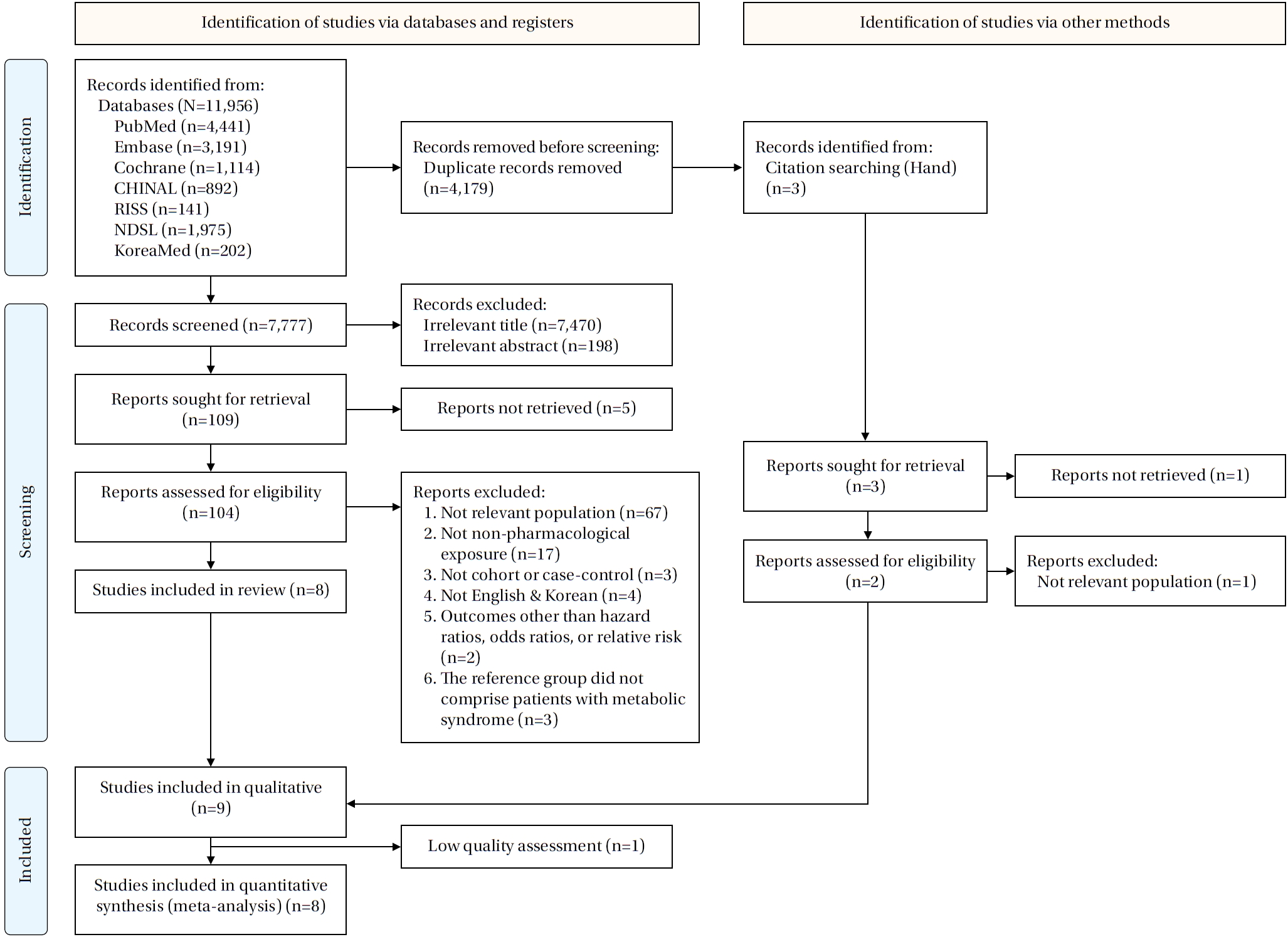
Methods Searches were conducted in seven databases (PubMed, Embase, CINAHL, Cochrane, RISS, NDSL, and KoreaMed) between August 7, 2024 and December 1, 2024. The quality of the included studies was assessed using the Newcastle-Ottawa Scale. The meta-analysis was conducted using the RevMan 5.4 program and RStudio 2022.12.0. A total of nine studies were included in the systematic review, with eight studies analyzed in the meta-analysis (PROSPERO CRD42024584658).
Results A total of nine studies were included in the systematic review, of which eight were eligible for meta-analysis to evaluate the effects of non-pharmacological exposures. Eight studies were included for meta-analysis to investigate the effect of non-pharmacological exposures. The quality of individual studies was rated “good” for eight studies and “poor” for one. Non-pharmacological exposures in MetS patients were effective in reducing CVD-related mortality (relative risk [RR]=0.81, 95% confidence interval [CI], 0.73–0.91) and all-cause mortality (RR=0.80, 95% CI, 0.75–0.85).
Conclusion Interventions and education on non-pharmacological exposures in MetS patients are associated with reduced CVD. As evidence continues to emerge, future studies should explore the long-term effects of diet, smoking, and sleep by assessing their individual impacts on CVD outcomes in individuals with MetS.
Purpose This study aimed to identify the prevalence of chronic diabetic complications in patients with type 2 diabetes mellitus.
Methods Data for adults aged over 30 years, who were diagnosed with type 2 diabetes mellitus and who had at least one claim for the prescription of antidiabetic medication were extracted from the National Health Insurance Service-National Health Screening Cohort in Korea from 2002 to 2015. Statistical analyses were performed using R version 3.5.1.
Results In total, 1,407 patients with type 2 diabetes mellitus without complications were extracted from the database. Patients were observed for an average of 10.43 years. The prevalence of chronic diabetic complications was 84.7% and was significantly higher for patients who were older women, who lived in the capital, and had diabetes mellitus for a longer time. The prevalence of eye disease was the highest at 42.4%, and cerebrovascular disease was the lowest at 15.1%. Cardiovascular disease, peripheral vascular disease, neuropathy, and foot ulcers often occurred between two and four years, and eye disease and nephropathy often occurred over eight years after the diagnosis of diabetes. Prior to the occurrence of nephropathy, microvascular complications such as neuropathy, peripheral vascular disease, and eye disease occurred.
Conclusion These findings provide compelling evidence of the prevalence of chronic diabetic complications based on a national database. Since a high incidence of diabetic complications occurs within a short period of time after the diagnosis of diabetes, aggressive interventions are required to prevent diabetic complications in the early stages after diagnosis.
Citations
Citations to this article as recorded by
Travel Time to Healthcare and Type 2 Diabetes Mellitus Management in Korea: A Nationwide Retrospective Study Rangkyoung Ha, Chang-yup Kim, Seung-sik Hwang, Kyunghee Jung-Choi Journal of Korean Medical Science.2026;[Epub] CrossRef
An 11‐Year Study to Predict Major Complications According to Biological Age in Patients With Diabetes: National Health Information Database (NHIS‐NHID 2002–2020) Chul‐young Bae, Bo‐seon Kim, In‐hee Kim, Min‐hee Jeon Diabetes/Metabolism Research and Reviews.2026;[Epub] CrossRef
Optimal Management of Diabetic Kidney Disease Jae-Han Jeon The Journal of Korean Diabetes.2025; 26(1): 1. CrossRef
Impact of smoking on diabetes complications: a secondary analysis of the Korean National Health Insurance Service-health screening cohort (2002–2019) Seonmi Yeom, Youngran Yang Journal of Korean Academy of Nursing.2025; 55(2): 222. CrossRef
Development and Effectiveness of a Pattern Management Educational Program Using Continuous Glucose Monitoring for Type 2 Diabetic Patients in Korea: A Quasi-Experimental Study Seung-Yeon Kong, Mi-Kyoung Cho Healthcare.2024; 12(14): 1381. CrossRef
Consistency of 1-day and 3-day average dietary intake and the relationship of dietary intake with blood glucose, hbA1c, BMI, and lipids in patients with type 2 diabetes DaeEun Lee, Haejung Lee, Sangeun Lee, MinJin Lee, Ah Reum Khang Journal of Korean Biological Nursing Science.2023; 25(1): 20. CrossRef
Factors Associated with Diabetic Complication Index among Type 2 Diabetes Patients: Focusing on Regular Outpatient Follow-up and HbA1c Variability Haejung Lee, Gaeun Park, Ah Reum Khang Asian Nursing Research.2023; 17(5): 259. CrossRef
Development and Validation of Simultaneous Quantitative Dissolution Analysis for the Two Active Pharmaceutical Ingredients in Dapagliflozin
Propanediol Monohydrate-sitagliptin Phosphate Monohydrate Multi-layered Tablets Ji-Hye Shin, Joo-Eun Kim Current Pharmaceutical Analysis.2023; 19(10): 776. CrossRef
Factors related to undiagnosed diabetes in Korean adults: a secondary data analysis Bohyun Kim Journal of Korean Biological Nursing Science.2023; 25(4): 295. CrossRef
Inverse Association of the Adequacy and Balance Scores in the Modified Healthy Eating Index with Type 2 Diabetes in Women Hye-Jeong Yang, Min-Jung Kim, Haeng-Jeon Hur, Dai-Ja Jang, Byung-Kook Lee, Myung-Sunny Kim, Sunmin Park Nutrients.2023; 15(7): 1741. CrossRef
The Mediating Role of Acceptance Action and Self-Care in Diabetes Self-Stigma’s Impact on Type 2 Diabetes Quality of Life: A Cross-Sectional Study Kawoun Seo Behavioral Sciences.2023; 13(12): 993. CrossRef
Evaluating the effect of the COVID-19 pandemic on hypertension and diabetes care in South Korea: an interrupted time series analysis Boram Sim, Sunmi Kim, Eun Woo Nam BMC Public Health.2023;[Epub] CrossRef
Analysis of the Association between Metabolic Syndrome and Renal Function in Middle-Aged Patients with Diabetes Yoonjin Park, Su Jung Lee International Journal of Environmental Research and Public Health.2022; 19(18): 11832. CrossRef
Factors Related to the Occurrence and Number of Chronic Diabetic Complications in Patients with Type 2 Diabetes Mellitus: Utilizing The National Health Insurance Service-National Health Screening Cohort in Korea, 2002~2015 Haejung Lee, Misoon Lee, Gaeun Park, Ah Reum Khang Journal of Korean Gerontological Nursing.2022; 24(1): 22. CrossRef
The Development of Automated Personalized Self-Care (APSC) Program for Patients with Type 2 Diabetes Mellitus Gaeun Park, Haejung Lee, Ah Reum Khang Journal of Korean Academy of Nursing.2022; 52(5): 535. CrossRef
Purpose This study aimed to identify the components of artificial intelligence-based healthcare interventions and determine their effects on health behaviors and physiological, psychological, and cost-effectiveness outcomes among adults. Methods Nine core electronic databases were searched for articles published between January, 2009 and May, 2021 using terms related to artificial intelligence, healthcare, and randomized controlled trials. Qualitative synthesis was then performed. Results Of the 1,194 retrieved articles, 20 were selected for analysis. Many of the studies targeted adults who wanted to change their health behaviors, patients with diabetes, and those aged 20~50 years. The characteristics of the artificial intelligence-based healthcare interventions were analyzed in terms of the following components: external data, artificial intelligence technology, problem solving, and goals. Many interventions offered personalized suggestions by learning participant behavior patterns using machine learning technology and diet and physical activity data. The majority of interventions targeted health behaviors and physiological outcomes. These artificial intelligence-based healthcare interventions were effective in decreasing hospital visits and improving psychological outcomes and health behaviors. Conclusion Artificial intelligence-based healthcare interventions can be an important part of decreasing hospital visits and improving psychological outcomes and health behaviors among adults. The results suggest that there is a need to develop and apply appropriate artificial intelligence algorithms for patients with chronic diseases that require continuous management in Korea.
Citations
Citations to this article as recorded by
Current Status and Associated Factors of Artificial Intelligence-Based Personalized Learning for Health Management in Older Adults Seung Gyeong Jang Korean Journal of Geriatrics & Gerontology.2026; 27(1): 9. CrossRef
Keyword Network Analysis and Topic Modeling of News Articles Related to Artificial Intelligence and Nursing Ju-Young Ha, Hyo-Jin Park Journal of Korean Academy of Nursing.2023; 53(1): 55. CrossRef
The Development of Automated Personalized Self-Care (APSC) Program for Patients with Type 2 Diabetes Mellitus Gaeun Park, Haejung Lee, Ah Reum Khang Journal of Korean Academy of Nursing.2022; 52(5): 535. CrossRef
Purpose This study aimed to examine the direct and indirect effects of general characteristics, basic psychological needs, health promoting behaviors, and emotional status on sleep quality of the older adults with low back pain.
Methods: We conducted a cross-sectional correlational study in B and Y cities between August and September 2020. A total of 217 older adults participated in the study and their general characteristics (age, gender, duration of back pain, pain intensity, disability, perceived health status, risk for malnutrition), basic psychological needs (autonomy, competence, relatedness), health promoting behavior (physical activity, self care), emotional status (depression, quality of life), and sleep quality were measured. Data were analyzed through descriptive analysis, independent t-test, ANOVA with Scheffé post-hoc test, hierarchical multiple regression, and path analysis using SPSS/WIN 22.0 and AMOS 22.0.
Results: The mean age of the participants was 70.31±5.39 years, the pain intensity was 6.40±1.09, and the duration of back pain was 6.69±6.46 years. The significant factors influencing sleep quality were depression (β=.45, p=.001), gender (β=-.22, p=.001), disability (β=.21, p=.003), perceived health status (β=-.21, p=.001), duration of back pain (β=-.20, p=.001), self care on back pain (β=-.15, p=.009), basic psychological needs (β=-.15, p=.001), and risk for malnutrition (β=.03, p=.028).
Conclusion: The findings of this study suggest that special attention is required for older women with high levels of depression and disability due to back pain, especially those with pain duration of less than 5 years or greater than 10 years.
Citations
Citations to this article as recorded by
Associations of Physical Activity Level with Sleep Quality, Depression, and Self-Efficacy among Korean College Students Hyunhee Kim Physical Therapy Rehabilitation Science.2026; 15(1): 72. CrossRef
Effects of Auricular Acupressure Therapy on Psychological Factors, Sleep Quality, and Salivary Cortisol Levels in South Korean Older Adults in the Community: A Single-blind, Randomized Controlled Trial Hyeongyeong Yoon Journal of Korean Academy of Fundamentals of Nursing.2023; 30(4): 509. CrossRef



 E-SUBMISSION
 First
First Prev
Prev