Purpose This scoping review identified the core components of nursing competence required for general ward nurses to recognize and manage clinical deterioration and examined how this competence has been conceptualized in previous studies. It also synthesized individual- and system-level factors associated with competence and identified research gaps relevant to nursing education, future research, and patient safety initiatives.
Methods This scoping review was conducted using Arksey and O’Malley’s framework and reported in accordance with the PRISMA-ScR guidelines. Six databases—PubMed, CINAHL, Embase, the Cochrane Library, Scopus, and Web of Science—were searched for studies published between January 2016 and December 2025 using search terms related to clinical deterioration and nursing competence.
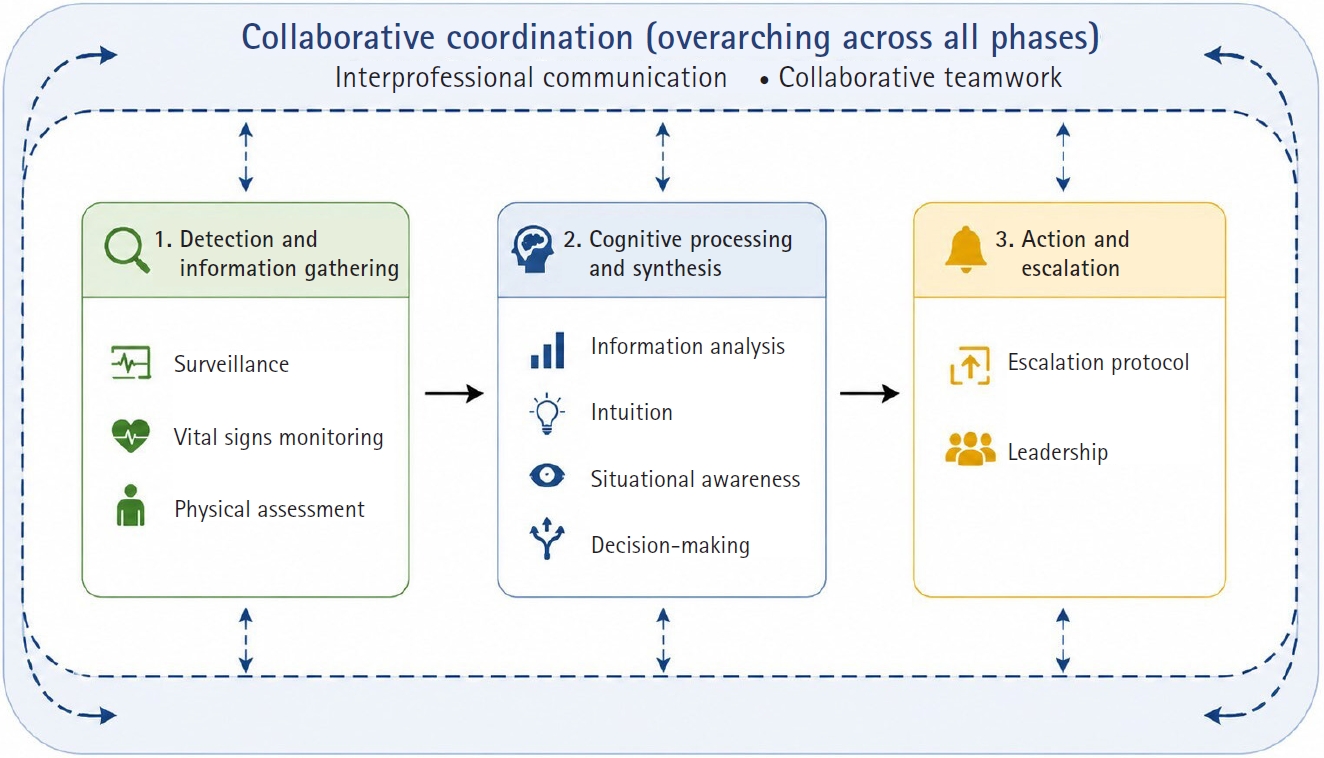
Results Twenty-one studies met the inclusion criteria. The findings were organized into two domains: nursing competencies and factors associated with competence. Technical competencies included physical assessment, vital-sign monitoring, surveillance, information analysis, and application of escalation protocols. Non-technical competencies included situational awareness, clinical decision-making, intuition, leadership, interprofessional communication, and teamwork. Individual-level factors included clinical experience, self-confidence, skill acquisition, and clinical judgment. System-level factors included education and training, relationship-building with physicians, supportive work environments, electronic tools, organizational support, and teamwork culture.
Conclusion Nursing competence in managing clinical deterioration is multidimensional and reflects the interaction of individual capabilities with system-level supports. Future research should develop educational strategies that strengthen both technical and non-technical skills while reinforcing organizational systems that support timely and effective responses to deterioration.
Purpose This study aimed to examine the effects of health-related behaviors on metabolically healthy non-obese or obese groups and to analyze gender differences. Methods This study was a secondary descriptive study. A total of 14,277 adults from the Korea National Health and Nutrition Examination Survey 2013~2015 were classified as: metabolically healthy non-obese; metabolically unhealthy non-obese; metabolically healthy obese; or metabolically unhealthy obese. Five health-related behaviors (amount of alcohol consumption, smoking status, physical activity, daily energy intake, and sleep duration) were included as independent variables. Results The health-related behaviors associated with metabolic status in non-obese participants were drinking and smoking, whereas those of obese individuals were associated with physical activity. Subgroup analysis showed that more metabolically healthy non-obese men were light drinkers and former smokers than metabolically unhealthy non-obese men.
Metabolically healthy non-obese women were more likely to engage in physical activity than metabolically unhealthy non-obese women. Among the obese men, light drinking and physical activity were associated with metabolic status. Conclusion Evidence-based interventions promoting health-related behaviors are needed to support metabolic health, considering the metabolic status and obesity phenotypes of the participants and their gender.
Citations
Citations to this article as recorded by
Health Characteristics, Nutrient Intake, and Associated Risk Factors According to the Metabolic Health and Obesity Status in Korean Adults : Based on the Korea National Health and Nutrition Examination Survey 2015 Jounghee Lee, Seonghyun Lim, Young-Min Lee Korean Journal of Human Ecology.2023; 32(6): 845. CrossRef



 E-SUBMISSION
 First
First Prev
Prev