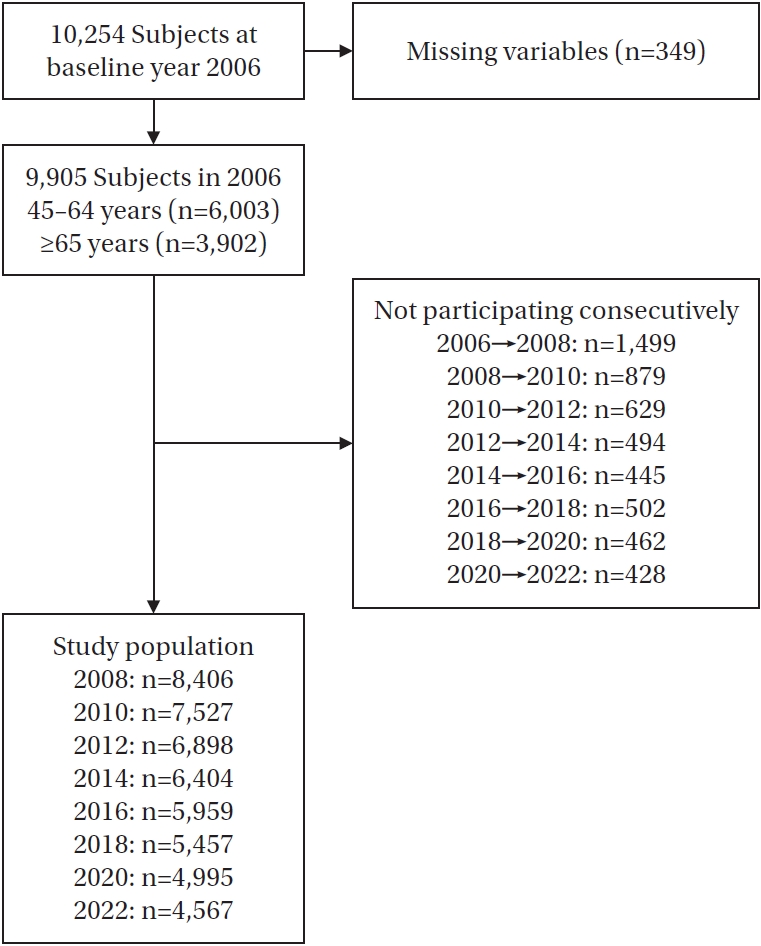
Purpose This study examined the 16-year longitudinal impact of social frailty on quality of life (QoL) and health-related quality of life (HRQoL) among middle-aged and older adults. Methods: Data were obtained from the Korean Longitudinal Study of Aging (2006–2022), comprising 9,905 participants (6,003, aged 45–64 years; and 3,902, aged ≥65 years). Social frailty was assessed using five components: social support, social activity, social network, loneliness, and living alone. QoL and HRQoL were measured using self-reported satisfaction scales. Generalized estimating equations were applied to adjust for covariates. Results: Social frailty was prevalent among both middle-aged (44.6%) and older adults (60.1%) and was significantly associated with lower QoL and HRQoL. In longitudinal analyses, declines in QoL and HRQoL persisted throughout the follow-up period in older adults, whereas in middle-aged adults, the declines were significant only during the earlier years. In middle-aged adults, current smoking exerted a stronger negative impact on QoL and HRQoL (QoL: β=–4.33, p<.001; HRQoL: β=–2.89, p<.001), while in older adults, lack of regular exercise had a greater effect on HRQoL (β=–3.84, p<.001). Conclusion: Social frailty was associated with lower QoL and HRQoL across both age groups, with stronger and more persistent effects among older adults. Early interventions are needed during midlife, while sustained strategies are essential in later life. Age-specific approaches are crucial to promoting healthy aging.
Citations
Citations to this article as recorded by
Longitudinal course of depressive symptoms and the risk of all-cause mortality in a nationally representative cohort of middle-aged and older adults in South Korea: exploring the mediating role of social frailty Seong-Uk Baek, Jin-Ha Yoon GeroScience.2026;[Epub] CrossRef
Association between social frailty and problematic alcohol use among middle-aged and older adults: findings from a longitudinal study in South Korea Seong-Uk Baek, Jin-Ha Yoon Archives of Gerontology and Geriatrics.2026; 148: 106282. CrossRef
Longitudinal trajectories of social frailty and the risk of all-cause mortality among older adults in South Korea: exploration of the mediating role of cognitive functioning Seong-Uk Baek, Jin-Ha Yoon, Qian-Li Xue The Journals of Gerontology, Series A: Biological Sciences and Medical Sciences.2026;[Epub] CrossRef
Longitudinal association between social frailty and poor oral health–related quality of life among middle-aged and older adults Seong-Uk Baek, Jin-Ha Yoon The Journal of the American Dental Association.2026;[Epub] CrossRef
Purpose This study was conducted to identify the factors affecting the performance of person-centered care among Intensive Care Unit (ICU) nurses from an ecological perspective. Methods The participants were 172 ICU nurses working in eight hospitals in B city. Data were collected from July to August, 2020. The questionnaire consisted of measuring tools for general characteristics, performance of person-centered care, compassion satisfaction, communication competence, and teamwork. The SPSS/25.0 program was used to analyze the data using hierarchical multiple regression. Results According to the hierarchical multiple regression analysis, total nursing experience, compassion satisfaction, communication competence, and team work accounted for 44.1% of the variance in performance of person-centered care among ICU nurses (p<.001). Conclusion Enhancing compassion satisfaction, communication competence, and teamwork can help increase the performance of ICU nurses’ person-centered care. In addition, in order to improve the performance of person-centered care among ICU nurses, it is necessary to investigate and explore the factors hindering the performance of person-centered care among ICU nurses with more than 5 years of experience. Therefore, multidimensional efforts are needed to develop educational programs to increase the performance of person-centered care among ICU nurses.
Citations
Citations to this article as recorded by
How the nursing work environment moderates the relationship between clinical judgment and person-centered care among intensive care unit nurses Mi Hwa Seo, Eun A. Kim, Hae Ran Kim, Mohammad Jamil Rababa PLOS ONE.2025; 20(1): e0316654. CrossRef
Workload, Teamwork, Compassion Competence, and Person-centered Critical Care Nursing among Critical Care Nurses Hyun A Lee, Myung Sun Hyun, Jin-Hee Park, Eun Ji Seo Journal of Korean Critical Care Nursing.2025; 18(2): 14. CrossRef
A Predictive Model for Person-Centered Care in Intensive Care Units in South Korea: A Structural Equation Model Sunmi Kwon, Kisook Kim Korean Journal of Adult Nursing.2025; 37(4): 467. CrossRef
Factors Influencing Person-Centered Care Among Psychiatric Nurses in Hospitals Ji Su Lee, Mi Heui Jang, Min Jung Sun Healthcare.2024; 12(22): 2269. CrossRef
Assessing Needs for Practical Training in Intensive Care Unit to Enhance Nursing Education: A Focus Group Interview Sunah Park, Bokyoung Kim Journal of Korean Critical Care Nursing.2024; 17(2): 55. CrossRef
Factors Influencing Person-Centered Care among Nurses in COVID-19 Special Care Units at Tertiary General Hospitals: A Cross-Sectional Descriptive Study Kisook Kim, Sunmi Kwon Korean Journal of Adult Nursing.2023; 35(2): 127. CrossRef
Influence of Person-Centered Perioperative Nursing and Patient Safety Competency on Patient Safety Management Activities among Operating Room Nurses: A Descriptive Survey Study Ji Yong Shin, Eun Hee Jang Korean Journal of Adult Nursing.2023; 35(2): 97. CrossRef
Person-centred care among intensive care unit nurses: A cross-sectional study Hyuna Youn, Miyoung Lee, Sun Joo Jang Intensive and Critical Care Nursing.2022; 73: 103293. CrossRef
Mediating Effect of Communication Competence in the Relationship between Compassion and Patient-Centered Care in Clinical Nurses in South Korea Miri Jeong, Kawoun Seo Healthcare.2022; 10(10): 2069. CrossRef
Factors Influencing the Performance of Person-centered Care Among Nurses in Designated COVID-19 Hospitals Hyun-Joung Yun, Jaehee Jeon Korean Journal of Adult Nursing.2022; 34(4): 413. CrossRef
Factors influencing mental health nurses in providing person-centered care Suyoun Ahn, Yeojin Yi Nursing Ethics.2022; 29(6): 1491. CrossRef



 E-SUBMISSION
 First
First Prev
Prev