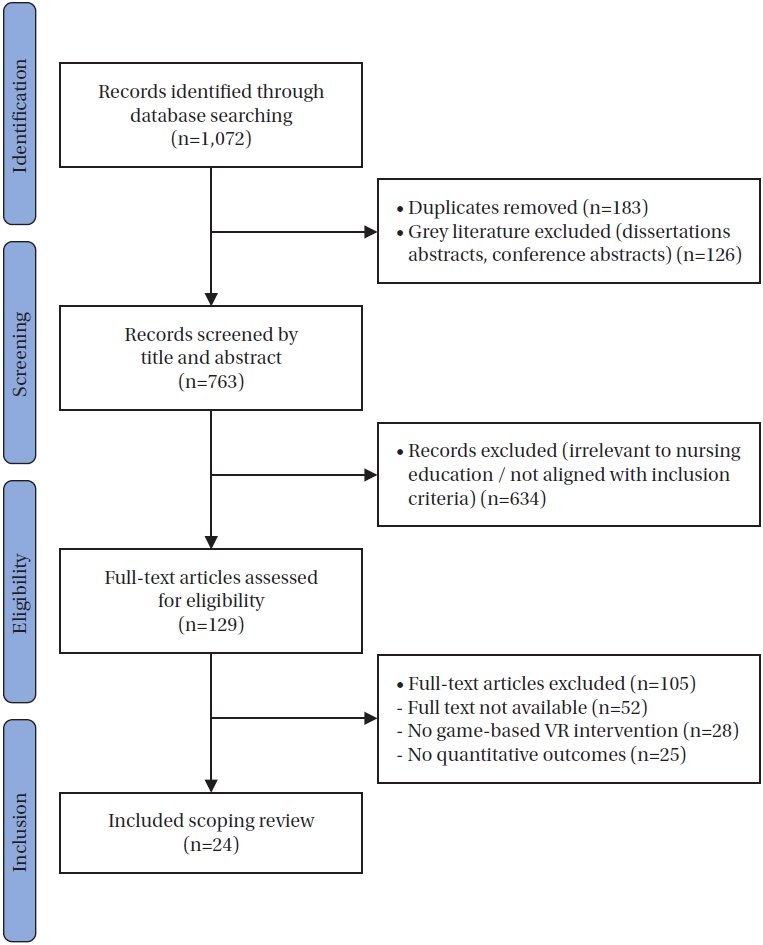
Purpose This scoping review aimed to explore the characteristics and educational effects of game-based virtual reality (VR) programs used in nursing education, providing foundational insights for future instructional design and research. Methods: Following the Joanna Briggs Institute guidelines and the Preferred Reporting Items for Systematic Reviews and Meta-Analyses extension for Scoping Reviews checklist, a comprehensive literature search was conducted across eight databases for studies published between April 2014 and March 2025. Studies were screened and selected using the population, concept, context framework. Twenty-four studies met the inclusion criteria and were analyzed. Results: Most of the 24 included studies targeted nursing students, with some involving practicing nurses. Interventions primarily employed immersive VR head-mounted displays and incorporated diverse game elements such as mission-based scenarios, challenges, feedback loops, and virtual patient interactions. Educational effects were categorized into cognitive, affective, and psychomotor domains. Improvements in knowledge acquisition, self-efficacy, learning motivation, and skill performance were consistently reported. Additionally, most studies reported enhanced learner satisfaction, engagement, and emotional immersion. However, limited evidence was found regarding teamwork and communication skills. Conclusion: Game-based VR programs show substantial potential as effective instructional strategies in nursing education. Their design features—including immediate feedback, repeatable immersive scenarios, and engaging game mechanics—support learner-centered and self-directed learning. Nevertheless, the current evidence base largely focuses on nursing students and short-term outcomes. Future studies should encompass diverse nursing populations and assess long-term effects and real-world applicability, particularly in team-based and clinical practice contexts.
Citations
Citations to this article as recorded by
Design and usability of an immersive virtual reality simulation in orthopaedic nursing education: A pilot study Carla Sílvia Fernandes, Ana Galvão, Cris Renata Grou Volpe, Marta Campos Ferreira International Journal of Orthopaedic and Trauma Nursing.2026; 61: 101286. CrossRef
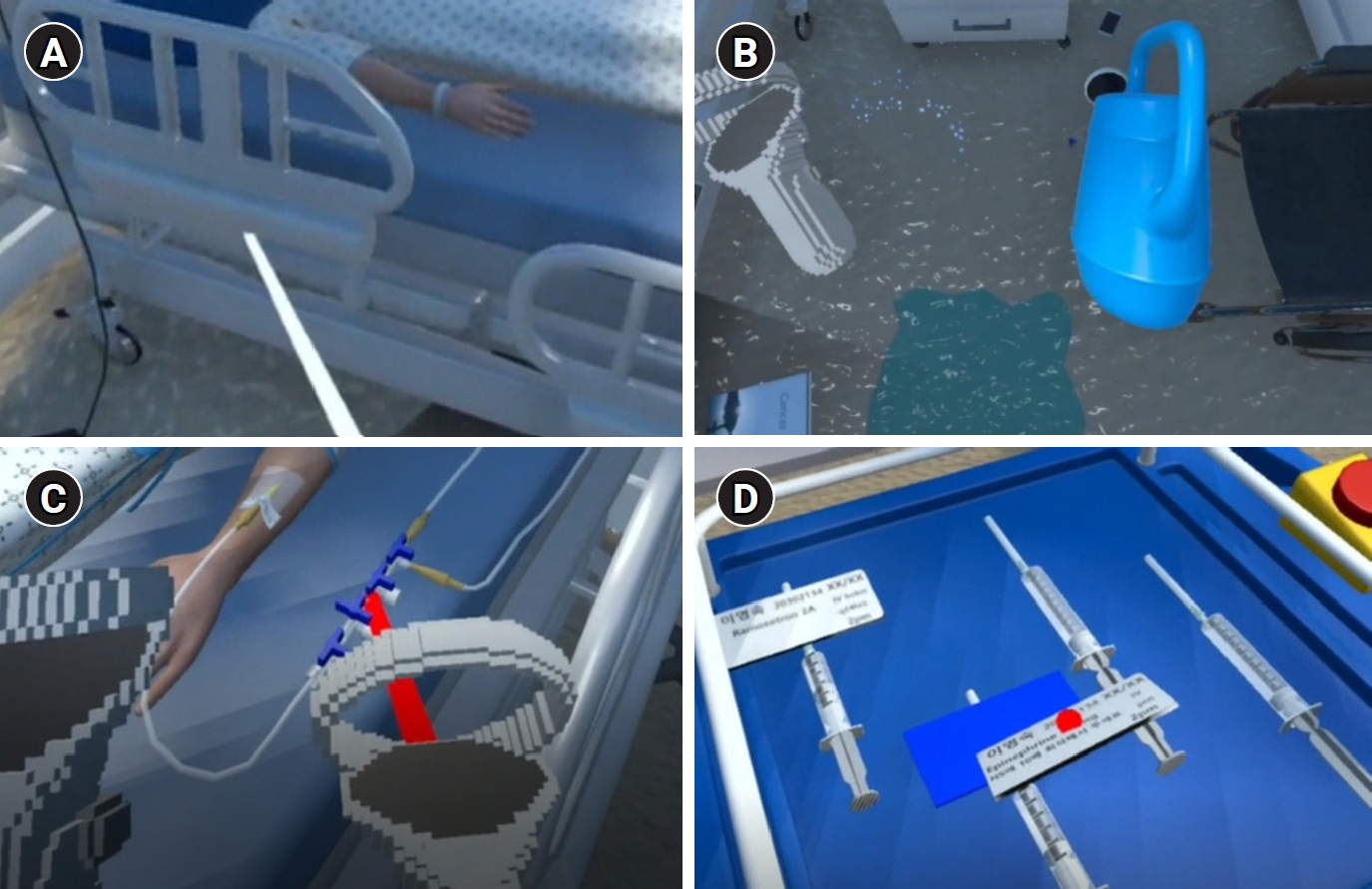
Purpose Falls and medication errors are the most common patient safety incidents globally. Kolb’s experiential learning theory supports the application of cognitive learning in clinical settings. This study examined the effectiveness of Experiential Learning–Based Fall and Medication Error Prevention Education (EFMPE), utilizing virtual reality and room of errors.
Methods A randomized controlled trial was conducted with 28 fourth-year nursing students (15 experimental, 13 control). The experimental group participated in EFMPE from February 1 to 6, 2024, comprising six sessions of 2 hours each. The control group received traditional lectures. Safety control confidence and course interest were measured before and immediately after the intervention; safety control confidence was reassessed 6 weeks later.
Results Both groups showed immediate improvement; however, only the experimental group sustained increased safety control confidence after 6 weeks (Wald χ²=13.21, p<.001). Course interest was significantly higher in the experimental group post-intervention (Wald χ²=10.64, p=.001).
Conclusion These preliminary findings suggest that EFMPE potentially supports the prevention of falls and medication errors in clinical practice.
Citations
Citations to this article as recorded by
Safety-centered simulation education using the 360-degree video room of errors: A mixed-methods study Jiyoung Kim, Yeji Kim, Hyunji Park, Jiyeong Won, Jiwon Yun, Yuran Lee Clinical Simulation in Nursing.2026; 111: 101899. CrossRef
Effects of different technology-based simulation on nursing students' self-confidence and critical thinking: A systematic review and network meta-analysis Huijie Wang, Shuwei Zhang, Yi Feng, Yiming Lu, Zhenzhen Wang, Mingyue Jia, Cui Hou, Guozeng Zhang Nurse Education Today.2026; 165: 107166. CrossRef
Personality-related learning pathways in virtual simulation: a theory-informed mixed-methods study among standardized training nurses Zhonglei Zhao, Xixi Li, Tong Zhou, Luyao Yang, Yunxia Li, Bo Yang Frontiers in Psychology.2026;[Epub] CrossRef



 E-SUBMISSION
 First
First Prev
Prev