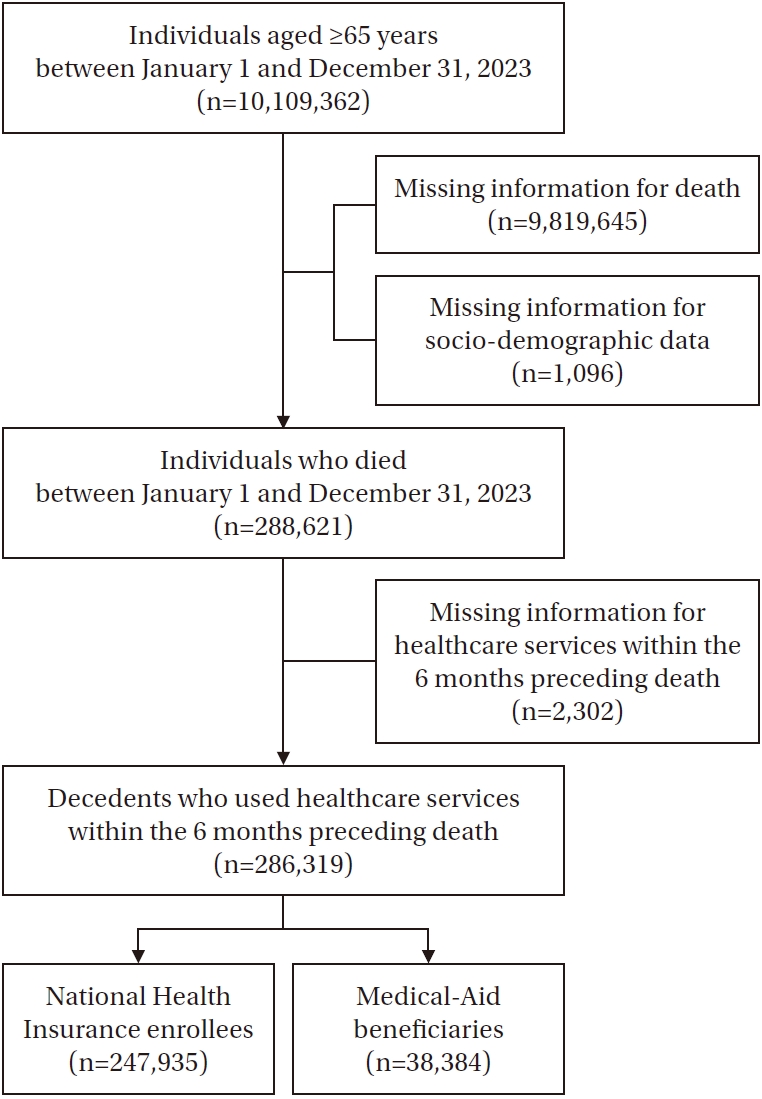
Purpose This study investigated differences in the use of life-sustaining treatments during the last six months of life between older adults covered by the National Health Insurance (NHI) and those enrolled in the Medical Aid (MA) program. Methods: A retrospective cohort design was applied using national claims data from the National Health Insurance Service. The study population included individuals aged ≥65 years who died in 2023, with 286,319 decedents (247,935 with NHI and 38,384 with MA) analyzed. We compared hospitalization frequency and duration, intensive care unit (ICU) stays, and the use of life-sustaining treatments, including cardiopulmonary resuscitation, mechanical ventilation, hemodialysis, chemotherapy, transfusions, and vasopressors, between NHI and MA groups. Logistic regression analyses were conducted with adjustments for age, sex, comorbidities, place of death, and advance care planning status. Results: Completion rates of advance directives and physician orders for life-sustaining treatment were lower in MA than in NHI decedents. MA decedents had fewer admissions but significantly longer hospital and ICU stays than NHI decedents. They were less likely to receive mechanical ventilation, chemotherapy, transfusion, and vasopressors but more likely to undergo hemodialysis. Conclusion: Substantial disparities exist in end-of-life care by insurance type, suggesting that socioeconomic inequalities and reimbursement structures influence patterns of intensive care near the end of life. Targeted interventions are needed to ensure equitable, patient-centered end-of-life care for socioeconomically vulnerable older adults.
Purpose The purpose of this study was to verify the effects of a repeated hemodialysis diet education program on dietary knowledge, dietary self-care compliance, and physiological indices in older adults on hemodialysis. Methods This study employed a non-equivalent control group pre-post repeated measures design. Based on Ebbinghaus’ forgetting curve, the experimental group received diet education four times. Data were analyzed by the x 2 -test, t-test, and Fisher’s exact test. A repeated measures ANOVA was used for hypothesis testing. Results There were statistically significant between-groups differences in dietary knowledge by time of assessment, within group differences by time of assessment, and interactions between group and time. Regarding dietary self-care compliance, there were significant within-group differences by time of assessment and interactions between group and time. There were significant within-group changes in inter-dialytic weight gain by time of assessment. For the physiological indices, blood sodium and albumin showed significant within-group changes by time of assessment.
Phosphorus and blood urea nitrogen scores showed significant within-group changes. For blood potassium concentration, there was a significant difference in interactions between group and time. Conclusion Owing to the resulting improvements in dietary knowledge and self-care compliance, the repeated education program applied in this study can be used as a preventive measure for complications in older adults on hemodialysis.
Citations
Citations to this article as recorded by
Effects of a digital repetitive dietary education intervention on dietary knowledge, dietary self-care behaviors, and physiological indicators among hemodialysis patients in rural Korea: a quasi-experimental study Eun-Ho Ha, Sun-Ju Park Journal of Korean Biological Nursing Science.2026; 28(2): 275. CrossRef
Development and Effectiveness of Dietary Self-care Promotion Program Using Online Community for Hemodialysis Patients: A Pilot Randomized Controlled Trial Hana Kim, Mi-Kyoung Cho Asian Nursing Research.2025; 19(2): 126. CrossRef
The Mediating Effects of Symptom Experiences on the Relationship between Body Image and Quality of Life among Hemodialysis Patients in a Single Center Yaki Yang Healthcare.2024; 12(17): 1779. CrossRef
Effects of a video-based enteral nutrition education program using QR codes for intensive care unit nurses: a quasi-experimental study Won Kee Seo, Hyunjung Kim Journal of Korean Biological Nursing Science.2024; 26(1): 16. CrossRef
The Effects of Tailored Dietary Education among Role Failure Hemodialysis Patients on Self-care Compliance, Self-efficacy and Physiologic Indices Sangsuk Kim, Youngsil Choi The Korean Journal of Rehabilitation Nursing.2021; 24(1): 46. CrossRef
PURPOSE The purpose of this study was to analyze the subjectivity of smoking cessation methods of smokers. METHOD: The Q. methodology which provides a method of analyzing the individual's subjectivity was used. The 34 subjects classified 38 selected Q-statements into a 9 point scale to make a normal distribution. The collected data was analyzed using a QUANL PC program. RESULTS: Three types of smoking cessation among smokers were identified. Type I, Family Centered; Type II, Suppressing Temptation; Type III, Self Overcoming. CONCLUSION: This study results revealed that different approaches of support programs are needed to address the three types of smoking cessation and their characteristics



 E-SUBMISSION
 First
First Prev
Prev