Purpose This study evaluated the immediate and sustained effects of a clinical decision-making program based on Simon’s decision-making model on medication safety competency among advanced-beginner nurses in intensive care units.
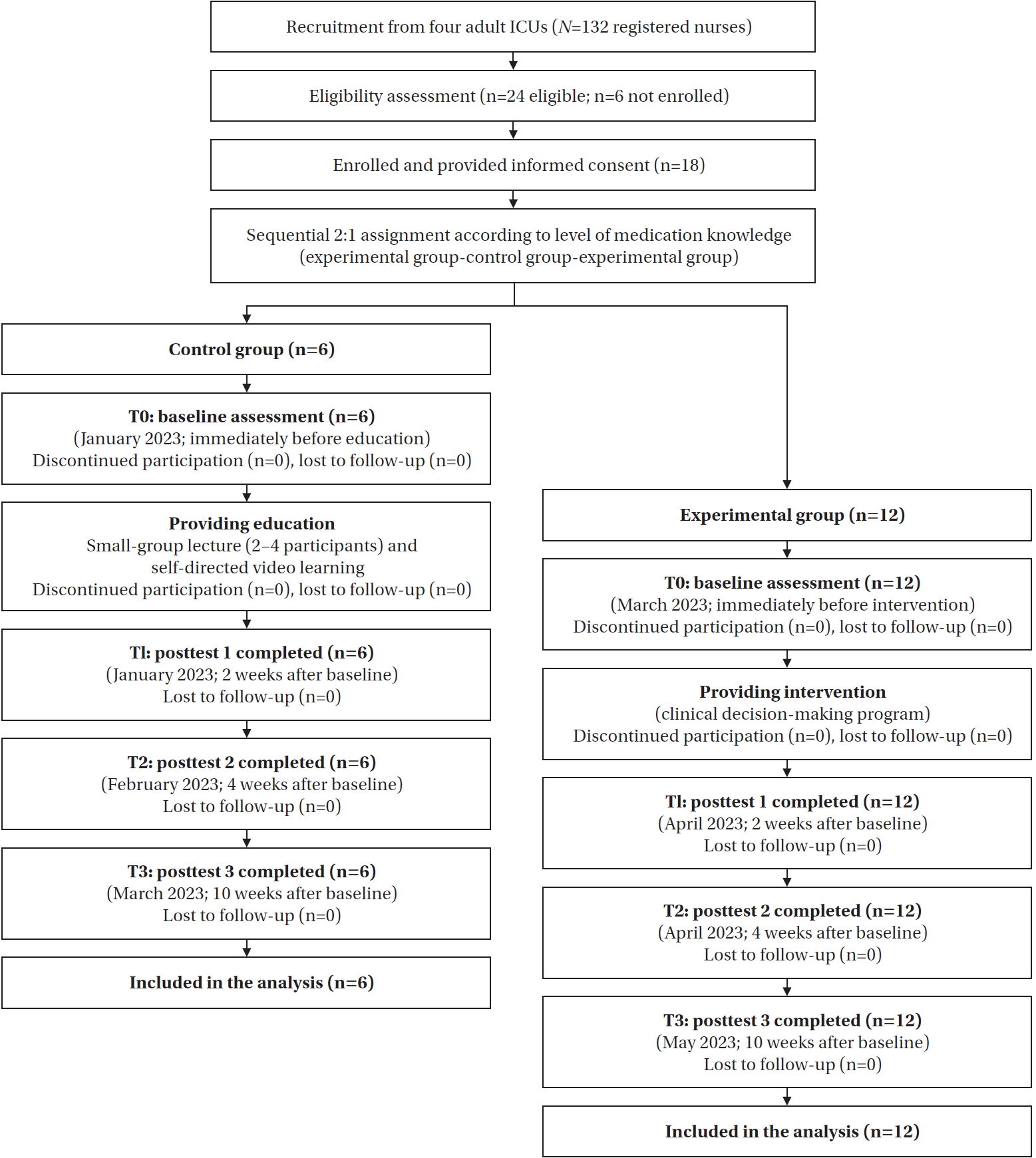
Methods This nonequivalent control group pretest-posttest study used a time-lagged design and included 18 intensive care unit nurses at a tertiary hospital, with 12 assigned to the intervention group and six to the control group. The intervention group participated in a 2-week clinical decision-making program that integrated case-based learning and high-fidelity simulation, whereas the control group received lecture-based education. Clinical decision-making ability, medication safety competency, and safety motivation were measured at baseline and at 2 and 4 weeks after baseline. Near-miss medication error experiences were assessed at baseline and at 4 and 10 weeks. Data were analyzed using the independent t-test, Mann-Whitney U test, and linear mixed models.
Results Clinical decision-making ability (F=3.94, p=.026), medication safety competency (F=4.97, p=.011), safety motivation (F=5.20, p=.009), and near-miss medication error experiences (F=14.28, p<.001) showed significant group-by-time interaction effects, indicating that outcome trajectories differed between the intervention and control groups.
Conclusion These findings suggest that the program may be an educational strategy for strengthening nurses’ clinical decision-making during medication administration and improving medication and patient safety in intensive care unit settings.
Purpose This study aimed to identify the main keywords, network structures, and topical themes in patient safety incident reports using text network analysis. Methods: The study analyzed patient safety incident reports from a general hospital in Seoul, covering a total of 3,576 cases reported over five years, from 2019 to 2023. Unstructured data were extracted from the text of the incident reports, detailing how the patient safety incidents occurred and how they were managed according to the six-part principles. The analysis was conducted in four steps: 1) word extraction and refinement, 2) keyword extraction and word network generation, 3) network connectivity and centrality analysis, and 4) topic modeling analysis. The NetMiner program was used for data analysis. Results: The analysis of degree, betweenness, and closeness centrality revealed that the most common keywords among the top five were "confirmation," "medication," "inpatient room," "caregiver," and "condition." Topic modeling analysis identified three main topic groups: 1) incidents caused by a lack of awareness of fall risk, 2) incidents of non-compliance with basic medication principles, and 3) incidents due to inaccurate patient identification. Conclusion To prevent patient safety incidents, it is necessary to promote a culture of safety in hospitals, standardize patient identification procedures, and provide basic training in medication safety and fall prevention to healthcare staff. Furthermore, empirical research on patient safety practices is necessary to encourage active participation in patient safety activities by patients and family caregivers.
Citations
Citations to this article as recorded by
Contemporary clinical incident analysis methods used within acute care settings: a scoping review Kathryn Kynoch, Xianliang Liu, Jing-Yu (Benjamin) Tan, Judeil Krlan Teus, Mary-Anne Ramis JBI Evidence Synthesis.2026; 24(5): 926. CrossRef
Topic Modeling of Nursing Documentation in Hemodialysis Units: A Mixed‐Methods Study of Nursing Surveillance Activities Mi-Kyoung Cho, Hye-Young Kim, Hyohjung Lee, Yoon Hee Cho, Justin Fontenot, Ph.D., RN, NEA-BC Journal of Nursing Management.2026;[Epub] CrossRef
A Nationwide Descriptive Epidemiological and Text-mining Analysis of Incidents and Adverse Events Involving Clinical Engineers in Japan Ryo Sato, Keizo Wauchi, Hirohito Imada Journal of Patient Safety.2026;[Epub] CrossRef



 E-SUBMISSION
 First
First Prev
Prev