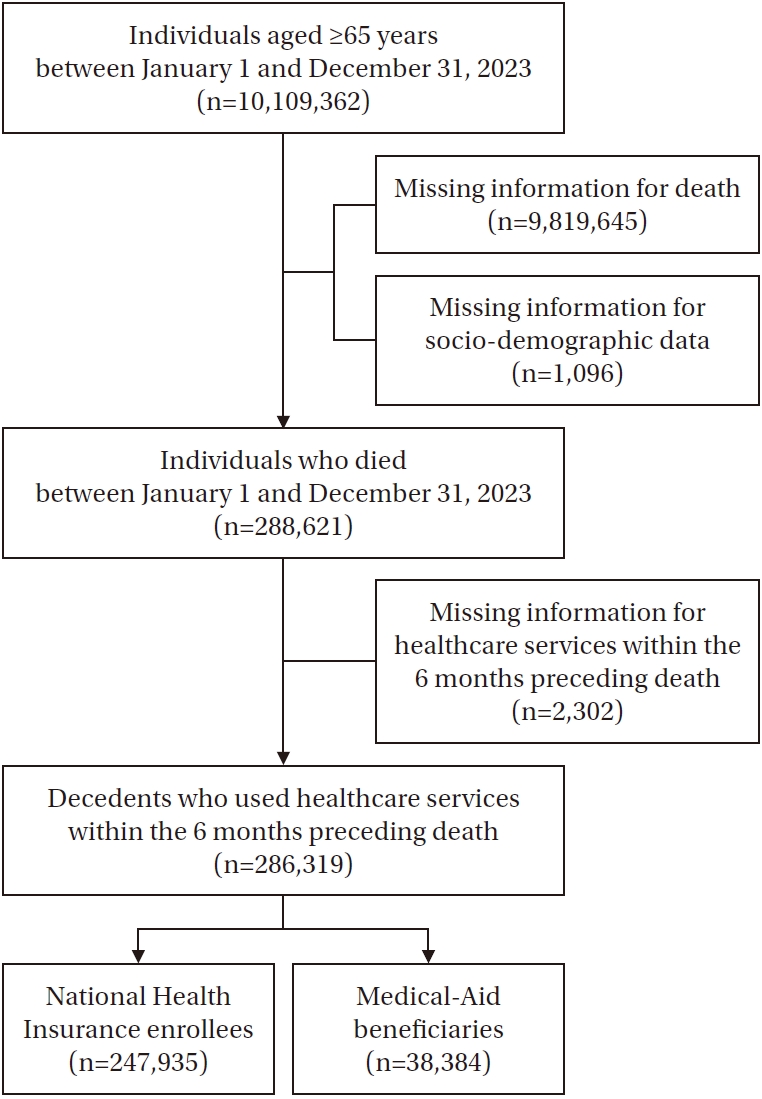
Purpose This study investigated differences in the use of life-sustaining treatments during the last six months of life between older adults covered by the National Health Insurance (NHI) and those enrolled in the Medical Aid (MA) program. Methods: A retrospective cohort design was applied using national claims data from the National Health Insurance Service. The study population included individuals aged ≥65 years who died in 2023, with 286,319 decedents (247,935 with NHI and 38,384 with MA) analyzed. We compared hospitalization frequency and duration, intensive care unit (ICU) stays, and the use of life-sustaining treatments, including cardiopulmonary resuscitation, mechanical ventilation, hemodialysis, chemotherapy, transfusions, and vasopressors, between NHI and MA groups. Logistic regression analyses were conducted with adjustments for age, sex, comorbidities, place of death, and advance care planning status. Results: Completion rates of advance directives and physician orders for life-sustaining treatment were lower in MA than in NHI decedents. MA decedents had fewer admissions but significantly longer hospital and ICU stays than NHI decedents. They were less likely to receive mechanical ventilation, chemotherapy, transfusion, and vasopressors but more likely to undergo hemodialysis. Conclusion: Substantial disparities exist in end-of-life care by insurance type, suggesting that socioeconomic inequalities and reimbursement structures influence patterns of intensive care near the end of life. Targeted interventions are needed to ensure equitable, patient-centered end-of-life care for socioeconomically vulnerable older adults.
PURPOSE Despite the importance of promoting quality of life (QOL) among patients with terminal cancer, a comprehensive understanding of QOL among this population is lacking in South Korea. Thus, the purpose of the integrative review was to identify patterns in studies about patient-reported QOL among Korean adult patients with a diagnosis of terminal cancer. METHODS The integrative review method described by Whittemore and Knaf was used in this stuy. Twenty-five articles were selected for analysis. RESULTS Most articles addressed factors that influenced QOL or validated an assessment instrument to measure QOL in patients with terminal cancer. Only one qualitative research article which described patients' experiences of living with terminal cancer. Six other articles examined the effects of interventions on patients' QOL but these did not provide detailed information about interventions. These articles seldom used robust designs and methods to test the interventions. CONCLUSION Findings from the review suggest conducting studies with qualitative methodologies to gain an in-depth understanding of QOL from patients' perspectives. Additional studies with robust designs and methods are also necessary to develop and test theory-based, empirically-derived interventions that help maintain or promote QOL in patients with terminal cancer.
Citations
Citations to this article as recorded by
Challenges and Proposed Improvements in Advance Care Planning: Insights from a Real Clinical Case of a Terminally Ill Patient in Korea Hongyeul Lee Korean Journal of Medical Ethics.2025; 28(1): 41. CrossRef
Effect of Laughter Therapy on Mood Disturbances, Pain, and Burnout in Terminally Ill Cancer Patients and Family Caregivers Hee Moon, Songjah Journ, Seonah Lee Cancer Nursing.2024; 47(1): 3. CrossRef
Cross-Cultural Validation of the McGill Quality of Life Questionnaire-Revised (MQOL-R), Korean Version; A Focus on People at the End of Life Kyung-Ah Kang, Myung-Nam Lee The Korean Journal of Hospice and Palliative Care.2022; 25(3): 110. CrossRef
Initial Assessment and Care Planning in Palliative Hospice Care: Focus on Assessment Tools Eun Ju Park, Su Jin Koh, Jae Kyung Cheon The Korean Journal of Hospice and Palliative Care.2019; 22(2): 67. CrossRef



 E-SUBMISSION
 First
First Prev
Prev