Purpose Guided by Kolcaba’s Comfort Theory, this study aimed to identify predictors of comfort among patients with hepatocellular carcinoma after liver resection.
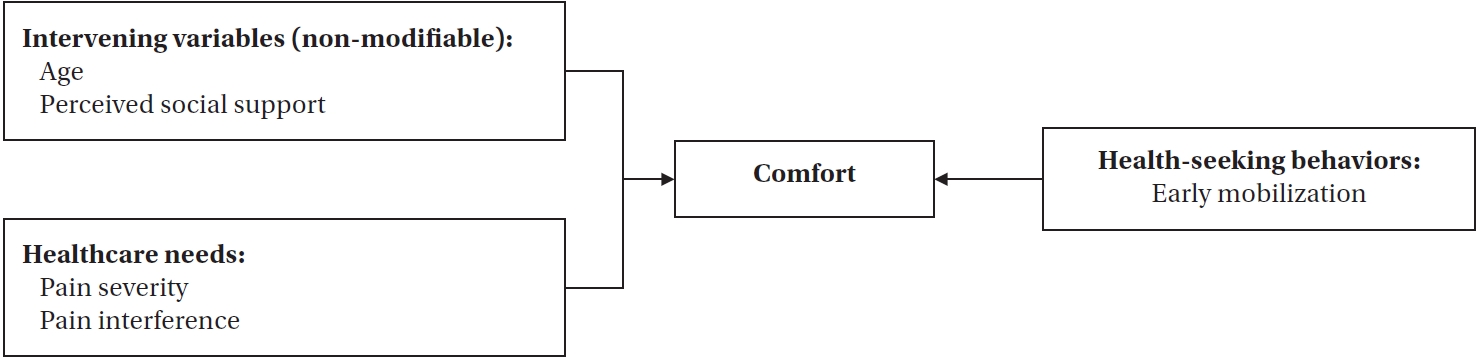
Methods This cross-sectional predictive correlational study included 132 patients with hepatocellular carcinoma who underwent liver resection in Wenzhou, China. Demographic and clinical characteristics, including age, were collected. Comfort, pain severity, pain interference, perceived social support, and early mobilization were assessed using validated instruments. Data were analyzed using descriptive statistics, the independent-samples t-test, one-way analysis of variance, Pearson correlation coefficients, and standard multiple linear regression.
Results Participants reported a moderate overall level of comfort. In the multiple regression model, pain interference (β=−.25, p=.008) and perceived social support (β=.39, p<.001) were significant predictors of comfort, with perceived social support emerging as the strongest predictor. Pain severity (β=−.09, p=.287), age (β=−.09, p=.264), and early mobilization (β=.01, p=.909) were not significant predictors. The regression model was statistically significant and explained 27% of the variance in comfort (R²=.27, F=9.20, p<.001).
Conclusion Perceived social support and pain interference were independently associated with postoperative comfort among patients with hepatocellular carcinoma following liver resection. These findings highlight the importance of comprehensive pain management and nursing strategies that strengthen social support; such interventions may help improve postoperative comfort and recovery.


 E-SUBMISSION
 First
First Prev
Prev