Purpose Metabolic syndrome (MetS) patients have a higher risk of cardiovascular disease (CVD) incidence and mortality than those without MetS. The effects of non-pharmacological exposures may help improve the management of CVD. This study aimed to assess the long-term effects of non-pharmacological exposures on CVD in MetS patients through a meta- analysis of cohort and case-control studies.
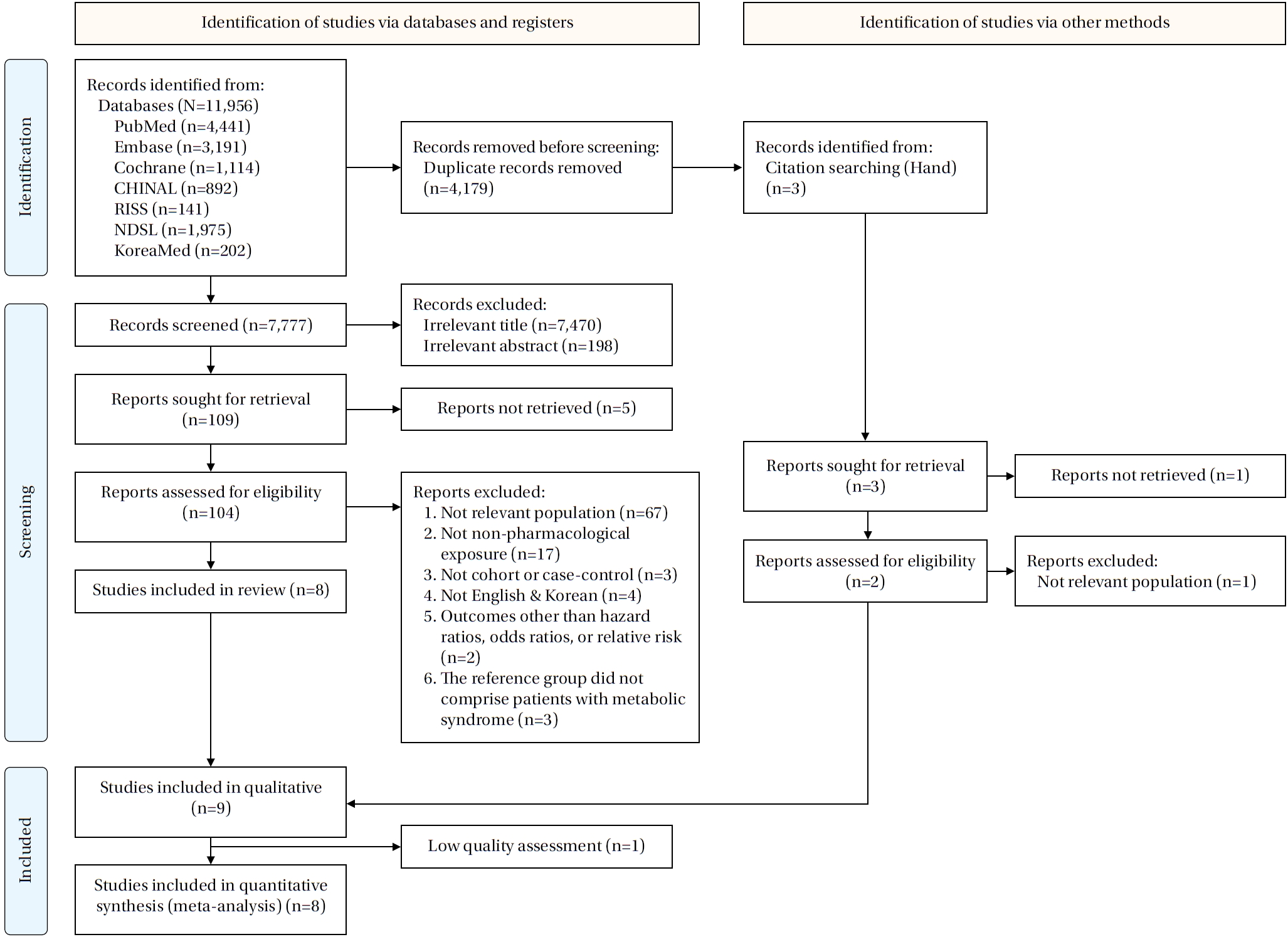
Methods Searches were conducted in seven databases (PubMed, Embase, CINAHL, Cochrane, RISS, NDSL, and KoreaMed) between August 7, 2024 and December 1, 2024. The quality of the included studies was assessed using the Newcastle-Ottawa Scale. The meta-analysis was conducted using the RevMan 5.4 program and RStudio 2022.12.0. A total of nine studies were included in the systematic review, with eight studies analyzed in the meta-analysis (PROSPERO CRD42024584658).
Results A total of nine studies were included in the systematic review, of which eight were eligible for meta-analysis to evaluate the effects of non-pharmacological exposures. Eight studies were included for meta-analysis to investigate the effect of non-pharmacological exposures. The quality of individual studies was rated “good” for eight studies and “poor” for one. Non-pharmacological exposures in MetS patients were effective in reducing CVD-related mortality (relative risk [RR]=0.81, 95% confidence interval [CI], 0.73–0.91) and all-cause mortality (RR=0.80, 95% CI, 0.75–0.85).
Conclusion Interventions and education on non-pharmacological exposures in MetS patients are associated with reduced CVD. As evidence continues to emerge, future studies should explore the long-term effects of diet, smoking, and sleep by assessing their individual impacts on CVD outcomes in individuals with MetS.
PURPOSE 1) to construct cohorts according to risk scores calculated with the Gail Breast Cancer Risk Assessment Tool (Gail et al., 1989) (Gail) and the Breast Cancer Risk Appraisal (Lee et al,. 2003) (Lee) 2) to identify the distribution of risk factors and preventive behavior stages between the cohorts 3) to identify abnormal breast conditions in risk cohort. METHOD Using convenience sampling, 775 rural women were selected. Risk appraisal was scored using Gail and Lee. Preventive behavior stages for BSE (Breast self examination) and mammography were measured using 4 stages of the Transtheoretical Model (Prochaska & DiClemente, 1983). RESULTS 1) The risk cohort according to Gail was 12.3% (n=95), and Lee, 3.1% (n=24). 2) There were significant differences in the distribution of risk factors (age, family history, age at 1st live birth, age at menarche, number of breast biopsy, history of breast disease, and breast-feeding) between cohorts. 3) There was a significant difference in the distribution of the stage of BSE according to Lee. 4) Six women in the risk group detected masses or nodules and physician consultation and ultrasonography were recommended. CONCLUSION On the basis of the constructed cohorts, further longitudinal studies of cohorts are recommended with interventions according to characteristics of cohorts.


 E-SUBMISSION
 First
First Prev
Prev