

| Ji-Yeon Park | 1 Article |
Purpose
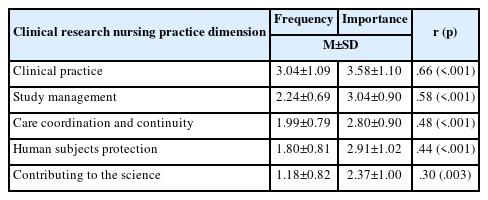
This study aimed to investigate the frequency and perceived importance of 52 clinical research nursing activities in Korea and to apply importance–performance analysis (IPA) to identify areas requiring improvement. Methods A descriptive survey was conducted among 96 clinical research nurses (CRNs) with ≥2 years of experience. Data were collected online in May 2022 using a questionnaire addressing 14 general characteristics and 52 clinical research nursing activities across five dimensions: clinical practice (CP), study management (SM), care coordination and continuity, human subjects protection, and contributing to the science (CS), as defined by the US National Institutes of Health (NIH). Frequency and importance were evaluated on a 6-point Likert scale. Analyses included descriptive statistics, Pearson correlation coefficients, the t-test, analysis of variance with Duncan post hoc tests, and IPA. Results The mean frequency and importance scores for the 52 activities were 2.02±1.27 and 2.91±1.24, respectively. CP activities were performed most often and rated as most important, whereas CS activities were performed least often and rated as least important. Higher education, certification, and professional association membership were associated with higher CS activity frequencies. IPA revealed strengths in CP and core SM activities, while regulatory reporting, data integrity assurance, and site audits were underperformed despite being highly important. Conclusion Korean CRNs play essential roles in CP and SM but require enhanced education, institutional support, and clearer role delineation in regulatory and quality-assurance activities. These findings provide evidence to guide CRN education, policy development, and the strengthening of professional identity among CRNs in Korea.
|
|
 E-SUBMISSION