

| Go Eun Choi | 1 Article |
Purpose
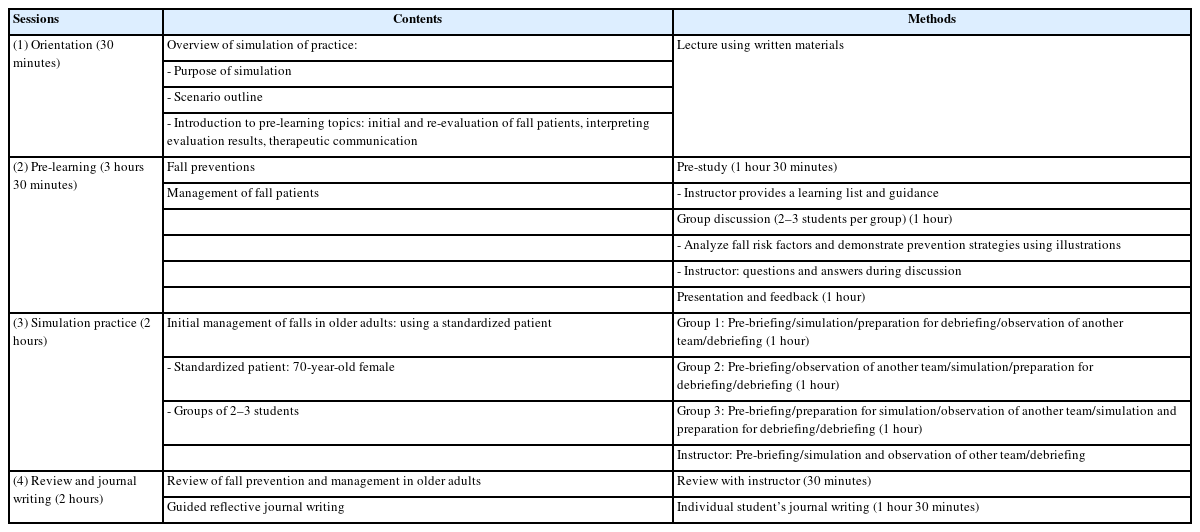
This study analyzed nursing students’ guided reflective journals following simulation-based practice using standardized patients for the initial care of older adults experiencing falls. It aimed to provide a deeper understanding of how changes in students’ thinking occurred through the learning experience and to describe their levels of reflection. Methods An eight-hour simulation-based education program was implemented during a geriatric clinical practicum. The program consisted of orientation, pre-learning activities, simulation practice, and a wrap-up session. Reflective journals from 53 third-year nursing students were analyzed using qualitative content analysis. Results Fifty-three third-year nursing students participated and submitted reflective journals. Three categories emerged from the analysis: “preparing for simulation-based practice,” which involved students setting care plans and employing observation; (2) “experiencing patient fall management through simulation-based practice,” where students actively engaged in realistic fall management scenarios; and (3) “critical reflection after simulation-based practice,” encompassing students’ acquisition of new insights and their personal growth. In the first category, students prepared for patient encounters by developing care plans and conducting observations. The second category highlighted realistic fall management scenarios utilizing standardized patients. The third category focused on personal growth through critical reflection. In the 53 reflective journals (185,021 words), level 3 reflections accounted for 31.6% of the content, while level 5, the highest reflection level, comprised only 8.6%. Conclusion Post-simulation reflective journaling stimulated critical thinking and self-assessment, enabling nursing students to analyze and reflect deeply on clinical practices. This process reinforced their knowledge base and behavioral foundations essential for clinical practice. Citations Citations to this article as recorded by

|
|
 E-SUBMISSION