Purpose Inadequate bowel preparation compromises the efficacy of colonoscopy. This study aimed to develop and evaluate a patient-tailored bowel preparation program designed to improve bowel preparation quality, medication adherence, and dietary adherence among patients undergoing colonoscopy.
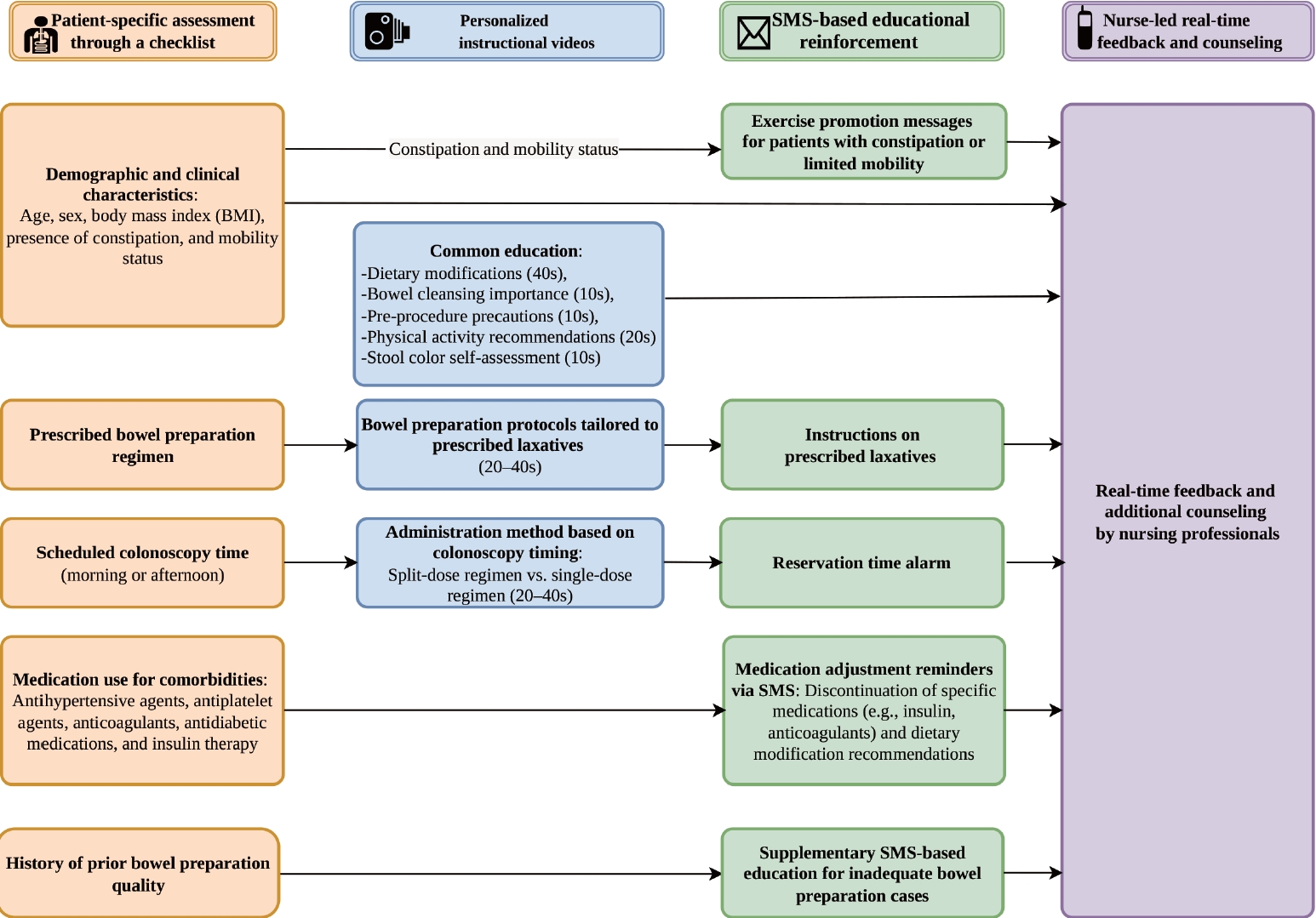
Methods The program consisted of four phases: (1) patient-specific assessment using a checklist; (2) personalized instructional videos; (3) short message service reminders; and (4) nurse-led counseling. A quasi-experimental, nonconcurrent nonequivalent control group, posttest-only design was used, with the control group recruited first. The study was conducted from April to July 2024 at a tertiary hospital in South Korea and included 80 adult outpatients scheduled for colonoscopy (40 control and 40 experimental participants). Outcomes included bowel preparation quality assessed using the Aronchick Bowel Preparation Scale, medication knowledge and adherence, and dietary knowledge and adherence.
Results The experimental group demonstrated significantly higher bowel preparation quality than the control group (Z=8.13, p<.001, r=0.91). Medication knowledge and adherence were also significantly higher in the experimental group than in the control group (Z=3.54, p<.001, r=0.40; Z=6.50, p<.001, r=0.73; respectively). Similarly, dietary knowledge and adherence improved significantly in the experimental group compared with the control group (Z=5.28, p<.001, r=0.59; Z=5.32, p<.001, r=0.60; respectively).
Conclusion The patient-tailored bowel preparation program effectively improved bowel preparation outcomes for colonoscopy. Future research should focus on integrating the program into electronic health records to enable automated delivery and improve efficiency and scalability in clinical practice.
Purpose This study aimed to explore the roles, facilitators, barriers, and future directions of rapid response teams (RRTs) in Korean hospitals from the perspectives of both RRT and ward nurses.
Methods Focus group interviews were conducted with 10 RRT nurses and 10 ward nurses across three hospitals that employed RRTs in Korea from August 2021 to February 2022. The interviews were recorded, transcribed, and analyzed using qualitative content analysis to identify themes relevant to RRT operations.
Results The analysis yielded 10 subtopics and 4 main themes: the exploration of RRT's essential roles, the facilitators and barriers impacting RRT operations, and the construction of a blueprint for future systems. Notable barriers included unclear job assignments without legal safeguards, conflict arising from hierarchical structures, and insufficient organizational support. The following facilitators were identified: transformed perceptions through collaborative efforts, organizational recognition and support, and self-reinforcement by demonstrating expertise.
Conclusion This study highlights the challenges and opportunities associated with implementing RRTs in Korean hospitals, including the need for clear role definitions, effective interprofessional collaboration, and organizational support. Based on these findings, future efforts should focus on establishing legal frameworks that define the scope of practice for RRT nurses.
Citations
Citations to this article as recorded by
Implementation of a Rapid Response System in a University Hospital: Impact on In-Hospital Mortality and Surgical Patient Outcomes Daiana Toma, Ovidiu Horea Bedreag, Diana Andrei, Marius Păpurică, Claudiu Rafael Bârsac, Adelina Băloi, Alexandru Rogobete, Laura Andreea Ghenciu, Dorel Săndesc Journal of Clinical Medicine.2026; 15(9): 3443. CrossRef
Implementation of an AI-Based Clinical Decision Support System Predicting In-Hospital Cardiac Arrest in General Wards: A Multicenter Staggered-Implementation Study in Secondary Hospitals in Korea Minjeong Kim, Dongjoon Yoo, Eunbi Noh, Yongwook Jeong, Minsoo Kim, Kyung-Jae Cho, Mincheol Kim, You Dong Sohn, Gyu Chong Cho Diagnostics.2026; 16(11): 1682. CrossRef
Enhancing postoperative recovery with multimodal prehabilitation: the journey begins before surgery Ah-Reum Cho, Wariya Vongchaiudomchoke, Detlef Balde, Do Jun Kim, Francesco Carli Korean Journal of Anesthesiology.2025; 78(5): 401. CrossRef



 E-SUBMISSION
 First
First Prev
Prev