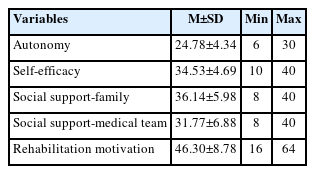
Purpose This study investigated the relationships of autonomy, self-efficacy, and social support with rehabilitation motivation in patients who had undergone acute stroke management. Methods: A cross-sectional descriptive correlational study was conducted at a tertiary university hospital in Suwon, South Korea. Data were collected from June 1, 2023, to June 1, 2024, using structured self-reported questionnaires administered to patients scheduled for discharge after their first-ever acute stroke management. A total of 231 patients diagnosed with stroke participated in the study. Hierarchical multiple regression analysis was performed to identify predictors of rehabilitation motivation. Results: Positive bivariate relationships were observed between autonomy (r=.26, p<.001), self-efficacy (r=.26, p<.001), social support from family (r=.22, p<.001), social support from medical teams (r=.26, p<.001), and rehabilitation motivation. In the hierarchical multiple regression analyses, patients with paralysis (β=−.21, p=.001), higher autonomy (β=.19, p=.003), and higher social support from the medical team (β=.22, p<.001) demonstrated higher rehabilitation motivation. Conclusion: Based on these findings, nursing interventions and educational strategies that enhance patient autonomy and strengthen support from medical teams should be developed and implemented to improve rehabilitation motivation, engagement, and health outcomes in acute stroke care.
Purpose This study identified relationships among person-centered care environment, patient engagement, and patient outcomes in stroke rehabilitation patients. Methods This descriptive, correlational study was conducted using data from 243 post-stroke patients who were admitted in 6 rehabilitation hospitals. We collected data using self-report, structured questionnaires, which included items about the person-centered care environment, patient engagement, patient outcomes (patient satisfaction with nursing care, activities of daily living, levels of depression), and demographic characteristics. Path analysis and descriptive analyses were performed using SPSS 20.0 and AMOS 20.0. Results The hypothesized path model fit well for data based on goodness-of-fit indices. In the path model, person-centered care environment was significantly related to patient engagement and patient satisfaction with nursing care but not to activities of daily living and levels of depression, controlling for demographic characteristics. Additionally, person-centered care was significantly related to patient satisfaction with nursing care and reduction of depression through patient engagement. Conclusion Findings indicate the importance of developing a person-centered care environment to improve satisfaction with nursing care for stroke rehabilitation patients. A person-centered care environment improves patient engagement, which might be a significant factor in patient outcomes, including reduced depression for stroke rehabilitation patients.
Citations
Citations to this article as recorded by
Relationship between Person-Centered Climate and Patient Satisfaction in Cancer Patients: The Mediating Effects of Patient Activation and Nurse Trust Hyun Jin Jung, Seon Hwa Park, Jung Hwa Jo, Hyun Jo Youn, A Ram Kim, Da Hye Lee, Mi Sun Park Asian Oncology Nursing.2024; 24(1): 21. CrossRef



 E-SUBMISSION
 First
First Prev
Prev