Purpose This study examined the knowledge structure and thematic characteristics of health literacy research in Korea through keyword network analysis and topic modeling.
Methods Keyword frequency and co-occurrence network analyses included 637 articles. For latent Dirichlet allocation, English abstracts were combined with standardized author keywords. After preprocessing and document-frequency filtering, 636 articles remained in the effective latent Dirichlet allocation corpus. Models with 3–10 topics were evaluated across 10 random seeds according to log-likelihood, perplexity, semantic coherence, topic distinctiveness, cross-seed stability, and interpretability of representative documents. A five-topic solution was selected, and the final model was estimated using seed 2026. An abstract-only sensitivity analysis was conducted with 633 articles.
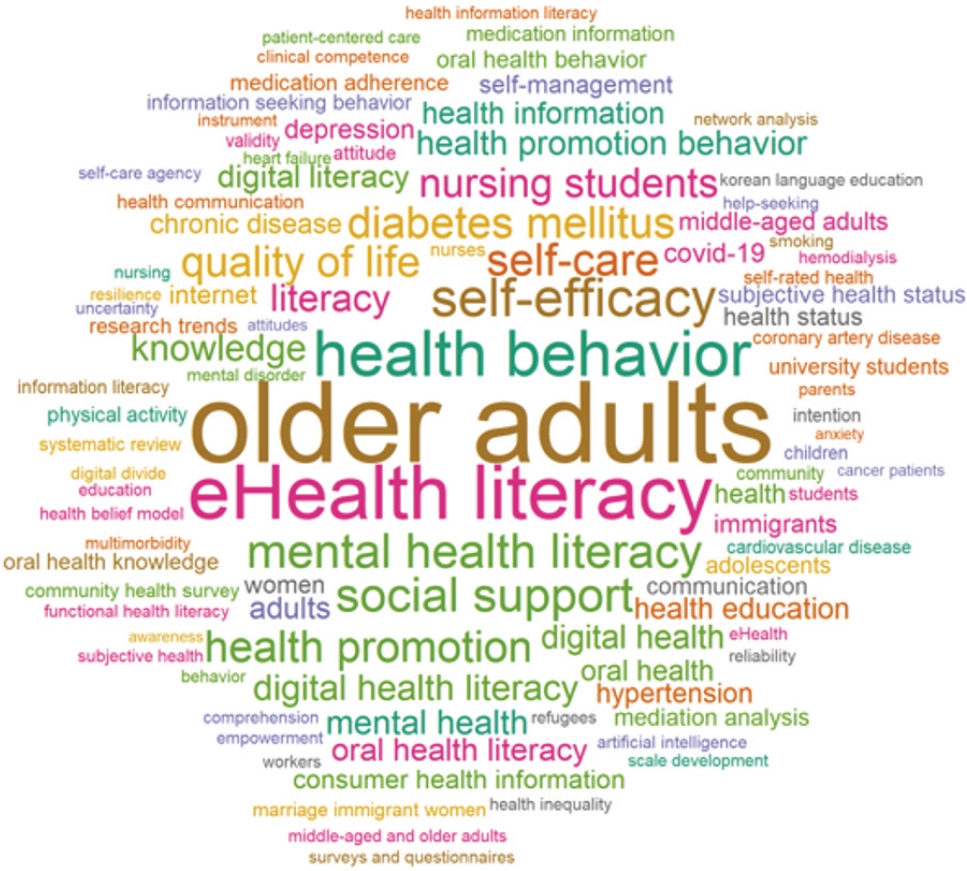
Results Health literacy occupied the most central position in the network, as expected because it was the core search concept. Among the remaining keywords, older adults, eHealth literacy, self-efficacy, health behavior, and self-care had the highest degree centrality. Louvain clustering identified six thematic communities. The five latent Dirichlet allocation topics were Health Literacy Measurement, Mental Health Literacy, Health Information and Communication, Digital Health Literacy, and Disease-Specific Health Literacy. Topic prevalence ranged from 17.1% to 21.4%. Disease-Specific Health Literacy was the largest topic (21.4%, n=136), followed by Digital Health Literacy (21.2%, n=135) and Mental Health Literacy (21.1%, n=134). The sensitivity analysis produced a broadly comparable five-topic structure.
Conclusion This study systematically mapped the knowledge structure of Korean health literacy research. The findings shed light on major research themes and their relationships and may help inform future research priorities.
Purpose This study aimed to identify the main keywords, network structures, and topical themes in patient safety incident reports using text network analysis. Methods: The study analyzed patient safety incident reports from a general hospital in Seoul, covering a total of 3,576 cases reported over five years, from 2019 to 2023. Unstructured data were extracted from the text of the incident reports, detailing how the patient safety incidents occurred and how they were managed according to the six-part principles. The analysis was conducted in four steps: 1) word extraction and refinement, 2) keyword extraction and word network generation, 3) network connectivity and centrality analysis, and 4) topic modeling analysis. The NetMiner program was used for data analysis. Results: The analysis of degree, betweenness, and closeness centrality revealed that the most common keywords among the top five were "confirmation," "medication," "inpatient room," "caregiver," and "condition." Topic modeling analysis identified three main topic groups: 1) incidents caused by a lack of awareness of fall risk, 2) incidents of non-compliance with basic medication principles, and 3) incidents due to inaccurate patient identification. Conclusion To prevent patient safety incidents, it is necessary to promote a culture of safety in hospitals, standardize patient identification procedures, and provide basic training in medication safety and fall prevention to healthcare staff. Furthermore, empirical research on patient safety practices is necessary to encourage active participation in patient safety activities by patients and family caregivers.
Citations
Citations to this article as recorded by
Contemporary clinical incident analysis methods used within acute care settings: a scoping review Kathryn Kynoch, Xianliang Liu, Jing-Yu (Benjamin) Tan, Judeil Krlan Teus, Mary-Anne Ramis JBI Evidence Synthesis.2026; 24(5): 926. CrossRef
Topic Modeling of Nursing Documentation in Hemodialysis Units: A Mixed‐Methods Study of Nursing Surveillance Activities Mi-Kyoung Cho, Hye-Young Kim, Hyohjung Lee, Yoon Hee Cho, Justin Fontenot, Ph.D., RN, NEA-BC Journal of Nursing Management.2026;[Epub] CrossRef
A Nationwide Descriptive Epidemiological and Text-mining Analysis of Incidents and Adverse Events Involving Clinical Engineers in Japan Ryo Sato, Keizo Wauchi, Hirohito Imada Journal of Patient Safety.2026;[Epub] CrossRef



 E-SUBMISSION
 First
First Prev
Prev