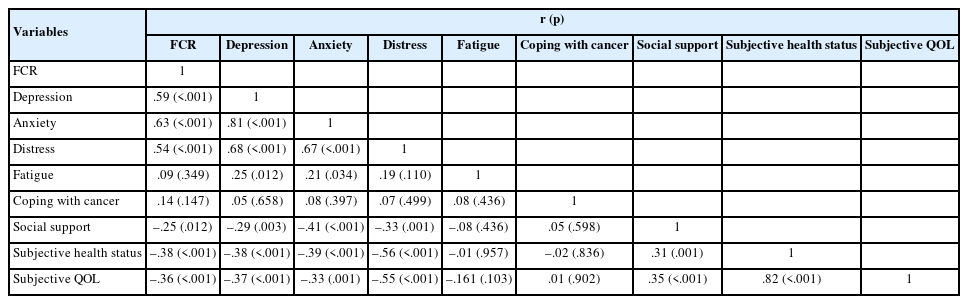
Purpose This study aimed to examine the level of fear of cancer recurrence (FCR) among adult breast cancer survivors and to identify factors influencing it. Methods: This cross-sectional study included 104 adult breast cancer survivors who were no longer receiving active treatment. Data were collected through self-report questionnaires addressing FCR, depression, anxiety, distress, fatigue, coping with cancer, social support, subjective health status, subjective quality of life, demographic characteristics, and disease-related characteristics. Surveys were administered both face-to-face and online between March and September 2024. Data analysis was conducted using descriptive statistics, frequencies, the independent t-test, one-way analysis of variance, Pearson’s correlation, and multiple regression. Results: The mean total FCR score was 78.83±25.71 (range, 0–168), reflecting a moderate level. Among participants, 22.1% scored above the cutoff for depression, 34.6% for mild anxiety, and 27.9% for severe distress. More than 70% of participants reported fatigue. Levels of coping with cancer, social support, subjective health status, and subjective quality of life were moderate or higher. Anxiety (β=.56, p<.001), fatigue (≤34) (β=.18, p=.019), and subjective quality of life (β=–.18, p=.022) significantly influenced FCR. Conclusion: Ongoing assessments and tailored interventions are essential to address FCR and to promote psychological well-being in breast cancer survivors following completion of active treatment.
Citations
Citations to this article as recorded by
Rebuilding life after breast cancer treatment among Korean breast cancer survivors: an integrative review Rina Kim, So-Young Choi Women's Health Nursing.2026; 32(2): 104. CrossRef
PURPOSE This study aimed to investigate the improvement in lifestyle of patients with Colorectal Cancer (CRC) by examining their lifestyle before and after diagnosis, and to identify the factors influencing lifestyle improvement to prevent the recurrence of CRC. METHODS The participants were 125 patients with CRC who visited the outpatient clinic of Kyungpook National University Chilgok Hospital in Daegu from December 2017 to March 2018. Questionnaires consisted of items on CRC-related lifestyle, knowledge of lifestyle risks for CRC, beliefs of lifestyle improvement (perceived benefits and barriers), self-efficacy, and fear of cancer recurrence. Lifestyle improvement referred to the score given to the improved lifestyle through the score difference in the measure of lifestyle related to CRC before and after diagnosis. The collected data were analyzed using SPSS/WIN 21.0 program. RESULTS The factors influencing lifestyle improvement were gender (β=.46, p<.001), age (β=.31, p<.001), knowledge of lifestyle risks for CRC (β=.20, p=.005), perceived benefits of lifestyle improvement (β=.19, p=.008), and number of discomforts(symptoms) that impede lifestyle improvement (β=.17, p=.016). These variables explained 38% of CRC patients' lifestyle improvement. CONCLUSION These findings suggest that we need to find ways to provide knowledge of the lifestyle risks for CRC to patients with CRC and improve their perceptions of the benefits of lifestyle improvement to promote lifestyle improvement and help prevent the recurrence of CRC after CRC diagnosis.
Citations
Citations to this article as recorded by
Health-promoting lifestyle among Chinese patients with colorectal polyps: a cross-sectional study Jingru Zhou, Yanjun Liu, Fang Yang, Yanfen Wang, Yan Liu, Wenwen Ming, Sisi Guo, Dan Zhou, Lin He, Xiaoli Zhong Scientific Reports.2025;[Epub] CrossRef
The Proliferation Inhibitory Effect of Postbiotics Prepared from Probiotics with Antioxidant Activity against HT-29 Cells Yeeun Kim, Hak Jun Kim, Keunho Ji Applied Sciences.2022; 12(24): 12519. CrossRef
What is the prevalence of fear of cancer recurrence in cancer survivors and patients? A systematic review and individual participant data meta‐analysis Yvonne L. Luigjes‐Huizer, Nina M. Tauber, Gerry Humphris, Nadine A. Kasparian, Wendy W. T. Lam, Sophie Lebel, Sébastien Simard, Allan Ben Smith, Robert Zachariae, Yati Afiyanti, Katy J. L. Bell, José A. E. Custers, Niek J. de Wit, Peter L. Fisher, Jacquel Psycho-Oncology.2022; 31(6): 879. CrossRef
Convalescent Hospital Use among Young and Older Female Cancer Survivors Hyesun Park, Kisook Kim International Journal of Environmental Research and Public Health.2021; 18(5): 2744. CrossRef



 E-SUBMISSION
 First
First Prev
Prev