Purpose This study examined the associations between sociodemographic characteristics, knowledge, self-efficacy, social support, comorbidities, and self-care quality among CAPD patients in Central Java, Indonesia.
Methods This cross-sectional study included CAPD patients recruited from two tertiary referral hospitals in Central Java (Dr. Kariadi Hospital and Dr. Moewardi Hospital). Data were collected from April to May 2025, with a total sample of 72 patients. The study instruments comprised the Self-care Scale for Peritoneal Dialysis Patients, a knowledge questionnaire, the Duke-UNC Functional Social Support Questionnaire, and the General Self-Efficacy Scale. Data analysis was performed using the chi-square test, Spearman’s rank correlation, and univariate logistic regression.
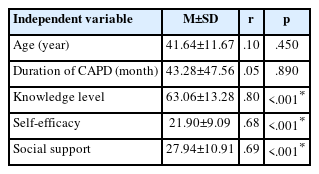
Results Univariate logistic regression analysis demonstrated that the presence of comorbidities was associated with significantly lower odds of good self-care quality (odds ratio [OR], 0.05; 95% confidence interval [CI], 0.01–0.18; p<.001). Higher levels of knowledge (OR, 1.45; 95% CI, 1.19–1.78; p<.001), self-efficacy (OR, 1.27; 95% CI, 1.14–1.42; p<.001), and social support (OR, 1.38; 95% CI, 1.16–1.64; p<.001) were significantly associated with better self-care quality. Sociodemographic factors showed no statistically significant associations with self-care quality (all p>.05).
Conclusion Among CAPD patients in Central Java, higher levels of knowledge, self-efficacy, and social support were associated with better self-care quality, whereas the presence of comorbidities was associated with factors hindering optimal self-care. Sociodemographic variables did not demonstrate clear associations with self-care quality, which may be partly attributable to limited statistical power in this sample.
This study was conducted to examine and compare the characteristics in the cognitive functions of peritoneal dialysis, hemodialysis and normal kidney function groups as basic data for effectively educating dialysis patients. The data were collected from May 10 to October 30. 2000, collected from each of 20 patients with peritoneal dialysis, hemodialysis and normal Kidney function and who registered for the dialysis room at a general hospital affiliated to a university in Seoul and sampled by age and educational level through personal interviews with the researchers of this study. As a measuring tool, MMSE developed by Folstein et al.(1975) to measure cognitive function disorder was used, slightly revised for hemodialysis patients. Collected data were processed into frequency, percentage, mean, and standard deviation by the use of SAS. The results of this study are as follows: 1.With a maximum of 30 points for cognitive function, the mean of the peritoneal dialysis patients was 27.06+/-2.06, while that of the hemodialysis patients was 27.25+/-2.76; that of the normal Kidney function patients was 27.85+/-2.00, indicating no significant difference among those three groups. 2. As for the subjects who scored 23 points, the turning point of confirming the cognitive disorder, the percentage was 5% in the case of the peritoneal dialysis, 10% in the case of the hemodialysis and 5% in the case of the normal Kidney function group. 3.Differences between the peritoneal dialysis and hemodialysis patients by gender, occupation, spouse, diabetes, hypertension, the period of dialysis, number of hospitalizations, and the use of erythropoietin were not significant in the scoring of cognitive function. 4. There was no significant correlation between the level of Hb, Hct, albumin, aluminium, PTH, BUN, Cr, dialysis adequacy and the cognitive function. Considering such results, it is clear that there is no significant difference in the cognitive functions of the sampled subjects. Therefore, the nurse in the dialysis room should continually carry out assessment and intervention against elements degrading the effect of patients' education to improve self-care.


 E-SUBMISSION
 First
First Prev
Prev