Purpose Stroke is a leading cause of morbidity and mortality worldwide, and rapid early detection is essential. Although screening tools such as FAST (face, arm, speech, and time) are widely used, they may miss posterior strokes, whereas BE-FAST (balance-eyes, face, arm, speech, and time) demonstrates greater sensitivity. However, its implementation in digital formats remains limited. This study aimed to develop, validate, and implement BE-ALERT (balance-eyes-arm weakness-language difficulties-extreme headache-reaction slowed or confusion-time to response) as a community-based early stroke detection application.
Methods This research and development study consisted of development, validation, diagnostic accuracy testing, and community implementation. The development and validation phase included 160 family caregivers of patients with stroke who were aged ≥18 years. The diagnostic accuracy phase included 500 family caregivers who accompanied consecutive patients with suspected stroke in the emergency department. Family caregivers completed the BE-ALERT assessment while accompanying the patients, and their assessment results were compared with neurologist-confirmed diagnoses.
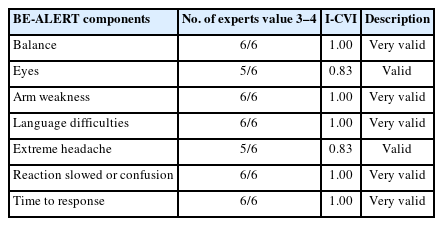
Results Validation showed a content validity index of 0.95 and a Cronbach α reliability coefficient of .82. Community implementation among 160 participants was associated with higher stroke knowledge scores (82.1) and stronger intention to seek immediate treatment (4.5). Receiver operating characteristic curve analysis yielded an area under the curve of 0.836, indicating good diagnostic accuracy. BE-ALERT showed a sensitivity of 85.0%, specificity of 82.1%, negative predictive value of 94.5% and System Usability Scale score of 74.
Conclusion BE-ALERT is a practical, accurate, and well-accepted tool for community-based early stroke detection. It may support stroke screening, public education, and timely treatment-seeking behavior.


 E-SUBMISSION
 First
First Prev
Prev