Purpose This study examined the knowledge structure and thematic characteristics of health literacy research in Korea through keyword network analysis and topic modeling.
Methods Keyword frequency and co-occurrence network analyses included 637 articles. For latent Dirichlet allocation, English abstracts were combined with standardized author keywords. After preprocessing and document-frequency filtering, 636 articles remained in the effective latent Dirichlet allocation corpus. Models with 3–10 topics were evaluated across 10 random seeds according to log-likelihood, perplexity, semantic coherence, topic distinctiveness, cross-seed stability, and interpretability of representative documents. A five-topic solution was selected, and the final model was estimated using seed 2026. An abstract-only sensitivity analysis was conducted with 633 articles.
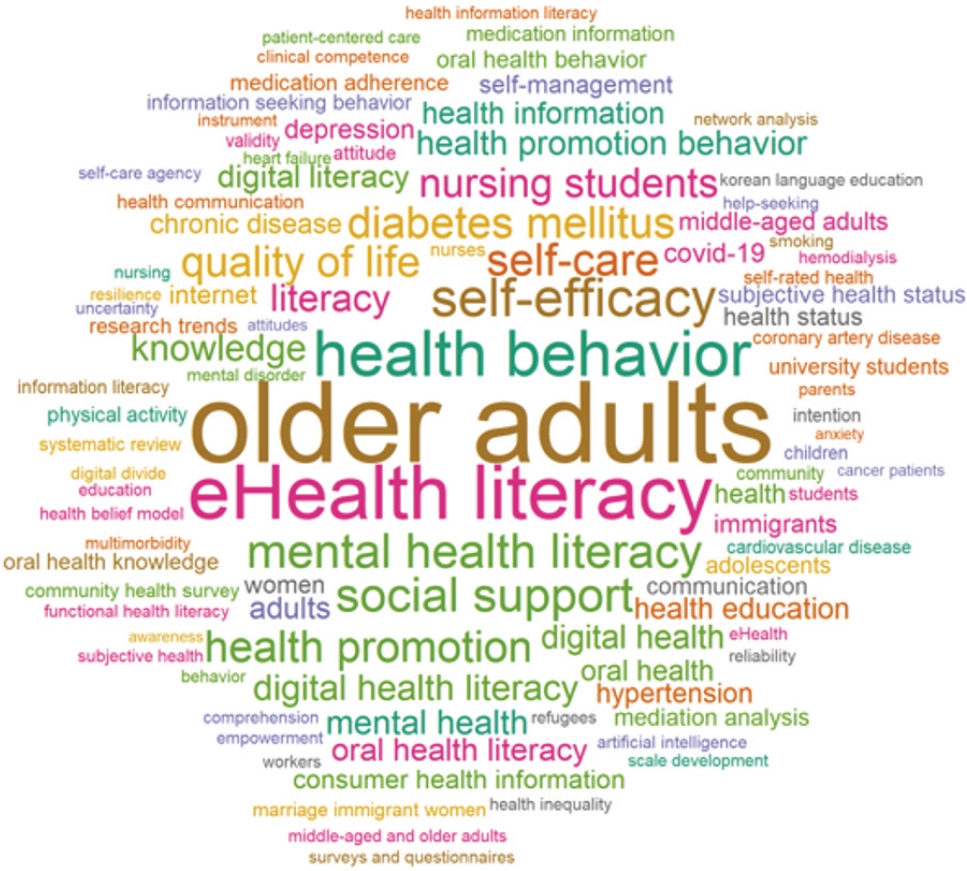
Results Health literacy occupied the most central position in the network, as expected because it was the core search concept. Among the remaining keywords, older adults, eHealth literacy, self-efficacy, health behavior, and self-care had the highest degree centrality. Louvain clustering identified six thematic communities. The five latent Dirichlet allocation topics were Health Literacy Measurement, Mental Health Literacy, Health Information and Communication, Digital Health Literacy, and Disease-Specific Health Literacy. Topic prevalence ranged from 17.1% to 21.4%. Disease-Specific Health Literacy was the largest topic (21.4%, n=136), followed by Digital Health Literacy (21.2%, n=135) and Mental Health Literacy (21.1%, n=134). The sensitivity analysis produced a broadly comparable five-topic structure.
Conclusion This study systematically mapped the knowledge structure of Korean health literacy research. The findings shed light on major research themes and their relationships and may help inform future research priorities.


 E-SUBMISSION
 First
First Prev
Prev