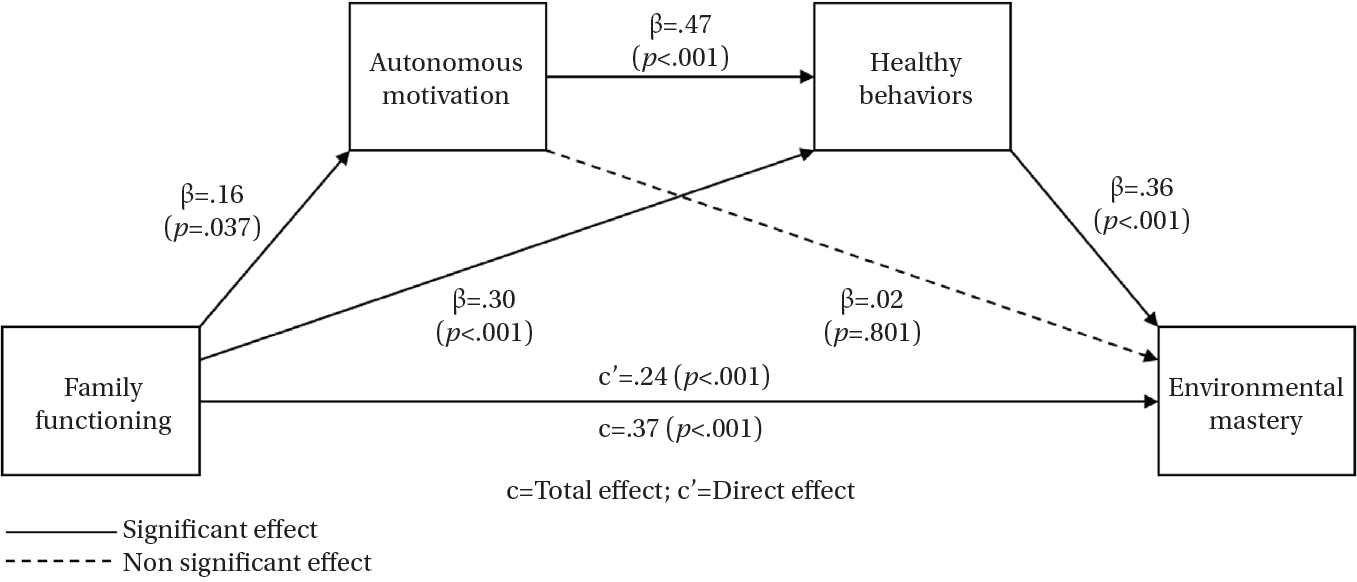
Purpose This study examined the association between family functioning and environmental mastery among breast cancer survivors. Specifically, it tested a serial mediation model involving autonomous motivation and healthy behaviors and compared this pathway with the potential role of controlled motivation.
Methods A cross-sectional survey was conducted with 192 community-dwelling Korean breast cancer survivors recruited from an outpatient breast clinic. Participants completed a structured self-administered questionnaire assessing family functioning, autonomous and controlled motivation for self-management, engagement in healthy behaviors, and environmental mastery. Serial mediation was tested using a regression-based bootstrapping approach implemented with Hayes’ PROCESS macro.
Results Family functioning was positively associated with both healthy behaviors and environmental mastery. The serial indirect effect through autonomous motivation and healthy behaviors was significant (standardized indirect effect, 0.03; 95% bootstrapped confidence interval [BootCI], 0.00–0.06). In addition, healthy behaviors independently mediated the association between family functioning and environmental mastery (standardized indirect effect, 0.11; 95% BootCI, 0.05–0.17). Controlled motivation was not significantly associated with family functioning and did not contribute to indirect effects.
Conclusion Supportive family functioning may enhance environmental mastery primarily through greater engagement in healthy behaviors, including a significant sequential pathway involving autonomous motivation. These findings support family-centered, autonomy-supportive approaches that strengthen healthy behaviors to promote psychological adjustment during breast cancer survivorship.
Purpose The purpose of this study was to investigate the roles of the perception of aging symptoms in mediating and moderating the relationship between family function and stress in middle-aged adults. Methods This was a cross-sectional correlational study of 244 middle-aged men and women. Self-administered surveys were conducted using the Family APGAR, stress index, and symptom management beliefs questionnaire. The data were analyzed using descriptive statistics, independent t-test, Pearson’s correlation coefficient, hierarchical multiple regression analysis, and PROCESS macro using SPSS 23.0. Results A significant interaction between family function and the perception of aging symptoms in predicting stress was found, indicating a moderating effect of the perception of aging symptoms on the relationship between family function and stress. An indirect effect of family function on stress through the perception of aging symptoms was not significant, indicating an insignificant mediating effect of the perception of aging symptoms. Conclusion The relationship between family function and stress differed depending on participants’ perceptions of aging symptoms. Individuals with negative perceptions of aging symptoms may be vulnerable to stress caused by poorer family function. It is necessary to develop programs to help modify negative perceptions of aging as well as strengthen family function to decrease the stress of middle-aged adults.
Citations
Citations to this article as recorded by
The Relationship Among Stress, Sense of Coherence and Sleep Quality in Middle-aged Women So Hyeon Kim, So Young Choi Journal of Korean Maternal and Child Health.2025; 29(3): 137. CrossRef



 E-SUBMISSION
 First
First Prev
Prev